

Mandarin, Spanish, Arabic, French, German, Japanese, Indonesian, Hindi, Portuguese, and Korean make up the strongest list of in-demand languages for Australians to learn in 2026, whether your goal is career advancement, trade, travel, or connecting with Australia's rich multicultural communities.
Here is why each earns its place at a glance:
- Mandarin Chinese — Australia's largest trading partner is China, making Mandarin the single most commercially valuable language for Australian professionals.
- Spanish — spoken by over 500 million people natively, it opens doors across Latin America, Spain, and a growing Australian diaspora community.
- Arabic — one of the six official UN languages and a high-demand skill in diplomacy, healthcare, and community services across Australia.
- French — valued in diplomacy, international organisations, and Pacific affairs, where Australia maintains active regional engagement.
- German — City Lit's 2026 analysis found German among the most requested languages in professional job ads, with strong representation in engineering, manufacturing, and finance.
- Japanese — a major Australian trade and tourism partner, with consistent employer demand in trade, hospitality, and education.
- Indonesian — Australia's nearest large neighbour, with government and defence sectors actively seeking Indonesian speakers.
- Hindi — India is one of Australia's fastest-growing source countries for migration and trade, lifting Hindi's community and commercial relevance sharply.
- Portuguese — Brazil's high-growth economy offers outsized ROI for speakers, and UoPeople notes that niche growth-market languages often outperform more widely spoken alternatives in career returns.
- Korean — South Korea is a top-five trade partner for Australia, and Korean-language skills are increasingly sought in technology, retail, and cultural industries.
According to Translinguist's 2025 overview, Australia's migration patterns and community demographics are actively reshaping which languages carry real local weight, making the choice of what to study more consequential than ever.
Key takeaways
Mandarin, Spanish, Arabic, French, German, Japanese, Indonesian, Hindi, Portuguese, and Korean are the most in-demand languages for Australians in 2026, with the strongest career ROI coming from matching your choice to your industry, trade partners, and local community rather than global speaker counts alone.
| Point | Details |
|---|---|
| Top languages for Australians | Mandarin, Spanish, Arabic, French, German, Japanese, Indonesian, Hindi, Portuguese, and Korean lead demand across career, trade, and community contexts. |
| Career alignment beats popularity | Match your language choice to your industry and trade partners; a niche language with direct job relevance outperforms a popular one you rarely use. |
| Python and SQL for tech careers | Analysis of nearly one million job postings shows Python in ~46% and SQL in ~45% of tech roles; combining both covers the widest range of data and analytics positions. |
| Realistic learning timelines | Conversational proficiency in accessible languages (Spanish, French, Indonesian) is achievable in 12–18 months; harder languages (Mandarin, Arabic, Korean) typically require two or more years. |
| Tutoroo for personalised tuition | Tutoroo connects Australian learners with private tutors in over 100 languages for flexible, one-to-one lessons online or in person. |
Table of Contents
- Top 10 in-demand languages to learn in 2026
- Which languages are in demand in Australia right now?
- How to pick the right language for your goals
- How long does it take, and what does it cost in Australia?
- Where Australians can start learning a language
- If your goal is a tech career: programming languages
- How this list was chosen
- Why career alignment matters more than popularity
- Start learning with a private tutor through Tutoroo
- Sources
Top 10 in-demand languages to learn in 2026
1. Mandarin Chinese
No language on this list carries more commercial weight for Australians. China remains Australia's largest two-way trading partner, and Mandarin proficiency is actively sought in resources, agriculture, finance, education, and tourism. Acolad's business-translation guidance places Chinese at the top of the priority list for companies expanding into Asian markets, citing both market size and spending power.
Difficulty for English speakers: Hard. The tonal system, character writing, and grammatical structure differ fundamentally from English.
Time to conversational level: Extended, typically several years of consistent study for meaningful fluency, though basic business phrases are achievable within months.
Australia note: Mandarin-speaking communities are among the largest non-English-speaking groups in Sydney and Melbourne. Employers in trade, education, and tourism regularly list Mandarin as a preferred or required skill.
2. Spanish
Spanish is the world's second most spoken native language, and its geographic spread across Latin America, Spain, and the United States makes it one of the most versatile choices on any list of popular foreign languages. For Australians, the appeal is both commercial and personal: Latin American trade ties are growing, and Spanish-speaking communities are well established in major cities.
Difficulty for English speakers: Moderate. Shared Latin roots and a phonetic writing system make Spanish one of the more accessible languages for English speakers.
Time to conversational level: Moderate. Many learners reach conversational confidence within 12–18 months of regular study.
Australia note: Spanish is among the most studied languages in Australian secondary schools, and demand for Spanish speakers in tourism, education, and healthcare is steady.
3. Arabic
Arabic is an official language of 22 countries and one of the six official languages of the United Nations. For Australians, its value spans diplomacy, defence, community health services, and aged care, where Arabic-speaking communities in Western Sydney and Melbourne are substantial. Indeed's career guidance highlights Arabic's particular strength in government, international relations, and translation roles.

Difficulty for English speakers: Hard. The script, grammar structure, and diglossia (the gap between formal and spoken Arabic) require significant commitment.
Time to conversational level: Extended. Reaching working proficiency in Modern Standard Arabic typically takes several years, though spoken dialects can be acquired more quickly.
Australia note: Arabic is consistently among the top community languages in Australia. Government agencies, healthcare providers, and community legal centres actively recruit Arabic speakers. Tutoroo connects learners with Lebanese Arabic tutors for those focused on the most widely spoken regional dialect in Australia.
4. French
French is spoken on five continents and remains the language of diplomacy, international law, and a significant portion of Pacific governance, an area of direct strategic interest to Australia. It is an official language of 29 countries and the working language of institutions including the International Court of Justice and UNESCO.
Difficulty for English speakers: Moderate. Shared vocabulary and a familiar alphabet help, though pronunciation and gendered nouns require adjustment.
Time to conversational level: Moderate. Conversational French is achievable within 12–18 months for a motivated learner.
Australia note: French is one of the most popular languages studied at Australian universities. Demand is strongest in diplomacy, international development, education, and Pacific-facing government roles.
5. German
City Lit's 2026 analysis of job ads found German among the most requested languages in professional postings, with German accounting for a large share of language-related roles across engineering, finance, and manufacturing. Germany's economic weight in Europe and its role as a gateway to broader EU markets make German a high-value choice for professionals in trade, automotive, and advanced manufacturing.
Difficulty for English speakers: Moderate. German shares Germanic roots with English, but its case system and compound nouns take time to master.
Time to conversational level: Moderate. Most learners reach conversational level within 12–18 months.
Australia note: German-Australian trade ties are significant, particularly in automotive, machinery, and chemicals. German is also valued in academic and research contexts at Australian universities.
6. Japanese
Japan is one of Australia's most important trade and investment partners, and the cultural connection runs deep through tourism, food, and popular culture. Japanese is consistently requested in roles spanning tourism, hospitality, education, trade logistics, and translation. The language also opens access to Japan's substantial technology and gaming industries.

Difficulty for English speakers: Hard. Three writing systems (hiragana, katakana, and kanji) and a fundamentally different sentence structure make Japanese one of the more demanding choices.
Time to conversational level: Extended. Meaningful conversational ability typically requires two or more years of dedicated study.
Australia note: Japanese is one of the most studied languages in Australian schools. Demand is particularly strong in Queensland and Western Australia, where Japanese investment in resources and tourism is concentrated.
Pro Tip: If Japanese is your goal, prioritise speaking and listening first. Many learners stall by focusing on writing systems before they can hold a basic conversation. A private tutor who structures lessons around spoken communication can accelerate your progress significantly.
7. Indonesian
Indonesia is Australia's nearest large neighbour, sharing a maritime border and deep economic, security, and people-to-people ties. Indonesian (Bahasa Indonesia) is the official language of a country of over 270 million people, and Australian government, defence, and diplomatic agencies actively recruit speakers. It is also one of the more accessible languages on this list for English speakers.
Difficulty for English speakers: Moderate to easy. Indonesian uses the Latin alphabet, has no tonal system, and its grammar is relatively straightforward compared to many Asian languages.
Time to conversational level: Shorter than most. Many learners reach conversational confidence within 12 months.
Australia note: The Australian government has historically prioritised Indonesian as a language of strategic importance. Demand exists in defence, foreign affairs, trade, and education, and the language is offered at many Australian universities.
8. Hindi
India is one of Australia's fastest-growing trade partners and the largest source country for new migrants in recent years. Hindi is spoken by hundreds of millions of people and serves as a gateway to business relationships across the Indian subcontinent. As the Indian-Australian community grows, so does demand for Hindi speakers in healthcare, community services, and education.
Difficulty for English speakers: Moderate. The Devanagari script requires learning, but grammatical patterns and some shared vocabulary (via historical contact) ease the process.
Time to conversational level: Moderate. Conversational Hindi is achievable within 12–18 months with consistent practice.
Australia note: Hindi is now one of the most widely spoken languages in Australian homes after English and Mandarin. Community organisations, healthcare providers, and multicultural services increasingly seek Hindi-speaking staff.
9. Portuguese
Brazil's economy is one of the largest in the world, and Portuguese gives access to a market that many English-speaking professionals overlook. As UoPeople highlights, niche high-growth markets can offer stronger career ROI than more widely spoken but saturated languages. Portuguese also opens doors to Portugal, Angola, Mozambique, and other Lusophone markets.
Difficulty for English speakers: Moderate. Closely related to Spanish, Portuguese is accessible for learners who already have some Romance language background.
Time to conversational level: Moderate. Conversational proficiency is achievable within 12–18 months.
Australia note: Australian trade with Brazil is growing in agriculture, mining, and energy. Portuguese is a niche skill that stands out on a CV precisely because fewer Australians study it.
10. Korean
South Korea is a top-five trading partner for Australia, and Korean cultural influence through K-pop, film, food, and technology has driven a surge in language interest among younger Australians. Korean is increasingly sought in technology, retail, education, and cultural industries, and the Korean-Australian community is one of the fastest growing in the country.
Difficulty for English speakers: Hard. The Hangul script is learnable quickly, but sentence structure and honorific systems require sustained effort.
Time to conversational level: Extended. Most learners need two or more years to reach comfortable conversational ability.
Australia note: Korean-language skills are valued in trade, technology, and community services. Korean is now offered at several Australian universities and is growing in secondary school curricula.
Which languages are in demand in Australia right now?
Australia's language needs are shaped by three overlapping forces: trade relationships, migration patterns, and public sector requirements. Understanding all three helps you see where real employment demand sits, not just where a language is globally popular.
Trade and economic drivers point clearly to Mandarin, Japanese, Korean, and Indonesian as the languages with the most direct commercial application for Australian professionals. China, Japan, South Korea, and Indonesia consistently appear among Australia's top trading partners, and employers in resources, agriculture, finance, and logistics reflect that in their hiring.
Migration and diaspora communities create sustained demand in healthcare, aged care, community services, and education. Translinguist's 2025 analysis identifies Mandarin, Arabic, Vietnamese, Cantonese, Hindi, and Punjabi as among the most widely spoken community languages in Australia, with migration from South Asia and Southeast Asia continuing to reshape the demographic picture. Aged care providers and hospitals in particular are actively recruiting staff who can communicate with patients in their first language.
Public sector and diplomacy create demand for Arabic, French, Indonesian, and Mandarin in defence, foreign affairs, intelligence, and international development. The Australian Public Service has long-standing language requirements for roles in the Indo-Pacific region, and French carries particular weight in Pacific affairs given Australia's engagement with Francophone Pacific nations.
Specific industries where language skills translate directly to employment include:
- Healthcare and aged care: Arabic, Mandarin, Cantonese, Vietnamese, Hindi, and Greek speakers are sought for patient-facing roles and community health outreach.
- Education: Spanish, French, Mandarin, Japanese, and Indonesian teachers are in demand at both school and university level.
- Trade and logistics: Mandarin, Japanese, Korean, and Indonesian are valued in supply chain, export, and business development roles.
- Government and defence: Arabic, Indonesian, Mandarin, and French are priority languages for public sector roles with regional or international focus.
- Tourism and hospitality: Japanese, Mandarin, Korean, and Indonesian speakers are sought in destinations with high visitor numbers from those markets.
The multilingual education advantages that come with genuine bilingualism extend well beyond vocabulary. Employers increasingly treat language proficiency as evidence of adaptability and cross-cultural communication, which means listing your proficiency level and the context in which you use the language on your CV matters as much as having the skill itself.
How to pick the right language for your goals
Popularity is a poor guide on its own. The language that serves you best depends on where you want to work, how much time you can commit, and what genuinely motivates you to keep going when the study gets hard.
A practical decision framework:
- Define your primary goal. Career advancement, travel, community connection, and academic study each point to different languages. A healthcare worker in Western Sydney has different needs from a trade finance professional or a backpacker planning a year in South America.
- Check job ads in your field. Search your target role on Seek or LinkedIn and filter for language requirements. If Mandarin appears in 30% of senior trade roles you want, that is a stronger signal than any popularity ranking.
- Consider your trade partner exposure. If your industry exports to Japan, Korea, or Indonesia, the language of your key market is almost always worth learning.
- Weigh effort against ROI honestly. Mandarin and Arabic are hard for English speakers and take years to reach professional proficiency. If your timeline is 12 months, Spanish, Indonesian, or French may deliver more usable skill faster.
- Factor in local community. Living near a large Arabic-speaking or Mandarin-speaking community gives you free immersion opportunities that accelerate learning and keep motivation high.
- Ask whether cultural interest will sustain you. Learners who genuinely enjoy the culture, music, or literature of a language consistently outperform those who study purely for career reasons. Motivation compounds over time.
Pro Tip: When listing a language on your CV, always state your proficiency level using a recognised framework such as CEFR (A1 through C2) and give one line of context: "Business-level Mandarin, used in client negotiations with Chinese suppliers." That specificity is far more persuasive to a hiring manager than "conversational Mandarin." You can find a clear explanation of language proficiency levels and how to describe them accurately before updating your resume.
How long does it take, and what does it cost in Australia?
Reaching conversational proficiency in a new language takes sustained, active practice. The honest answer is that marketing timelines for language learning are often optimistic. Conversational ability in a language close to English (Spanish, French, Indonesian) is realistic within 12–18 months of consistent study. For harder languages (Mandarin, Arabic, Japanese, Korean), two to four years of dedicated effort is a more grounded expectation for professional working proficiency.
Proficiency milestones worth understanding:
- Conversational (CEFR B1–B2): You can handle most everyday situations, discuss familiar topics, and manage basic professional interactions.
- Professional working proficiency (CEFR C1): You can participate in meetings, write formal documents, and handle complex negotiations in the language.
Typical costs for language learning in Australia vary considerably by format and city:
| Learning route | Typical cost range (AUD) | Notes |
|---|---|---|
| Private tutor (one-to-one) | $— per hour | Varies by tutor experience, language, and city |
| Group classes (community or private) | $— per session | Community language schools often offer lower rates |
| University extension courses | $500 per semester | Structured, credit-bearing options |
| Online apps and subscriptions | $10–$30 per month | Useful for vocabulary and listening; limited for speaking |
Pro Tip: One-to-one tuition with a native or near-native speaker accelerates progress faster than any other format, particularly for speaking and listening. Even two hours per week with a skilled private tutor, combined with daily self-study, typically outperforms a weekly group class. The key is consistency: short daily sessions beat long infrequent ones every time.
Where Australians can start learning a language
The options available to Australian learners are genuinely broad, and the right combination depends on your budget, schedule, and learning style.
Private tutors (local and online) offer the most personalised path. A good tutor adapts to your goals, corrects your specific errors, and structures lessons around your industry or travel context. Online tutoring removes geography as a barrier, meaning you can access a native speaker of any language regardless of where you live in Australia. The role of language platforms in connecting learners with specialist tutors has expanded significantly, making it easier than ever to find someone who teaches, for example, business Mandarin or medical Arabic rather than generic beginner content.
Community language schools operate in most Australian cities and are often run by diaspora communities. They tend to offer lower costs and authentic cultural immersion alongside language instruction. Many operate on weekends and cater to both heritage learners and newcomers.
University extension and continuing education programmes suit learners who want structured, credit-bearing study. Most Go8 universities offer language programmes at various levels, and some provide intensive options for professionals.
Online platforms and apps work well for vocabulary building, listening practice, and maintaining momentum between tutor sessions. They are less effective as a standalone method for reaching speaking proficiency.
When evaluating a private tutor, consider:
- Native or near-native proficiency in the target language
- Experience teaching your specific goal (business language, exam preparation, conversational fluency)
- Structured lesson plans rather than unguided conversation
- Scheduling flexibility that fits your working week
- Clear pricing with no hidden fees
- Trial lesson availability so you can assess fit before committing
If your goal is a tech career: programming languages
Some readers searching for a list of in-demand languages are thinking about programming rather than spoken languages. The distinction matters, and the answer is different.
For tech careers, the most commercially valuable programming languages in 2026 are Python and SQL, and the evidence is clear. Analysis of nearly one million U.S. job postings found Python appearing in approximately 46% of postings and SQL in approximately 45%, with Python and SQL together forming the most commonly co-mentioned pair across roles. That pattern holds across data science, analytics, finance, and software development.
GlobeNewswire's summary of recent research shows SQL's growth is particularly pronounced in transactional and records-driven industries, where it outpaces other languages. SQL is not just a data-science tool; it is a foundational skill for roles in banking, healthcare administration, retail analytics, and government.
| Programming language | Primary use cases | Demand signal |
|---|---|---|
| Python | Data science, AI/ML, automation, scripting | ~46% of tech job postings |
| SQL | Data analysis, database management, reporting | ~45% of tech job postings |
| JavaScript | Web development, front-end, full-stack | Consistently high in web roles |
| Rust | Systems programming, performance-critical applications | Entered TIOBE top 10 (July 2026) |
The TIOBE Index for July 2026, as reported by TechRepublic, shows Python still leading popularity rankings while Rust entered the top ten and SQL continued to climb. The TIOBE Index reflects search and activity signals rather than direct employer demand, so it is best read alongside job-posting data rather than in isolation.
For tech career seekers, the practical takeaway is to build a skill stack rather than chase a single language. Python combined with SQL covers the widest range of data and analytics roles, and adding JavaScript opens web development pathways.
How this list was chosen
The ranking above draws on several overlapping signals rather than a single source, because no one dataset captures the full picture of language demand in Australia.
Criteria used:
- Job-ad signals: Labour-market analysis from City Lit (UK, 2026) and Indeed provided cross-industry demand data for natural languages. Programming-language demand drew on the Finopotamus job-posting analysis and GlobeNewswire research.
- Trade partner weight: Australia's Department of Foreign Affairs and Trade partner rankings informed the weighting of Mandarin, Japanese, Korean, and Indonesian.
- Diaspora and community population: Translinguist's 2025 demographic overview of languages spoken in Australia shaped the community-services and healthcare demand signals.
- Business translation priority: Acolad's business-language priority guidance provided a market-reach lens for commercial language choices.
- Tourism and cultural flows: Inbound and outbound tourism data informed the inclusion of Japanese and Korean for hospitality and travel contexts.
- Editorial review: Rankings were reviewed against current Australian labour-market conditions and adjusted where global signals did not translate directly to the Australian context.
Where a source is UK- or US-based (such as City Lit's job-ad analysis), it is used as an indicative signal rather than a direct measure of Australian demand, and Australia-specific context is noted separately.
Why career alignment matters more than popularity
The most common mistake language learners make is choosing a language because it is widely spoken rather than because it fits where they are headed. Mandarin has roughly 900 million native speakers. That fact alone does not make it the right choice for every Australian professional.
What actually matters is the intersection of your industry, your geography, and your timeline. A nurse working in Western Sydney who wants to communicate better with patients has a strong case for Arabic or Cantonese. A trade finance analyst with clients in Seoul has a clear case for Korean. A secondary school teacher in regional Queensland who wants to add a second subject has a strong case for Indonesian, which is achievable to conversational level faster than most Asian languages and is actively sought by Australian schools.
Choosing a difficult language like Mandarin or Arabic because it signals commitment is a real strategy, and employers do notice the effort. But that signal only pays off if you reach a level where the language is genuinely useful. A half-finished Mandarin journey that stalls at beginner level serves no one. Matching the language to your actual goals, your available time, and your genuine cultural interest is what produces the sustained effort that gets you to proficiency.
Pairing a spoken language with complementary sector knowledge compounds the advantage. A Portuguese speaker who also understands Brazilian agricultural markets, or an Arabic speaker with healthcare sector experience, is far more employable than a language learner without that context. The benefits of learning multiple languages extend beyond communication; they shape how you think about problems and how clients and colleagues perceive your commitment to their world.
Start learning with a private tutor through Tutoroo
Knowing which language to learn is the first step. Finding the right person to teach it to you is what makes the difference between a language that stays on your to-do list and one you actually speak.
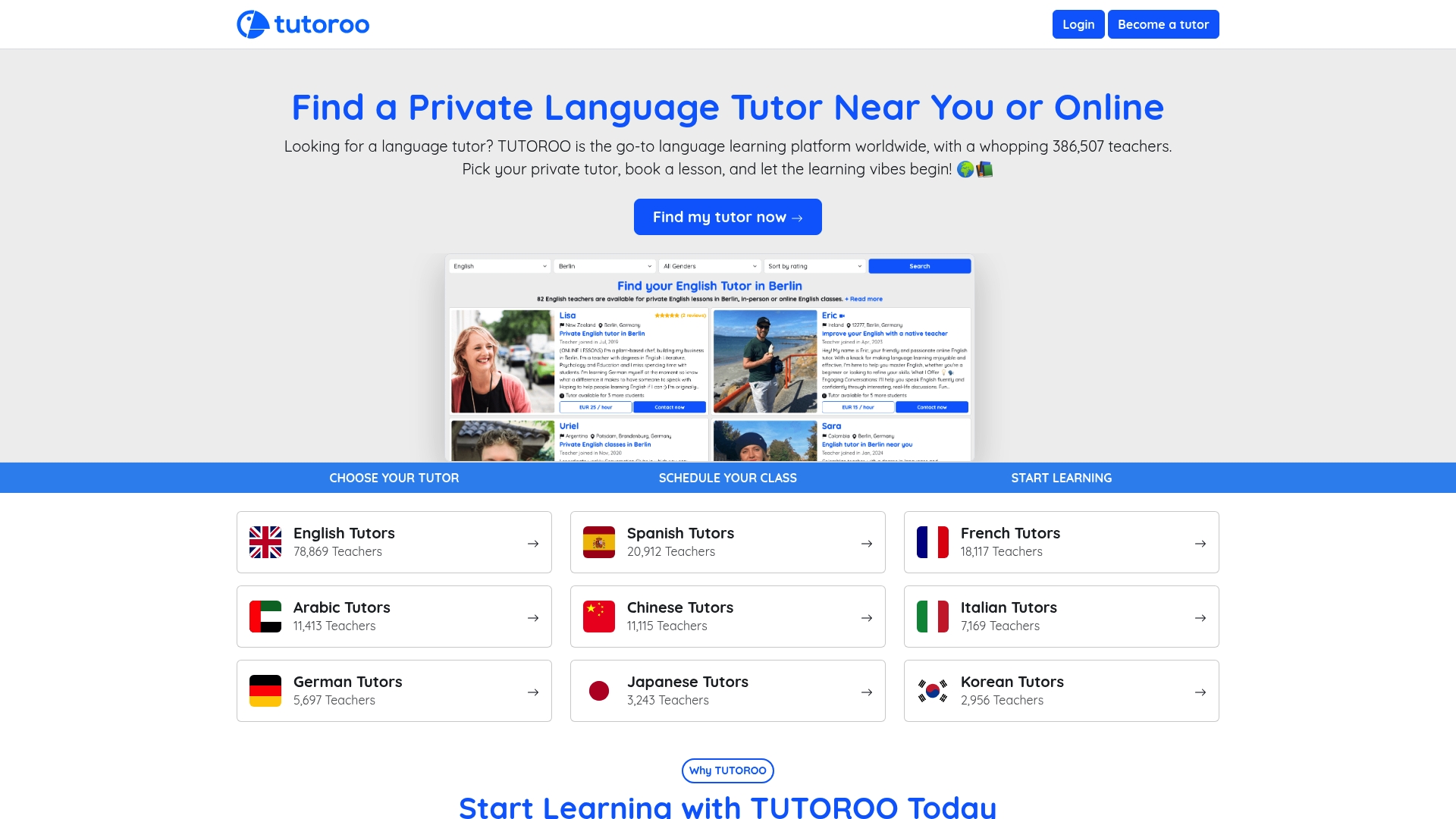
Tutoroo connects Australian learners with private language tutors for personalised, one-to-one lessons, delivered online or in person, in over 100 languages. Whether you are preparing for a business trip to Tokyo, building Mandarin for a trade role, or working toward Arabic proficiency for community health work, you can search tutors by language, location, and availability and message them directly before committing to a lesson. Scheduling is flexible, pricing is set by the tutor, and there are no lock-in contracts.
Search for your language on Tutoroo and book a trial lesson to get started.
Sources
- Top in‑demand languages for professionals in the UK (2026) | City Lit
- Which languages should your business translate into first? – Acolad
- What nearly 1 million U.S. job postings reveal about today’s most in‑demand programming languages | Finopotamus
- New research: SQL rivals Python as America’s most in‑demand programming language | GlobeNewswire
- Languages spoken in Australia: 2025 trends and businesses | Translinguist