

TL;DR:
- By 2026, language platforms will act as governed infrastructure combining AI, human expertise, and controls for measurable outcomes. Learners benefit most from adaptive personalization, live practice, and progress metrics, while institutions prioritize governance and compliance. Incorporating human tutors like those on Tutoroo enhances real conversational skills beyond AI's limitations.
In 2026, language platforms function as governed language infrastructure, combining AI models, human expertise, and platform-level controls to deliver personalised, measurable language outcomes. Survey data shows 95% of enterprise teams now use AI translation, and 89% prioritise platform governance and data sovereignty over the choice of underlying model. Metrics like Time to Edit (TTE), which measures how much a human editor must correct after machine output, have replaced raw throughput as the standard for quality. Compliance frameworks including SOC 2, ISO 27001, and Australia's Privacy Act now shape procurement decisions at every level. Marketplaces like Tutoroo sit within this ecosystem as the human layer, connecting learners with expert tutors for the live, culturally rich conversation practice that no AI model fully replicates.
Table of Contents
- Key trends shaping the role of language platforms in 2026
- How AI changes feedback, assessment, and the learning loop
- What platforms now do for schools, universities, and workplaces
- Practical guidance for learners: choosing and using platforms in 2026
- What the platform shift means for language teachers and tutors
- Where platforms and tutors meet: marketplaces and the role of Tutoroo
- Industry data and timelines that support the 2026 claims
- How community and peer interaction features strengthen learning
- Key takeaways
- The case for strategic adoption in 2026
- Tutoroo: your next step for live language practice
- Selected sources and further reading
Key trends shaping the role of language platforms in 2026
The following trends define how learners, educators, and organisations use language technology this year. Some are most relevant to individual learners, others to teachers, and others to enterprise buyers — each bullet flags who benefits most.
- Adaptive personalisation — platforms reorder lessons after an oral proficiency check, so a learner who struggles with tonal pronunciation gets targeted drills before moving on. Most relevant to: learners.
- AI-assisted speaking practice — real-time pronunciation scoring and automated feedback on register let learners practise outside class hours with immediate correction. Most relevant to: learners and tutors.
- Multi-engine orchestration — platforms route content to different AI models or human reviewers based on domain risk and language pair, rather than trusting a single model for everything. Most relevant to: enterprise buyers.
- Continuous localisation and continuous learning — LMS and CMS integrations enable simultaneous international releases, so course updates go live across markets without delay. Most relevant to: educators and enterprise.
- Microlearning — five-to-ten-minute lesson modules with a single communicative goal are now the dominant format for professional learners with limited time. Most relevant to: learners and L&D managers.
- Embedded speech translation and automated captioning — over 90% of global hybrid events are predicted to include live speech translation or automated captioning by late 2026. Most relevant to: enterprise and educators.
- Data governance and privacy — institutions demand SOC 2, ISO 27001, and Australian Privacy Act alignment before procuring any platform that handles student or employee data. Most relevant to: enterprise and education buyers.
- Platform-native assessment and TTE metrics — TTE has emerged as the leading operational metric, tracking edit effort after machine output to reflect real quality. Most relevant to: educators and enterprise.
- Community-driven practice features — peer conversation groups, tandem partnerships, and discussion forums extend learning beyond scheduled lessons. Most relevant to: learners.
- AR/VR immersion — early-adopter institutions are piloting augmented and virtual reality environments where learners practise ordering coffee in Paris or negotiating in Tokyo, adding cultural context that flat-screen apps cannot match. Most relevant to: learners and forward-looking educators.
How AI changes feedback, assessment, and the learning loop
The single most important shift in 2026 is that AI moves platforms from content delivery to context-aware feedback and continual adaptation. A platform no longer just presents a lesson; it listens, scores, and adjusts the next activity based on what the learner just did.
The distinction between semantic understanding and token-level translation matters here. Older systems matched words and phrases. Current models understand register, idiom, and pragmatic intent, which means a learner who says "Can I get a coffee?" in a formal business simulation receives feedback not just on grammar but on whether the phrasing fits the social context. For pronunciation, this translates to scoring that catches the difference between a vowel that is phonetically close and one that actually sounds natural to a native speaker.
Concrete features learners encounter in 2026 include real-time pronunciation scoring, multimodal prompts that combine audio and image cues, personalised error-driven drills that repeat patterns the learner keeps missing, and automated summaries of spoken practice sessions. Longitudinal metrics, particularly TTE-style measures that track how much correction a learner's output still requires over time, give both learner and teacher a clear picture of genuine progress rather than lesson-completion rates.
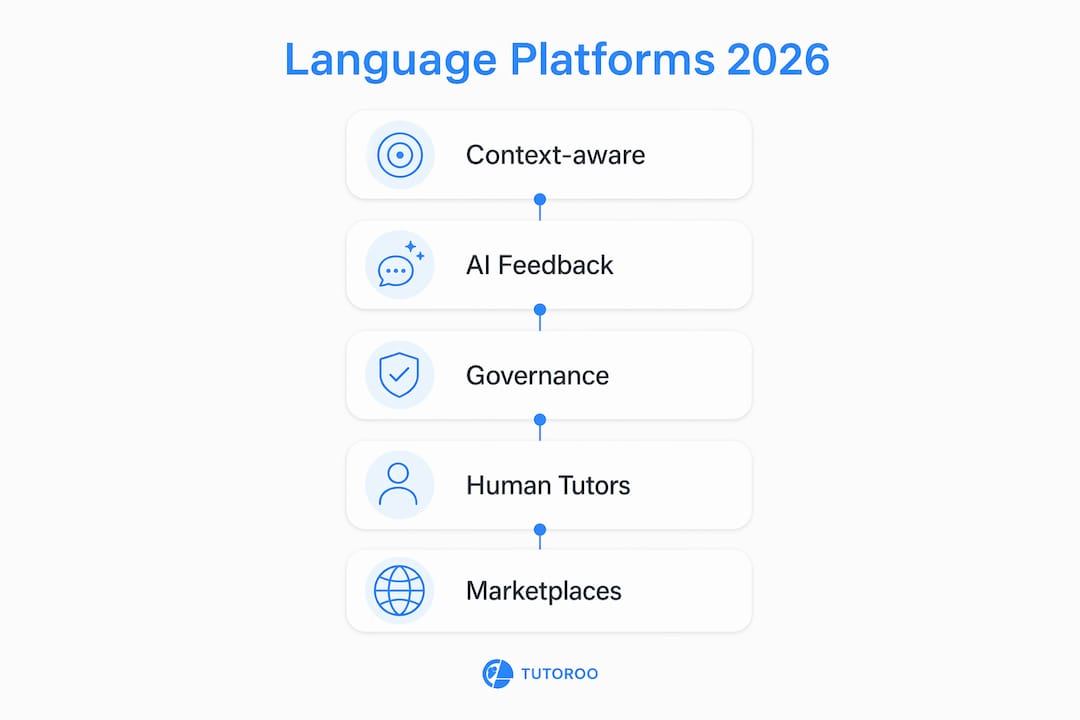
Orchestration is the architectural decision underneath all of this. Platforms route content to the best available model or human reviewer based on content risk, domain, and language pair. A legal document goes to a specialist human reviewer; a casual conversation drill goes to a fast speech model. This prevents over-reliance on any single system and keeps quality consistent across very different content types.
Pro Tip: Use AI feedback to identify your top three recurring errors, then bring those specific patterns to your next human tutor session. AI is reliable for phonetic scoring and grammar pattern detection; a human tutor is irreplaceable for cultural nuance, humour, and the kind of spontaneous correction that sticks.
What platforms now do for schools, universities, and workplaces
Institutions in 2026 buy platform governance and measurement, not just raw translation or content. The question a procurement officer asks is no longer "which model is most accurate?" but "does this platform give us audit trails, data residency controls, and measurable learning outcomes?"

Core institutional features now expected as standard include LMS and CMS integrations that push content updates across platforms without manual re-entry, reporting dashboards that surface learner outcomes at cohort and individual level, glossary and style-guide enforcement that keeps terminology consistent across departments, and multi-engine orchestration with human-in-the-loop workflows for high-stakes content. Continuous localisation has become essential for universities shipping course materials across international campuses simultaneously.
Live captioning and event translation have moved from a premium add-on to a baseline expectation. The prediction that over 90% of global hybrid events will include live speech translation or automated captioning by late 2026 reflects how quickly this has shifted from experimental to standard practice. Australian universities running hybrid lectures with international students are already treating this as infrastructure, not a feature.
95% of enterprise teams now use AI translation, and 89% prioritise platform governance and data sovereignty over model choice. — Bluente
Security and compliance are non-negotiable at the institutional level. SOC 2 and ISO 27001 certifications signal that a platform has independently verified controls over data handling. For Australian schools and universities, alignment with the Privacy Act 1988 and the Australian Privacy Principles is a procurement requirement, not a nice-to-have. Platforms that cannot demonstrate data residency options or clear data-deletion policies are being removed from shortlists before evaluation even begins.
Language technology is now positioned alongside CRM and personalisation tools as core growth infrastructure for global organisations, which explains why L&D budgets are increasingly treating platform licences as infrastructure spend rather than discretionary training costs.
Practical guidance for learners: choosing and using platforms in 2026
Choose platforms that give you measurable feedback, live human conversation practice, and clear data controls. Those three criteria filter out the majority of tools that look impressive in a demo but fail to produce lasting spoken fluency.
Here is a practical checklist for selecting and using a platform this year:
- Define your communicative job. Are you preparing for a job interview, travelling, or passing an academic language test? The answer shapes which platform features actually matter to you.
- Prioritise live speaking practice. No AI model fully replicates the unpredictability of a real conversation. Look for platforms that connect you with human tutors or structured conversation partners, not just chatbots.
- Check for personalised pathways. A platform worth your time adapts to your errors, not just your level. Adaptive learning mechanics that reorder content based on your performance are a strong signal of genuine personalisation.
- Confirm privacy and data policies. In Australia, check whether the platform complies with the Privacy Act 1988 and whether your data is stored locally or offshore. This matters especially for learners using workplace or institutional accounts.
- Look for TTE or measurable progress reports. Platforms that show you how much your output has improved over time, rather than just tracking lessons completed, give you evidence of real progress.
- Test glossary and style settings for your field. If you are learning for a specific professional context, a platform that lets you set domain-specific vocabulary will produce far more relevant feedback than a general-purpose tool.
The most effective routine in 2026 combines short AI-driven practice sessions with regular human tutor conversations. Use the AI layer for daily pronunciation drills and grammar pattern work, then bring your accumulated errors and questions to a weekly or fortnightly session with a tutor who can address cultural context, register, and the kind of spontaneous correction that builds real confidence.
Pro Tip: Fifteen minutes of focused speaking practice with immediate corrective feedback beats an hour of passive listening. Set a single communicative goal for each micro-session, record yourself, and compare your output to the AI's feedback before your next tutor session.
What the platform shift means for language teachers and tutors
Teachers in 2026 are quality architects and remediators, not primarily first-draft content producers. The platforms handle initial content delivery, pronunciation scoring, and pattern drilling. What they cannot do is make the cultural judgement call, read the room, or explain why a grammatically correct sentence sounds odd in a particular social context.
Workflows have shifted accordingly. More tutor time goes to glossary governance, curriculum tuning, and evaluating AI outputs for accuracy and cultural fit. A teacher reviewing AI-generated conversation prompts for a business English course is doing something closer to editorial quality control than lesson planning in the traditional sense. That is a genuinely different skill set, and it is worth developing deliberately. Innovative online teaching methods that pair AI feedback with human remediation are already being adopted by forward-thinking tutors across Australia.
Professional development priorities for teachers this year include upskilling in AI output evaluation, designing assessments that AI cannot easily game (open-ended spoken tasks, culturally specific role plays), and building quality control rules into their own workflows before platforms impose them. Tutors who understand how orchestration works, which content types go to AI and which require human review, are better placed to position their services as the high-value layer in a blended system.
Pro Tip: When positioning your tutoring services alongside AI tools, be specific about what you offer that the platform cannot: cultural context, spontaneous conversation, and the ability to adjust in real time to a learner's emotional state and confidence level. Learners who understand this distinction are willing to pay a premium for it.
Where platforms and tutors meet: marketplaces and the role of Tutoroo
Marketplaces occupy a distinct and practical layer in the 2026 language learning ecosystem. They handle matching, scheduling, discovery, and payment arrangements, freeing both learners and tutors from the administrative friction that used to make private tuition hard to organise. This layer complements platform-driven learning infrastructure rather than competing with it.

Tutoroo is a concrete example of how this works in practice. With a community of over 386,000 language teachers offering tuition in languages including English, Spanish, French, Arabic, and Chinese, Tutoroo connects learners with tutors for personalised one-on-one lessons delivered either online or in person. For learners who have been working through AI-driven platforms and need live conversation practice to consolidate what they have learned, finding a tutor through Tutoroo is a natural next step. The marketplace supports blended learning by making the human layer accessible, discoverable, and easy to schedule around an existing platform routine.
The advantages learners and tutors gain from marketplace integration include:
- Discoverability — learners can search by language, location, availability, and teaching style, rather than relying on word of mouth or institutional assignment.
- Flexible payment arrangements — Tutoroo's model allows direct payment between learner and tutor after an initial matching fee, keeping ongoing costs transparent and predictable.
- Tutor profiles with credentials — detailed profiles let learners assess a tutor's background, native language, teaching experience, and specialisations before committing.
- Local and online options — for learners who want in-person cultural immersion alongside digital practice, the ability to find a local tutor is a genuine advantage that purely digital platforms cannot offer.
- Community connection — the marketplace environment creates a sense of shared purpose among learners and tutors, which supports motivation and long-term engagement.
Human linguists and tutors are shifting from first-draft production to quality architecture and oversight, and the same logic applies to private tutors: their value is in the judgement, cultural knowledge, and adaptive conversation that AI cannot replicate. Marketplaces like Tutoroo make that value accessible and affordable.
Industry data and timelines that support the 2026 claims
The claims in this guide rest on a set of quantitative signals that are worth examining directly. The two strongest are enterprise AI translation adoption and the trajectory of hybrid event captioning.
| Source | Metric | Why it matters |
|---|---|---|
| Bluente | 95% of enterprise teams use AI translation; 89% prioritise governance over model choice | Confirms that platform controls, not raw AI capability, drive procurement decisions |
| Kudo.ai | Over 90% of global hybrid events predicted to include live speech translation or automated captioning by late 2026 | Shows how quickly speech translation has moved from experimental to standard infrastructure |
| Translated | TTE (Time to Edit) named as the leading operational metric for translation quality in 2026 | Signals a shift from throughput to semantic accuracy as the primary quality measure |
| f-g.com | Translated sites received 327% more visibility in AI Overviews in one analysis | Demonstrates the discoverability advantage of multilingual content for organisations and educators |
| Phrase | Platforms described as providing context that travels with content, intelligent orchestration, and systems that learn from repeated use | Defines the three capabilities that separate platform infrastructure from point tools |
Over 90% of global hybrid events are predicted to include live speech translation or automated captioning by late 2026. — Kudo.ai
The 327% visibility figure for multilingual content in AI-generated search overviews is particularly striking for Australian educators and content creators. It suggests that multilingual AI content is not just a communication tool but a discoverability asset. Organisations that treat language as governed infrastructure, with glossaries, style guides, and continuous review built in, are compounding that advantage over time.
How community and peer interaction features strengthen learning
Community features within language platforms do something that AI feedback loops and solo practice cannot: they create social accountability and authentic communicative pressure. A learner who knows a peer is waiting for a response in a tandem exchange is more motivated to produce accurate, contextually appropriate language than one completing a drill in isolation.
Peer interaction features in 2026 range from structured tandem partnerships, where two learners each practise the other's native language, to moderated discussion forums, group conversation challenges, and live community events. Platforms that build these features well see higher retention and more consistent daily practice, because the social layer makes showing up feel meaningful rather than mechanical.
For educators, community features offer a practical extension of classroom time. A teacher who sets a weekly discussion prompt in a platform's community space can observe how learners use language in a lower-stakes, peer-facing context, which often surfaces errors and hesitations that never appear in formal assessments. Community-based language platforms that combine peer interaction with tutor oversight create a richer learning environment than either element alone.
The quality of moderation matters enormously here. Unmoderated community spaces can reinforce errors or create discouraging experiences for less confident learners. Platforms that invest in curated templates, expert-maintained discussion prompts, and active moderation produce communities where learners feel safe enough to make mistakes, which is exactly the condition under which real language acquisition happens.
Key takeaways
Language platforms in 2026 function as governed infrastructure that combines AI, human expertise, and platform controls to deliver measurable language outcomes.
| Point | Details |
|---|---|
| Platforms are infrastructure, not point tools | Choose platforms with governance features, LMS integrations, and measurable outcomes rather than standalone apps. |
| Speaking practice requires a human layer | AI handles drills and scoring; live conversation with a tutor builds the cultural fluency and confidence that platforms alone cannot deliver. |
| Governance and privacy are procurement criteria | In Australia, check for Privacy Act 1988 compliance, data residency options, and SOC 2 or ISO 27001 certification before committing to any platform. |
| TTE is the quality metric to watch | Time to Edit measures how much human correction AI output still needs — a falling TTE score is the clearest signal of genuine platform improvement. |
| Tutoroo connects the human layer | For live speaking practice and personalised tutor matching, Tutoroo's marketplace of over 386,000 teachers complements AI-driven platform learning. |
The case for strategic adoption in 2026
The most common mistake learners and institutions make right now is treating platform selection as a one-off tool choice rather than an infrastructure decision. The organisations and learners who are making genuine progress in 2026 are the ones who have embedded governance, human oversight, and measurable outcomes into their workflows from the start, rather than adding them as an afterthought when something goes wrong.
For learners in Australia, the practical recommendation is straightforward: use AI-driven platforms for daily practice and pattern reinforcement, but anchor your progress in regular live conversation with a qualified tutor. The two approaches compound each other. For educators, the priority is upskilling in AI output evaluation and designing assessments that require genuine communicative competence. For institutions, the question is not which model to use but whether the platform gives you the controls, compliance alignment, and measurement tools to justify the investment over time.
Tutoroo's community of over 386,000 language teachers, available for online and in-person lessons across a wide range of languages, represents exactly the kind of human layer that makes platform-driven learning stick. The marketplace model keeps the process transparent and the matching genuinely personalised.
Tutoroo: your next step for live language practice
If you have been building your language skills through AI-driven platforms and apps, the clearest next step is adding a human tutor to your routine. Tutoroo connects learners with private language tutors for personalised one-on-one lessons, delivered online or in person, across languages including English, Spanish, French, Arabic, and Chinese.
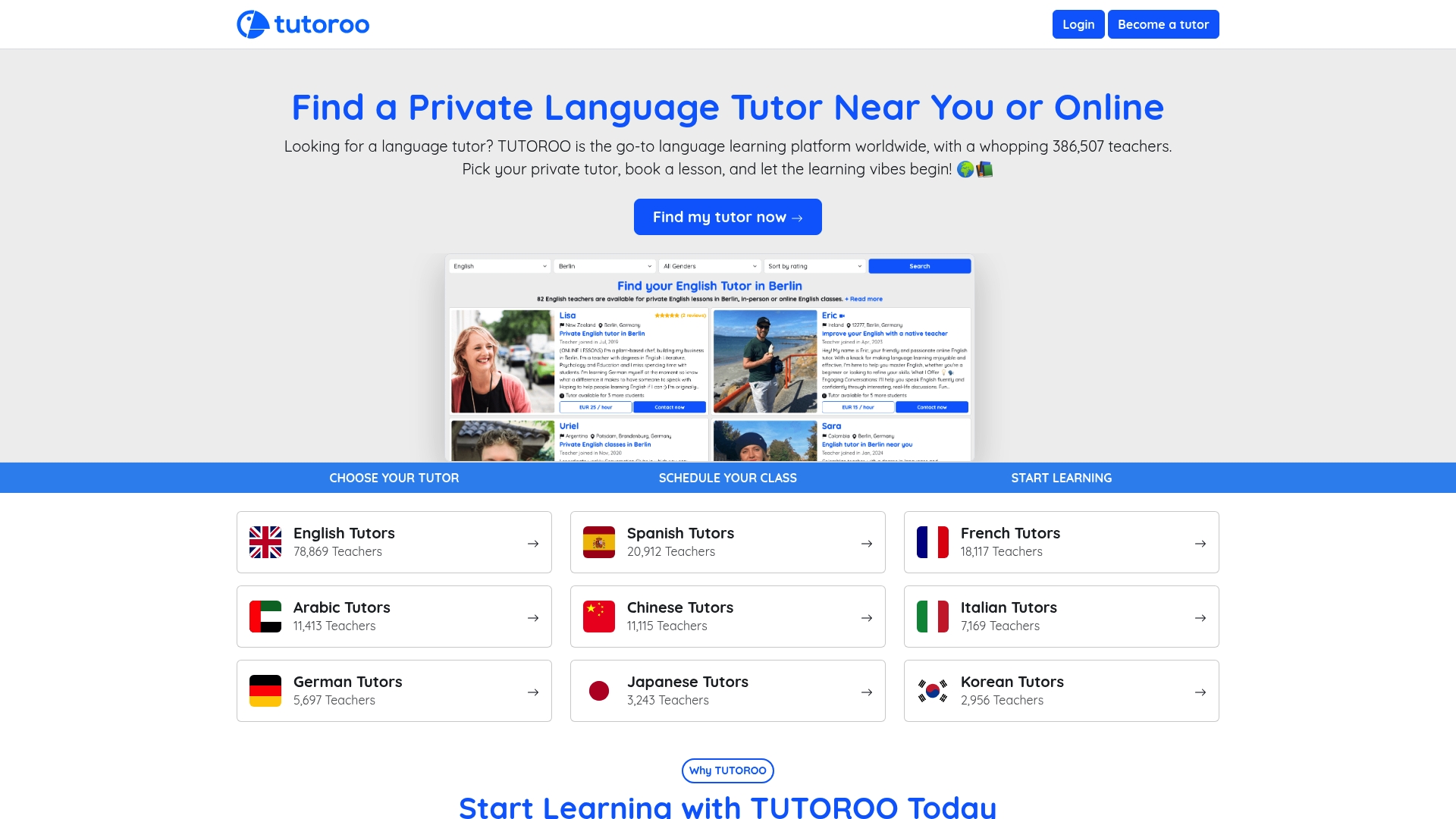
The matching process is straightforward: search by language, location, and availability, message a tutor directly, and schedule your first lesson. There are no ongoing platform fees between you and your tutor after the initial introduction, so the arrangement stays flexible and affordable. Whether you want weekly conversation practice to complement your platform learning, or intensive preparation for a language exam, find a private language tutor on Tutoroo and start your first session on your own terms.
Selected sources and further reading
- Platforms over models: why companies choose governance not just raw models — Bluente's survey data on enterprise AI translation adoption and the primacy of platform governance over model selection.
- AI speech translation: 2026 trends, predictions and industry insights — Kudo.ai's analysis of how live speech translation and automated captioning are becoming standard at hybrid events.
- What 2026 taught us about translation: trends, surprises, and predictions for the year ahead — Translated's review of TTE as the leading quality metric and the rise of continuous localisation.
- The state of multilingual AI in 2026 — f-g.com's analysis of multi-engine orchestration, the shift from NMT to LLM-powered translation, and the visibility advantage of multilingual content.
- Introducing the language intelligence platform — Phrase's framework for understanding platforms as context, orchestration, and learning systems rather than point tools.
- Language is the new growth infrastructure — MartechView's positioning of language technology alongside CRM and personalisation as core growth infrastructure.
- Where AI language infrastructure is heading — Entretech's analysis of the structural shift toward multi-model verification systems and the compounding cost of unmanaged AI verification overhead.
- Language learning trends and statistics — Kent State University's overview of language learning trends and adoption statistics for educators and researchers.
- How effective are language learning apps? — University of Wisconsin-La Crosse's evidence-based assessment of app effectiveness for language acquisition.