

TL;DR:
- Personalized feedback directly addresses each learner’s unique strengths, weaknesses, and learning preferences to accelerate progress.
- Research shows that tailored feedback improves noticing, retention, engagement, and language proficiency significantly.
Personalised feedback is the targeted guidance language learners receive that directly addresses their individual strengths, weaknesses, and learning preferences to accelerate progress. Unlike generic correction, this approach, formally known as adaptive corrective feedback in applied linguistics, treats each learner as a distinct individual with a unique proficiency level, motivation, and learning style. Research published in Frontiers in Education confirms that tailoring feedback to a learner's psychological and linguistic profile significantly improves noticing, retention, and engagement. Tutoroo connects learners with over 386,000 private tutors worldwide, making this kind of targeted, one-on-one guidance accessible at every level.
What are the main types of personalised feedback in language learning?
Personalised feedback takes several distinct forms, and understanding each one helps learners choose the right approach for their goals.

Corrective feedback addresses specific language errors in real time or after the fact. A tutor might recast a mispronounced word mid-conversation or annotate a written draft with targeted grammar notes. Research from Frontiers in Education shows that immediate corrective feedback during chatbot conversations enhances learner experience and positive perceptions, even when grammar gains are statistically similar to delayed feedback. The takeaway is clear: timing matters as much as content.
Formative feedback focuses on ongoing progress rather than isolated errors. It tracks patterns across multiple sessions and adjusts guidance accordingly. This type aligns closely with self-regulated learning, where learners monitor their own development and respond to feedback over time.
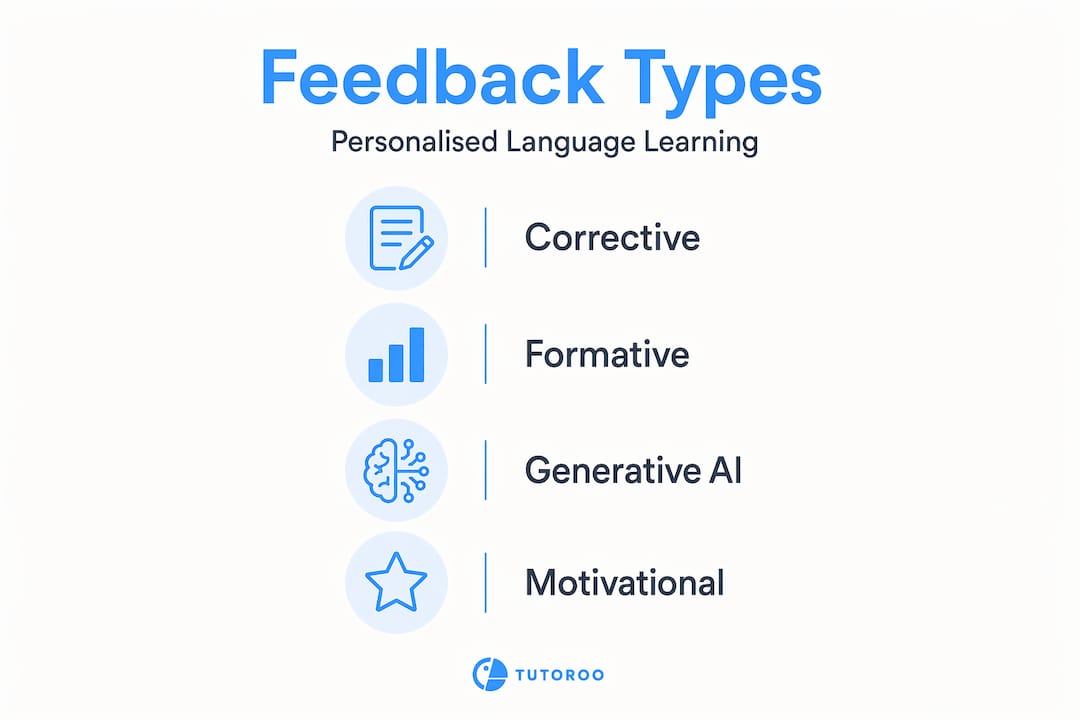
Generative AI feedback is the newest category. Tools powered by large language models can analyse written or spoken output and return detailed, personalised responses within seconds. A 2026 study in the International Journal of Educational Technology in Higher Education found that students rated generative AI feedback more positively than tutor feedback, reporting significant improvement in task skills and perceptions of genuineness. That result challenges the assumption that human feedback is always preferred.
Motivational feedback addresses the emotional dimension of learning. It acknowledges effort, celebrates progress, and reframes errors as learning opportunities. This type is often underestimated, yet it directly influences whether a learner persists through difficulty or disengages.
The table below compares automated and human feedback across key dimensions:
| Dimension | Automated feedback | Human feedback |
|---|---|---|
| Speed | Immediate, available 24/7 | Depends on tutor availability |
| Depth on surface errors | Strong, consistent | Varies by tutor experience |
| Higher-order skills | Limited without scaffolding | Strong, contextually rich |
| Motivational support | Minimal | High, relationship-driven |
| Personalisation to affect | Low | High |
Research on automated writing evaluation tools confirms that automated tools improve surface-level writing effectively but have real limitations for higher-order skills like argumentation and coherence. Human tutors remain the stronger choice when a learner needs feedback on meaning, not just mechanics.
How does personalised feedback improve language learning outcomes?
The evidence base for personalised feedback has grown sharply in 2026, and the findings are striking.
A meta-analysis examining generative AI interventions in language learning found that feedback-generating tools produced an effect size of g=1.708 on language proficiency and affective-cognitive outcomes. That figure outperforms productivity assistants, which recorded g=1.454. Effect sizes above 0.8 are considered large in educational research, so these numbers signal a genuinely meaningful impact.
"Generative AI feedback tools show the strongest effect on both language proficiency and affective-cognitive outcomes among all AI interventions studied, with effects amplified in informal and longer learning settings." — Meta-analysis of generative AI effects on language learning, 2026
The research also highlights important moderators. Learner proficiency level shapes how much benefit feedback delivers. Beginners often need more explicit, limited-scope correction, while advanced learners benefit from feedback that targets nuanced errors in register or discourse. Motivation acts as a second moderator. Learners who believe feedback is relevant to their goals engage with it more deeply and retain corrections longer.
Engagement itself is a measurable outcome. The Frontiers in Education chatbot study found that learner engagement increased with immediate feedback, even when grammar scores did not differ significantly from delayed conditions. This matters because sustained engagement predicts long-term acquisition far better than short-term test scores.
Learners' perceptions of the feedback source also shape outcomes. A 2026 Springer Nature study found that AI literacy and source awareness moderate how effectively learners use AI-generated feedback. Learners who understand how AI tools work accept and apply that feedback more readily than those who distrust or misunderstand the source.
Why does aligning feedback with motivation and learner readiness matter?
Feedback only works when the learner is ready and willing to receive it. Proficiency level determines which errors a learner can notice and process. Affective state determines whether they act on what they notice.
Research from Frontiers in Education confirms that tailoring feedback to affective and motivational profiles significantly enhances effectiveness. Personalisation must account for motivation, personality, aptitude, and learning style, not just current grammar level. A learner who is anxious about speaking needs different feedback delivery than a confident learner who is ready to be challenged.
Formative assessment research by Toni Mäkipää and Dina Tsagari highlights that feedback supports self-regulated learning best when it targets the monitoring and control phase of learning. Learner receptiveness varies significantly based on beliefs about their own ability and their history with feedback. A learner who has received harsh, discouraging correction in the past may resist even well-designed personalised feedback.
Practical implications for learners include:
- Match feedback type to your current goal. If you are building fluency, prioritise feedback on communication breakdowns over minor grammar slips.
- Communicate your preferences to your tutor. Tell them whether you prefer in-the-moment correction or a summary at the end of a session.
- Track your emotional response to feedback. If a particular type of correction consistently discourages you, that is data worth sharing with your tutor.
- Seek feedback on one skill at a time. Limiting scope keeps corrections manageable and actionable.
Pro Tip: Ask your tutor to focus each session on a single language feature, such as verb tense accuracy or linking words in writing. Narrowing the feedback scope makes it far easier to notice, process, and apply corrections before moving on.
You can read more about matching feedback to learner needs in Tutoroo's guide to tailored curricula in private tutoring.
How can language learners maximise the benefits of personalised feedback?
Receiving feedback is only half the process. What you do with it determines how much your language skills actually improve.
- Act on feedback immediately. Research confirms that feedback effectiveness depends on alignment with learner goals and actionable next steps. After a session, rewrite a corrected sentence in your own words or repeat a corrected phrase aloud three times.
- Keep a feedback log. Record recurring errors and the corrections you receive. Reviewing this log before each session activates prior learning and helps you spot patterns in your mistakes.
- Learn how AI feedback tools work. Managing expectations about AI-generated feedback is essential for realising its benefits. Understand that AI tools excel at surface corrections but may miss cultural nuance or pragmatic errors.
- Ask clarifying questions. When a correction is unclear, ask your tutor to explain the rule behind it. Understanding the reason for a correction makes it far more memorable than simply accepting the fix.
- Limit the scope of what you ask for. Learners need feedback that is actionable for their next utterance and limited to manageable language forms. Asking for feedback on everything at once leads to cognitive overload and poor retention.
- Alternate between human and AI feedback. Use AI tools for high-frequency practice between sessions and human tutors for deeper, context-rich correction on complex tasks.
Pro Tip: After each tutoring session, spend five minutes writing three sentences that use the corrected language feature. This short practice loop moves corrections from short-term awareness into long-term memory far more reliably than passive review.
For more practical strategies, Tutoroo's guide to fast, personalised language learning covers the latest research-backed approaches for 2026.
Key takeaways
Personalised feedback is the single most effective mechanism for accelerating language acquisition because it targets the specific gaps, motivations, and readiness of each individual learner.
| Point | Details |
|---|---|
| Feedback type shapes outcomes | Corrective, formative, AI-generated, and motivational feedback each serve different learning needs. |
| AI feedback shows strong effects | Meta-analysis records an effect size of g=1.708 for generative AI feedback tools on language proficiency. |
| Timing and scope matter | Immediate feedback boosts engagement; limiting scope to one feature at a time improves retention. |
| Motivation must be part of the equation | Aligning feedback with a learner's affective profile and goals significantly increases its effectiveness. |
| Active processing is non-negotiable | Learners who act on feedback immediately and track corrections over time gain the most from personalised guidance. |
Tutoroo's view on feedback that actually moves the needle
After working with learners across dozens of languages and proficiency levels, one pattern stands out clearly. The learners who progress fastest are not the ones who receive the most feedback. They are the ones who receive the right feedback at the right moment, and who know what to do with it.
Generic correction is easy to deliver and easy to ignore. Truly personalised feedback requires a tutor who understands not just where a learner is making errors, but why. Is the error a gap in knowledge, a habit formed in the learner's first language, or a confidence issue that surfaces under pressure? Each cause calls for a different response.
The 2026 research on generative AI is genuinely exciting, and these tools have a real place in a learner's practice routine. But the evidence also shows that AI feedback has clear limits, particularly for higher-order skills and motivational support. The most effective approach combines the consistency of AI tools with the cultural intelligence and relational depth of a skilled human tutor.
Learners who treat feedback as a two-way conversation, rather than a verdict, tend to progress with remarkable speed. Ask questions. Push back when a correction does not make sense. Tell your tutor what kind of guidance actually helps you. That kind of active engagement with how feedback shapes success is what separates learners who plateau from those who keep growing.
— Tutoroo
Personalised tutoring with Tutoroo
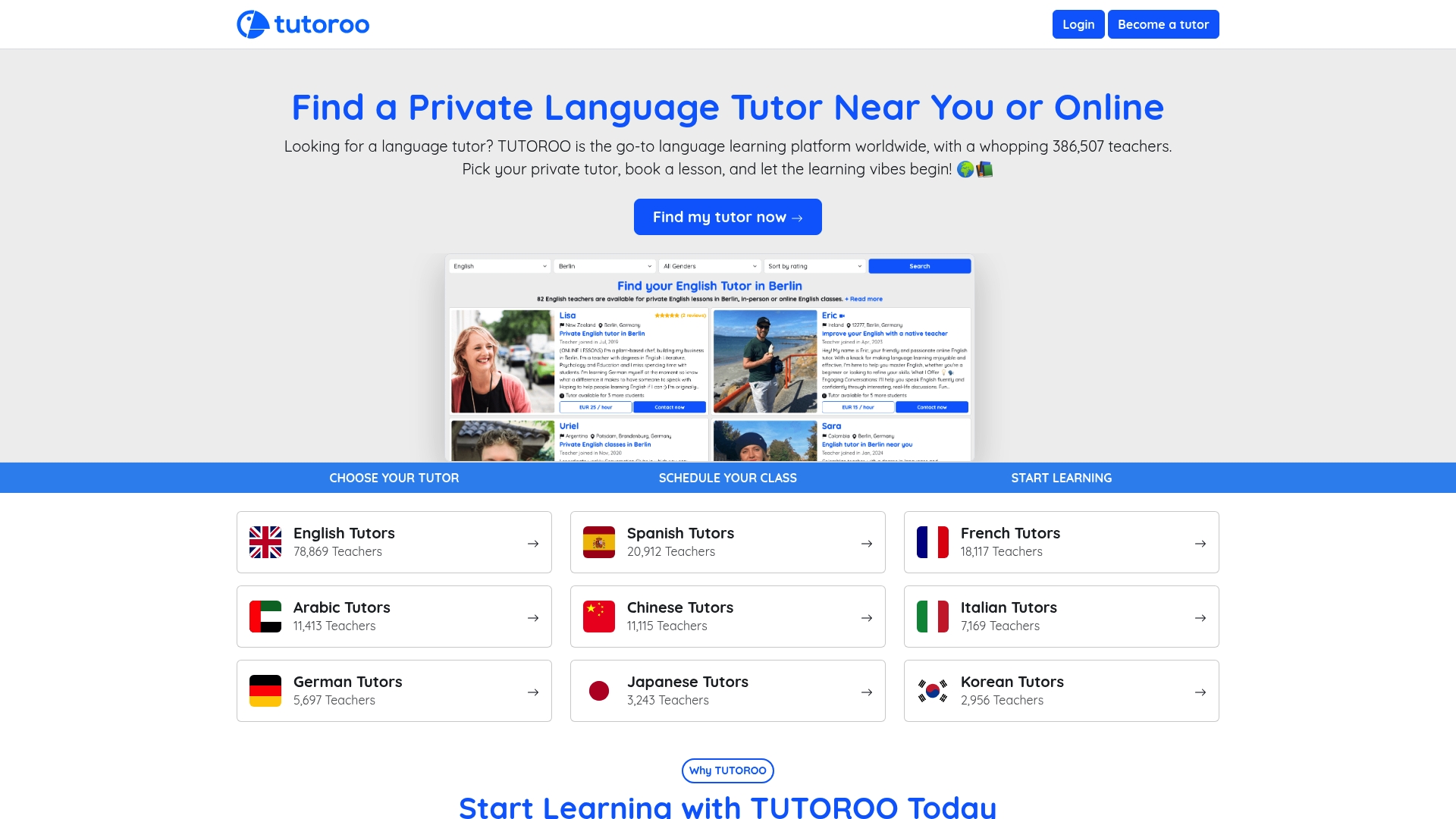
Tutoroo connects language learners with over 386,000 private tutors across the world, offering one-on-one lessons that are built around your goals, your schedule, and your learning style. Whether you are working on conversational fluency, exam preparation, or professional communication, a Tutoroo tutor delivers the kind of targeted, responsive feedback that generic courses simply cannot match. Sessions run locally or online, so you can find the right tutor regardless of where you are based. Explore private language tutors on Tutoroo and start learning with feedback that is genuinely tailored to you. If you are focused on a specific language, Tutoroo also offers dedicated English tutoring online with qualified tutors at every level.
FAQ
What is personalised feedback in language learning?
Personalised feedback is targeted guidance that addresses a learner's specific errors, goals, and proficiency level. It differs from generic correction by adapting to the individual's motivation, learning style, and affective profile.
Is AI feedback as effective as human tutor feedback?
A 2026 meta-analysis found generative AI feedback tools produce an effect size of g=1.708 on language proficiency, which is strong. However, AI tools are most effective for surface-level corrections, while human tutors provide stronger support for higher-order skills and motivation.
How often should language learners receive personalised feedback?
Frequency matters less than consistency and quality. Research shows that feedback aligned with learner goals and limited in scope to manageable language forms produces better retention than high-volume, unfocused correction.
Does immediate feedback work better than delayed feedback?
Immediate corrective feedback improves learner experience and engagement, even when grammar gains are similar to delayed feedback conditions. For most learners, immediate feedback is the preferred approach during conversational practice.
How can learners get the most from personalised feedback?
Learners gain the most by acting on corrections immediately, keeping a feedback log, limiting the scope of each session to one language feature, and communicating their preferences clearly to their tutor.