

Most US states do not set a foreign language credit for homeschoolers, so the credit is yours to define, count and document. Colleges generally expect two to four years of the same language, and a private tutor can supply the instruction, the speaking practice and the evidence that make a transcript entry credible. Below we explain how state rules work, how many years to plan, how to count hours, what to keep on file, and how personalised one-on-one lessons fit in, from Spanish to Hindi in Chicago.
TL;DR
- Most states leave homeschool credit minimums to families, so the real benchmark is what your student's target colleges expect: usually two to four years of one language.
- Stay with one language across high school. Colleges read steady progress as depth.
- Credit rests on genuine, substantial coursework, which you document with a course description, materials list and evaluation method.
- A private tutor gives you regular speaking practice, a clear schedule and a record of progress, all of which support a transcript entry.
- Check your own state's homeschool law and each target college's admissions page before you lock in a plan.
Table of Contents
- Do homeschoolers need foreign language credit at all?
- What colleges expect: how many years, and of which language
- Which languages and formats can count
- How to count a credit: hours, units and evidence
- What to keep on file
- Where a private tutor fits
- Example: Hindi lessons for a Chicago homeschooler
- Find a tutor for your homeschool language plan
- A simple four-year plan
- Common mistakes to avoid
- FAQ
- Sources
Do homeschoolers need foreign language credit at all?
In most cases the law does not require it, but college plans make it worth doing. Homeschool laws in the United States differ by state, and in most states they do not specify a credit minimum. Maryland is a clear example: its homeschool regulation lists the subjects to be taught, and the Maryland Homeschool Association notes that foreign language is not among the required areas.
Georgia works similarly. The Georgia Home Education Association explains that homeschool students are not bound by the 23-credit public-school graduation requirement, though most colleges require or like to see two foreign language credits. Its sample plans list foreign language at two to four credits.
Illinois treats homeschools as private schools. The Will County Regional Office of Education strongly encourages college-bound families to follow the same graduation requirements used in public schools. That advice is a useful rule of thumb in many states: if there is no state minimum, borrow the public-school pattern and the college-admissions pattern, and write your plan around the stricter of the two.
The practical answer is this: you decide whether the transcript carries a language, and if the student is heading to college, it should.

What colleges expect: how many years, and of which language

The National Association for College Admission Counseling advises that to meet admission criteria at a majority of colleges, students should take two to four years of a foreign language. Requirements vary by institution, so treat that as the range to plan within, not a promise about any single school.
A few points shape the plan:
- Two years is the common floor. Many universities list two years in the same language as the minimum.
- More is stronger. Selective colleges often prefer three or four years, because longer study shows depth and consistent progress.
- Same language beats a sampler. One year of Spanish followed by one year of French reads as two beginnings. Sustained study in one language is what shows proficiency building. A school that works with children on a second language from the primary years makes the same point from the other direction, and sticking with one language over several years is the idea behind it.
- Start early if you like. A seventh grader who wants to begin a language does not have to wait. Time spent before ninth grade builds a base, and the family can decide later what counts toward high school credit.
Because policies differ, open the admissions page of each college your student is considering and look for the foreign or world language line. Some state universities also publish how they treat homeschool transcripts. Write down what you find and build the plan backwards from it.
Which languages and formats can count
The Georgia Home Education Association lists French, Spanish, Latin, German, Russian and Sign Language as foreign language courses, with at least two years of the same language preferred. That list is a sample, not a limit. Families commonly choose a language for heritage, travel, a future career or personal interest, and colleges generally care that the study is sustained and serious.
A few common questions:
- Spoken languages beyond the usual three. Japanese, Mandarin, Arabic, Hindi, Portuguese and others can all fill a transcript line when the coursework is real. Because fewer local classes exist for them, one-on-one tutoring is often the practical route.
- American Sign Language. Many colleges accept it, but acceptance is not universal, so confirm with each target school. If ASL is the plan, our sign language tutors are one way to get live instruction.
- Latin. Often accepted as a foreign language, though it builds reading rather than speaking skills.
- Format. Textbooks, co-op classes, online courses, apps and tutoring can all contribute, provided the work is genuine and substantial and you can show what was covered.
A mix usually works best: a core text or course for structure, plus a live conversation partner for speaking and listening.
How to count a credit: hours, units and evidence
Homeschool credit is not issued by a central authority, so parents define it. Many families borrow the public-school idea of a Carnegie unit, which is commonly described as roughly 120 to 180 hours for a full-year high school course. Pick a figure you can defend, state it on your course description and apply it consistently across subjects.
A workable language year might look like this:
| Component | Example weekly time | What it produces |
|---|---|---|
| Core course or textbook | 2 to 3 hours | Units completed, quizzes, a vocabulary log |
| Live tutoring | 1 hour | Speaking practice, corrections, tutor notes |
| Listening and reading | 1 hour | Short summaries, a reading list |
| Writing | 30 to 60 minutes | Paragraphs, emails, a portfolio |
Over a 34 to 36 week school year, that adds up to roughly 160 to 200 hours, which comfortably supports a full credit. Adjust the weekly blocks to your own calendar; the aim is to reach the number of hours you set and to be able to show them.
Measuring level, not just time
Hours show effort. Proficiency shows results. The ACTFL Proficiency Guidelines describe language ability in five major levels, starting with Novice, where a learner can express basic personal information using memorised phrases and lists. Using those descriptors in your course description gives an outside reader a common vocabulary: "completed a first-year course aimed at the Novice range, with regular speaking tasks," for example. Students who want an external measure can also look at standardised world language exams, and your tutor can help prepare for whichever one you choose.
What to keep on file
Credit is only as strong as the paperwork behind it. For every language year, keep:
- A course description. One page covering what was studied, the materials used (textbooks, online lessons, tutoring), and how the student was evaluated.
- A materials list. Titles, platforms and, for tutoring, the tutor's name and the weekly schedule.
- Evaluation samples. Tests, graded writing, a recorded conversation, a project or presentation.
- A time log. A simple sheet of dates and minutes. It takes thirty seconds a session and answers any question about hours.
- A transcript entry. Parent-issued transcripts typically list courses by year with credits, grades, a cumulative GPA, the graduation date and the parent's signature.
Name the course the way a school would: "Spanish I", "Spanish II", "Mandarin Chinese III". Keep the level numbering continuous. A transcript that reads Hindi I, Hindi II, Hindi III tells a clear story. Also check your state's rules on record keeping, since some states ask for specific documentation and others leave it to you.
Where a private tutor fits
A tutor turns a language from a subject you supervise into a skill your student practises with a real person. That matters for credit in several ways.
- Speaking and listening. Textbooks and apps are strong on vocabulary and reading. A live tutor supplies conversation, pronunciation feedback and the pressure of answering in real time. Our guide to lessons that build real speaking skills explains how to structure that practice.
- Structure for parents who do not speak the language. If you are not fluent, you do not have to be. The tutor sets a pace, assigns practice and gives feedback, while you track hours and keep records.
- Consistency. Short, frequent sessions tend to suit teens and younger learners. Our article on two 30-minute sessions a week for homeschool language tutoring walks through a rhythm that many families find manageable.
- A paper trail. Session notes, assigned work and message history on the platform help document what was covered and when.
If you are weighing in-person against online lessons, our comparison of local and online language tutoring sets out the trade-offs, and our overview of online language tutor costs will help you budget for a school year. For younger learners starting before high school, see online language lessons for kids.
Example: Hindi lessons for a Chicago homeschooler
Languages with fewer local classes are where a tutor makes the biggest difference, and Hindi is a good example. Chicago has a large South Asian community and many families have a heritage connection, yet a homeschooler rarely finds a four-year Hindi sequence at a co-op down the road.
A family building a Hindi credit might plan it like this:
- Year 1 (Hindi I): the Devanagari script, greetings, family, daily routines, numbers and basic sentence patterns. Two sessions a week with a tutor, plus a workbook or course for reading and writing.
- Year 2 (Hindi II): past and future tenses, short readings, simple conversations and a written paragraph each week.
- Years 3 and 4: longer texts, songs and films with summaries, a presentation in Hindi, and discussion on topics the student picks.
A student with Hindi at home may start further along than a pure beginner. In that case, the tutor can focus on reading and writing in Devanagari and formal registers, where heritage speakers often have the most to gain.
Choosing a tutor for level and goals
When you talk with a prospective Hindi tutor in Chicago, whether in person or online, look for fit rather than a tick-list:
- Your student's level. A true beginner, a heritage speaker who understands but rarely speaks, and a student polishing literacy need different lesson plans. Ask how the tutor would start.
- Your goal. Is it the transcript credit, conversation with relatives, or a college language placement? Share it so lessons point at it.
- Script and materials. Ask how reading and writing in Devanagari will be taught and what materials the tutor uses, so you can list them on the course description.
- Schedule and format. Decide on weekly frequency, session length, and whether in-person Chicago lessons or online lessons suit your household. Online widens the choice of tutors.
- Reporting. A tutor who is happy to give a short note on topics covered and progress each month makes your record keeping simple.
On our platform you can search by language, location and availability, message tutors directly and agree a schedule that fits your homeschool week.
Our perspective
We built TUTOROO around a simple belief: personalised tuition opens doors to culture, connection and opportunity, and homeschool families should not have to settle for whatever language class happens to be nearby.
Credit is a parent's decision, and the strongest transcripts come from steady, documented work with one language. That is where one-on-one lessons shine. A tutor who meets your student every week provides the rhythm, the authentic speaking practice and the accountability that turn "we studied some Spanish" into "Spanish II, completed."
Our network of language teachers spans numerous languages, from the familiar to those no local co-op teaches. Students can learn locally or online, message tutors directly and choose the schedule that suits their household. Tutors receive payment directly from students for ongoing lessons.
TUTOROO
Find a tutor for your homeschool language plan
If you are ready to put a language on the schedule, we can help you find an expert tutor for your student's level and goals. Browse English, Spanish, French, Japanese, Chinese, German, Italian and Portuguese teachers, search by location or choose online lessons, then message tutors to agree a timetable that fits your school year.
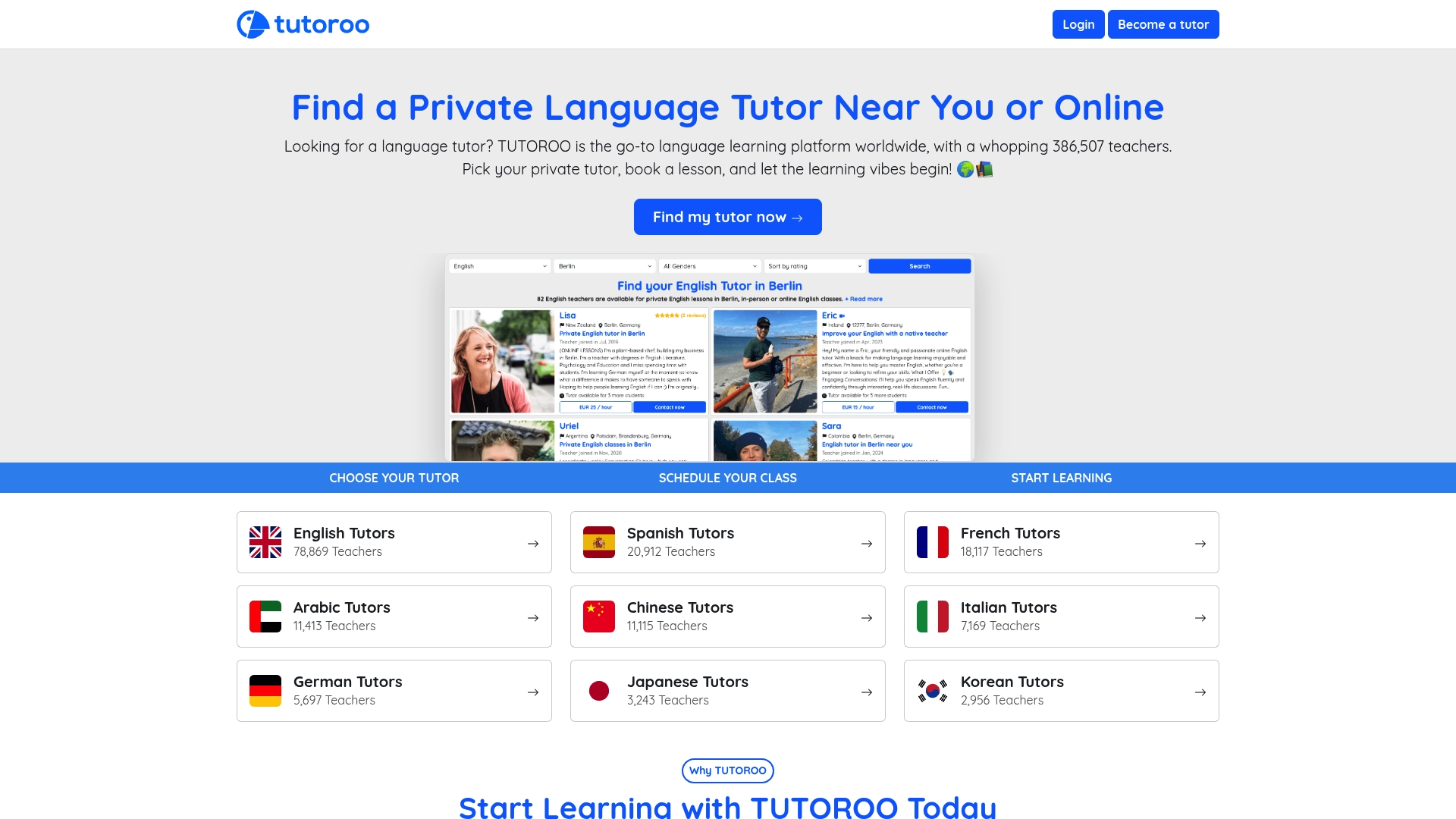
Parents often start with a trial conversation to see whether a tutor's style suits their student, then settle into a weekly rhythm. For ideas on how sessions can run, read our online tutoring examples for building fluency and our step-by-step guide to online tutoring.
A simple four-year plan
Putting it together, here is a framework you can adapt:
| Grade | Course name | Goal | Suggested evidence |
|---|---|---|---|
| 9 | Language I | Novice-level communication on everyday topics | Unit tests, vocabulary log, recorded dialogue |
| 10 | Language II | Simple conversations and short written texts | Weekly paragraph, reading list, tutor notes |
| 11 | Language III | Longer texts, opinions and narration | Essay, presentation, listening summaries |
| 12 | Language IV | Greater accuracy and independence | Portfolio, extended conversation, optional exam |
If the student plans to apply to selective colleges, aim for all four years. If the target schools ask for two, finish two well and decide later whether to continue. Either way, starting in eighth or ninth grade leaves room to adjust.
Common mistakes to avoid
- Switching languages each year. It dilutes the story and rarely leads to real proficiency.
- Counting hours without evidence. Keep samples of work, not only a log.
- Leaving speaking to the end. Begin conversation in the first month, even with a handful of phrases.
- Skipping the college check. Look up each target college's language line early, so a last-minute surprise does not undo a plan.
- Ignoring your state. A few states have specific record or subject rules for homeschools; read yours, or ask your state homeschool association.
FAQ
Do colleges accept parent-issued homeschool transcripts?
Yes, parent-issued transcripts are standard for homeschoolers. What persuades an admissions office is the detail: course names, credits, grades and a course description that shows what was studied and how it was assessed. Check each college's homeschool applicant page for any extra requests.
Can a private tutor alone count as a foreign language credit?
Credit depends on genuine, substantial coursework, not on one format. A tutor-led year works well when it follows a clear syllabus, reaches your hour target and produces evidence such as tests, writing and speaking samples. Many families pair tutoring with a textbook or course for structure.
Is two years of a language enough?
Two years of the same language meets the minimum at many colleges, and the National Association for College Admission Counseling puts the typical range at two to four years. Selective schools may prefer three or four, so check the admissions pages of the colleges on your list.
Can we start a language before ninth grade?
Yes. Early study builds a strong base, and you can decide later how much of it to count toward high school credit. Many families start in middle school with short weekly lessons and then formalise the course in ninth grade.
How do I find a Hindi tutor in Chicago?
Search by language and location on TUTOROO, then message tutors about your student's level, goals and schedule. You can choose lessons in person or online, which widens your options if you want a particular teaching style.
Sources
- Graduation Requirements, Maryland Homeschool Association
- Coursework and Credits, Georgia Home Education Association
- Home Schooling, Will County Regional Office of Education
- High School Classes Required for College Admission, NACAC
- ACTFL Proficiency Guidelines 2024