

Heritage language tutoring is one-on-one teaching for people who already have a family or community connection to a language, and who want to turn what they understand at the kitchen table into confident speaking, reading and writing. A private tutor can start from what you already know, which a beginner course cannot. At TUTOROO, learners and parents can browse private tutors across many languages, including Spanish, French, Japanese, Chinese/Mandarin, German, Italian and Portuguese, and message them directly to find the right fit.
TL;DR
- A heritage language learner has a cultural or family tie to a language and some proficiency in it, usually stronger listening than speaking, reading or writing.
- Heritage lessons should maintain and develop existing skills, not teach from zero, so a beginner course is often the wrong starting point.
- Research favours meaningful, task-based conversation, respectful correction and a diagnostic check at the start over drills and grammar lists.
- One-on-one tutoring lets the lessons follow your own gaps, dialect and goals, whether that is family conversations, travel or an exam.
- Look for a tutor who treats your home speech as a strength and can name where they will take you in the first few lessons.
Table of Contents
- What a heritage language speaker is
- How heritage lessons differ from beginner lessons
- Why one-on-one tutoring suits heritage learners
- Before you book: a quick self-check
- What good heritage language tutoring looks like
- Heritage tutoring for different goals
- How to find the right tutor
- Find your heritage language tutor
- Our perspective
- FAQ
- Sources
What a heritage language speaker is
The Center for Applied Linguistics (CAL), a US research organisation, defines a heritage language as any language other than English spoken by an individual, family or community. That covers immigrant languages such as Spanish, indigenous languages such as Navajo, and colonial languages such as French and German. A heritage learner is someone studying that language who has some proficiency in it or a cultural connection to it through family, community or country of origin.
That definition is broad on purpose. CAL's own assessment module notes that the term has been debated for decades and that learners have different degrees of exposure and different areas where they know more. Two heritage speakers of the same language can sound very different.
The University of California, Davis offers a practical example. Its Spanish programme describes a heritage speaker as someone with a personal, family or community connection to Spanish whose formal schooling was mostly in English. That might be a child born in a Spanish-speaking country who moved to the US, or someone raised in a Spanish-speaking home who attended English-language schools.
You do not have to speak fluently, or at all, to belong in this group. A surname is not a test either. A Texas education guide warns that identifying students by surname leads to misidentification and suggests looking at the ability to understand and speak the language.

How heritage lessons differ from beginner lessons
Baylor University puts the difference plainly: second-language courses build a new skill for students with little or no Spanish, while heritage courses maintain and develop existing skills. Heritage students may be at very different levels in speaking, reading and writing.
The pattern behind that is well documented. A University of Oregon open textbook chapter explains that heritage speakers typically learned the language through family interactions, use it in limited settings such as family gatherings, and often develop listening more than speaking. Reading and writing are the skills least likely to be practised at home.
So a heritage learner often looks like this:
- You understand most of what your grandparents say but answer in English.
- You speak comfortably about food, family and daily routines, but freeze when the topic is work, news or an essay.
- You can say a sentence but are unsure how to spell it, or which register (formal or casual) fits a teacher, an employer or an elder.
A beginner course would spend weeks on greetings and numbers you already know, then give you very little on the things you are missing. Heritage lessons reverse that balance.
What the evidence says about where heritage learners start
The American Association for Applied Linguistics (AAAL) reports that even beginning-level Spanish heritage learners have considerable receptive skills: they understand most spoken Spanish and produce everyday interactional phrases. More advanced learners may handle irregular verbs well but still lack some forms, such as the subjunctive. The sensible conclusion for lesson planning is to find out what the learner can do first.
The Texas guide mentioned above makes a similar point. Many Spanish-speaking students understand more than they can express, are often literate only in English, and use Spanish mainly at home. It recommends treating existing oral ability as an advantage and building on it towards full literacy, with meaning first and form second.
Why one-on-one tutoring suits heritage learners
Classrooms struggle with heritage learners because the group is so mixed. AAAL's authors point out how varied these groups are from one semester to the next. A private tutor does not have that problem, because there is only one learner in the room.
That matters in four ways.
Lessons can start where you are. A tutor can spend ten minutes finding out what you understand, what you say naturally and where you hesitate, then plan from there. Our guide to one-on-one lessons explains why personal attention tends to move learners along faster.
Your home dialect can be treated as a resource. A Utah State University report cautions that imposing a standard dialect while ignoring the home variety can be academically, economically and psychologically harmful, and can put a speaker's sense of ethnic identity at risk. It cites four goals for teaching Spanish to heritage speakers: language maintenance, acquiring the standard dialect, widening bilingual range and transferring literacy skills. A good tutor adds the formal register to your family's way of speaking and does not replace it.

Correction can be gentle. UCLA's heritage-class guidance advises against over-correcting, because it harms motivation, and suggests praising effort. Many heritage learners have been corrected by relatives for years and arrive anxious. One-on-one, a tutor can tailor correction to how sensitive you are.
There is evidence tutoring helps reading and confidence. A Duke University study of Spanish heritage children aged 8 to 11 gave them seven weekly one-on-one interactive reading sessions with a peer tutor. Their self-rating of reading skills rose from 1.89 to 2.01 on a 1 to 3 scale, and the share who said they read Spanish very or fairly well rose by 28.57 percentage points, against 9.09 in the control group. It is a small study, but it shows what regular personal sessions can do for motivation.
Before you book: a quick self-check
UCLA recommends a diagnostic check at the start so that teaching builds on what the learner knows instead of highlighting what they do not. You can do a rough version yourself before you contact anyone. Write down honest answers to these:
- Listening: Can you follow a family conversation, a news clip or a film without subtitles?
- Speaking: Can you keep going for five minutes on an everyday topic? On an unfamiliar one?
- Reading: Can you read a menu, a text message, a short article, a novel?
- Writing: Can you write a message to a relative, a formal email, a paragraph with correct spelling and accents?
- Register: Do you know how to speak to an elder, a boss or a stranger?
- Goal: Do you want to talk with grandparents, prepare for travel, pass a placement or proficiency exam, or read and write for school or work?
Share the answers with a prospective tutor. They give the tutor a starting map, and they make your first lesson far more useful than "let's see where you are".
What good heritage language tutoring looks like
Research from US language-education bodies points to a consistent set of practices. Use them as a yardstick when you speak to a tutor, or as a plan if you teach.
Meaningful tasks over drills
AAAL recommends task-based, communicative activities in which students use what they already have in real exchanges, for example planning a shopping trip for a cultural event the student chooses. It advises against decontextualised drills and against putting explicit grammar ahead of contextualised practice. In a lesson, that might mean cooking a family recipe in the target language, then writing the instructions for it.
Our article on lessons that build real speaking skills covers the same principle for all learners.
The heritage language most of the time
UCLA's guidance suggests using the heritage language all or most of the time. It also accepts that learners may mix in English when they urgently need to get a point across, after which the tutor helps them say it again in the heritage language. That is more realistic than a strict no-English rule and keeps the learner talking.
Meeting the literacy gap
Because reading and writing are usually the weakest areas, the Utah State report notes that these skills are often lacking since English literacy took priority at school. Good tutoring adds reading and writing early, with texts that suit your age and interests. The National Heritage Language Resource Center (NHLRC) at UCLA advises that materials for beginning heritage students can start at a higher level and move faster than beginner foreign-language materials, and should cover register and politeness markers.
Safe, welcoming practice
AAAL's authors argue that the focus should be on the students and their relationship with the language, not only the language itself. Safe spaces that foster belonging matter more in the long run than perfecting verb tenses. Confidence grows when nobody shames you for an accent or a mistake, a theme explored in this piece on the role of community in learning. Our own look at the role of community in language education makes the same point for language learners.
A tutor who respects what you bring
NHLRC practitioners recommend that tutors learn each student's linguistic background, say openly that heritage learners are usually strong in speaking while second-language learners tend to be stronger in grammar, acknowledge the validity of the learner's own way of speaking, and offer varied ways to show progress. UCLA adds that tutors should be glad to learn about the language and culture from their students while teaching the skills the student needs. Guidance for mixed classes sets out these practices in detail.
Heritage tutoring for different goals
Reconnecting with family
The goal here is conversation. Ask for a tutor who will talk about your family's own world: the stories, places and foods that matter to you. If your relatives come from a particular region, say so, so the tutor can include that variety of the language. The aim is to be able to answer your grandmother in her language.
Exams and school credit
If you want to move out of a beginner class or prepare for a placement test, literacy and formal register become the priority: essays, reading comprehension, spelling and accents. Some universities run separate heritage tracks. UC Davis, for instance, offers a heritage Spanish programme with weekly one-on-one writing meetings and general education credit. A private tutor can prepare you for that kind of entry point.
Travel and work
Heritage speakers often find travel is where the gap shows: you follow everything but cannot always reply as quickly as you would like. A tutor can rehearse the situations you expect, such as meetings, bookings and formal introductions, and build vocabulary beyond home topics. Our overview of skills students need in 2026 is a good companion.
Children and teens
Parents often ask when to start. The Duke study found positive results in children aged 8 to 11 with short weekly sessions, and it noted that one in five people in the US speaks a language other than English at home. Spanish is the most common. The same study observes that school systems built around English alone often neglect these children's needs and treat them as lacking something. For a child, look for a tutor who is warm, uses games and stories, and praises effort. For a teenager, choose topics that connect to their own interests.
How to find the right tutor
Start with the language and variety you need, then look for these things in a tutor's profile and first message:
- Experience with learners who already understand the language. Ask how they would plan the first lessons for someone who understands but rarely speaks.
- A clear approach to correction. Ask how they handle mistakes.
- Willingness to work on your goal. Family conversation, exam, travel and school literacy each need a different lesson plan.
- Schedule and format. Decide between online or local lessons, and how often you can meet. Short, regular sessions suit most learners.
- Fit. A friendly first chat tells you more than any profile.
On TUTOROO you can search by language, location and availability, and message tutors directly through the platform. That makes it easy to explain your background before you commit to a lesson. Our guide to types of private language lessons can help you decide between conversation-focused, exam-focused and mixed lessons. To keep progress over the long term, see our tips on how to retain a new language.
A note for tutors
If you are a native or fluent speaker thinking of teaching heritage learners, the research suggests a few habits that make a difference. Ask learners about their family languages, treat their speech as valid, correct sparingly, pair speaking with reading and writing, and let them choose topics. Tutors on TUTOROO register themselves, set their own schedules and are paid directly by their students for ongoing lessons.
Find your heritage language tutor
TUTOROO is an international platform that connects learners with private language tutors for one-on-one lessons, online or in person. You can look for tutors in Spanish, French, Japanese, Chinese/Mandarin, German, Italian and Portuguese, and the platform's community includes more than 386,000 language teachers. Tell a tutor your background and goals in your first message, and you can begin from what you already know.
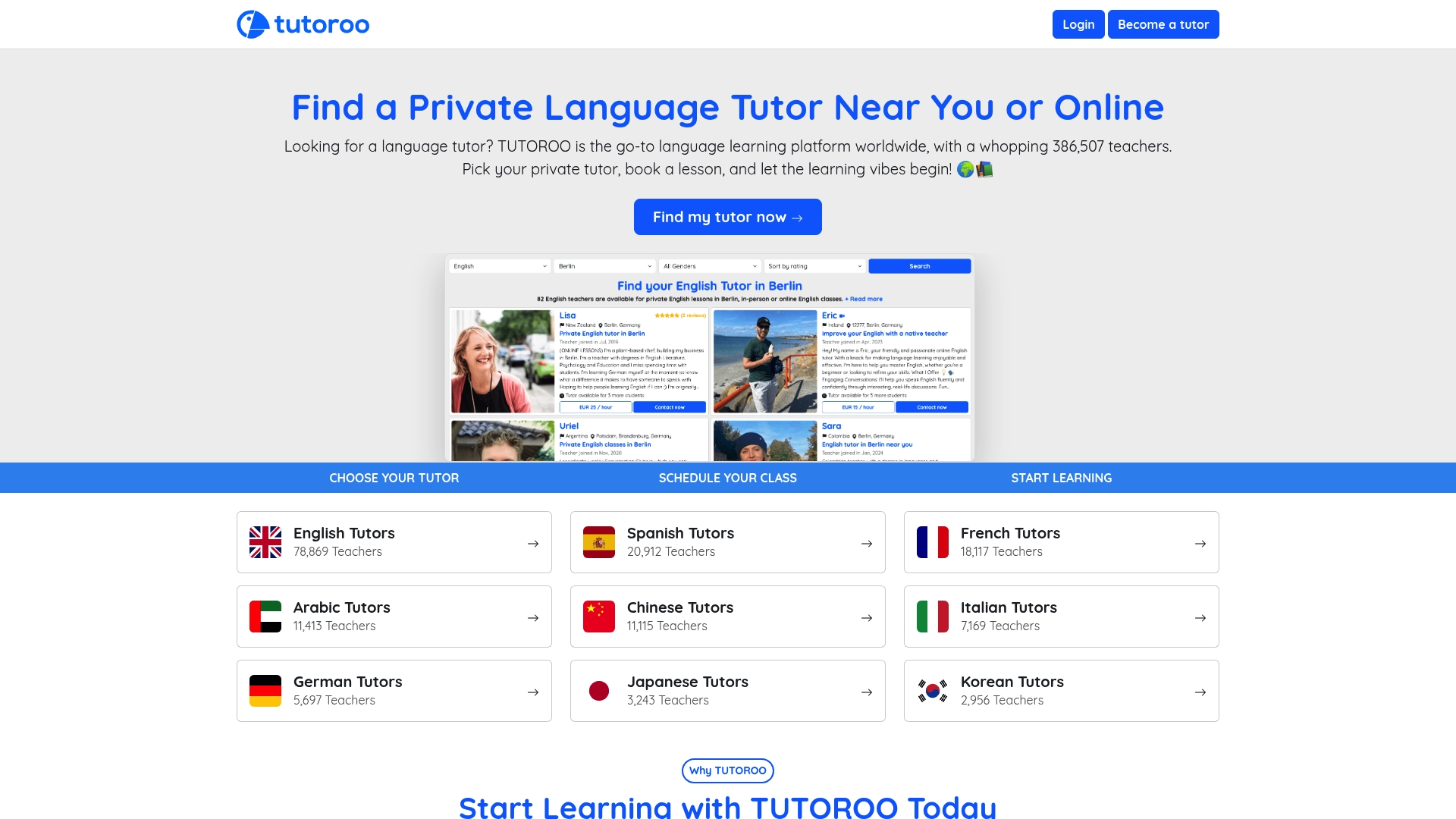
Browse tutors on TUTOROO and choose the language you grew up around.
Our perspective
Many of the learners who contact language platforms say the same thing: "I understand everything, but I can't answer." That is not a beginner's problem, and it should not be fixed with a beginner's course.
We believe the best heritage lessons are personal. A learner's family, dialect and goals shape the plan, and a one-to-one relationship with a tutor is the most natural way to honour that. It is also a human exchange: a tutor who is pleased to hear how your grandmother talks makes you want to talk more.
That is why we built TUTOROO around direct contact between students and tutors, with a worldwide network that covers many languages and places. Learners can choose a tutor by location, language and availability, write to them first and agree the kind of lessons they want. Our hope is that more families rediscover the language of their home, with confidence and pride.
TUTOROO
FAQ
What is heritage language tutoring?
It is private teaching for people with a family or community link to a language who already have some skills in it. Lessons maintain and develop those skills, usually widening speaking, reading and writing, instead of starting from the basics.
How do I improve my Spanish as a heritage speaker?
Work on the skills you use least, which for most heritage speakers are reading, writing and formal register. Practise through real tasks such as writing messages, reading articles on topics you like and speaking regularly with a tutor or relatives. Task-based practice, as recommended by AAAL, tends to work better than isolated grammar drills.
Can I be a heritage speaker if I can't speak the language?
Yes. A heritage learner is defined by a cultural or family connection, and proficiency can range from understanding only to near fluency. Many learners understand far more than they say.
Is a heritage course the same as a beginner course?
No. Beginner courses assume little or no knowledge and teach the basics first. Heritage teaching assumes you already have skills and aims to extend them, as Baylor University describes in its Spanish programme.
Sources
- CAL: Heritage Languages in America, frequently asked questions
- CAL: Heritage language assessment module, introduction
- UC Davis: Heritage Spanish Program FAQs
- SEDL: Español para el Hispanohablante
- Baylor University: Spanish for Heritage Speakers
- University of Oregon: Heritage Languages
- AAAL: Teaching Spanish as a heritage language for the first time
- Utah State University: Teaching Spanish to Second-Language and Heritage-Language Learners
- UCLA: Heritage learners proficiency and use
- Duke Bass Connections: Promoting Multilingualism Through a Spanish Reading Program
- NHLRC: Curriculum guidelines for heritage language classrooms
- NHLRC: Organizing principles and best practices for mixed classes