

TL;DR:
- Community involvement in language education enhances learning outcomes by providing social support, emotional safety, and real-world practice. Structured activities and community partnerships are essential for sustained progress, especially in developing oral skills and learner confidence. Combining community programs with private tutoring offers a comprehensive approach to language acquisition.
Community involvement in language education is defined as the social, emotional, and cultural support networks that surround learners and directly shape how they acquire and use a new language. The role of community in language education goes far beyond classroom walls. Research confirms that community-integrated learning produces measurably stronger outcomes than traditional instruction alone. Learners embedded in supportive communities gain real-world practice, emotional safety, and peer feedback that no textbook can replicate. For educators, language learners, and community organisers alike, understanding this dynamic is the first step toward building programmes that genuinely work.
How does community involvement influence language acquisition outcomes?
Community involvement produces measurable gains in learner performance. A study comparing community-integrated and traditional classroom learners found a mean score of 14.77 versus 13.15 in favour of the community group, with a statistically significant result of p = .005 across 113 pre-service teachers. That gap reflects something real: learners who practise language within a community context receive more varied, authentic input than those confined to structured drills.
The picture for oral proficiency is more nuanced. Community language schools consistently improve literacy outcomes, yet their effect on oral skills is weak or inconsistent. Nearly 50% of heritage language students complete only the equivalent of first-grade instruction before dropping out. Oral gains tend to come from informal peer interactions rather than formal lessons, which means programmes that rely solely on structured teaching miss a critical piece of the puzzle.
Speaking anxiety is one of the biggest barriers to language progress. Community-based models address this directly by shifting from teacher-centred to peer-supported environments, where learners observe, imitate, and negotiate meaning with peers rather than performing for an authority figure. A qualitative study found improved confidence and speaking comfort over a single semester in community-based settings. That shift in dynamic changes how learners relate to the language itself.
| Outcome area | Community-integrated learning | Traditional classroom learning |
|---|---|---|
| Academic performance | Higher mean scores (14.77) | Lower mean scores (13.15) |
| Oral proficiency | Gains linked to informal peer use | Structured but limited real-world transfer |
| Speaking confidence | Increased through peer support | Often constrained by teacher-centred formats |
| Literacy outcomes | Consistently strong | Dependent on curriculum quality |
| Learner retention | Variable; dropout rates remain a challenge | More predictable attendance structures |
Pro Tip: Design at least one unstructured peer conversation session per week. Informal talk between learners builds the oral confidence that structured lessons often cannot.
What are the key factors within communities that support effective language learning?
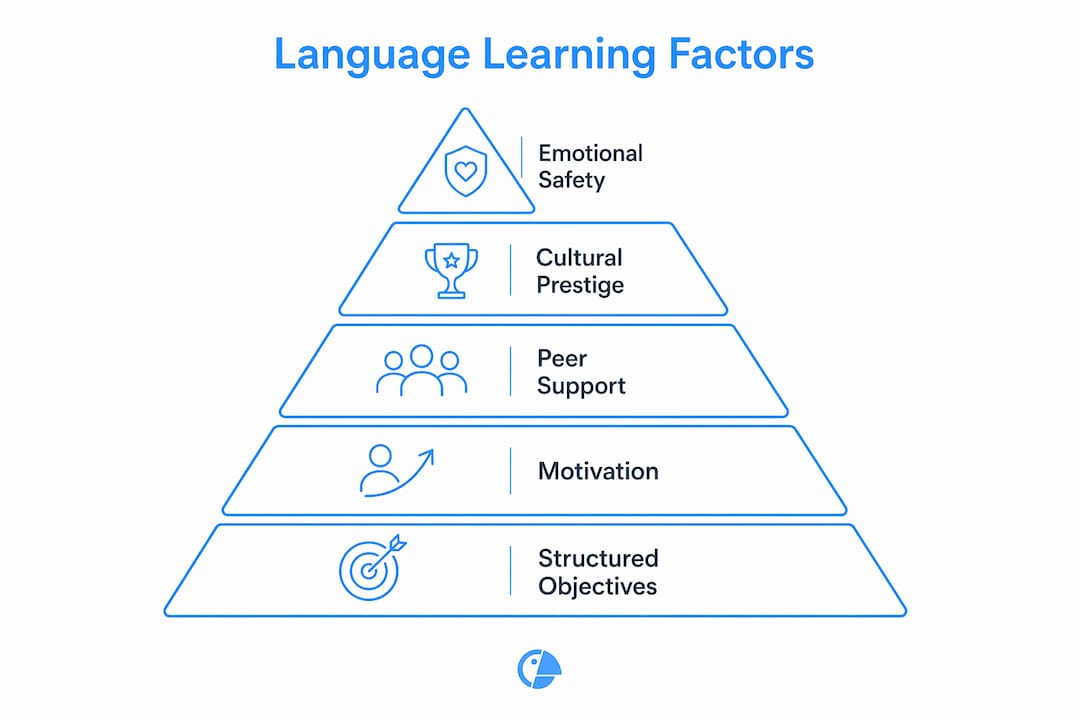
Emotional safety is the single most powerful factor in sustained language learning. When learners feel safe to make mistakes, they experiment more freely with the language. Emotional safety and peer networks act as key moderators in sustaining long-term language use and communicative confidence. Without that safety, even motivated learners retreat into silence.
Cultural prestige and perceived utility shape motivation in ways that formal instruction rarely addresses. Community attitudes toward a language's prestige and utility directly influence whether learners persist or abandon their studies. A heritage language spoken at home but dismissed in the wider community loses its motivational pull quickly. Educators who ignore this dynamic often find that learners disengage not because of difficulty, but because the language feels socially irrelevant.
Creating explicit "spaces of use" is a practical response to this challenge. These are designated contexts, whether cultural events, community kitchens, or sports clubs, where the target language is the natural medium of communication. Community involvement succeeds when it creates these spaces, balancing the symbolic prestige of a language with its everyday utility. Learners who see a language functioning in real life are far more likely to keep using it.
Key factors that support effective community-based language learning include:
- Emotional safety: Peer environments reduce anxiety and encourage risk-taking with new vocabulary and grammar.
- Cultural relevance: Connecting language to cultural identity and community pride sustains long-term motivation.
- Spaces of use: Real-world contexts outside the classroom give learners authentic reasons to communicate.
- Peer networks: Consistent contact with other learners creates natural observation and imitation opportunities.
- Community prestige: When the wider community values a language, learners internalise that value and persist.
Pro Tip: Talk to community leaders before designing a language programme. Their insight into local attitudes toward a language will shape your curriculum more than any textbook framework.
What challenges affect community-based language education and how can they be addressed?
Community language programmes face real structural obstacles. High student turnover, inconsistent attendance, and the dominance of a majority language in employment all erode programme effectiveness. Community language programmes face systemic challenges including employment-driven language preferences, where learners prioritise the language that pays rather than the one that connects them to their heritage. Attendance suffers when community classes compete with work, sport, and family commitments.
Oral proficiency remains the hardest outcome to achieve. Even well-run community programmes show weak or inconsistent oral gains because informal peer interaction, while valuable, is not a substitute for structured speaking practice. Learners may become comfortable chatting with friends but struggle in formal or professional contexts. That gap requires deliberate pedagogical design, not just more community time.
Addressing these challenges requires a structured, collaborative approach. The following steps give educators and community organisers a practical starting point:
- Set clear pedagogical objectives before entering community settings. Establishing clear objectives before community engagement begins is critical to managing learning risks and connecting academic theory to real-world practice.
- Partner with community leaders to improve attendance. When community figures champion a language programme, attendance improves because the programme carries social weight.
- Build structured speaking tasks into informal settings. Pair natural conversation time with guided speaking activities to address the oral proficiency gap.
- Acknowledge language prestige openly. Discuss with learners why the target language matters, both culturally and practically, to counter the pull of majority-language employment pressures.
- Track dropout patterns and intervene early. Nearly half of heritage language students leave before completing foundational instruction, so early identification of at-risk learners is not optional.
How can educators and community organisers integrate community involvement effectively?
Effective integration starts with redefining where learning happens. School-community collaborations are more effective when they occur outside traditional classroom hours and spaces, such as kitchens, sports fields, and cultural venues. A cooking class conducted entirely in the target language, for example, creates authentic communicative pressure that a grammar exercise cannot. The physical environment signals to learners that the language belongs to real life, not just school.
Structured objectives and ongoing collaboration between schools and communities are equally critical. Structured pedagogical objectives and collaboration frameworks are what separate successful community language initiatives from well-intentioned but ineffective ones. Without a clear framework, community involvement becomes social time with no measurable language outcome. With one, it becomes the most powerful learning environment available.

The table below compares two common integration models to illustrate how structure affects outcomes.
| Integration model | Learning environment | Pedagogical structure | Typical outcome |
|---|---|---|---|
| Community-embedded learning | Cultural venues, kitchens, sports clubs | Guided tasks within authentic contexts | Strong oral confidence and cultural connection |
| Classroom-only instruction | School or training room | Formal curriculum with structured assessment | Reliable literacy gains, limited real-world transfer |
Successful programmes also treat community partnerships as two-way relationships. Schools bring pedagogical expertise; communities bring authentic language environments and cultural authority. The impact of community on language learning is strongest when both sides contribute deliberately rather than one simply hosting the other. Educators who approach community partners as co-designers, rather than venues, build programmes that last.
Understanding peer-to-peer teaching within these community settings also helps educators design more effective group activities. Peer teaching activates the same social dynamics that make community learning powerful, giving learners agency and reinforcing their own understanding as they support others.
Key takeaways
Community involvement in language education works because it combines emotional safety, real-world language use, and peer support in ways that formal classroom instruction cannot replicate alone.
| Point | Details |
|---|---|
| Community boosts performance | Community-integrated learners outperform traditional classroom peers on measurable academic outcomes. |
| Oral proficiency needs structure | Informal peer interaction improves confidence but must be paired with structured speaking tasks to close the oral proficiency gap. |
| Emotional safety drives persistence | Learners who feel safe to make mistakes stay engaged longer and develop stronger communicative confidence. |
| Prestige shapes motivation | Community attitudes toward a language directly influence whether learners persist or disengage over time. |
| Clear objectives are non-negotiable | Community programmes without structured pedagogical goals produce social connection but not reliable language outcomes. |
Tutoroo's perspective on community and language learning
The most underestimated element in language education is not curriculum or technology. It is the feeling a learner gets when they use a new language and nobody laughs. Emotional safety is not a soft concept. It is the mechanism that determines whether a learner keeps going or quietly gives up.
At Tutoroo, we see this play out constantly. Learners who come to us after years of classroom study often describe the same experience: they understood the grammar but froze when they had to speak. What they lacked was not knowledge. It was a safe space to practise. Community environments, when designed well, provide exactly that. But "designed well" is the critical phrase. A community gathering without clear language goals is just a social event.
The pitfall we see most often is programmes that confuse presence with progress. Attending a community language class is not the same as acquiring language. The difference lies in whether learners are given structured opportunities to produce language, receive feedback, and reflect on their progress. Community settings are uniquely powerful for this, but only when educators bring a clear pedagogical framework to the table.
Our strongest advice to educators and community organisers is this: treat the community as a co-teacher, not a backdrop. The cultural knowledge, authentic communication, and emotional investment that community members bring are irreplaceable. Pair that with clear learning objectives and regular speaking practice, and you have a language programme that genuinely changes outcomes.
— Tutoroo
Private tutoring as a complement to community language learning
Community programmes build cultural connection and peer confidence. Private tutoring fills the gaps that group settings cannot address, particularly for learners who need personalised feedback on grammar, pronunciation, or exam preparation.

Tutoroo connects learners with over 386,000 private language tutors across dozens of languages, from widely spoken languages like English, Spanish, French, and Arabic to heritage and niche languages that community programmes often struggle to staff. Whether you are an educator looking to refer learners for supplementary support, or a community organiser seeking to strengthen your programme, private language tutors through Tutoroo offer flexible, one-on-one sessions that work around community schedules. For learners pursuing less common languages, Tutoroo's Malay tutors are one example of the depth available across the platform.
FAQ
What is the role of community in language education?
Community provides the social support, emotional safety, and real-world language use that formal instruction alone cannot deliver. Research confirms that community-integrated learners consistently outperform those in traditional classroom-only settings.
How does community involvement affect oral language skills?
Community involvement improves speaking confidence by reducing anxiety through peer-supported environments. However, oral proficiency gains require structured speaking tasks alongside informal interaction to produce consistent results.
What makes a community language programme effective?
Clear pedagogical objectives, consistent community partnerships, and explicit "spaces of use" for the target language are the defining features of effective programmes. Without structured goals, community involvement produces social connection but not reliable language outcomes.
How can educators address low language prestige in a community?
Educators can work with community leaders to elevate a language's cultural and practical value by connecting it to identity, opportunity, and community pride. Community attitudes toward language prestige directly shape learner motivation and long-term bilingual success.
Can private tutoring complement community language learning?
Private tutoring addresses the personalised feedback and structured practice that community settings rarely provide at an individual level. Combining community engagement with one-on-one tutoring produces the strongest overall language outcomes.