

TL;DR:
- Peer-to-peer teaching involves students alternating between teaching and learning roles to deepen understanding. It produces about six months of additional progress per year and enhances engagement, motivation, and cognitive skills. Effective implementation requires structured roles, a safe environment, and active teacher facilitation to maximize learning outcomes.
Peer-to-peer teaching is defined as an educational method where students alternate between the roles of teacher and learner, deepening their understanding by explaining concepts to one another. Also known formally as peer tutoring, this approach sits at the heart of collaborative learning theory and has a strong evidence base behind it. Research from the Education Endowment Foundation shows that peer tutoring produces the equivalent of six months additional progress within a single academic year. That figure alone makes it one of the most cost-effective strategies available to educators, students, and parents alike.
What is peer-to-peer teaching and how does it work in practice?
Peer-to-peer teaching works by placing students in structured roles where one explains material while another listens, questions, and checks understanding. The most common formats include paired tutoring, where two students swap roles after each task; small group teaching, where one student leads a mini lesson for three or four peers; and study buddy arrangements, where partners review content together before an assessment. Each format gives students a clear purpose and a defined responsibility.

Within any session, students typically move through three roles: teacher, learner, and checker. The teacher role requires the student to recall and explain a concept clearly. The learner role demands active listening and honest questioning. The checker role involves verifying answers and flagging errors. Rotating through all three roles in a single session produces deeper engagement than any one role alone.
The classroom teacher does not step back during peer teaching. The teacher circulates, listens for misconceptions, and targets gaps that student pairs cannot resolve on their own. This facilitation role is what separates effective peer teaching from unstructured group chat.
Pro Tip: Assign roles in writing before the session begins. Students who know their role in advance prepare more thoroughly and stay on task longer.
What are the benefits of peer-to-peer teaching supported by research?
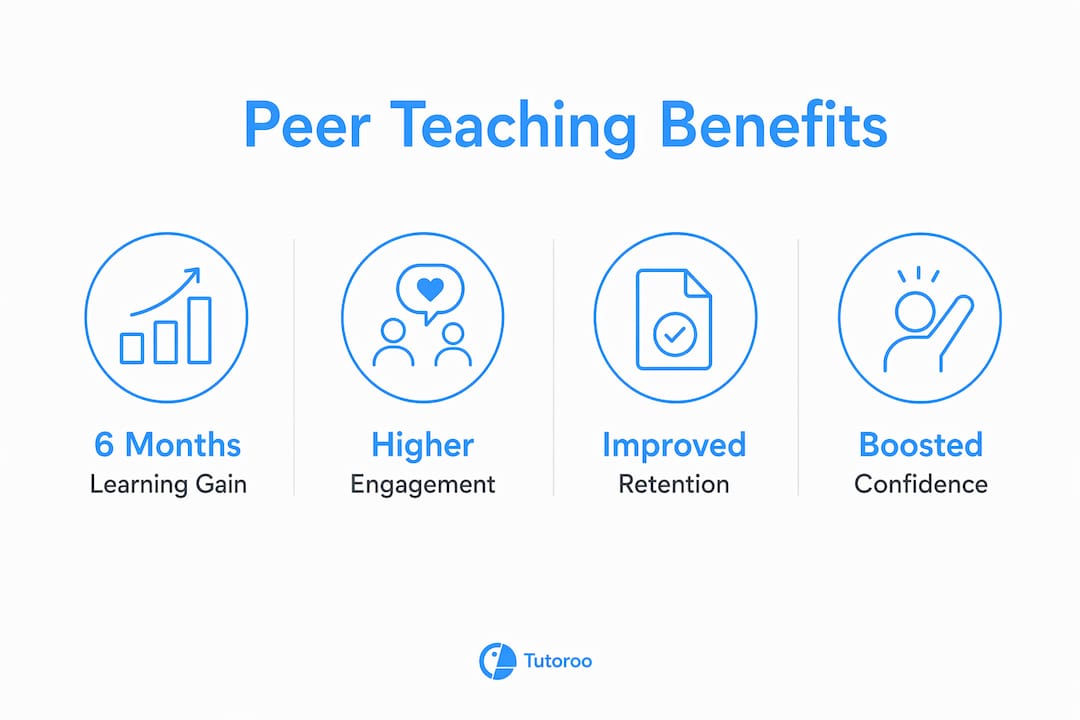
Peer teaching delivers measurable gains across academic progress, engagement, and cognitive development. The evidence is consistent and spans multiple disciplines.
Academic progress and retention
The Education Endowment Foundation's review of peer tutoring places its effect on learning at approximately six months of additional progress compared to traditional instruction. A meta-analysis of 225 STEM studies confirms that active peer teaching consistently outperforms passive lecture formats for retention and mastery. Passive instruction simply does not produce the same depth of processing that explaining a concept to a peer requires.
Engagement and motivation
A study published in BMC Medical Education found that peer learning modules produced significantly higher engagement and academic progress compared to conventional tutorials, with a p-value below 0.05. That statistical threshold means the result is unlikely to be due to chance. Students who teach their peers report greater ownership of their learning and stronger motivation to prepare thoroughly.
Cognitive benefits of the teaching role
The Power Hypothesis explains why the teaching role is so cognitively valuable. When students take on a teaching position, they experience a heightened sense of influence and responsibility that improves metacognitive processing and question generation. Metacognition is the ability to think about one's own thinking. Students who teach are forced to organise their knowledge, identify gaps, and anticipate the questions a confused peer might ask.
Social and emotional advantages
"Low-stakes environments enable students to admit confusion more readily and engage more effectively in peer-to-peer questioning." — Research on supportive peer learning environments
Students ask questions more freely when a peer is listening than when a teacher is watching. The social dynamic reduces the fear of looking uninformed. This psychological safety produces more honest dialogue and faster identification of misunderstandings.
Limitations worth knowing
| Strength | Limitation |
|---|---|
| Excellent for review and consolidation | Less effective for introducing entirely new material |
| Builds communication and reasoning skills | Requires careful role assignment to avoid dominant students |
| Increases motivation and ownership | Risk of reinforcing misconceptions without teacher oversight |
| Cost-effective and scalable in classrooms | Needs structured prompts to prevent off-task conversation |
Peer teaching is most effective for consolidation, not for first exposure to complex new content. Teacher guidance remains necessary when students encounter genuinely unfamiliar material.
What are best practices for implementing peer teaching effectively?
Effective peer teaching does not happen by accident. It requires deliberate design, clear expectations, and active teacher involvement throughout.
-
Create a low-stakes environment first. Students need to feel safe admitting confusion before peer teaching can work. A supportive classroom culture where mistakes are treated as learning opportunities is the foundation for everything else. Without it, students perform rather than learn.
-
Assign roles with written prompts. Vague instructions produce vague results. Give each student a card or worksheet that specifies their role, the topic they will explain, and the questions they should ask. Structured peer learning with clear roles and verification steps consistently outperforms informal collaboration in research settings.
-
Keep sessions focused on review material. Peer teaching works best when students already have some familiarity with the content. Use it after a lesson to consolidate understanding, not as the primary vehicle for introducing a new concept.
-
Build in a verification step. After each explanation, the checker role should confirm whether the answer is correct before the pair moves on. This step catches errors early and builds accountability into the process.
-
Debrief as a class after each session. Spend five minutes at the end asking students what they found confusing or surprising. This gives the teacher a clear picture of which misconceptions need addressing and reinforces the learning for the whole group.
Pro Tip: Pair students strategically rather than randomly. A student who is slightly ahead of their partner, rather than far ahead, produces the most productive teaching dynamic. The gap should be small enough to feel relatable.
For educators interested in how feedback fits into this process, the relationship between peer feedback and progress is worth exploring in depth.
What are some examples of peer-to-peer teaching in different settings?
Peer teaching adapts well across age groups, subjects, and learning environments. The format changes, but the core mechanism stays the same.
In school classrooms
Think-pair-share is one of the most widely used peer teaching strategies. A teacher poses a question, students think individually, then discuss their answer with a partner before sharing with the class. Jigsaw learning takes this further: each student becomes an "expert" in one section of a topic, then teaches that section to peers from other groups. Peer review in writing classes asks students to read and critique each other's drafts using a structured checklist.
In language education
Language learning is one of the most natural homes for peer teaching. Conversation practice between learners builds fluency in ways that solo study cannot replicate. One student might explain a grammar rule while another applies it in a sentence, then they swap. Tutoroo connects language learners with expert tutors who use active learning techniques that mirror peer teaching principles, making sessions more dynamic and memorable.
Online and technology-supported formats
Digital tools have expanded what peer teaching looks like. Video calls allow paired tutoring across cities and countries. Shared documents let students co-write and peer review in real time. Discussion forums in learning management systems create asynchronous peer teaching opportunities where students post explanations and others respond with questions or corrections.
At home with parental support
Parents can apply peer teaching principles at home without any formal training. Asking a child to explain what they learned at school that day is a simple and effective version of the teaching role. Siblings can quiz each other before tests. The key is to make the explanation feel purposeful rather than performative.
In project-based learning
Project-based and problem-based learning naturally incorporate peer teaching. When a group divides a project into specialised sections, each member becomes the resident expert on their part. Presenting findings to the group and fielding questions replicates the cognitive demands of formal peer teaching in a real-world context. For a broader look at how interactive formats support this, interactive learning methods offer useful frameworks for educators.
Key takeaways
Peer-to-peer teaching is most effective when students have clear roles, a safe environment to admit confusion, and a teacher actively facilitating to correct misconceptions.
| Point | Details |
|---|---|
| Defined roles matter | Assign teacher, learner, and checker roles in writing before each session begins. |
| Research backs the gains | Peer tutoring produces the equivalent of six months of additional learning progress per year. |
| Use it for consolidation | Peer teaching works best for reviewing familiar material, not introducing new concepts alone. |
| Safety enables honesty | Low-stakes environments produce more genuine questions and faster identification of gaps. |
| Teacher facilitation is non-negotiable | Circulating and correcting misconceptions keeps peer sessions accurate and productive. |
Tutoroo's perspective on peer teaching in language learning
Peer teaching is one of those methods that sounds simple but rewards careful thought. At Tutoroo, we have seen how the principles behind peer teaching show up in the most effective one-on-one language sessions. When a tutor asks a learner to explain a grammar rule back in their own words, or to teach a phrase to an imaginary friend, the cognitive shift is immediate and visible. The learner stops being passive and starts being responsible for the knowledge.
The research on the Power Hypothesis resonates with what we observe every day. Students who are asked to teach, even briefly, prepare differently. They anticipate questions. They look for gaps in their own understanding before they are exposed. That kind of self-directed thinking is exactly what accelerates language acquisition.
The honest limitation of peer teaching is that it cannot stand alone. Without a knowledgeable facilitator to catch errors, misconceptions can take root and become harder to correct later. This is why the combination of peer interaction and expert guidance produces the best outcomes. Peer teaching opens the conversation; expert tutoring ensures the conversation is accurate.
Educators and parents who want to apply peer teaching thoughtfully should start small. One structured pair activity per lesson is enough to see a difference. Build the routine before scaling the method.
— Tutoroo
Personalised language learning with Tutoroo
Peer teaching builds confidence and deepens understanding, and private tutoring takes those gains further by providing expert guidance tailored to each learner's needs.
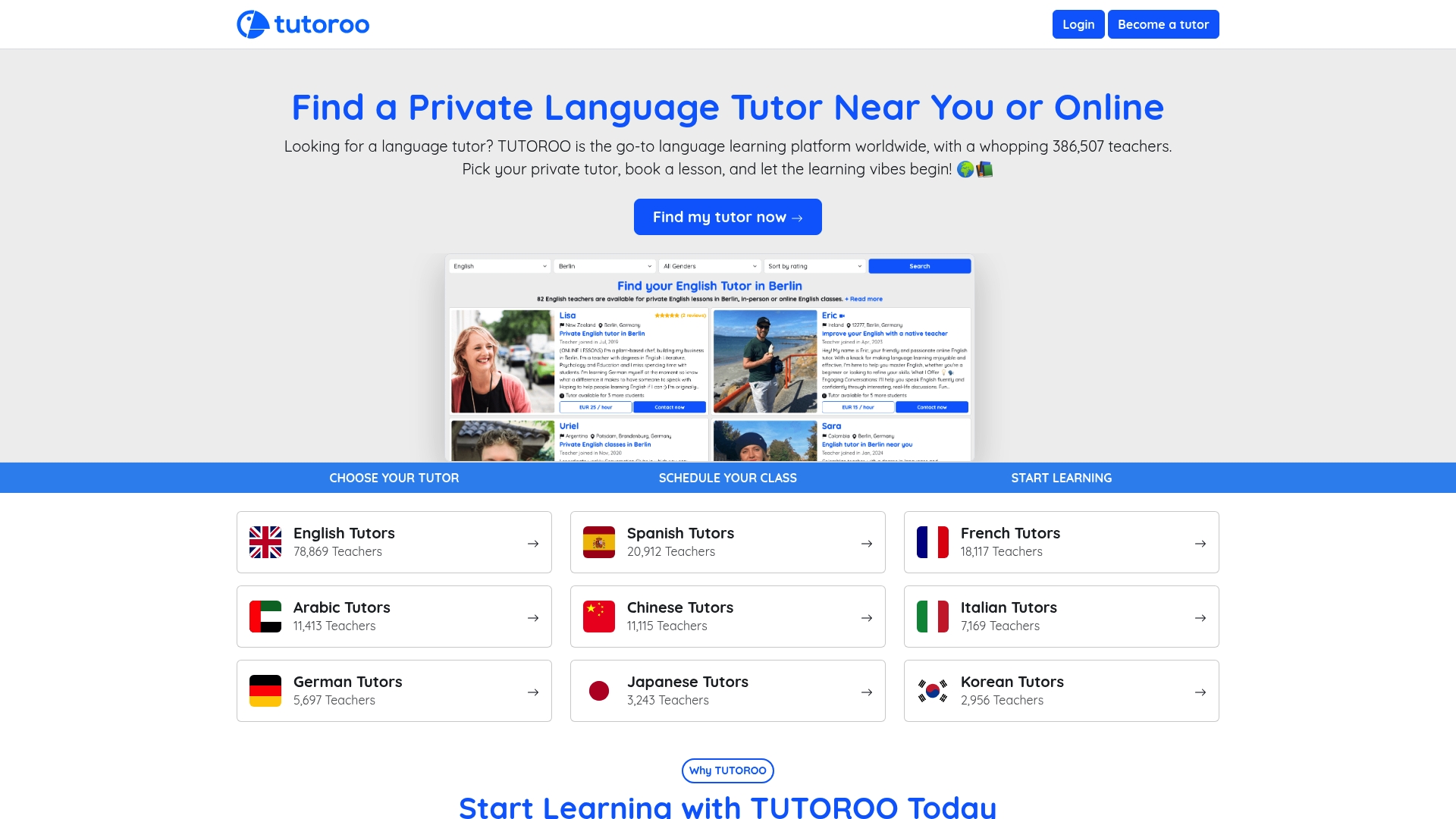
Tutoroo connects learners with over 386,000 private language tutors across the world, offering one-on-one sessions in English, Spanish, French, Arabic, Chinese, and many more languages. Sessions can be conducted locally or online, making it easy to find a tutor who fits your schedule and learning goals. Whether you are a student looking to consolidate what peer sessions have covered, or a parent seeking structured support for your child, Tutoroo makes the matching process straightforward. Explore one-on-one language teaching to understand how personalised tutoring complements peer learning for faster, more lasting results.
FAQ
What is the peer tutoring definition in education?
Peer tutoring is a structured educational method where students take turns teaching and learning from each other. It is also called peer-to-peer teaching and is used across schools, universities, and language programmes worldwide.
How effective is peer-to-peer teaching compared to traditional instruction?
Research from the Education Endowment Foundation shows peer tutoring produces the equivalent of six months of additional learning progress within an academic year. A meta-analysis of 225 STEM studies also confirms it outperforms passive lecture formats for retention.
What are the best peer teaching strategies for classrooms?
Think-pair-share, jigsaw learning, and structured peer review are among the most effective strategies. Assigning clear roles and using written prompts produces better outcomes than informal group discussion.
Is peer teaching suitable for all subjects and age groups?
Peer teaching works across most subjects and age groups, but it is most effective for reviewing and consolidating material rather than introducing entirely new concepts. Teacher facilitation remains necessary regardless of the subject.
How can parents use peer-to-peer learning at home?
Parents can ask children to explain what they learned at school each day, or encourage siblings to quiz each other before tests. The act of explaining material aloud replicates the cognitive benefits of the formal teaching role.