

TL;DR:
- Community language learning is a humanistic method where teachers act as counselors to reduce anxiety and promote authentic communication. It emphasizes learner ownership, meaningful interactions, and deferred grammar instruction to build confidence and cultural connection. Modern practices adapt these principles into community settings to enhance socio-pragmatic skills and cultural identity.
Community language learning is a humanistic language teaching approach that treats the teacher as a counsellor and each learner as a client within a supportive group. Developed by Charles A. Curran in the 1970s, the method draws directly on Carl Rogers' client-centred counselling theory, using unconditional positive regard and empathy to lower what Stephen Krashen later termed the Affective Filter. The result is a learning environment where anxiety drops, authentic communication rises, and learners gradually take ownership of their own acquisition. This guide covers both the original Community Language Learning model and the modern community-based extensions that have grown from it.
What is community language learning and how did it begin?
Community Language Learning (CLL) is defined as a language teaching method in which the teacher acts as counsellor and the student acts as client, creating a trust-based environment designed to reduce the anxiety that blocks language acquisition. Curran borrowed directly from Carl Rogers' therapeutic framework, applying the principles of empathy, acceptance, and genuine dialogue to the language classroom. The core insight is simple but powerful: learners cannot acquire a new language when they feel judged or afraid. Remove that fear, and acquisition follows naturally.
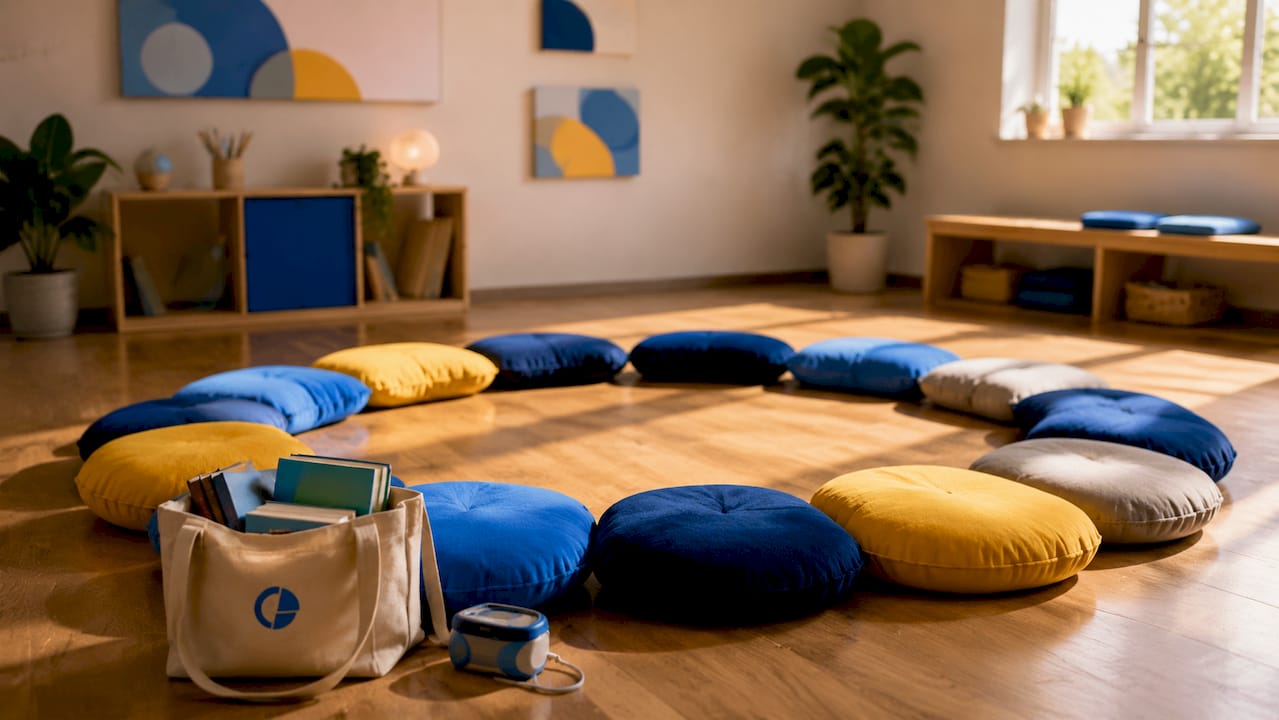
The method places learners in a circle, physically and psychologically. They speak to one another in their native language, the teacher translates quietly into the target language, and learners then repeat and reflect on what they have heard. Grammar is not the starting point. Meaning comes first, structure comes later. This sequencing was radical in the 1970s and remains a meaningful departure from grammar-first approaches today.
CLL sits within a broader family of humanistic methods that prioritise the whole person, not just the linguistic output. Understanding this context helps educators and learners appreciate why the method works where traditional instruction sometimes fails.
How does the original CLL method work in practice?
The original CLL classroom follows a clear sequence that puts learner intent at the centre of every interaction.
- Learners sit in a circle. The physical arrangement signals equality and community rather than hierarchy.
- A learner speaks in their native language. They say something they genuinely want to communicate, not a scripted drill.
- The teacher translates quietly. The teacher whispers the target-language equivalent directly to the learner, acting as a supportive voice rather than an authority figure.
- The learner repeats the target-language phrase. They say it aloud to the group, owning the utterance.
- The group reflects together. Learners discuss what they heard, building shared understanding.
- Grammar instruction is deferred. Meaning is communicated first; structural accuracy is addressed only after the learner feels secure in the message.
This sequence does something that grammar-translation methods cannot: it connects language to genuine human intent. A learner who wants to say "I miss my family" is far more motivated to master that phrase than one who is asked to conjugate a verb on a worksheet.
The psychological foundation matters as much as the procedure. CLL lowers existential anxiety by creating a space where errors are not punished but absorbed and gently corrected through the teacher's translation. Carl Rogers called this "unconditional positive regard." In a CLL classroom, it means the teacher never interrupts, never corrects harshly, and never makes a learner feel foolish for trying.
Pro Tip: If you are facilitating a CLL session, resist the urge to correct pronunciation in the moment. Let the learner complete their thought, then offer the target-language version warmly. This single habit reduces anxiety more than any other classroom technique.
What are the benefits and challenges of community language learning?
Benefits worth knowing
The benefits of community language learning are most visible in learner confidence and motivation.
- Reduced anxiety. The counsellor-client dynamic removes the fear of public failure, which is the primary barrier to fluency for most adult learners.
- Learner autonomy. Because learners choose what to say, they develop ownership of their own acquisition from the first session.
- Peer collaboration. Group members support one another, creating a social bond that sustains motivation across weeks and months.
- Personalised content. Every utterance comes from the learner's own life, making vocabulary immediately relevant and memorable.
- Communicative competence. By prioritising meaning over structure, CLL builds real conversational ability faster than many form-focused methods.
Challenges to plan for
No method is without limits, and CLL has several worth acknowledging honestly.
- Teacher dependency. Learners can become reliant on the teacher's translation rather than developing independent strategies for communication.
- Skilled facilitation required. The counsellor role demands emotional intelligence and training that not every educator has received.
- Slower structural progress. Learners who need grammar for academic or professional purposes may find the deferred-structure approach frustrating.
- Group dynamics. A single anxious or dominant participant can shift the group's emotional climate significantly.
Practitioners who apply CLL principles without following the pure original method often find the best results. They borrow the counsellor-client dynamic and the anxiety-reduction techniques while combining them with structured input when learners need it. This hybrid approach is now far more common than the 1970s original.
Pro Tip: To reduce teacher dependency, introduce "independence rounds" where learners attempt to express an idea in the target language before the teacher translates. Even a failed attempt builds confidence and reduces reliance on the counsellor role.
How does modern community-based language learning expand on traditional CLL?
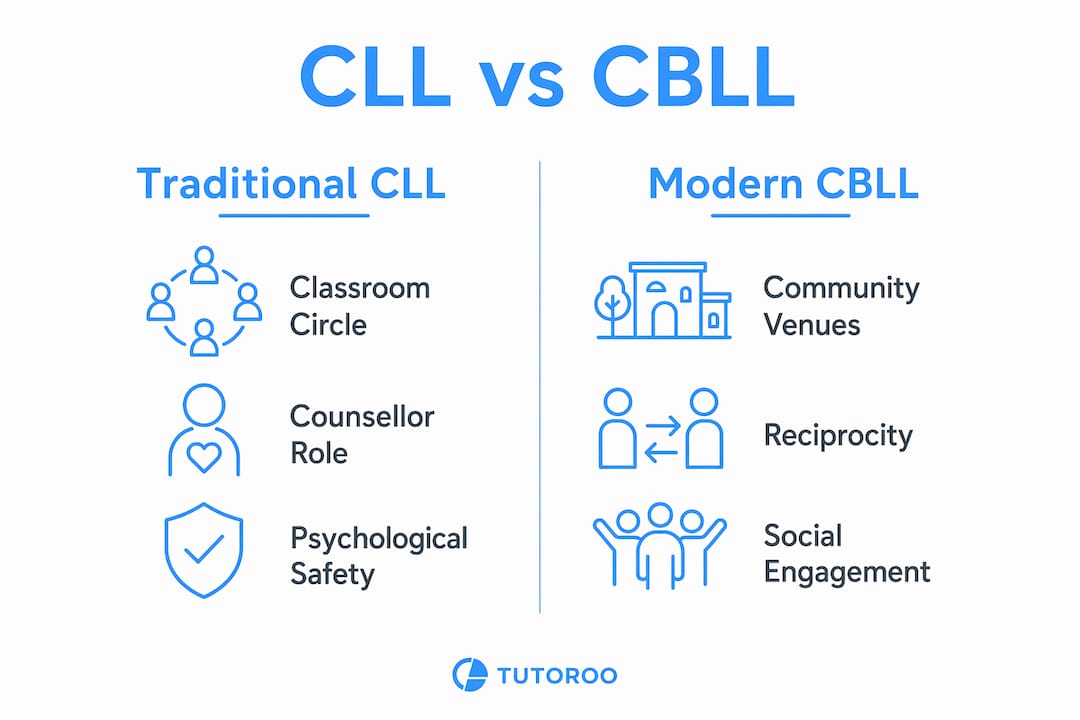
Modern community-based language learning (CBLL) takes the humanistic principles of Curran's original method and moves them out of the classroom entirely. Language instruction is decentralised, embedded instead within local communities where learners engage in real activities: volunteering at community organisations, participating in cultural events, or working alongside native speakers in everyday settings.
The shift from classroom to community changes what learners develop. Traditional CLL builds communicative confidence within a safe group. CBLL builds socio-pragmatic competence, the ability to read social cues, adjust register, and navigate ambiguous real-world interactions. These are skills that no classroom drill can fully replicate.
| Feature | Traditional CLL | Modern CBLL |
|---|---|---|
| Setting | Classroom circle | Community venues and real-world contexts |
| Teacher role | Counsellor and translator | Facilitator and cultural guide |
| Learner role | Client within the group | Active community participant |
| Primary skill | Communicative confidence | Socio-pragmatic and cultural competence |
| Grammar instruction | Deferred until meaning is secure | Integrated as needed for real tasks |
| Anxiety management | Counsellor-client trust | Authentic relationships and reciprocity |
Modern CBLL thrives on reciprocity, meaning learners contribute to communities rather than simply observing them. A learner who volunteers at a local community centre is not just practising vocabulary. They are building social bonds, developing cultural identity, and creating motivation that sustains learning far beyond any classroom session. That reciprocal relationship is what makes CBLL genuinely different from a field trip or a conversation exchange.
CBLL benefits motivated learners who treat language as a social tool rather than an academic subject. Learners who want a grammar syllabus and clear progression milestones may find the ambiguity of real-world interaction uncomfortable at first. Understanding this distinction helps educators match the right approach to the right learner. You can read more about learning languages outside classrooms and the real results this produces.
What role do community language schools play in preserving heritage and culture?
Community language schools are after-hours or weekend programmes that teach heritage and minority languages to children and adults within diaspora communities. In Australia, these schools serve hundreds of language communities, from Vietnamese and Arabic to Greek and Mandarin, providing mother-tongue instruction that mainstream education does not offer.
Community language schools provide heritage language maintenance and cultural identity reinforcement through instruction in the learner's first language. Teachers in these settings report stronger community connections and reduced isolation compared to their counterparts in mainstream schools. That sense of belonging is not incidental. It is central to why these schools exist and why learners attend them.
The functions of community language schools extend well beyond grammar lessons.
- Heritage language maintenance. Learners keep their first language alive across generations, preventing language shift and loss.
- Cultural identity reinforcement. Instruction connects learners to stories, traditions, and values that define their community.
- Social cohesion. Schools create gathering points for diaspora communities, reducing isolation and building networks.
- Intergenerational connection. Children who attend these schools can communicate with grandparents and elders in the family language.
- Psychological wellbeing. Maintaining a heritage language is linked to stronger self-identity and reduced cultural alienation.
Teachers in community language schools shift their role from subject experts to cultural mediators and facilitators of dialogue. This shift mirrors the CLL counsellor role in important ways. The teacher is no longer the authority who delivers grammar rules. They are a cultural guide who helps learners connect language to lived experience and identity. Cultural dialogue, not grammar correction, is what maintains heritage and keeps minority languages alive across generations. Educators interested in this approach will find the discussion of niche language teaching particularly relevant to their work.
How can educators and learners apply CLL principles effectively today?
Applying community language learning principles does not require a full return to Curran's 1970s method. The most effective educators today borrow selectively, using the counsellor-client dynamic and the anxiety-reduction philosophy while adapting structure to their learners' goals.
Building a low-anxiety environment
The first step is physical and psychological. Arrange seating in a circle or small clusters rather than rows. Establish a clear group agreement that errors are welcome and that the goal is communication, not perfection. This single environmental shift changes how learners relate to risk-taking in the target language.
Encouraging learner initiative
Give learners control over the content of each session. Ask them what they want to be able to say or do in the target language, then build the lesson around those goals. When learners choose the content, motivation is intrinsic rather than imposed. Pair this with regular reflection time so learners can notice their own progress and articulate what they have acquired.
Integrating real community engagement
Move beyond the classroom when possible. Connect learners with local community organisations, cultural events, or conversation partners who are native speakers. Community-based language platforms make this connection easier than ever, linking learners to authentic interaction opportunities that no textbook can replicate.
Pro Tip: The most common pitfall in applying CLL principles is allowing the teacher to become the sole source of language input. Build in peer-to-peer conversation tasks and community interaction from the first week. Learners who rely only on the teacher never fully develop independent communication strategies.
Key takeaways
Community language learning works because it addresses the emotional barriers to acquisition first, then builds communicative competence through authentic, learner-driven interaction.
| Point | Details |
|---|---|
| CLL reduces anxiety first | The counsellor-client dynamic lowers fear of errors, which is the primary barrier to fluency. |
| Meaning precedes grammar | Learners communicate intent before studying structure, building real confidence faster. |
| Modern CBLL adds real-world depth | Community-based learning develops socio-pragmatic skills that classroom practice cannot replicate. |
| Community language schools preserve culture | Heritage language schools maintain identity, social cohesion, and intergenerational connection. |
| Hybrid approaches work best today | Borrowing CLL's anxiety-reduction principles while adding structured input suits most modern learners. |
Tutoroo's perspective on community language learning
The counselling approach that Curran built in the 1970s was ahead of its time, and the evidence for its core insight has only grown stronger. Anxiety is not a minor inconvenience in language learning. It is the wall that stops most adult learners from ever reaching fluency. Every educator who has watched a confident, articulate adult become silent and hesitant the moment they switch to a second language has seen this wall up close.
What strikes us most about the evolution from traditional CLL to modern community-based practice is the shift in who holds the language. In Curran's original model, the teacher holds it and passes it across. In modern CBLL, the community holds it, and the learner earns access through genuine participation. That shift from passive recipient to active contributor changes everything about motivation and retention.
The caution we would offer is against rigid application of any single method. CLL works because it is dialogical, responsive, and human. The moment it becomes a fixed script, it loses what makes it effective. The best language educators we have seen treat the counsellor role as a disposition, not a procedure. They bring empathy and patience to every session, whether they are following Curran's original sequence or running a conversation class in a community hall.
Learners who want to experience this kind of authentic, low-anxiety practice should seek out environments, whether private tutoring, community groups, or heritage schools, where the relationship between teacher and learner is built on trust rather than performance. That relationship is where language learning actually happens.
— Tutoroo
Private tutoring that puts community language learning into practice
Tutoroo connects learners with over 386,000 private language tutors worldwide, offering one-on-one sessions that reflect the best of the CLL philosophy: personalised content, low-pressure conversation, and a tutor who adapts to your goals rather than a fixed syllabus.
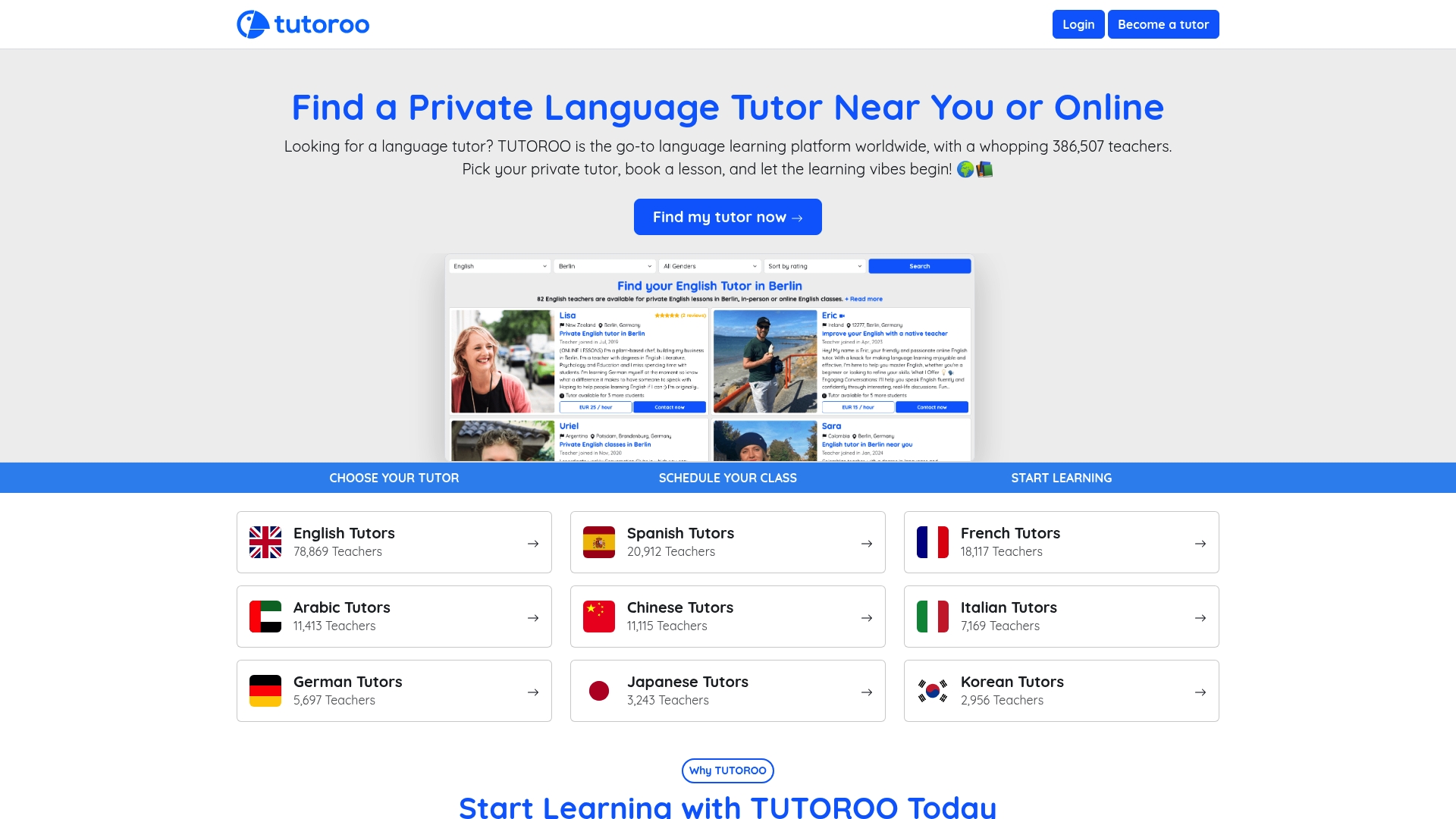
Whether you want to practise conversational skills with a native speaker, maintain a heritage language, or build confidence before entering a community setting, Tutoroo matches you with a tutor who fits your needs. Sessions run online or in person, giving you the flexibility to learn in the environment where you feel most comfortable. Explore private language tutoring with Tutoroo and find a tutor who brings the warmth and cultural connection that community language learning is built on.
FAQ
What is community language learning in simple terms?
Community language learning is a teaching method where the teacher acts as a supportive counsellor and learners communicate in their native language first, with the teacher translating into the target language for gradual acquisition.
Who developed the community language learning method?
Charles A. Curran developed CLL in the 1970s, drawing on Carl Rogers' client-centred counselling theory to reduce learner anxiety and build communicative confidence.
What is the difference between CLL and community-based language learning?
Traditional CLL is a structured classroom method using the counsellor-client dynamic, while modern community-based language learning embeds practice in real-world community settings to develop socio-pragmatic and cultural skills.
What are the main benefits of community language learning?
The main benefits include reduced anxiety, stronger learner motivation, peer collaboration, personalised content, and faster development of genuine communicative competence.
Is community language learning still used today?
Pure 1970s CLL is rarely used in its original form. Most educators today apply its core principles, particularly the counsellor-client dynamic and anxiety-reduction techniques, within broader, more flexible teaching approaches.