

TL;DR:
- Community-based language platforms foster ownership, cultural authenticity, and data sovereignty, outperforming commercial apps. They enable communities to maintain and preserve minority languages through collective governance, open-source models, and culturally accurate AI tools. These platforms enhance learner engagement, reduce anxiety, and support endangered language revitalization beyond commercial proliferation.
Community-based language platforms are collaborative, culturally embedded learning environments where learners, educators, and native speakers collectively own, govern, and shape the educational experience. Unlike proprietary apps that treat language as a product, these platforms treat it as a living cultural inheritance. The difference is not cosmetic. Platforms like LibreLingo operate on open-source licences, giving communities direct control over course content, data, and long-term direction. For language learners and educators who want authentic, personalised education rather than algorithmically optimised engagement, understanding why community-based language platforms outperform commercial alternatives is the starting point for making a genuinely informed choice.
Why community-based language platforms outperform proprietary apps
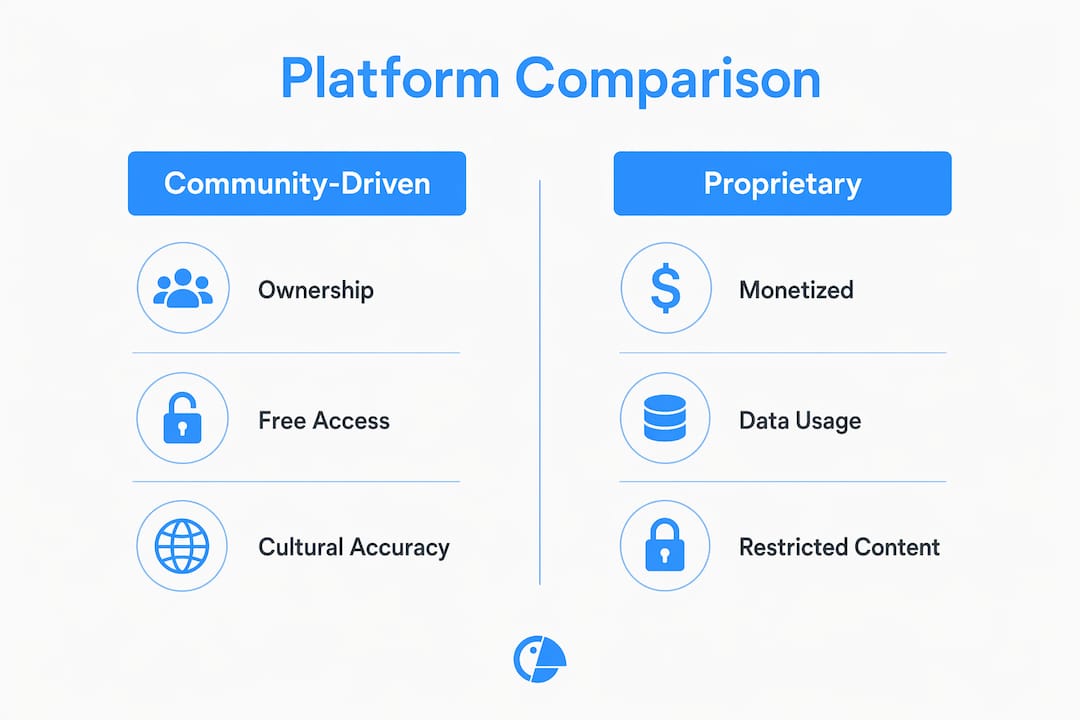
The core advantage of community-driven platforms is ownership. When learners and educators govern a platform collectively, the incentives align with genuine learning outcomes rather than subscription renewals or advertising revenue. Open-source platforms like LibreLingo can be accessed for $0 indefinitely, saving users from typical subscription fees of around $167 per year. That financial accessibility removes a real barrier for learners in lower-income communities or those studying less commercially popular languages.

Data sovereignty is the second major distinction. Proprietary platforms routinely monetise user behaviour, progress data, and interaction patterns. Community-owned platforms, by contrast, run on open-source licences such as AGPLv3, where users hold data ownership and govern collectively. This matters enormously for indigenous and minority language communities, where data about speakers, dialects, and oral traditions carries cultural weight far beyond its commercial value.
Community governance also produces more resilient platforms. When Duolingo removed its Basque course, the LibreLingo community forked and maintained it, keeping thousands of active learners engaged. No corporate decision can erase a course that the community itself controls. Learners and creators act as shareholders in a platform that is financially transparent and built for permanence, not profit cycles.
Key features that distinguish community-owned platforms:
- Zero or donation-based pricing, removing financial barriers for learners worldwide
- Open-source licensing, giving every contributor visibility into how the platform operates
- Collective course creation, allowing native speakers and educators to build culturally accurate content
- Data sovereignty, protecting learner and speaker data from commercial exploitation
- Community governance, ensuring no single corporate decision can shut down a language course
Pro Tip: If you are an educator building content for a minority or indigenous language, prioritise platforms with AGPLv3 or similar open-source licences. This guarantees your work remains accessible even if the platform changes hands or funding dries up.
How do community-built AI models preserve endangered languages?
Centralised AI language models are trained on the internet's most common languages, which means they systematically underrepresent the world's estimated 7,000 languages. Community-built models solve this by training on smaller, curated datasets that reflect local dialects, oral histories, and cultural protocols. Small language models built for specific communities capture linguistic structures and vocabulary far more effectively than generic global data ever could.
The results are measurable. Te Hiku Media, a Māori-led organisation in New Zealand, developed an automatic speech recognition system governed by community data protocols. That system achieved 92% accuracy for the Māori language, a result that centralised models trained on English-dominant datasets cannot replicate. The accuracy comes not from scale but from cultural specificity and community oversight.
"Centralised language models miss key cultural elements like respect registers and oral traditions. Community-built models transform language learning into a peace infrastructure promoting empathy and social cohesion." — Why today's centralised language models must give way to local models
The technology enabling this shift is increasingly accessible. Frugal AI techniques allow community labs to operate on commodity hardware, meaning a community does not need a Silicon Valley budget to build and maintain its own language model. Organisations like FLAIR have developed offline, self-governed tools specifically designed for communities with limited internet access. This decentralisation of AI capability is one of the most significant shifts in language education technology in the past decade.
Four ways community-built AI outperforms centralised models for language preservation:
- Cultural protocol compliance — community data governance ensures recordings and texts are used only in ways the community approves
- Dialect accuracy — training on local media, oral histories, and community-generated content captures pronunciation and vocabulary that global datasets miss
- Offline functionality — tools like those developed by FLAIR operate without reliable internet, reaching remote communities
- Long-term self-governance — self-governed and locally managed technology survives corporate tech changes that would otherwise erase years of preservation work
What are the pedagogical benefits of collaborative language learning?
The Community Language Learning method, developed by Charles Curran in the 1970s, positions the teacher as a counsellor and the learner as a whole person rather than a passive recipient of instruction. This approach, actively researched and applied today, reduces speaking anxiety among EFL learners by creating a psychologically safe environment where mistakes are part of the collaborative process rather than failures to be corrected.
Modern community platforms extend this principle into digital spaces. When learners share a cultural identity or a genuine connection to the language they are studying, the affective filter lowers significantly. Community-based learning reduces learner stress and promotes identity validation through shared cultural space, which sustains motivation far more effectively than streak-based gamification. A learner studying Welsh because their grandparents spoke it is motivated differently from someone chasing a daily notification badge, and community platforms are designed to honour that distinction.
The social dimension also accelerates acquisition in ways that solo app use cannot replicate. Learners on community platforms engage in authentic dialogue with native speakers, receive culturally contextualised feedback, and participate in content creation. This mirrors the faster language learning results that international platforms consistently demonstrate when cultural engagement and social learning are central to the design.
Benefits that collaborative platforms deliver for learners and educators:
- Reduced speaking anxiety, because the community frames errors as shared learning moments rather than individual failures
- Identity validation, where learners see their cultural background reflected in course content and community interactions
- Authentic dialogue, giving learners access to native speaker patterns, idioms, and register that textbooks rarely capture
- Educator agency, allowing teachers to create and adapt content that reflects their students' specific cultural contexts
- Sustained motivation, built on genuine connection to the language rather than external reward systems
Pro Tip: Educators designing courses on community platforms should include content created by native speakers from the target community, not just linguists. Learners respond to authentic voices, and that authenticity is what community platforms make possible.
UNESCO recognises that multilingualism empowers youth to act as cultural connectors between home and formal education. Community platforms are uniquely positioned to support this, because they treat the learner's mother tongue as an asset rather than an obstacle.
Community-driven vs proprietary platforms: which serves learners better?
The choice between community-driven and proprietary platforms is not simply a matter of preference. It reflects fundamentally different assumptions about who language belongs to and who benefits from learning it.
| Feature | Community-driven platforms | Proprietary platforms |
|---|---|---|
| Cost model | Free or donation-based; no subscription required | Subscription fees averaging $167 per year |
| Data ownership | Learners and communities hold data rights | Platform monetises user data and behaviour |
| Course creation | Native speakers and educators build content collaboratively | Centralised teams control course design |
| Cultural representation | Deep, community-verified cultural nuance | Generalised content optimised for mass markets |
| Platform sustainability | Community can fork and maintain courses independently | Corporate decisions can remove courses without notice |
| Language coverage | Prioritises minority, indigenous, and regional languages | Focuses on commercially viable languages |
The sustainability column deserves particular attention. Proprietary platforms have removed courses for minority languages when user numbers fell below commercial thresholds. Community platforms do not operate on that logic. The educational freedom and digital sovereignty built into community governance means a language course can survive indefinitely as long as even a small, committed community maintains it.
For educators, the course creation control column is equally significant. On proprietary platforms, a language teacher submits content that the platform may alter, restrict, or remove. On community platforms, that teacher is a co-owner of the educational resource they have built. The difference in professional agency is substantial, and it directly affects the quality and cultural accuracy of what learners receive.
Key takeaways
Community-based language platforms outperform proprietary alternatives because they align ownership, data sovereignty, and cultural authenticity with the actual goals of language learners and educators.
| Point | Details |
|---|---|
| Community ownership protects learners | Open-source governance keeps courses accessible and data out of commercial hands. |
| Community AI achieves superior dialect accuracy | Te Hiku Media's Māori ASR reached 92% accuracy through community-curated training data. |
| Collaborative learning reduces anxiety | The Community Language Learning method lowers speaking anxiety by treating learners as collaborators. |
| Sustainability is built into the model | Communities can fork and maintain courses independently, unlike proprietary platforms. |
| Cultural authenticity drives motivation | Identity validation and native speaker content sustain engagement beyond gamification. |
Tutoroo's perspective on community-driven language education
At Tutoroo, we have watched the conversation around language learning shift considerably over the past few years. The platforms that generate the most genuine progress are not the ones with the most polished interfaces or the largest marketing budgets. They are the ones where learners feel a real sense of belonging and cultural connection.
What strikes us most about the community-driven model is how it reframes the relationship between learner and language. When a community owns its platform, the language stops being a product and starts being a shared responsibility. That shift changes everything about how people engage with learning. We see this reflected in the learners who come to Tutoroo after years of app-based study. They often have solid vocabulary but struggle with authentic conversation, cultural register, and the confidence to actually use the language. Those gaps are precisely what community-based approaches address.
The growth of community-built AI tools for endangered and indigenous languages is particularly significant. The fact that a Māori-led organisation can build a speech recognition system with 92% accuracy, governed entirely by community protocols, tells us that the future of language education does not belong exclusively to large technology companies. It belongs to the communities who speak those languages and the educators who care enough to build the right tools.
We believe the most effective language education combines community connection with personalised instruction. Neither replaces the other. Community platforms build cultural fluency and motivation. One-on-one tutoring builds the specific skills and confidence that transform a learner into a genuine speaker. The student-tutor relationship remains one of the most powerful accelerators in language acquisition, and it works best when the learner already has a strong sense of why they are learning.
— Tutoroo
Start your personalised language learning journey with Tutoroo
Community-driven platforms open doors to cultural connection and authentic learning. The next step is pairing that community foundation with personalised, one-on-one instruction that targets your specific goals.
Tutoroo connects learners with over 386,000 private language tutors across the world, covering languages from Spanish and French to Arabic, Malay, and Chinese. Whether you prefer local or online tutoring, Tutoroo matches you with a tutor who fits your schedule, location, and learning style. Every lesson is personalised, culturally informed, and built around your goals. Explore Tutoroo's community of expert tutors and find the right match for your language learning journey at Tutoroo.
FAQ
What are community-based language platforms?
Community-based language platforms are collaborative learning environments where learners, educators, and native speakers collectively own and govern the platform. Examples include LibreLingo, which operates under an open-source licence and allows communities to build and maintain their own language courses.
Why choose community-driven platforms over apps like Duolingo?
Community-driven platforms offer free or donation-based access, data sovereignty, and culturally accurate content created by native speakers. Proprietary apps typically charge subscription fees, monetise user data, and can remove minority language courses when commercial interest declines.
How does community language learning reduce speaking anxiety?
The Community Language Learning method, developed in the 1970s, treats the teacher as a counsellor and the learner as a collaborator, which lowers speaking anxiety among EFL learners. Community platforms extend this by creating shared cultural spaces where errors are treated as collective learning moments.
Can community-built AI tools accurately capture dialects and cultural nuances?
Yes. Te Hiku Media's community-governed automatic speech recognition system achieved 92% accuracy for the Māori language by training on curated local datasets. Centralised AI models trained on global data cannot replicate this level of dialect-specific accuracy.
How do community platforms support endangered language preservation?
Community platforms allow native speakers to build, own, and maintain language courses independently of corporate decisions. Research shows that stronger indigenous language knowledge within communities correlates with better social health outcomes, making language preservation a matter of community wellbeing, not just cultural heritage.