

TL;DR:
- Teaching niche languages fosters cognitive development and preserves unique cultural perspectives. Their scarcity creates valuable professional opportunities that remain stable despite automation.
Niche languages, also called minority or less commonly taught languages, are defined as any language outside the dominant languages of formal education systems. Teaching them is one of the most undervalued decisions an educator, linguist, or parent can make. The importance of teaching niche languages reaches far beyond cultural curiosity. It shapes cognitive development, opens career doors that most graduates never find, and preserves ways of seeing the world that no other language can replicate. This article explains exactly why that matters and how to act on it.
Why teach niche languages: the core case
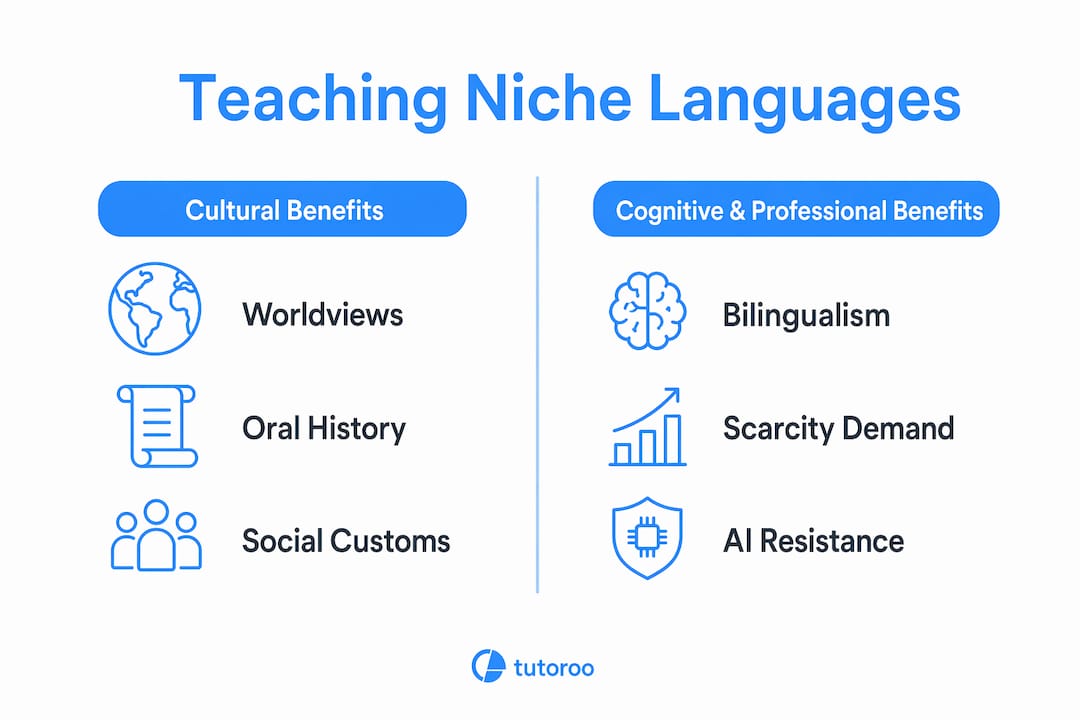
Niche languages are the repositories of entire worldviews. Quechua, for example, uses landmark orientation rather than left and right to describe direction. A speaker of Quechua does not just learn a new word for "turn left." They learn to read the physical world differently. That kind of cognitive rewiring is impossible to achieve through dominant languages alone.

The cognitive benefits of bilingualism are well established, and niche language acquisition amplifies them. Learners who acquire a less common language develop enhanced memory, mental flexibility, and a more empathetic brain structure. That flexibility also makes learning subsequent languages significantly easier, because the brain has already been trained to manage unfamiliar linguistic structures.
The cultural case is equally strong. Niche languages carry oral histories, ecological knowledge, and social customs that written records rarely capture. When a language disappears, that knowledge disappears with it. Teaching niche languages is not a nostalgic exercise. It is an act of cultural preservation with real consequences for communities and learners alike.
What are the cultural and cognitive benefits of teaching niche languages?
Teaching a niche language gives learners access to a cultural framework they cannot get from a textbook. Cultural immersion through language builds genuine empathy because learners must adopt the perspective of another community to communicate at all. That process produces a more flexible, open worldview.
The neurological benefits are striking. Bilingualism can delay dementia onset by up to five years. That figure applies to bilingualism broadly, but niche language acquisition tends to demand greater cognitive effort than learning a closely related major language. Greater effort produces greater neurological reward.
The advantages of niche language education in the classroom include:
- Deeper cultural empathy. Students who learn a niche language must engage with non-Western or non-dominant worldviews directly, not through translation.
- Stronger working memory. Managing two structurally different languages trains the brain to hold and switch between competing systems.
- Faster acquisition of additional languages. The brain flexibility developed through rare linguistic structures transfers to future language learning.
- Conflict resolution skills. Multilingualism enables communication across cultural divides, which builds the capacity to see disputes from multiple perspectives.
Pro Tip: When designing curriculum for a niche language, split instruction equally between grammar and cultural immersion. Research shows that effective niche language instruction requires a 50/50 balance between grammar and cultural content. Students who receive only grammar instruction miss the worldview concepts that give the language its full meaning.
How do niche languages contribute to professional and economic advantages?
The professional case for niche language skills is grounded in scarcity. When fewer people speak a language, those who do command higher rates and face less competition. That principle applies to translators, interpreters, educators, and diplomats alike.
The economic evidence at a national level is clear. A lack of language skills costs the UK economy 3.5% of GDP annually, and businesses that use language skills see 30% higher export success rates. Those figures reflect the value of language competence in general. For niche languages, the premium is even sharper because supply is so limited.
Here are four professional domains where niche language skills create exclusive opportunities:
- Legal and medical translation. Niche language professionals who combine linguistic expertise with specialised domain knowledge in law or medicine hold roles that no algorithm can fill. The intersection of rare language and technical domain creates genuine scarcity.
- Diplomatic and humanitarian work. International organisations working in conflict zones or remote regions depend on interpreters who speak local languages. Niche language speakers are recruited ahead of major language speakers in these contexts.
- Academic research. Linguists and anthropologists who can work in niche languages access primary sources unavailable to researchers working only in dominant languages.
- Community education. Demand for niche language teachers is growing in diaspora communities across Australia and globally, where parents want children to maintain heritage languages.
AI automation struggles with niche language translation because training data for less common languages is sparse. That means human niche linguists remain professionally stable even as machine translation advances. Scarcity is not a limitation here. It is a career strategy.
Pro Tip: Pair niche language study with a specialised domain such as law, medicine, or environmental science. That combination creates a professional profile that is genuinely difficult to replicate and highly sought after in international organisations.
What challenges and strategies exist for teaching niche languages effectively?
The biggest challenge in niche language education is institutional. Most school curricula do not include less common languages, and few teacher training programmes prepare educators to teach them. That leaves the work to community groups, diaspora organisations, and individual educators who build programmes from the ground up.
Mainstream curricula rarely cover niche language instruction, which means educators must rely on community partnerships and native speakers to fill the gap. This is not a weakness. Community involvement produces richer, more authentic instruction than any standardised textbook can offer.
Effective strategies for niche language teaching include:
- Native speaker partnerships. Involving native speakers in teaching brings authentic pronunciation, idiom, and cultural context that trained non-native teachers cannot replicate.
- Cultural immersion activities. Cooking, storytelling, music, and ceremony give learners embodied experience of the language's cultural context. These activities are not supplementary. They are core instruction.
- Diaspora community networks. Local community organisations often hold language classes, cultural events, and archives that educators can draw on directly.
- Online and hybrid learning. Digital platforms expand access to niche language instruction beyond geographic constraints, connecting learners with qualified tutors anywhere in the world.
Pro Tip: Avoid treating cultural immersion as an add-on to grammar lessons. Research confirms that curriculum balance between grammar and culture is the single most important factor in niche language proficiency. Build the cultural content into the lesson plan from day one, not as a reward for finishing grammar exercises.
The table below compares two common instructional approaches for niche languages:
| Approach | Strengths | Limitations |
|---|---|---|
| Grammar-focused instruction | Builds structural accuracy and reading ability | Misses worldview concepts and cultural nuance |
| Immersion-based instruction | Develops authentic communication and cultural empathy | Can lack structural rigour without grammar scaffolding |
The most effective programmes combine both. Neither approach alone produces a proficient, culturally literate speaker.
How does teaching niche languages support cultural preservation and social cohesion?
Languages are not just communication tools. They are living archives. Each niche language encodes a community's relationship with its environment, its history, and its values. When a language ceases to be taught, that archive closes permanently.
Languages should be valued like biological diversity to preserve unique worldviews and cultural identities. That framing is not sentimental. Biodiversity loss reduces an ecosystem's resilience. Linguistic diversity loss reduces a society's capacity to think in genuinely different ways.
The social benefits of niche language education extend beyond the individual learner. Multilingualism helps resolve conflicts by enabling communication on equal terms across cultural divides. Communities where multiple languages are taught and respected tend to show greater tolerance and civic participation.
"The value of a language rises with the number of speakers, but the unique value of a niche language lies precisely in what it offers that no other language does." — Network economics of minority tongues
That insight captures why supporting niche language programmes is a democratic act. When communities can participate in public life in their own language, they engage more fully. Niche languages do not fragment societies. They enrich them.
Key takeaways
Teaching niche languages delivers cognitive, cultural, professional, and social benefits that no major language programme can replicate, making them a priority for educators, linguists, and parents in 2026.
| Point | Details |
|---|---|
| Cognitive gains are real | Bilingualism with niche languages can delay dementia onset by up to five years and builds lasting brain flexibility. |
| Scarcity creates career value | Niche language skills combined with domain expertise produce roles that AI automation cannot replace. |
| Curriculum balance is critical | Effective instruction splits equally between grammar and cultural immersion to develop full proficiency. |
| Community partnerships are essential | Native speakers and diaspora networks provide authentic instruction that institutional curricula cannot supply. |
| Cultural preservation is a social good | Teaching niche languages sustains unique worldviews and strengthens democratic participation in multilingual communities. |
Tutoroo's perspective on niche language education
The most common mistake we see is treating niche language education as a niche problem. Institutions dismiss it as too specialised, too expensive, or too difficult to resource. That thinking misses the point entirely.
The educators and parents who champion less common languages are not chasing novelty. They are responding to something real. They see children who connect more deeply with their heritage, learners who develop cognitive agility that shows up across every subject, and graduates who walk into professional markets with skills that almost nobody else holds.
What we have observed consistently is that the biggest barrier is not resources. It is confidence. Educators worry they lack the expertise to teach a language they did not study formally. Parents worry their children will be disadvantaged by learning a language with fewer speakers. Both concerns dissolve quickly when learners see results.
The grassroots model works. A parent who speaks Yoruba, a community elder who holds Arrernte oral traditions, a tutor who grew up speaking Malay at home. These people are the curriculum. The formal lesson plan is just the structure around them.
We are genuinely optimistic about where niche language education is heading. The professional case has never been stronger. The cognitive evidence keeps accumulating. And the tools available to connect learners with qualified native speakers have never been more accessible.
— Tutoroo
Niche language tutoring with Tutoroo
Private tutoring is one of the most effective ways to learn or teach a niche language, and Tutoroo connects learners with over 386,000 language teachers worldwide.

Whether you are a parent looking for a heritage language tutor, an educator seeking professional development in a less common language, or a learner ready to build genuine fluency, Tutoroo makes the match simple. Lessons run online or in person, on a schedule that suits you. Tutoroo's community includes tutors for widely spoken languages and genuinely rare ones. If you are ready to find a private language tutor or want to explore options for a specific language such as Malay tutoring, Tutoroo has qualified tutors available now.
FAQ
What is a niche language?
A niche language is any language that falls outside the dominant languages taught in formal education systems, including minority languages, heritage languages, and less commonly taught world languages.
Why learn less common languages if they have fewer speakers?
Fewer speakers means greater professional scarcity and higher demand for qualified speakers in translation, diplomacy, and education. Cognitive benefits such as delayed dementia onset apply regardless of speaker population.
How do niche languages enhance learning in the classroom?
Niche languages build working memory, mental flexibility, and cultural empathy. Learners who manage rare linguistic structures also find it easier to acquire additional languages later.
What is the best strategy for teaching a niche language?
Research confirms that a 50/50 split between grammar instruction and cultural immersion produces the strongest outcomes. Native speaker involvement and community partnerships are equally important.
Are niche language skills future-proof as a career?
Yes. AI automation cannot reliably handle niche language translation, particularly when combined with specialised domain knowledge in law or medicine. Human niche linguists remain in demand.