

TL;DR:
- Asynchronous language learning is a self-paced approach that allows learners to study independently without real-time interaction. It offers flexibility, repeated content review, and reduced anxiety, but may lack immediate feedback and live conversational practice. Combining asynchronous tools with synchronous sessions maximizes language acquisition and fluency development.
Asynchronous language learning is a self-paced educational format where learners engage with language materials independently of their teacher's or peers' schedules, with no requirement for real-time participation. Unlike synchronous learning, which demands that everyone be present at the same time, asynchronous learning separates teaching and learning by time, giving you the freedom to study when you are most cognitively ready. Tools like pre-recorded lectures, discussion forums, mobile apps such as Duolingo, and MOOC platforms on Coursera or edX are the building blocks of this approach. Flexibility and accessibility sit at the heart of asynchronous language learning, making it a genuinely practical option for learners juggling work, family, or different time zones.
What benefits does asynchronous language learning offer?
Asynchronous language learning benefits learners in ways that a fixed classroom schedule simply cannot replicate. The most immediate advantage is flexible scheduling. Whether you are a shift worker in Melbourne, a student in Manila, or a professional in London, you can access your course materials at a time that suits your life rather than your institution's timetable.
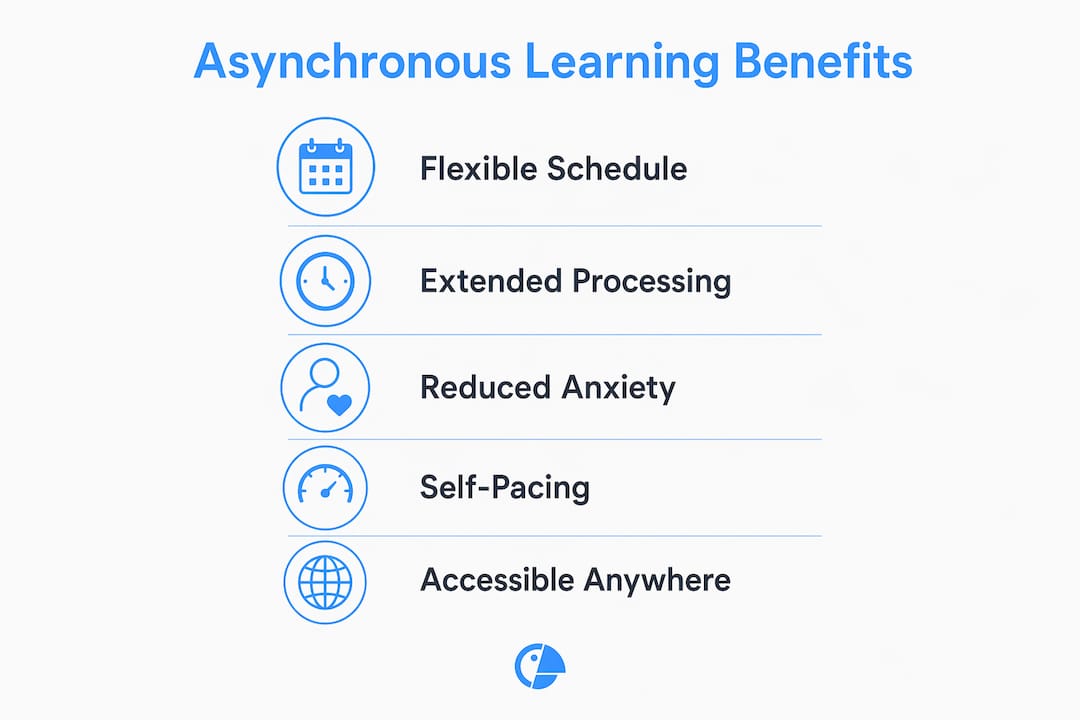
Beyond scheduling, asynchronous learning provides extended processing time that is genuinely valuable for language acquisition. You can pause a recorded lecture, replay a difficult grammar explanation, or revisit a vocabulary exercise as many times as you need. This kind of repetition is not possible in a live classroom without disrupting the group.
A less obvious but equally powerful benefit is reduced performance anxiety. Speaking a new language in front of peers and a teacher in real time can feel paralysing for many learners. Practising pronunciation with a voice recorder or completing speaking tasks on your own schedule removes that social pressure, encouraging more authentic and experimental language use. Research confirms that asynchronous modules improved listening and speaking proficiency, including vocabulary, grammar, and fluency, in empirical studies of A2-level English learners.
Self-paced study also builds metacognitive skills. When you manage your own learning schedule, you develop self-regulation, goal setting, and progress tracking habits that serve you well beyond any single course.
Key advantages at a glance:
- Flexible scheduling across time zones and lifestyles
- Repeated access to difficult content without social pressure
- Reduced anxiety during speaking and pronunciation practice
- Metacognitive growth through self-directed study habits
- Vocabulary gains supported by MOOC-based courses
"Asynchronous learning excels in providing processing time, but works best as a complement to live practice rather than a standalone method." — Sanako
Pro Tip: Set a specific study window each day, even if it is only 20 minutes. Learners who plan their weekly schedule show greater achievement and motivation in self-paced formats.
How does asynchronous learning work for language acquisition?
Asynchronous language learning in practice draws on a wide range of activities and tools, each designed to build different aspects of language competence. Recorded lectures and video lessons form the backbone of most online language courses, delivering grammar instruction and cultural context that you can absorb at your own pace.

Discussion boards and written forums extend this further by encouraging you to produce language output in writing, respond to peers, and receive feedback without the pressure of a live conversation. Automated quizzes and grammar exercises provide instant, low-stakes feedback on accuracy, while spaced repetition apps like Anki target long-term vocabulary retention.
Speech practice is where asynchronous learning gets particularly interesting. Successful asynchronous learners build feedback loops using voice recorders and automated speech recognition (ASR) software to mimic the corrective feedback of a live instructor. Recording yourself reading a passage aloud, then comparing your pronunciation against a native model, is a surprisingly effective technique that most learners overlook.
Pro Tip: Use free ASR tools like Google's speech input or dedicated language apps with pronunciation scoring to get objective feedback on your spoken output. Passive listening alone will not move your speaking forward.
Here is a comparison of common asynchronous tools and their primary features:
| Tool | Primary feature | Best for |
|---|---|---|
| Duolingo | Gamified vocabulary and grammar drills | Daily habit building and vocabulary |
| Anki | Spaced repetition flashcard system | Long-term vocabulary retention |
| Moodle | Course management with quizzes and forums | Structured course delivery |
| Coursera / edX | MOOC-based video lectures and assessments | Grammar, reading, and listening skills |
| Voice recorder + ASR | Speech recording and pronunciation feedback | Speaking and fluency practice |
Metacognitive skills like self-regulation and progress tracking significantly improve success rates in asynchronous formats. Building a simple weekly study plan, logging completed activities, and reviewing your own recordings are habits that separate learners who progress from those who stall.
What are the limitations of asynchronous language learning?
Asynchronous language learning carries real limitations that every learner should understand before committing to it as their sole method. The most significant is the absence of immediate, personalised feedback. When you make a grammatical error in a forum post, you may wait hours or days for a correction, and that delay weakens the corrective feedback loop that accelerates language acquisition.
Communicative competence, the ability to hold a real conversation fluidly and appropriately, is genuinely harder to develop without live interaction. Writing discussion posts and recording yourself are valuable, but they do not replicate the unpredictability and social negotiation of a real conversation.
Motivation and engagement also present challenges. Fully asynchronous programmes without real-time interaction struggle to maintain learner motivation, and a 2026 study identified lack of real-time interaction as a major barrier to engagement and communication skill development. Without a teacher or classmates holding you accountable, it is easy to let study sessions slide.
Common challenges and practical solutions:
- Weak communicative practice. Schedule regular speaking sessions with a tutor or language partner to fill this gap.
- Motivation decline. Join online language communities or forums to maintain social connection and accountability.
- Delayed feedback. Use ASR tools and peer review forums to create faster feedback cycles.
- Digital literacy barriers. Choose platforms with clear interfaces, such as Moodle or Duolingo, before moving to more complex tools.
- Isolation. Pair asynchronous study with conversational language practice to maintain communicative momentum.
Understanding these limitations is not a reason to avoid asynchronous learning. It is a reason to design your study plan with them in mind from the start.
How can learners combine asynchronous and synchronous methods?
Hybrid approaches combining asynchronous self-paced study with synchronous conversation practice yield better language acquisition outcomes than either method alone. The logic is straightforward. Asynchronous tools build your knowledge base, vocabulary, and grammar accuracy. Synchronous sessions with a tutor or language partner give you the space to activate that knowledge in real conversation.
A practical weekly structure might look like this:
- Monday and Wednesday: Complete one asynchronous lesson on your chosen platform, focusing on new vocabulary or a grammar point. Use Anki to review new words before bed.
- Tuesday: Record yourself speaking for two minutes on the week's topic. Listen back and note pronunciation or grammar issues.
- Thursday: Join a language exchange forum or discussion board to write a short response in your target language, applying the week's grammar focus.
- Friday or Saturday: Book a one-on-one session with a private tutor to practise the week's material in live conversation, ask questions, and receive immediate feedback.
- Sunday: Review your notes, update your vocabulary list, and set goals for the following week.
This structure uses asynchronous tools to prepare you thoroughly for each live session, so you arrive with specific questions and vocabulary already in place. Your tutor's time becomes far more productive, and you leave each session with corrections and new language to absorb during the following week's self-study.
Pro Tip: Before each synchronous session, write down three specific things you want to practise or ask about. Learners who arrive with a focused agenda make measurably faster progress than those who simply show up and chat.
Explore expert tips for boosting language skills to refine your hybrid study approach further.
Tutoroo's perspective on asynchronous language learning
After working with learners across dozens of languages and learning contexts, one pattern stands out clearly. The learners who thrive in asynchronous formats are not necessarily the most disciplined or the most talented. They are the ones who treat feedback as a non-negotiable part of their routine, not an optional extra.
The biggest mistake Tutoroo sees is learners who consume asynchronous content passively, watching videos, completing exercises, and ticking boxes, without ever producing language output that gets evaluated. Passive consumption builds recognition but not production. You can recognise a word in a reading passage and still be unable to use it in conversation six months later.
The reduced anxiety of self-paced learning is genuinely one of its most underrated gifts. Learners who have spent years feeling embarrassed in classroom settings often discover, for the first time, that they can actually speak a language when the social pressure is removed. That confidence, built quietly through recorded practice and written output, carries over powerfully into live sessions.
Technology is an enabler here, not a replacement for human connection. The most effective learners Tutoroo has observed use asynchronous platforms to build knowledge and confidence, then bring that foundation into live sessions with a tutor who can push them further, correct nuanced errors, and open doors to cultural understanding that no app can replicate.
— Tutoroo
Ready to complement your self-paced study with live tuition?
Asynchronous learning builds a strong foundation, but real fluency opens up when you bring that knowledge into live conversation with an expert tutor.
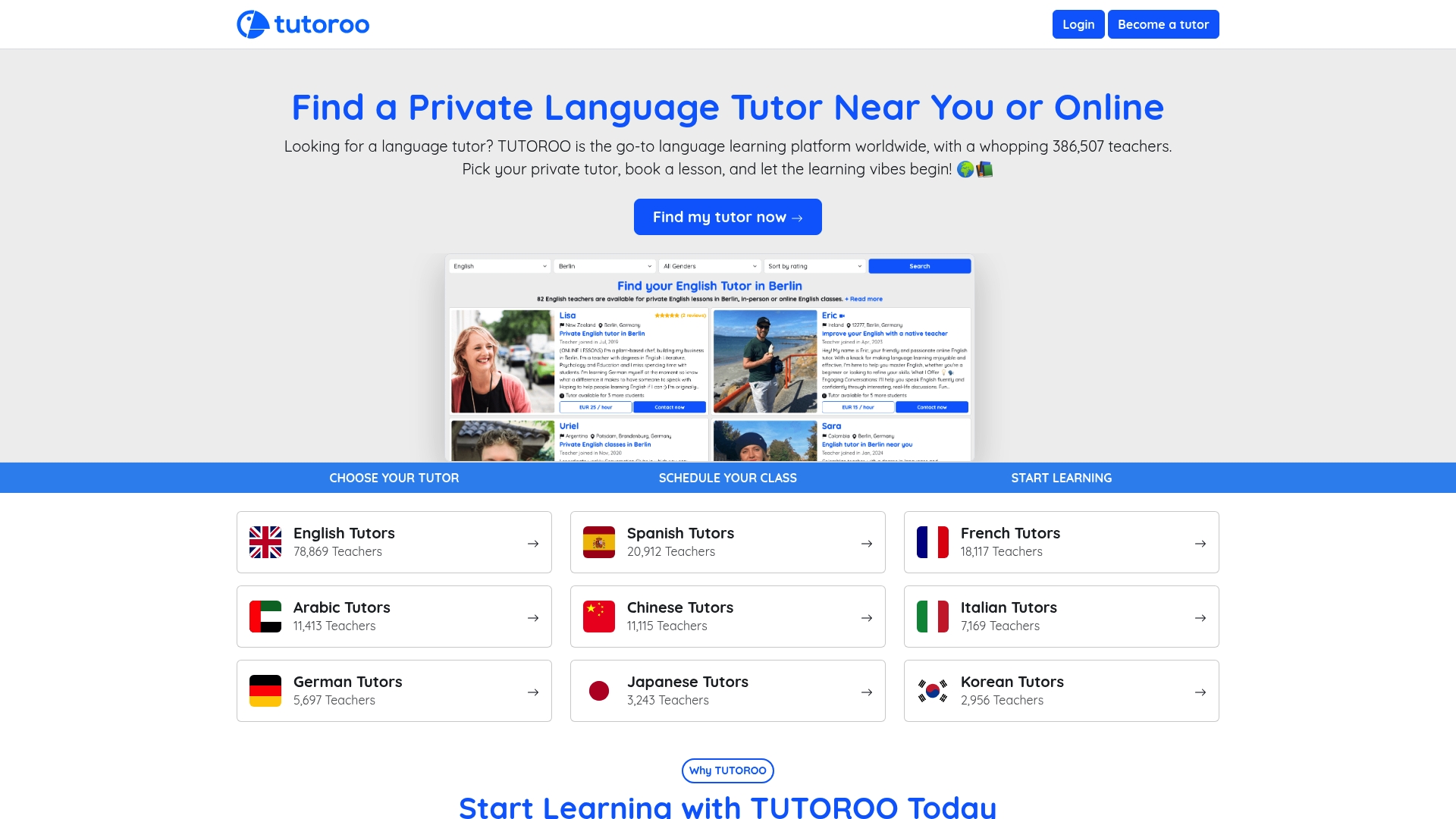
Tutoroo connects you with over 386,000 private language tutors worldwide, offering flexible online and in-person sessions tailored to your pace and goals. Whether you are learning English, Arabic, Spanish, French, or Lebanese Arabic, Tutoroo matches you with a tutor who fits your schedule and learning style. Find your private language tutor today and experience the difference that personalised, real-time practice makes alongside your asynchronous study. For those focusing on specific languages, Tutoroo also offers dedicated English tutors online and Lebanese tutors online to support your learning journey.
Key takeaways
Asynchronous language learning works best as a structured, feedback-rich practice that combines self-paced tools with regular synchronous sessions to develop both accuracy and communicative fluency.
| Point | Details |
|---|---|
| Core definition | Asynchronous learning separates teaching and study by time, enabling fully self-paced engagement. |
| Proven vocabulary gains | A 2025 MOOC study showed significant productive vocabulary progress after just four weeks of asynchronous study. |
| Biggest limitation | Fully asynchronous programmes struggle with motivation and communicative skill development without live interaction. |
| Feedback is non-negotiable | Use voice recorders, ASR tools, and peer forums to replicate corrective feedback loops. |
| Hybrid model wins | Combining asynchronous self-study with synchronous tutor sessions produces the strongest language acquisition outcomes. |
FAQ
What is asynchronous language learning?
Asynchronous language learning is a format where teaching and learning are separated by time, allowing learners to engage with materials such as recorded lectures, apps, and forums on their own schedule. It contrasts with synchronous learning, which requires all participants to be present simultaneously.
How does asynchronous learning work in practice?
Learners access pre-recorded lessons, complete automated quizzes, participate in discussion boards, and practise speaking using voice recorders or ASR software, all without needing a live instructor present. Self-regulation tools like weekly study plans and progress logs keep learners on track.
What are the main advantages of asynchronous learning for language learners?
The main advantages include flexible scheduling, the ability to revisit difficult content repeatedly, reduced performance anxiety during speaking practice, and the development of metacognitive skills like goal setting and self-monitoring.
Can asynchronous learning alone make you fluent in a language?
Asynchronous learning alone is unlikely to develop full communicative fluency because it lacks real-time interaction, which is critical for conversational competence. Experts recommend pairing it with synchronous practice, such as sessions with a private tutor, for the best outcomes.
What are the best platforms for asynchronous language learning?
Widely used platforms include Duolingo for daily vocabulary drills, Anki for spaced repetition, Moodle for structured course delivery, and Coursera or edX for MOOC-based language courses covering grammar, listening, and reading skills.