

TL;DR:
- Online education in 2026 is now a central part of modern learning ecosystems, emphasizing engagement and flexibility. It features significant trends such as cohort-based courses, AI personalization, microlearning, and mobile-first design to improve completion rates and access. Combining these elements with industry-recognized credentials offers learners a more effective and career-oriented educational experience.
Online education in 2026 is defined as a core component of modern learning ecosystems, not a supplement to traditional classrooms. The global eLearning market sits at approximately $370–400 billion, with 93% of companies now incorporating eLearning into professional development. That scale signals a permanent structural shift. Educators, students, and lifelong learners who understand the role of online education in 2026 will be far better placed to choose the right credentials, tools, and learning models for their goals.
What are the latest online education trends in 2026?
Online education trends in 2026 are defined by three forces: AI personalisation, microlearning design, and the rise of cohort-based courses. Each one addresses a different failure point in traditional online delivery.
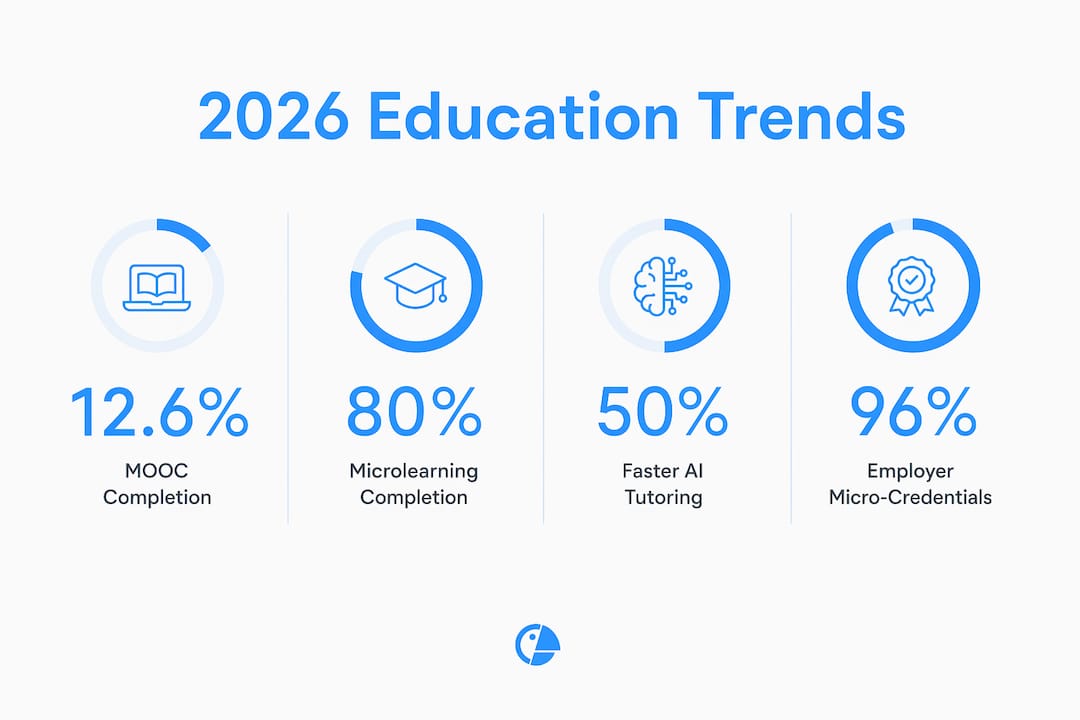
The most striking data point is the completion rate gap. MOOC average completion sits at just 12.6%, while cohort-based courses exceed 90% completion. The difference is peer accountability and fixed schedules, not content quality. Learners who feel connected to a group finish. Learners who work alone, at their own pace, often do not.
Microlearning is the other major shift. Microlearning modules achieve 80% completion compared to 20% for traditional long-form online courses. Shorter, focused lessons fit into the real lives of working adults, parents, and commuters. Corporate training departments adopted this model first, and higher education is catching up quickly.
AI tutoring is reshaping how fast learners progress. AI tutoring can reduce learning times by up to 50% by adapting content difficulty and pacing in real time. That is not a minor efficiency gain. It means a learner can cover the same ground in half the time when the system responds to their actual performance rather than a fixed syllabus.
Mobile-first design is no longer optional. 67% of learners worldwide use mobile devices as their primary learning tool. Courses that are not designed for small screens and offline access exclude a significant portion of the global learner population.
Key trends reshaping online learning right now include:
- Cohort-based courses with structured schedules and peer accountability
- AI-adaptive tutoring that adjusts pacing and content to individual performance
- Microlearning modules of 5–15 minutes replacing hour-long lectures
- Mobile-first course design with offline access for learners in low-connectivity areas
- Skill-based micro-credentials accepted by major employers for hiring decisions
Pro Tip: If you are choosing between a self-paced MOOC and a cohort-based programme, pick the cohort model. The completion data is unambiguous, and the peer connections you build are worth as much as the credential itself.
How does online education improve access and flexibility?
Online education removes the two biggest barriers to learning: geography and time. For working adults, rural learners, veterans, and parents, flexible online models deliver genuine life improvements that traditional classroom settings simply cannot match.

The myth that online education lacks rigour persists in some quarters, but the evidence does not support it. Online learning retention rates range from 25–60%, compared to 8–10% for face-to-face instruction. Digital tools and the ability to revisit content at will drive that difference.
Understanding asynchronous versus synchronous learning is critical for learners choosing a format. Asynchronous models give maximum flexibility but require strong self-discipline. Synchronous and cohort models add structure and social connection, which most learners need to stay on track.
The four groups who benefit most from online access are:
- Working adults who cannot attend fixed-schedule classes without risking employment
- Rural and regional learners who live hours from the nearest campus or language school
- Parents and carers who need to study around family responsibilities
- Veterans and career changers who need recognised credentials without returning to full-time study
61% of online learners plan to pursue an additional degree, and 56% are actively considering non-degree upskilling options. That data shows online education is not a fallback. It is the deliberate choice of ambitious, goal-oriented learners. Institutions that design for this audience, rather than treating online as a lesser version of campus study, will attract and retain the most motivated students.
What challenges and limitations remain in online education delivery?
Online education has real weaknesses, and pretending otherwise does learners a disservice. The most persistent problem is engagement. Asynchronous models give learners freedom, but that freedom often becomes isolation. Without peer interaction and structured check-ins, motivation drops and completion rates follow.
The AI digital divide is the most significant emerging risk in 2026. Students with institutional support and strong AI literacy gain a measurable advantage over isolated learners who lack access to the same tools. This divide risks producing unequal learning outcomes at scale, and it requires targeted policy responses from institutions and governments alike.
Course design is another underappreciated problem. Many online courses are simply recorded lectures with a quiz attached. That is not online learning. It is a digitised classroom, and it performs accordingly. Effective online delivery requires purpose-built instructional design, not retrofitted face-to-face content.
The key challenges facing online education right now include:
- Low MOOC completion rates averaging 12.6% in self-paced formats
- Student isolation in asynchronous models without community structures
- AI literacy gaps creating unequal access to personalised learning tools
- Academic integrity risks in remote assessment environments
- Poor course design where face-to-face content is simply moved online without redesign
Pro Tip: Before enrolling in any online programme, ask the provider how they support student engagement. Look for live sessions, peer forums, or cohort structures. A course with no community features is a course with a high dropout risk.
Learners with lower prior academic performance can actually benefit more from online learning than their high-achieving peers, particularly in non-applied fields. High achievers in applied disciplines like medicine or engineering may find pure online formats limiting for hands-on skill development. Choosing the right format for your field and your starting point matters enormously.
How are AI and technology redefining personalised learning?
AI is the most consequential technology in online education right now, but its impact depends entirely on how it is implemented. AI tutors personalise learning paths by adapting content difficulty, pacing, and feedback in real time. That capability is genuinely new. No human tutor can simultaneously track the performance of 500 learners and adjust each one's curriculum accordingly.
The critical caveat is explainability. AI-supported learning tools need to show learners why they are being directed toward certain content. When AI operates as a black box, learners cannot build the metacognitive skills they need to manage their own learning long-term. Explainable AI supports learner agency. Opaque AI creates dependency.
The best outcomes come from hybrid models combining AI and human instruction. AI handles pacing, gap detection, and repetition. Human instructors handle nuance, motivation, and the kind of contextual judgement that algorithms cannot replicate. For language learning in particular, a human tutor brings cultural knowledge and authentic conversation that no AI system currently matches.
Emerging technologies like augmented reality and virtual reality are beginning to appear in applied training contexts, particularly for medical, engineering, and language immersion programmes. These tools are not yet mainstream, but they point toward a future where online learners can practise real-world skills in simulated environments.
| Technology | Primary function | Best suited for |
|---|---|---|
| AI adaptive tutoring | Adjusts pacing and content difficulty | Self-paced skill building |
| Cohort-based platforms | Peer accountability and fixed schedules | Completion-focused programmes |
| Mobile-first design | Offline access and small-screen optimisation | Learners in low-connectivity regions |
| AR/VR immersion tools | Applied practice in simulated environments | Language, medical, and technical training |
| Explainable AI feedback | Metacognitive support and gap identification | All learner types, especially independent learners |
For educators exploring technology's role in language education, the key question is not which tool is most advanced. It is which tool best supports the specific learner in front of you.
What does the future hold for accreditation and credentials?
Credentials are changing faster than most learners realise. 96% of employers now recognise micro-credentials for hiring decisions. That figure represents a fundamental shift in how qualifications are valued. A three-year degree is no longer the only signal of competence that employers trust.
Industry-backed credentials from Google, IBM, and Meta now carry genuine hiring weight in technology, data, and marketing roles. These credentials are specific, verifiable, and directly tied to job-relevant skills. They also take weeks or months to complete, not years. For learners who need to change careers quickly or add a specific skill, they are often the most efficient path.
The shift from degree signalling to skill-specific certification does not mean degrees are obsolete. It means learners now have a genuine choice. A degree signals broad capability and institutional credibility. A micro-credential signals a specific, current skill. The most competitive learners in 2026 hold both.
Higher education institutions are responding by making micro-credentials credit-bearing, meaning learners can stack them toward a full qualification over time. This modular approach suits working adults who cannot commit to full-time study but want a pathway to a recognised degree. Choosing credentials with career impact requires matching the credential to a specific role, not just collecting certificates.
Pro Tip: Before committing to any micro-credential, search job listings in your target role and confirm the credential appears in employer requirements. If it does not appear in at least a handful of listings, its market value is unproven.
Tutoroo's perspective on making online education work in 2026
The most common mistake learners make in 2026 is treating access as the goal. Getting into an online course is easy. Finishing it, applying what you learned, and building on it is where most people struggle. At Tutoroo, we see this pattern clearly in language learning. Learners who sign up for a self-paced app or MOOC often plateau within weeks. Learners who work with a private tutor, even once a week, progress consistently because they have accountability, real conversation, and someone who notices when they are stuck.
The AI digital divide concerns me more than any other trend. Institutions with resources are building sophisticated AI-supported learning environments. Learners without those resources are falling further behind. The answer is not to slow down AI adoption. It is to pair AI tools with human support, particularly for learners who lack the digital literacy to use AI effectively on their own.
My advice to educators is direct: stop retrofitting face-to-face content for online delivery. Design for the medium. That means shorter modules, built-in community features, and regular live touchpoints. A well-designed online course is not a lesser version of a classroom. It is a different and often more effective thing entirely.
— Tutoroo
Personalised tutoring to complement your online learning
Online education opens doors to culture, connection, and opportunity across every language and discipline. The most effective learners combine the flexibility of online platforms with the depth of personalised instruction.
Tutoroo connects learners with over 386,000 private language tutors worldwide, available for one-on-one online lessons that fit around any schedule. Whether you are building on a micro-credential, preparing for a language exam, or simply wanting authentic conversation practice, a private tutor adds the human element that no algorithm can replicate. Tutoroo also offers a dedicated category of online Malay tutors for learners exploring Southeast Asian languages and cultures. Find your tutor, set your schedule, and start learning on your terms.
FAQ
What is the role of online education in 2026?
Online education in 2026 functions as a core component of hybrid learning ecosystems, combining AI-driven personalisation, micro-credentials, and flexible delivery to serve working adults, regional learners, and lifelong learners. It is no longer a supplement to traditional education but an equal and often preferred alternative.
What completion rates can online learners expect?
Completion rates vary significantly by format. Self-paced MOOCs average 12.6% completion, while cohort-based courses with peer accountability exceed 90%. Microlearning modules achieve 80% completion, making format choice the single biggest factor in whether a learner finishes.
Are micro-credentials worth pursuing in 2026?
96% of employers now recognise micro-credentials for hiring, and industry-backed credentials from Google, IBM, and Meta carry significant weight in technology and marketing roles. Learners should verify that a specific credential appears in job listings for their target role before enrolling.
How does AI improve the online learning experience?
AI tutors adapt content difficulty and pacing to individual performance, provide real-time feedback, and identify learning gaps automatically. The best outcomes occur when AI is paired with human instruction, and when the AI system explains its recommendations so learners can manage their own progress.
How does online education support diverse learners?
Online education delivers measurable benefits for working adults, rural and regional learners, veterans, and parents by removing geographic and scheduling barriers. Online learning retention rates range from 25–60%, compared to 8–10% for face-to-face instruction, largely because learners can revisit content at will.
Key takeaways
Online education in 2026 is most effective when it combines cohort-based engagement models, AI-supported personalisation, and industry-recognised credentials, rather than relying on access alone.
| Point | Details |
|---|---|
| Format determines completion | Cohort-based courses exceed 90% completion; self-paced MOOCs average 12.6%. Choose your format deliberately. |
| AI works best with human support | AI tutors reduce learning time by up to 50%, but pair them with a human instructor for best outcomes. |
| Micro-credentials carry real weight | 96% of employers recognise micro-credentials; verify market demand before enrolling in any programme. |
| Mobile-first design matters | 67% of learners use smartphones as their primary device; courses without mobile optimisation exclude a large audience. |
| Engagement beats access | Learners who have peer community and live touchpoints consistently outperform those studying in isolation. |