

TL;DR:
- Language learners are mainly categorized by the context in which they acquire language, influencing their strategies and progress. Motivation, growth mindset, and multimodal practice are key factors predicting long-term success across all learner profiles. Adaptive learning platforms that use real performance data offer more personalized and effective content matching than static labels or fixed styles.
Language learners are defined by the context in which they acquire a new language and the cognitive and motivational characteristics they bring to that process. Understanding the main learner categories gives you a practical framework for choosing strategies that actually work, rather than guessing what might suit you. Whether you are studying Spanish in a classroom in Melbourne, picking up Mandarin through daily immersion in Shanghai, or reviving a heritage language spoken at home, your learner profile shapes everything from the pace of your progress to the methods that will sustain your motivation. Frameworks like VARK and adaptive platforms like those used by Tutoroo make it possible to personalise that experience with real precision.
1. What are the main types of language learners?
Learner types are categorised primarily by the context in which language acquisition takes place, not by personality or fixed ability. Six core profiles emerge consistently across second language acquisition research.
- Classroom learners acquire language through formal instruction, structured grammar lessons, and teacher-led feedback. They tend to develop strong accuracy in writing and reading but may need extra effort to build conversational fluency.
- Naturalistic learners acquire language through immersion and informal social interaction, without systematic instruction. Think of a student who moves to France and learns French entirely through daily life.
- Mixed-context learners combine formal study with real-world exposure. This is the most common profile globally, covering learners who attend classes and also use the language socially or professionally.
- Heritage learners grew up hearing or speaking the target language at home but are dominant in a second language. They often have strong oral intuition but gaps in formal registers and literacy.
- Simultaneous bilinguals acquire two languages from birth, developing parallel competence in both from the earliest stages of development.
- Sequential learners establish a first language fully before beginning acquisition of a second, which is the most common pathway for adult language study.
Pro Tip: If you identify as a heritage learner, skip beginner textbook content entirely. Heritage instruction targets morphosyntactic gaps, pragmatic nuance, and formal literacy, not the conversational basics you already possess.
2. How do cognitive learning styles relate to language acquisition?

Cognitive learning style models describe how learners prefer to process and absorb new information. The VARK model, developed by Neil Fleming, identifies four preferences: visual, auditory, read/write, and kinesthetic. Kolb's Experiential Learning Theory, the Dunn and Dunn model, and the Felder-Silverman model offer additional dimensions such as reflective versus active processing and sequential versus global understanding.
The critical point is that most learners are multimodal. They draw on several processing preferences depending on the task, not just one dominant style. Research confirms that learning style preferences exist but do not reliably predict better outcomes when teaching is matched to a single sensory modality. This is one of the most persistent neuromyths in education, and it matters because acting on it can actually limit your progress.
| Learning style model | Core dimensions | Practical application |
|---|---|---|
| VARK (Fleming) | Visual, auditory, read/write, kinesthetic | Use as a starting point for exploring modality variety, not as a fixed label |
| Kolb's ELT | Concrete experience, reflective observation, abstract conceptualisation, active experimentation | Rotate between doing, reflecting, and theorising during study sessions |
| Felder-Silverman | Active/reflective, sensing/intuitive, visual/verbal, sequential/global | Useful for identifying gaps in study habits rather than confirming preferences |
| Dunn and Dunn | Environmental, emotional, sociological, physiological, psychological | Highlights that context and environment affect learning as much as modality |
What actually works is combining modalities with retrieval practice and immediate corrective feedback. Multimodal approaches that pair visual input with spoken output and written consolidation reduce cognitive overload and build both recognition and production skills simultaneously.
Pro Tip: Rather than asking "what is my learning style?", ask "which modality am I underusing?" Deliberately practising in your weaker modality often produces faster gains than doubling down on your preference.
3. What role does motivation and mindset play in learner profiles?
Motivation is not a background factor in language learning. It is a defining characteristic of learner profiles and one of the strongest predictors of long-term success. Two mindset orientations shape how learners respond to difficulty and setback.
A growth mindset treats language ability as developable through effort and strategy. A fixed mindset treats it as innate, leading learners to interpret mistakes as evidence of permanent limitation. A longitudinal study of 904 undergraduates found that a growth mindset predicts higher engagement (β 0.18 to 0.22) and significantly lower burnout risk (β –0.18 to –0.21). This means learners who believe they can improve are measurably more likely to stay the course.
Practical strategies for sustaining motivation across different learner profiles include:
- Setting task-specific goals rather than vague targets like "become fluent." Replacing "I want to speak French" with "I will hold a five-minute conversation about my work by the end of the month" creates measurable progress.
- Using proven motivation strategies such as spaced repetition, meaningful task design, and regular social use of the target language.
- Tracking streaks or session frequency to create visible momentum, which reinforces the growth mindset loop.
- Pairing study with genuine interest areas. A learner passionate about Korean cinema will sustain effort through Korean film and subtitles far longer than through grammar drills alone.
Engagement mediates the relationship between mindset and burnout, which means motivation support is not optional. It is the mechanism through which mindset translates into real outcomes.
4. How adaptive platforms use learner profiles for personalised learning
Adaptive learning platforms move beyond static learner type labels by continuously updating a learner's profile based on real performance and engagement signals. Rather than assigning you a fixed category at the start and never revisiting it, these systems use clustering algorithms and decision trees to match content to your current state.
Intelligent adaptive platforms achieve over 82% accuracy in matching content to learner profiles in experimental trials. That figure reflects a simulation of 30 students across 50 learning items, using weighted matching models. The practical implication is that a well-designed adaptive system is more precise than any self-reported style questionnaire.
| Feature | Static style labelling | Dynamic adaptive profiling |
|---|---|---|
| Profile update frequency | Once at onboarding | Continuously during every session |
| Data sources | Self-report questionnaire | Performance, response time, error patterns, engagement |
| Content matching accuracy | Varies, often low | Over 82% in experimental models |
| Personalisation depth | Broad category | Item-level content selection |
International adaptive platforms that use this kind of dynamic profiling consistently outperform static approaches for learner engagement and retention. The key advantage is responsiveness. When a learner plateaus or disengages, the system detects it and adjusts, rather than continuing to deliver content that no longer fits.
5. Which learning strategies suit each learner type best?
Matching your study method to your learner context produces far better results than applying a one-size-fits-all approach. Here is how different profiles benefit from different strategies.
Classroom learners benefit most from form-focused instruction, corrective feedback on written and spoken output, and structured vocabulary building. Grammar explanation followed by communicative practice is the most effective sequence for this group.
Naturalistic learners need sustained social interaction in the target language. Sustained exposure and interaction over many months, not short isolated practice blocks, is what drives real-world fluency. Joining conversation groups, finding a language exchange partner, or living in an immersive environment accelerates progress for this profile.
Mixed-context learners gain the most from deliberately combining structured feedback with unstructured social use. Attending a weekly tutoring session to address accuracy gaps, then using the language socially throughout the week, creates a productive cycle of correction and consolidation.
Heritage learners should focus on formal register development and literacy rather than conversational basics. A tutor who understands heritage speaker needs will target morphosyntactic gaps and written fluency rather than teaching vocabulary the learner already knows intuitively.
For learners across all profiles, language instruction works best when it combines multimodal input with retrieval practice and corrective feedback. Building both recognition skills and production accuracy prevents the common plateau where learners understand a great deal but struggle to speak or write with confidence.
Pro Tip: Use top language learning apps as supplementary tools rather than primary instruction. Apps are excellent for vocabulary retrieval practice and listening exposure, but they rarely provide the corrective feedback that classroom and mixed-context learners need most.
Key takeaways
Learner context, growth mindset, and multimodal practice are the three factors that most reliably predict language learning success across all profiles.
| Point | Details |
|---|---|
| Context defines learner type | Classroom, naturalistic, mixed, and heritage contexts each require distinct instructional strategies. |
| Learning styles are not fixed | Most learners are multimodal; matching teaching to a single style does not reliably improve outcomes. |
| Mindset predicts engagement | A growth mindset measurably reduces burnout and sustains effort over the long term. |
| Adaptive platforms outperform labels | Dynamic profiling using performance data achieves over 82% content-matching accuracy versus static questionnaires. |
| Heritage learners need specialist focus | Heritage instruction targets formal registers and literacy, not conversational basics already present. |
What Tutoroo has learned about learner types
After working with learners across dozens of languages and contexts, one pattern stands out clearly: the learners who make the most sustained progress are not the ones who found their "perfect" learning style. They are the ones who stayed curious, stayed consistent, and stayed connected to real human interaction in the target language.
The learning styles framework is genuinely useful as a starting point for self-reflection, but it becomes a trap when learners use it as a reason to avoid certain types of practice. Telling yourself "I am not an auditory learner" to justify skipping listening exercises is not self-awareness. It is avoidance dressed up as strategy.
What Tutoroo sees work, again and again, is learners who combine structured feedback from a knowledgeable tutor with genuine social use of the language outside sessions. The classroom learner who also watches films in the target language. The heritage learner who finally works on formal writing with a specialist tutor. The mixed-context learner who stops treating grammar and conversation as separate activities and starts integrating them.
Motivation is the variable that most people underestimate. Learners who connect their language goals to something personally meaningful, whether that is family, career, travel, or culture, sustain effort through the inevitable difficult periods. Those who study because they feel they "should" tend to plateau and disengage. The type of learner you are matters far less than why you are learning and whether that reason is strong enough to carry you through the hard weeks.
— Tutoroo
Find a tutor who understands your learner profile
Every learner is different, and the right tutor makes that difference count. Tutoroo connects you with over 386,000 private language tutors worldwide, each able to adapt their teaching to your specific learner context, whether you are a heritage speaker refining formal Arabic, a classroom learner building Spanish conversational confidence, or a mixed-context learner who needs structured feedback alongside real-world practice.
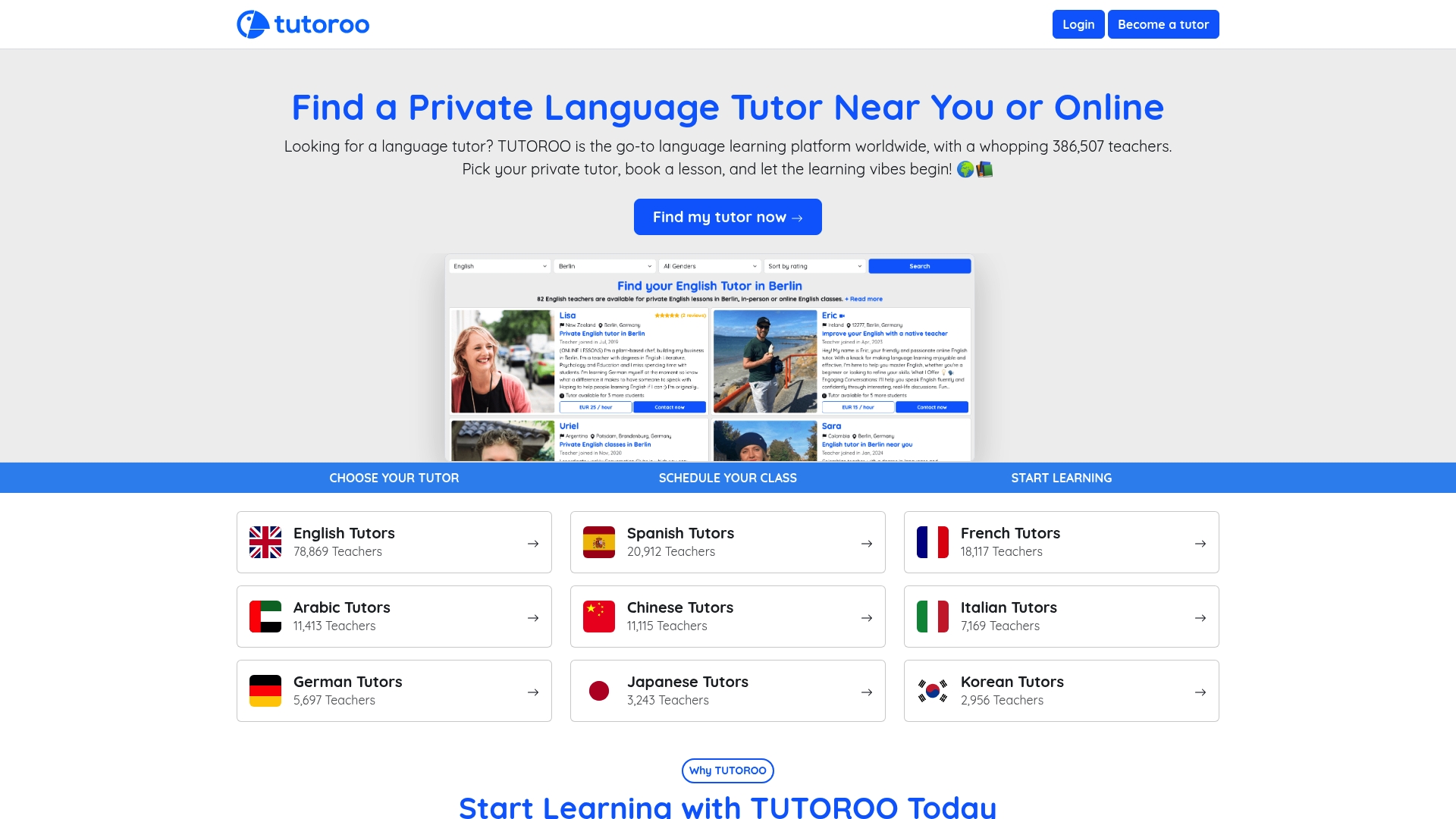
Tutoroo tutors work one-on-one, online or in person, and adjust their approach to your goals, pace, and motivation style. That kind of personalised attention is what separates genuine progress from spinning your wheels with generic content. Explore private language tutors on Tutoroo and find the right match for where you are right now in your language learning experience.
FAQ
What are the main types of language learners?
The main types are classroom learners, naturalistic learners, mixed-context learners, heritage learners, simultaneous bilinguals, and sequential learners. Each type is defined primarily by the context in which language acquisition takes place.
Do learning styles like VARK actually improve language learning?
Learning style preferences exist but do not reliably predict better outcomes when teaching is matched to a single sensory modality. Multimodal approaches combining visual, auditory, and kinesthetic input with retrieval practice produce stronger results across all learner types.
How does mindset affect language learning progress?
A growth mindset predicts higher engagement and lower burnout in language learners, based on a longitudinal study of 904 undergraduates. Learners who treat ability as developable through effort consistently outperform those with a fixed mindset over time.
What makes heritage learners different from beginner learners?
Heritage learners already possess conversational competence in the target language from home exposure. Effective instruction for this group focuses on formal registers, written literacy, and morphosyntactic accuracy rather than basic vocabulary or pronunciation.
How do adaptive learning platforms personalise content for different learner types?
Adaptive platforms use continuous performance and engagement data, including response time and error patterns, to update learner profiles dynamically. Experimental models using decision trees and clustering algorithms achieve over 82% accuracy in matching content to individual learner needs.