

TL;DR:
- Effective vocabulary learning combines spaced repetition, active recall, and context-based reading to ensure long-term retention. Using tools like Anki and authentic content improves retention, but real progress depends on balancing study phases with conversation and real-world use. Private tutors enhance this process by providing personalized guidance and authentic language practice.
The most effective methods to learn vocabulary combine spaced repetition, active recall, and context-based reading to build lasting word knowledge. Passive exposure alone does not create retention. Research confirms that spaced repetition significantly improves explicit vocabulary retention compared to massed learning, and tools like Anki make this technique accessible to any learner. Whether you are studying Spanish for travel, Arabic for work, or English for academic purposes, the strategies below are grounded in cognitive science and real classroom results. Tutoroo's community of over 386,000 language teachers applies these same techniques every day.
1. What are the best methods to learn vocabulary?
Vocabulary acquisition refers to the process of learning new words well enough to understand and use them accurately. The most effective vocabulary building techniques share three qualities: they space out review, they demand active retrieval, and they embed words in meaningful context. Learners who combine all three qualities retain words far longer than those who rely on a single approach. The sections below cover each method in depth, from spaced repetition to AI-assisted tools, so you can build a study plan that fits your goals.

2. How does spaced repetition boost vocabulary retention?
Spaced repetition is a study method that schedules each word review just before you are likely to forget it. Instead of cramming a list in one sitting, you revisit words at growing intervals: one day later, then three days, then a week, and so on. A study with 69 Japanese learners showed better explicit recall using spaced learning than massed repetition. That result means the timing of review matters as much as the review itself.
Anki is the most widely used tool for spaced repetition. It uses an algorithm to calculate the ideal review date for each card based on how well you recalled it. Physical flashcards work too, sorted into boxes labelled by review frequency. The key is consistency: short daily sessions outperform long weekly ones.
Retrieval practice sits at the heart of why spaced repetition works. Each time you pull a word from memory, you strengthen the neural pathway for that word. This is called the testing effect, and it is covered in more detail in section 4.
- Review cards daily, even for just 10–15 minutes
- Mark difficult cards honestly so the algorithm reschedules them sooner
- Add example sentences to each card, not just translations
- Review new cards the same day you encounter the word
Pro Tip: Adapt your review intervals based on recall success. If you recalled a word easily, push the next review further out. If you struggled, bring it back sooner. Anki does this automatically, but manual flashcard users can replicate it with a simple three-box system.
3. Why is context-based learning essential for vocabulary growth?
Reading and listening in context produces deeper word knowledge than memorising definitions alone. When you encounter a word in a sentence, a paragraph, or a conversation, you absorb its grammar, tone, and typical usage at the same time. This is called incidental vocabulary acquisition, and it scales powerfully once your vocabulary reaches a certain size.
Paul Nation's research shows learners need 95–98% lexical coverage to reliably infer new words from reading context. That threshold corresponds to roughly 3,000–4,000 word families. Below that level, context-based reading produces more confusion than learning. Above it, every page of authentic text becomes a vocabulary lesson.
Graded readers are the practical solution for learners who have not yet reached that threshold. Publishers like Oxford University Press and Cambridge University Press produce graded readers at every level, from beginner to advanced. Podcasts designed for language learners, such as those from Pimsleur or BBC Learning English, serve the same purpose for listening. Once you reach intermediate level, authentic novels, news articles, and films become your most powerful vocabulary sources.
Free reading motivation predicts vocabulary gains more than assigned reading does. Choosing content you genuinely enjoy produces higher word exposure volume. That volume is what drives incidental acquisition.
- Start with graded readers matched to your current level
- Move to authentic content once you reach 3,000 word families
- Choose topics you find genuinely interesting
- Keep a vocabulary notebook for words you encounter repeatedly
- Re-read favourite texts to reinforce words in familiar contexts
4. What role does active recall and testing play?
Active recall is the act of retrieving a word from memory without looking at the answer first. It is more demanding than re-reading a list, and that difficulty is exactly what makes it effective. Testing boosts delayed retention more than passive review, even when no feedback is given. Re-reading a word list feels productive but produces far weaker long-term memory than testing yourself on the same list.
Practical active recall methods include flashcard testing, fill-in-the-blank exercises, and self-explanation. Self-explanation means closing your notes and writing out what a word means in your own words, with an example sentence. This forces deeper processing than simply reading a definition.
Frequent testing also spaces study efforts naturally. When you test yourself and get a word wrong, you are more likely to review it again soon. That self-correction loop mirrors the logic of spaced repetition and reinforces retention.
- Use flashcard apps in test mode, not browse mode
- Write example sentences from memory before checking
- Take short quizzes at the end of each study session
- Use test results to flag words for extra spaced repetition review
Pro Tip: After each self-test, sort your cards into three piles: knew it well, knew it partially, did not know it. Schedule the third pile for review the next day, the second pile for two days later, and the first pile for a week later. This manual system replicates the core logic of Anki without any technology.
5. How can technology and AI personalise vocabulary learning?
Mobile-assisted language learning, known as MALL, uses apps and AI tools to deliver personalised, context-rich vocabulary practice. AI-assisted vocabulary teaching combines authentic contexts, social interaction, and adaptive difficulty to improve engagement and recall over traditional methods. That combination addresses the three biggest weaknesses of self-study: lack of feedback, lack of real-world context, and lack of social pressure to perform.
Apps like Duolingo use gamification to maintain daily habits. Anki provides algorithm-driven spaced repetition. Language exchange platforms connect you with native speakers for authentic conversation practice. Each tool targets a different part of the vocabulary learning process.
The risk with AI tools is context collapse. Some apps present words in isolated sentences that do not reflect how the word is actually used in conversation or writing. The fix is to blend app-based study with tutor-guided or online teaching methods that provide genuine communicative context. Technology works best as a supplement, not a replacement, for meaningful language use.
- Use Anki or a similar SRS app for daily review
- Supplement with authentic content: podcasts, films, news
- Join language exchange communities for real conversation practice
- Ask a tutor to review words you have learned in context
6. What methods should language learners combine for best results?
No single technique covers all aspects of vocabulary acquisition. Paul Nation's Four Strands framework recommends balancing four types of activity: meaning-focused input, meaning-focused output, language-focused learning, and fluency development. Overemphasis on any one strand, particularly flashcard drilling, reduces overall effectiveness. A balanced plan produces sustainable, long-term gains.
For beginners, deliberate study comes first. Building a core vocabulary of 1,000–2,000 high-frequency words through spaced repetition gives you the foundation needed for context-based reading to work. Without that base, authentic texts are too dense to be useful. Once that foundation is in place, separating word discovery from consolidation prevents overload. You encounter new words while reading or listening, then study them deliberately in a separate session.
The table below compares the main vocabulary learning strategies by purpose, strengths, and best use case.
| Method | Best for | Strength | Limitation |
|---|---|---|---|
| Spaced repetition (Anki) | All levels | Long-term explicit retention | Weak on usage depth |
| Extensive reading | Intermediate and above | Natural usage and context | Requires vocabulary base first |
| Active recall and testing | All levels | Retention and self-assessment | Needs good source material |
| AI and MALL apps | All levels | Engagement and daily habit | Risk of decontextualised learning |
| Tutor-guided conversation | All levels | Authentic output and feedback | Requires scheduling and cost |
Academic learners benefit most from spaced repetition combined with reading academic texts in their field. Travel learners gain more from conversation practice and listening to authentic audio in the target language. The right mix depends on your goal, your current level, and how much time you can commit each week.
Pro Tip: Keep a vocabulary journal with three columns: the word, an example sentence from something you actually read or heard, and your own sentence using the word. Reviewing this journal weekly adds a personalised layer of spaced repetition that no app can replicate.
For a structured approach to combining these methods, Tutoroo's step-by-step language learning guide walks through how to sequence techniques by proficiency level.
Key takeaways
The most effective vocabulary acquisition strategy combines spaced repetition for explicit retention, context-based reading for usage depth, and active recall to lock words into long-term memory.
| Point | Details |
|---|---|
| Spaced repetition works | Schedule reviews just before forgetting using Anki or a manual flashcard system. |
| Context requires a vocabulary base | Learners need roughly 3,000–4,000 word families before reading context reliably teaches new words. |
| Testing beats re-reading | Active recall produces stronger delayed retention than passive review, even without feedback. |
| Balance all four strands | Paul Nation's Four Strands framework prevents over-reliance on flashcards and supports sustainable gains. |
| Technology supplements, not replaces | AI and MALL apps improve engagement but work best alongside tutor-guided or authentic language use. |
Tutoroo's perspective on choosing vocabulary methods
The most common mistake language learners make is treating vocabulary study as a single activity. They open Anki, drill cards for 30 minutes, and call it done. That approach builds recognition but rarely builds the ability to use words naturally in speech or writing.
At Tutoroo, we see learners make the fastest progress when they treat vocabulary as a system with distinct phases. Discovery happens during reading and listening. Consolidation happens during deliberate study. Production happens during conversation and writing. Keeping these phases separate prevents the cognitive overload that makes so many learners plateau after the beginner stage.
Technology is genuinely useful, but it rewards patience. An app can tell you whether your answer was right or wrong. It cannot tell you why a word sounds unnatural in a particular sentence, or how a native speaker would actually use it in conversation. That gap is where a good tutor makes a real difference. The expert tips for language skills Tutoroo's tutors apply consistently point to one truth: words learned in authentic, human interaction stick far longer than words learned in isolation.
The learners who succeed long-term are not the ones who study the most. They are the ones who stay curious, choose content they love, and keep using the language in real situations.
— Tutoroo
Private tutoring to accelerate your vocabulary growth
Building a vocabulary that actually works in conversation takes more than apps and flashcard decks. A private tutor can design a spaced repetition schedule around your specific goals, choose reading materials at exactly the right level, and give you real-time feedback on how you use new words in context.
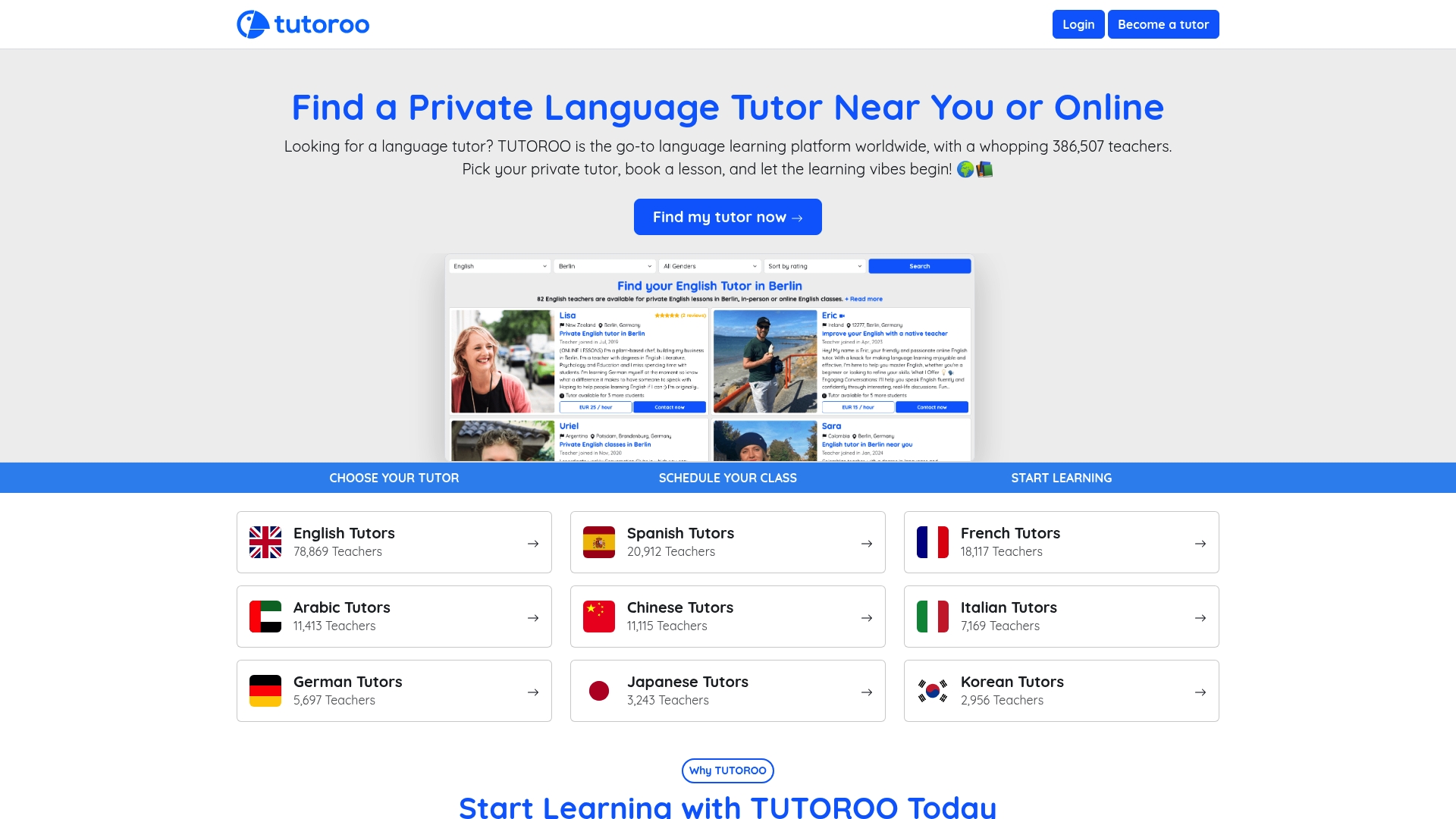
Tutoroo connects learners with over 386,000 language teachers across the world, covering languages from English and Spanish to Arabic, Chinese, French, and beyond. Lessons are available online or in person, so you can fit personalised vocabulary coaching around your schedule. Whether you are preparing for an exam, planning a trip, or simply passionate about a new language, a Tutoroo tutor brings the kind of authentic, human context that no algorithm can replicate. Find a private tutor and put these vocabulary methods into practice with expert guidance from day one.
FAQ
What is the most effective method for vocabulary retention?
Spaced repetition is the most research-supported method for long-term vocabulary retention. Tools like Anki schedule reviews at optimal intervals to prevent forgetting.
How many words do I need before extensive reading becomes useful?
Research by Paul Nation shows learners need roughly 3,000–4,000 word families, or 95–98% lexical coverage, before reading context reliably teaches new words.
Is active recall better than re-reading vocabulary lists?
Active recall produces stronger delayed retention than re-reading, even without feedback. Self-testing through flashcards or quizzes is more effective than passive review.
How should beginners start building vocabulary?
Beginners benefit most from deliberate study of high-frequency words using spaced repetition before moving to context-based reading. A core of 1,000–2,000 words provides the foundation needed for authentic texts to become useful.
Can AI apps replace a language tutor for vocabulary learning?
AI apps improve engagement and daily habits but cannot replicate the authentic feedback a tutor provides. AI-assisted vocabulary tools work best as a complement to tutor-guided learning, not a replacement.