

TL;DR:
- Building habits consistently is more effective than focusing solely on methods or tools for language learning. Starting early with speaking, guessing, and spaced repetition transforms progress from tentative to confident. Embracing errors and maintaining short, daily practice sessions foster real communication, cultural connection, and lasting fluency.
Starting a new language feels exciting right up until the moment you realise you have no idea where to begin. Most tips for beginner language learners focus on apps and vocabulary lists, but they skip the part that matters most: how you build habits, how you practise thinking in a new tongue, and why waiting until you feel "ready" to speak is one of the most common mistakes beginners make. This article covers science-backed, practical strategies that open doors to real communication, cultural connection, and lasting confidence.
Table of Contents
- Key takeaways
- 1. Build a daily learning routine around existing habits
- 2. Guess first — the science of pretesting
- 3. Prioritise high-frequency words and start speaking early
- 4. Use spaced repetition with a structured review schedule
- 5. Balance active retrieval with passive exposure
- Our take: the mindset shift that changes everything
- Take your learning further with a private tutor
- FAQ
Key takeaways
| Point | Details |
|---|---|
| Build habits before chasing methods | Attaching language practice to daily routines beats searching for the perfect app or course. |
| Guess before you learn | Attempting vocabulary before formal instruction strengthens memory, even when your guesses are wrong. |
| Prioritise the top 1,000 words | High-frequency vocabulary covers roughly 80% of everyday conversation, reducing overwhelm fast. |
| Space your reviews at 2, 7, and 30 days | Structured spaced repetition locks new words into long-term memory far better than random review. |
| Retrieval beats re-reading | Testing yourself on what you've learned, rather than reviewing it passively, builds real fluency. |
1. Build a daily learning routine around existing habits
The single biggest predictor of progress for beginners is not talent or the right method. It is consistency. Daily habit stacking attaches language practice to activities you already do, making it far easier to maintain momentum without relying on willpower.
Think about your morning commute, your lunch break, or the five minutes you spend waiting for your coffee to brew. Each of those moments is an opportunity to listen to a short podcast in your target language, review a handful of new words, or even just whisper vocabulary aloud to yourself. The friction disappears when learning slots into life rather than competing with it.
Research supports starting with sessions as short as 15 minutes per day. Short, focused bursts prevent the burnout that derails so many beginners who try to study for hours in one sitting. Gradual increases over weeks feel manageable rather than punishing.
- Use your commute for listening practice or podcast episodes in the target language
- Review flashcards during lunch rather than scrolling social media
- Keep a personal vocabulary journal and add three to five new words every evening
- Track your sessions in a learning log to see tangible progress over time
Pro Tip: Set a recurring phone alarm labelled with your target language name. When it goes off, that is your one non-negotiable signal to practise, even if only for five minutes.
2. Guess first — the science of pretesting
Here is something most beginner guides skip entirely. Attempting to recall or guess a word before you formally learn it actually strengthens memory more than studying the correct answer outright. This technique is called pretesting, and the research behind it is striking.
Four experiments showed that learners who guessed vocabulary before instruction, and then received immediate feedback, remembered words significantly better than those who saw the answer first. Your brain treats an incorrect guess as unfinished business, which makes the correct answer more memorable when it arrives.
"Deliberate cycles of attempt, immediate correction, and retry build beginner confidence and reduce learning anxiety." — Psychology Today
You can apply this immediately with a few simple exercises:
- Show yourself a picture and try to name it in your target language before checking the word
- Cover the translation on a flashcard, make your best guess, then flip it over
- Write down what you think a sentence means before looking at the translation
- After each guess, correct yourself straight away and say the right answer aloud at least twice
The key is the feedback loop. Guessing without correction does not help much. It is the combination of attempt, immediate correction, and retry that builds confidence and reduces the anxiety that so many beginners feel about making mistakes.
3. Prioritise high-frequency words and start speaking early
One of the most effective beginner language study tips is also one of the most overlooked. Rather than trying to memorise every word you encounter, focus on the vocabulary that appears most often. The top 1,000 high-frequency words cover roughly 80% of everyday conversation in most languages. That is a remarkably achievable target for any beginner.

Once you have a working vocabulary of common words, start speaking. Do not wait until your grammar feels perfect. Early spoken practice prevents over-reliance on reading and writing alone, which creates a lopsided skill set where you can recognise words on a page but freeze the moment someone speaks to you.
Here is a practical sequence for building speaking and listening skills from the start:
- Learn 10 to 15 high-frequency words per week and focus on those only
- Listen to native speech at a slightly slower pace, using learner podcasts or subtitled videos
- Shadow what you hear. Repeat sentences immediately after the speaker, matching rhythm and intonation as closely as you can
- Record yourself speaking for 60 seconds each day and listen back to notice pronunciation patterns
- Find a language exchange partner or tutor to practise real conversation, even at a basic level
Pro Tip: Shadowing is one of the most underused tools for beginners. Play a short audio clip, pause it every few seconds, and repeat the exact phrase aloud. It trains your mouth and ear at the same time, which is something flashcards simply cannot do.
Relying only on recognition skills like reading and watching gives you a false sense of progress. Productive skills require early practice to develop, and the sooner you start speaking, the more natural it becomes.
4. Use spaced repetition with a structured review schedule
Random flashcard sessions feel productive but rarely are. The most effective spaced repetition follows a concrete schedule: review new vocabulary at two days, seven days, and thirty days after first exposure. This cadence matches how human memory consolidates information, reinforcing words just before they would naturally fade.
The source of your vocabulary matters too. Words you encountered in a real conversation, a film scene, or a graded reader carry more emotional context than words pulled from a random list. Selective spaced review tied to real input creates stronger retention because your brain associates the word with a meaningful moment.
| Input type | Best for | Watch out for |
|---|---|---|
| Graded readers | Building reading fluency at your level | Choosing texts that are too easy with no new vocabulary |
| Learner podcasts | Listening comprehension and natural speech patterns | Moving to native-speed content too early |
| Subtitled videos | Connecting spoken and written forms of words | Relying on subtitles as a crutch rather than removing them progressively |
| Flashcard apps | Structured vocabulary review at spaced intervals | Reviewing cards randomly without a timing strategy |
Avoid the temptation to use multiple resources at once. Sticking with one or two methods for several months builds consolidation. Switching apps or courses every few weeks disrupts progress and leaves gaps in your knowledge.
Pro Tip: After each immersion session, write down three to five words that were new or interesting. Add those specific words to your spaced repetition system rather than importing a generic word list. They will stick far better because you already have a memory attached to them.
5. Balance active retrieval with passive exposure
Reading a word ten times feels like studying. Testing yourself on that word once is actually more effective for memory. Retrieval practice outperforms re-reading for long-term retention, and beginners who understand this shift their study sessions dramatically.
Active retrieval means producing the language from memory, not recognising it on a page. Write a sentence without looking at your notes. Record a voice note where you describe your day using only words you have learned. These activities simulate the real-life demand of speaking or writing and prepare your brain for those moments.
Effective retrieval practice for beginners looks like this:
- Write vocabulary from memory before checking your notes or flashcard app
- Leave a short delay, even just a few minutes, between studying a word and testing yourself on it
- Mix new vocabulary with older words you have already studied to keep earlier learning alive
- Use voice notes to practise speaking, then listen back and note any gaps or mistakes
- Combine retrieval tests with immediate correction to reinforce the right form straight away
Passive exposure plays a supporting role too. Listening to music in your target language, watching television programmes with subtitles, or even leaving a foreign-language radio station playing in the background reinforces the sounds and rhythms of the language without demanding full concentration. The combination of comprehensible input and frequent output is what separates learners who plateau from those who keep growing.
For more ideas on how to practise in ways that feel natural and enjoyable, explore these language practice activities that work across all proficiency levels.
Our take: the mindset shift that changes everything
I've worked alongside thousands of language learners at Tutoroo, and the pattern I keep seeing is this: the learners who make the fastest progress are not the ones with the best apps or the most time. They are the ones who stopped waiting to feel ready.
In my experience, the "I'm not ready to speak yet" trap is the single most damaging belief a beginner can carry. Hesitation does not protect you from embarrassment. It just delays the very practice that would have made you confident. Every minute spent perfecting grammar in private is a minute not spent getting corrected by a real speaker, which is where actual acquisition happens.
What I've learned from watching so many learners succeed and struggle is that consistency in short sessions crushes sporadic marathon study sessions every single time. Thirty minutes daily, five days a week, will produce more fluency than a four-hour Saturday binge followed by three days of nothing.
My strongest advice? Make mistakes on purpose. Guess words you do not know. Speak before you are ready. The feedback loop that follows, the correction, the retry, the "oh, that's how it works" moment, is where language learning truly lives. Embrace a growth mindset and treat every error as data, not failure. The learners who see it that way are the ones who arrive at fluency.
— TUTOROO
Take your learning further with a private tutor
The strategies covered in this article give you a strong foundation, but self-study has a ceiling. Without personalised feedback, errors can quietly become habits. A private tutor spots those patterns early, adapts lessons to your specific goals, and creates the authentic speaking practice that accelerates everything else.
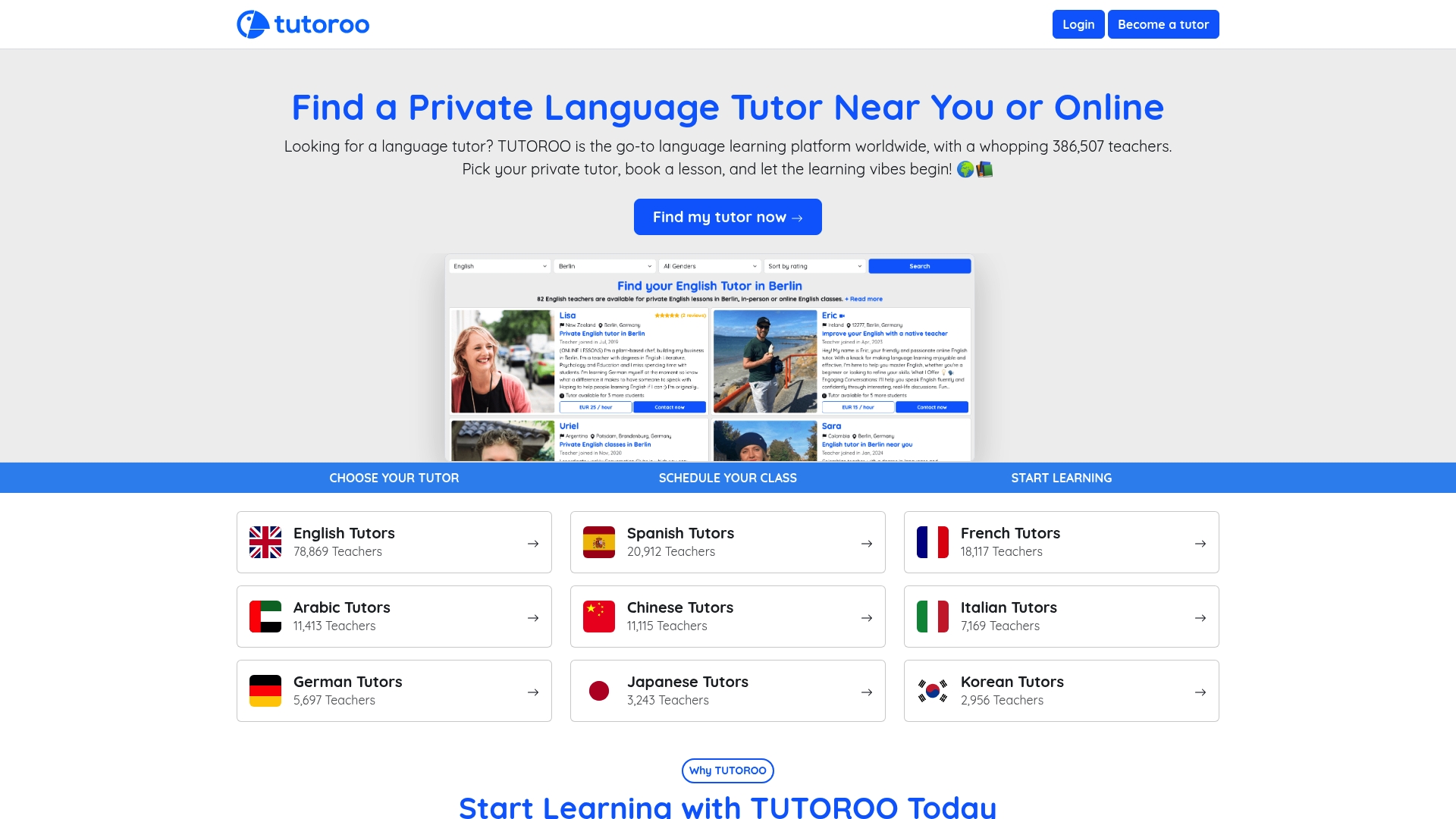
At Tutoroo, you can connect with over 386,000 language tutors worldwide, whether you prefer online sessions from home or face-to-face lessons in your local area. Every tutor on the platform brings real cultural knowledge and personalised guidance that no app can replicate. If you are serious about learning a language and want support that fits around your routine, Tutoroo makes it simple to find the right tutor and start your first session. For learners of English specifically, Tutoroo's English tutoring services connect you with experienced tutors ready to help you build confidence from your very first lesson.
FAQ
How long should a beginner practise each day?
Fifteen to twenty minutes of focused daily practice is enough to build momentum as a beginner. Consistency matters more than session length, so short daily sessions outperform infrequent long ones.
What are the best languages for beginners to learn?
Languages that share vocabulary or structure with your native tongue tend to feel more accessible. English speakers often find Spanish, French, or Italian more approachable because of the shared Latin roots and familiar alphabet.
Is it really okay to speak before you feel ready?
Yes. Beginning to speak early, even with mistakes, accelerates acquisition. Waiting for perfect grammar delays the real-life practice that builds fluency and confidence.
What is spaced repetition and how does a beginner use it?
Spaced repetition involves reviewing vocabulary at increasing intervals, ideally at two, seven, and thirty days after first learning a word. It prevents forgetting by reinforcing words just before they would naturally fade from memory.
How do I know if I'm making real progress?
Keep a learning log that tracks vocabulary learned, sessions completed, and conversations attempted. Monitoring tangible progress through a journal gives you concrete evidence of growth and keeps motivation strong when progress feels slow.