

Write student-centred learning goals that start with "Students will…" and pair each one with a measurable objective. That single habit separates lessons where progress is visible from lessons where it is only hoped for.
Here is the checklist you can copy into your next lesson plan:
- Start with the student, not the teacher. Frame every goal as what the student will do, not what you will cover.
- Choose an observable action verb. Words like "analyse," "construct," or "compare" can be assessed. "Understand" cannot.
- Apply SMART criteria. Each objective should be Specific, Measurable, Achievable, Relevant, and Time-bound.
- Attach assessment evidence. Name how you will know the student has met the objective (a quiz, a spoken response, a written paragraph).
- Keep it lesson-sized. One objective per lesson is enough. A unit goal can hold three to five.
Copyable template:
By the end of this [lesson / unit], students will [observable action verb] [specific content or skill] [under these conditions] to [success criteria / timeframe].
Example: By the end of this lesson, students will compare two persuasive texts by identifying three rhetorical devices in each, using a structured annotation guide.
Key takeaways
Effective learning objectives are student-centred, use observable action verbs from Bloom's Taxonomy, align with assessments, and stay lesson-sized so progress is visible and measurable.
| Point | Details |
|---|---|
| Start with "Students will…" | Frame every objective from the student's perspective using one observable action verb. |
| Apply SMART criteria | Each objective should be Specific, Measurable, Achievable, Relevant, and Time-bound. |
| Align to assessment | Match the verb in your objective to the cognitive demand of your formative and summative tasks. |
| Keep objectives lesson-sized | One objective per lesson; break larger goals into a staircase of smaller targets. |
| Tutoroo for language goals | Tutoroo connects Australian learners with private tutors for personalised, objective-driven language sessions online or in person. |
Table of Contents
- What is the difference between learning goals and learning objectives?
- How to set learning goals using backward design
- How to write measurable objectives with SMART criteria and Bloom's verbs
- How do you align objectives with assessments and activities?
- Ready-to-use templates and examples across levels
- How do you track progress against learning objectives?
- Common goal-setting mistakes and how to fix them
- What does the research say about effective learning objectives?
- A practical tutor workflow for turning curriculum into daily targets
- How private tutoring helps you reach measurable language goals
- Sources
What is the difference between learning goals and learning objectives?
The terms get used interchangeably, but the distinction is worth keeping. A learning goal is broad and course-level. It describes the big idea or capability a student should develop over a unit, semester, or programme. A learning objective (also called a learning target) is specific, lesson-sized, and student-centred. It tells students exactly what to learn and how to show it.
ASCD's research on learning targets puts it plainly: goals set broad intentions while objectives are the measurable steps students take to reach those goals. The practical difference is scope and perspective.
Stanford's guidance on writing learning goals frames the course-level question as: What should students know and be able to do by the end of this course, and how will you assess that? That question belongs at the goal level. The daily lesson question is narrower: What will students demonstrate today?
Why does this matter for assessment? Because a goal like "Students will develop critical thinking in history" cannot be marked. An objective like "Students will evaluate two primary sources by identifying one strength and one limitation in each" can be.
Here are three side-by-side examples showing the shift from teacher-centred to student-centred phrasing:
- Teacher-centred: "I will teach students about persuasive writing techniques." → Student-centred: "Students will write a persuasive paragraph using at least two rhetorical devices."
- Teacher-centred: "We will cover Spanish verb conjugation." → Student-centred: "Students will conjugate ten regular -ar verbs in the present tense with 80% accuracy."
- Teacher-centred: "Students will understand photosynthesis." → Student-centred: "Students will explain the role of chlorophyll in photosynthesis using a labelled diagram."
When students understand the target and the success criteria, they can assess their own progress and become more intentional learners. Sharing the objective at the start of a lesson is not a formality. It is one of the most direct ways to build self-regulation.
How to set learning goals using backward design
Backward design, developed by Grant Wiggins and Jay McTighe, flips the usual planning sequence. Instead of starting with activities, you start with the end in mind. Washington State University's teaching toolkit describes the first stage as getting clear about the course's most important outcomes before designing assessments or activities to support them.
Here is a four-step workflow you can follow for any lesson or unit.
-
Identify what really matters. Start with your curriculum standards or the course's big idea. Ask: what is the one thing students must be able to do when this is over? For a Year 9 English unit, that might be: "Students will construct a sustained argument in writing." For a language tutoring session, it might be: "Students will hold a three-minute conversation about daily routines in French."
-
Decide on acceptable evidence first. Before you plan a single activity, ask: how will I know the student has got there? Name the assessment. A written essay, a spoken role-play, a short quiz, an annotated diagram. This step keeps objectives honest because it forces you to ask whether the outcome is actually assessable.
-
Draft a unit goal, then break it into lesson-sized objectives. The unit goal is the destination. Each lesson objective is one step on the staircase. School District 72's learning hub recommends designing objectives as a progression of smaller targets so students can track progress and make learning visible. A unit goal about constructing arguments might break into three lesson objectives: identifying a claim, selecting evidence, and structuring a rebuttal.
-
Make objectives SMART and choose observable verbs. Once you have a draft objective, run it through the SMART test and replace any vague verb with a Bloom's Taxonomy action verb. More on that in the next section.
Pro Tip: Keep each objective teachable in a single session. If you cannot realistically assess it by the end of one lesson, split it. An objective that spans three lessons is a mini-goal, not a lesson target.
How to write measurable objectives with SMART criteria and Bloom's verbs
The SMART framework gives you a quick checklist for any objective you draft. Johns Hopkins University's guidance on writing effective learning objectives specifies that a well-written objective includes who will do what, under which conditions, and criteria for evaluation. SMART maps directly onto that structure.
- Specific: Name the exact skill or content. "Students will summarise" is more specific than "Students will understand."
- Measurable: Attach a criterion. "…in three sentences" or "…with 80% accuracy" makes the bar visible.
- Achievable: Pitch the objective at the right level for the learner. A Year 7 student and a Year 11 student need different targets for the same topic.
- Relevant: Connect the objective to the unit goal or curriculum standard it serves.
- Time-bound: Specify the lesson or session. "By the end of today's lesson" is enough.
Bloom's Taxonomy action verbs by level
Bloom's Taxonomy organises thinking from lower-order recall to higher-order creation. Choosing the right level ensures your objective matches the cognitive demand of the task.
| Bloom's level | Sample action verbs |
|---|---|
| Remember | list, recall, identify, name, define |
| Understand | summarise, explain, paraphrase, classify |
| Apply | use, demonstrate, solve, calculate, execute |
| Analyse | compare, differentiate, examine, break down |
| Evaluate | judge, justify, critique, assess, argue |
| Create | design, construct, produce, compose, plan |
Rewriting weak objectives
Vague verbs like "understand," "know," and "appreciate" are the most common problem in objective writing. They describe internal states that cannot be observed or assessed. Here are four rewrites:
- "Students will know the water cycle." → "Students will label the four stages of the water cycle on a diagram."
- "Students will understand fractions." → "Students will calculate equivalent fractions for five given examples."
- "Students will appreciate Spanish culture." → "Students will describe two cultural traditions from a Spanish-speaking country in a short spoken presentation."
- "Students will learn about persuasion." → "Students will construct a persuasive paragraph using a claim, evidence, and a counter-argument."
The Yale Poorvu Center's guidance on writing learning goals reinforces this directly: effective objectives start with "Students will…" and state what students will demonstrate, not what the instructor will teach.
How do you align objectives with assessments and activities?
Instructional alignment means your objective, your teaching activities, and your assessment all point at the same target. When they do, students are significantly more likely to make cognitive connections and achieve learning success, according to UConn's Centre for Excellence in Teaching and Learning. When they do not, students often study the wrong things or feel blindsided by assessments.
Think of it as a triangle: the objective sits at the top, the learning activity and the assessment sit at the base. All three must face the same direction. If your objective asks students to "evaluate" but your assessment only asks them to "recall," the triangle collapses.
Here is a mapping example across three disciplines:
| Objective | Formative check | Summative evidence |
|---|---|---|
| Students will compare two poetic forms by identifying structural differences | Exit ticket: name one difference between a sonnet and a ballad | Written comparison paragraph submitted at end of unit |
| Students will conjugate regular -er verbs in French present tense with 80% accuracy | Quick oral drill with tutor feedback mid-lesson | Short written quiz: ten sentences, self-marked against answer key |
| Students will analyse a data set to identify one trend and one anomaly | Think-pair-share discussion during lesson | Lab report section: results and discussion |
Rubrics are the practical tool that closes the loop. A rubric translates the success criteria from your objective into specific, observable performance levels. When students see the rubric before the task, the objective stops being abstract. KDP's research on student-friendly learning targets confirms that rubrics and exemplars are central to turning objectives into feedback students can use immediately, not just after the fact.
Ready-to-use templates and examples across levels
Good templates save time and keep phrasing consistent. The examples below are written for Australian classroom and tutoring contexts. Copy them and adjust the verb, content, and criteria to suit your learners.
Primary (Years 3–6)
Goal: Students will develop confidence in reading for meaning. Lesson objective: By the end of this lesson, students will identify the main idea and two supporting details in a short non-fiction text using a graphic organiser.
Secondary (Years 7–10)
Goal: Students will build skills in scientific reasoning. Lesson objective: By the end of this lesson, students will analyse experimental results by identifying one variable that affected the outcome and explaining why, in two to three sentences.
Tertiary / subject-specific
Goal: Students will develop academic writing skills at university level. Lesson objective: By the end of this tutorial, students will construct a thesis statement for a given essay prompt that includes a claim, a reason, and a scope qualifier.
Language learning (tutoring contexts)
These templates align with Tutoroo's guidance on setting language learning goals and suit one-on-one sessions.
- Vocabulary: By the end of this session, students will use ten new food vocabulary items in original sentences with correct article agreement in Spanish.
- Speaking: By the end of this lesson, students will hold a two-minute conversation about weekend plans in Mandarin without referring to notes.
- Writing: By the end of this unit, students will write a 150-word email in French using at least three formal register phrases from the session vocabulary list.
Personalising for diverse learners
For students with additional learning needs, reduce the quantity criterion rather than the cognitive demand. Instead of "identify three rhetorical devices," try "identify one rhetorical device and explain its effect." For ESL and ELL learners, add a language scaffold to the condition: "using a sentence frame provided" or "with access to a bilingual glossary." The verb and the standard stay the same; the support changes.
How do you track progress against learning objectives?
Tracking progress does not require elaborate systems. The most useful tools are the ones you can use in the last five minutes of a lesson.
Formative checks are low-stakes, frequent, and fast. They tell you whether students are on track before the summative assessment arrives.
- Exit ticket: One question on a sticky note or digital form at the end of the lesson. "Write one thing you can now do that you could not do at the start." Directly tied to the lesson objective.
- Quick quiz: Three to five questions, self-marked, focused on the lesson's action verb. Useful for recall and application levels.
- Observation checklist: A simple grid with student names and the lesson objective. Tick when you hear or see the target behaviour during a task.
- Think-pair-share: Students articulate the objective in their own words to a partner. If they cannot explain it, they have not met it yet.
For tracking language progress specifically, a short spoken check at the end of each tutoring session is often more revealing than a written quiz.
A weekly tracking checklist for students or tutors might look like this:
- Did I write a clear objective for each session this week?
- Did I check progress against that objective before the session ended?
- Did I give or receive specific feedback tied to the objective?
- Did I adjust next week's target based on what I found?
Feedback is only useful when students have a chance to act on it. Returning a marked rubric the day before the next assessment is too late. Build in a short revision or response task immediately after feedback so the loop closes within the same learning sequence.
Common goal-setting mistakes and how to fix them
Most problems with learning objectives come down to four recurring errors. Each has a quick fix.
- Vague verbs. "Students will understand the causes of World War I." Fix: Replace "understand" with an observable verb. "Students will identify three causes of World War I and rank them by significance."
- Teacher-centred phrasing. "I will introduce students to the present perfect tense." Fix: Rewrite from the student's perspective. "Students will form five sentences using the present perfect tense to describe recent experiences."
- Multiple actions in one objective. "Students will read, analyse, and write a response to a poem." Fix: Split into three separate objectives across three lessons. One verb per objective.
- Objectives too large for one lesson. "Students will master essay writing." Fix: Break it down. "By the end of this lesson, students will write an introductory paragraph that includes a hook, context, and thesis statement."
Quick vetting checklist before you publish an objective:
- Does it start with "Students will…"?
- Does it contain one observable action verb?
- Is there a clear success criterion (how well, how many, to what standard)?
- Can it be assessed within this lesson or session?
- Is it pitched at the right level for this group of learners?
If you answer "no" to any of these, revise before sharing the objective with students.
What does the research say about effective learning objectives?
The evidence base for the practices in this guide is consistent across university teaching centres and peer-reviewed work. Three findings stand out.
Observable verbs and student-centred framing are foundational. The Yale Poorvu Center recommends using measurable action verbs from Bloom's Taxonomy and framing objectives so they state what students will demonstrate. This is not stylistic preference. It is the difference between an objective that can be assessed and one that cannot.
Alignment drives learning success. UConn's teaching guidance is direct: when objectives are properly aligned with materials, activities, and assessments, students are more likely to make cognitive connections and achieve success. Alignment should drive course and lesson design from the start, not be retrofitted after activities are chosen.
Shared targets build student agency. ASCD's research shows that when students understand the learning target and success criteria, they can assess their own progress and become more motivated and intentional learners. Posting the objective on the board is not enough. Students need to understand what it means and what success looks like.
KDP's work on student-friendly targets adds that rubrics and exemplars are not optional extras. They are central to turning objectives into feedback students can use straight away.
A practical tutor workflow for turning curriculum into daily targets
The most useful planning habit is also the simplest: before each lesson or session, write one learning target on a card or in your planner. Not a topic. A target. "Students will…" followed by a verb and a criterion.
Here is a weekly workflow that works for both classroom teachers and private tutors:
- Plan: Review the unit goal and identify one lesson-sized target for the session.
- Share: Tell the student the target at the start. Write it where both of you can see it.
- Teach: Design the activity to practise the exact skill named in the target.
- Formative check: In the last five minutes, assess whether the target was met (exit ticket, quick question, brief spoken response).
- Feedback: Give one specific piece of feedback tied to the target. Not general praise.
- Adjust: If the target was not met, carry it forward or break it into a smaller step for next time.
This loop keeps sessions purposeful and makes progress visible over time. For a step-by-step language learning approach, this workflow pairs naturally with a structured curriculum where each session builds on the last.
Pro Tip: In tutoring contexts, involve the student in writing the target. Ask: "What do you want to be able to do by the end of today?" Then shape their answer into a proper objective together. Students who co-author their targets are more invested in meeting them.
How private tutoring helps you reach measurable language goals
One-to-one tutoring is particularly well-suited to goal-based learning because every session can be built around a single, personalised objective. There is no need to pace to a class average or cover content a student already knows. A tutor can identify exactly where a learner is, set a target that stretches them by one step, and give immediate feedback on whether they reached it.
Learners who benefit most from this approach are those who need targeted practice in a specific skill (speaking fluency, grammar accuracy, academic writing), those working toward a defined milestone (a language exam, a job interview, a university application), and those who have tried group classes but found the pace or content did not match their needs.
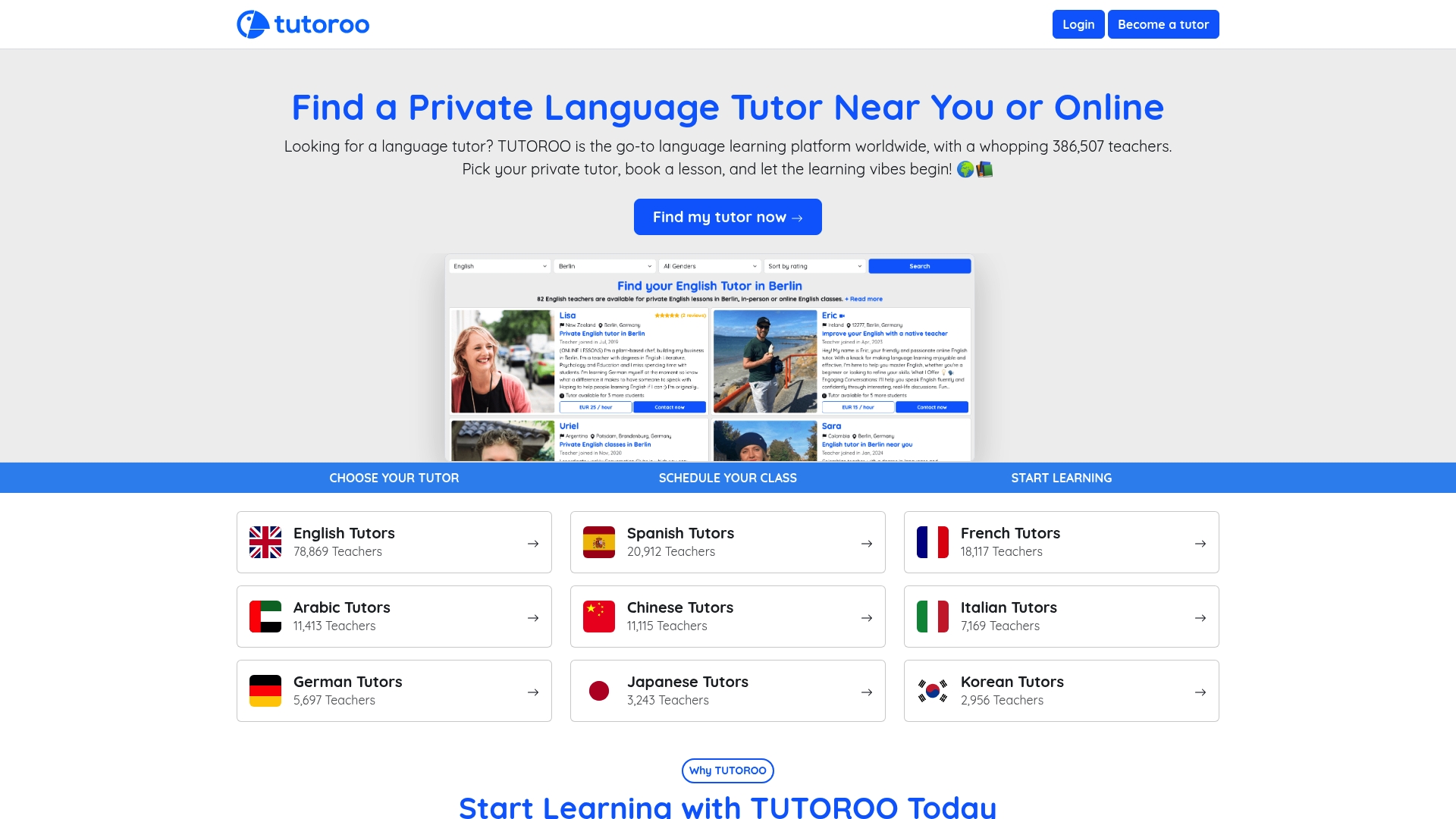
Tutoroo connects language learners across Australia with over 386,000 private tutors in languages including English, Spanish, French, Arabic, Mandarin, and many more. Sessions can be conducted locally or online, and tutors set their own schedules so lessons fit around study, work, and life. Whether you are a student setting personal language learning goals or a tutor looking to structure sessions around clear objectives, the platform makes the match straightforward.
Find your tutor and start working toward a measurable goal at Tutoroo.
Sources
These resources underpin the guidance in this article. Each one is worth bookmarking for ongoing lesson planning.
- Writing Learning Goals, Objectives and Outcomes | Poorvu Center for Teaching and Learning
- Knowing your learning target
- Writing Learning Objectives | eCampus | Center for Excellence in Teaching and Learning | University of Connecticut
- Writing Effective Learning Objectives / Educational Objectives | Office of the Provost
- How to write learning goals | Stanford