

TL;DR:
- Personalised instruction consistently outperforms uniform teaching by improving achievement and long-term outcomes.
- Effective lesson design involves assessing learners, maintaining core outcomes, and using tiered activities for individual readiness.
Personalised instruction consistently outperforms one-size-fits-all teaching for language learners. Student-centred instruction produces a medium-strength effect size of g = 0.44 across a meta-analysis of 365 studies, confirming that tailoring how you teach genuinely moves the needle on achievement. RAND Corporation research adds that learners in personalised settings show stronger growth and better long-term outcomes, with benefits becoming more pronounced after educators gain at least one year of experience with these methods. For Australian tutors and educators working across diverse classrooms, the importance of customised lesson plans comes down to one practical reality: learners arrive with different starting points, cultural backgrounds, and goals, and a single lesson design cannot serve all of them well.
Key benefits at a glance:
- Higher engagement and motivation when content connects to learner interests and cultural context
- Stronger academic outcomes through tiered activities matched to individual readiness
- Greater equity by addressing gaps without lowering expectations
- Better long-term retention when pacing suits the individual learner
Key benefits of customised lesson plans for language learners in Australia
Australia's classrooms reflect extraordinary cultural and linguistic diversity, making tailored instruction not a luxury but a practical necessity. Differentiated instruction leads to increased student engagement and positively impacts learning outcomes by recognising each learner's unique strengths and challenges. For language learners specifically, this means lessons that draw on authentic cultural references, real-world vocabulary relevant to Australian life, and tasks calibrated to where the learner actually is rather than where the curriculum assumes they should be.
Benefits for language learners in Australian contexts:
- Lessons anchored in familiar cultural settings increase motivation and participation
- Tiered tasks prevent knowledge gaps by matching complexity to prior attainment
- Inclusive design supports English language learners alongside native speakers
- Personalised one-on-one lessons accelerate progress by removing the pacing constraints of group instruction
- Equity improves when instruction addresses both academic needs and learner confidence
Individualised instruction works best as a complement to high-quality whole-class teaching, not a replacement. Used this way, it yields medium-strength achievement gains as reported in systematic reviews, particularly when tasks are matched accurately to student readiness.
Common challenges in implementing customised lesson plans and how to overcome them
The biggest practical obstacle is time. Designing separate materials for every learner group is exhausting, and the administrative burden on teachers can reduce the quality of pedagogical interaction if it is not managed carefully. A second challenge is curriculum integrity: when educators pull materials from unvetted sources to fill personalisation gaps, they risk diluting the rigour of standards-aligned content.
Common challenges and practical responses:
- Workload: Use modular lesson design with a core standards-based plan plus pre-prepared differentiation blocks for specific learner groups, avoiding the need to rewrite entire lessons each week.
- Curriculum tension: Follow a standards-based curriculum as the foundation, then adapt delivery rather than replacing content with unvetted materials.
- Managerial burden: Digital tools and AI-assisted planning assistants can handle the structural drafting, freeing up time for genuine teaching interaction.
- Skill gaps in differentiation: Professional development focused on tiered task design builds confidence without requiring educators to reinvent their practice from scratch.
Pro Tip: Build your lesson around a core set of learning outcomes that every learner must reach, then prepare two or three differentiation blocks in advance. Swap them in as needed rather than rewriting the whole plan. This approach protects curriculum quality while giving you genuine flexibility.
Best practices for creating effective customised lesson plans for language learners
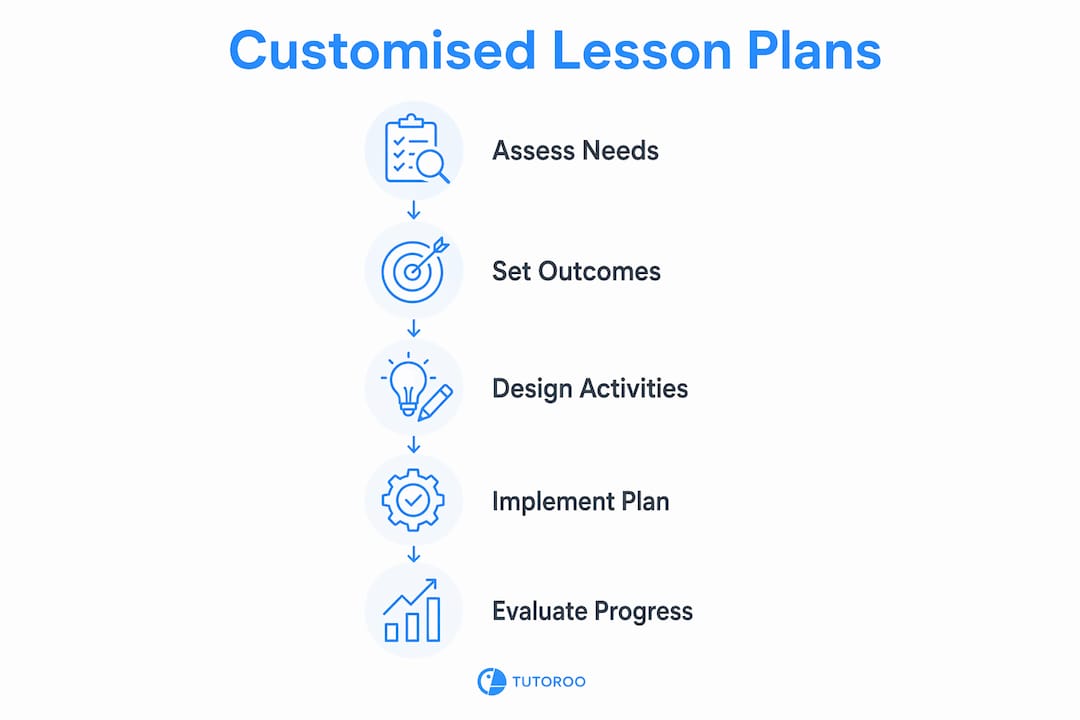
Effective personalisation changes how content is taught, not what learners are expected to achieve. Successful customisation keeps core learning outcomes intact while adapting instructional methods, pacing, scaffolds, and materials to student readiness. That distinction matters practically: every learner deserves access to the same conceptual richness; only the path to get there changes.
A step-by-step approach:
- Assess learner readiness before designing any activity. Use diagnostic tasks, conversation samples, or placement tools to map where each learner sits relative to the target outcome.
- Frame outcomes conceptually. Teach the concept of, say, expressing opinion or narrating sequence rather than a specific topic, so learners at different levels can engage with the same essential question from different entry points.
- Design tiered activities. Prepare three versions of the core task: one with additional scaffolding (sentence frames, vocabulary banks), one at grade level, and one with extended complexity for advanced learners.
- Use multimodal instruction. Rather than matching lessons to assumed learning styles, multimodal teaching exposes learners to text, audio, and visual content across sessions, developing skills across all modes without limiting any learner to a single channel.
- Apply flexible grouping. Rotate learners between readiness-based and interest-based groups so grouping serves the task, not a fixed label.
- Maintain common rubrics. Personalise the form of assessment (essay, oral response, graphic organiser) but hold all learners to the same quality criteria.
- Review and adjust regularly. Treat the lesson plan as a living document, updated as learner progress data comes in.
Explore types of language lesson plans to find formats that suit different instructional goals and learner profiles.
How Tutoroo supports tailored language learning in Australia
Tutoroo connects learners with over 386,000 private language tutors worldwide, offering one-on-one lessons that are designed around individual goals, schedules, and learning preferences. For Australian educators and tutors, the platform provides a practical environment where customised instruction is the default, not the exception.
- Tutors set their own schedules and work directly with learners to build lesson plans suited to specific language goals, whether conversational fluency, exam preparation, or cultural immersion.
- The Tutoroo blog offers resources on tailored curriculum strategies and lesson plan formats to support tutors in designing effective personalised sessions.
- Learners can find tutors across languages including English, Spanish, French, Arabic, and Mandarin, matched by location, availability, and teaching approach.
- The platform's direct messaging system makes it straightforward to discuss learner needs before the first lesson, so tutors arrive prepared rather than guessing.
How to assess individual learner needs before customising
Accurate assessment is the foundation of any effective personalised plan. Without it, differentiation is guesswork. Adaptive learning approaches emphasise that matching tasks to a learner's actual attainment level prevents knowledge gaps from widening over time.
Practical assessment steps:
- Conduct a short diagnostic conversation or written task to gauge vocabulary range, grammar control, and confidence
- Use a learner questionnaire to capture goals, interests, cultural background, and previous language learning experience
- Review any prior assessment results or placement test scores
- Identify specific gaps (pronunciation, reading comprehension, writing fluency) rather than assigning a single broad level
- Revisit the assessment every four to six weeks as the learner progresses
What customised lesson plan components look like in practice
A well-built customised lesson plan for a language learner typically includes several distinct, adaptable components rather than a single fixed sequence.
| Component | What it looks like in practice |
|---|---|
| Learning outcome | Conceptually framed goal all learners work toward (e.g., "express and justify an opinion") |
| Vocabulary scaffold | Tiered word lists: core terms for all learners, extended terms for advanced learners |
| Input text or audio | Authentic material at the learner's current reading or listening level |
| Tiered task | Three versions of the same activity at different complexity levels |
| Cultural connection | Content referencing Australian contexts or the learner's own cultural background |
| Assessment | Flexible format (oral, written, visual) with a shared rubric |
How to measure whether your customised lesson plans are working
Measuring the impact of individualised lesson design requires more than a single end-of-term test. Ongoing, layered evaluation gives a clearer picture of whether the plan is actually moving the learner forward.
Effective evaluation strategies:
- Pre and post tasks: Use matched tasks at the start and end of a unit to measure specific gains in vocabulary, grammar, or fluency.
- Learner self-assessment: Ask learners to rate their own confidence on target skills before and after each lesson. This builds metacognitive awareness and surfaces gaps the tutor may not see.
- Observation notes: Record qualitative observations during lessons, noting where learners hesitate, self-correct, or ask for clarification.
- Personalised feedback cycles: Regular, specific feedback tied to the learner's stated goals creates a feedback loop that informs the next lesson's design.
- Progress portfolios: Collect samples of learner output over time so both tutor and learner can see concrete evidence of development.
Tools and resources that help you build customised lesson plans
Several practical tools support the planning process without requiring educators to start from a blank page every session.

TeachQuill's Customised Teaching Planner generates draft lesson plans based on grade level, standards, learner readiness, and accommodation needs. Tutors can input their classroom context and receive a structured draft to edit, which is particularly useful for managing differentiation across multiple learner groups.
TeachQuill's Differentiated Instruction Generator takes a core learning objective and produces tiered strategies, scaffolded activities, and extension tasks for different learner profiles, including English language learners and advanced students.
Beyond AI-assisted tools, the Education Endowment Foundation's Teaching and Learning Toolkit provides evidence ratings for individualised instruction approaches, helping tutors prioritise strategies with the strongest research backing. The ASCD publishes practical guides on personalised learning that translate research into classroom-ready frameworks.
Common mistakes to avoid when customising lesson plans
Even experienced tutors fall into predictable traps when personalising instruction.
- Changing the learning outcome instead of the method. Lowering expectations to make a lesson easier is not differentiation. Keep the conceptual goal constant and adjust the scaffold instead.
- Over-relying on assumed learning styles. Matching instruction to learning styles offers minimal advantage and limits skill development. Multimodal instruction serves learners more effectively.
- Pulling unvetted materials from unreviewed sources to fill gaps, which risks inconsistent quality and curriculum misalignment.
- Treating customisation as a one-off task. A lesson plan built on last term's assessment data quickly becomes outdated. Regular reassessment keeps personalisation accurate.
- Neglecting the whole-group dimension. Individualised instruction works best alongside high-quality shared teaching, not as a complete replacement for it.
- Skipping common rubrics. Personalising the assessment format is fine; personalising the quality criteria is not. All learners should be held to the same standard of achievement.
Key takeaways
Customised lesson plans improve language learning outcomes by adapting instruction to individual readiness, cultural context, and goals while keeping core learning standards consistent for every learner.
| Point | Details |
|---|---|
| Research-backed impact | Student-centred instruction produces an effect size of g = 0.44 across 365 studies, confirming real achievement gains. |
| Keep outcomes constant | Personalise the method and scaffold, never the learning standard or conceptual goal. |
| Assessment comes first | Accurate diagnosis of learner gaps is the prerequisite for any effective customisation. |
| Modular design reduces workload | A core plan plus pre-built differentiation blocks protects quality without rewriting lessons from scratch. |
| Tutoroo enables personalised practice | Over 386,000 tutors on Tutoroo deliver one-on-one lessons built around individual learner needs and goals. |