
TL;DR:
- Tracking progress involves monitoring study hours, vocabulary growth, and real-world communication milestones. Focusing on a few key metrics helps learners stay motivated and avoid burnout while measuring meaningful improvements.
Tracking language progress means monitoring measurable aspects of your language acquisition, including study hours, vocabulary growth, and real-world communication milestones. Without a clear system, learners often feel stuck even when they are genuinely improving. The good news is that knowing how to track language progress does not require formal tests or expensive software. Frameworks like the Common European Framework of Reference for Languages (CEFR) and hour estimates from the Foreign Service Institute (FSI) give you concrete benchmarks to measure against. This guide explains which metrics matter, which tools work, and how to turn tracking into a habit that keeps you motivated.
What core metrics should you track to measure language progress?
The most reliable way to measure language learning progress is to focus on a small number of meaningful, quantifiable metrics. Tracking everything at once leads to burnout. Tracking nothing leaves you guessing.
Study hours and CEFR benchmarks
Study time is the most objective metric available to any learner. The CEFR framework maps proficiency levels directly to approximate study hours: A1 requires roughly 100 hours, A2 around 200 hours, B1 around 400 hours, B2 around 600 hours, C1 around 800 hours, and C2 over 1,000 hours. Achieving full proficiency in some languages requires 600 to 2,200 hours of dedicated study. That range reflects the difference between learning Spanish and learning Mandarin. Logging your hours gives you a realistic sense of where you sit on that scale.
Vocabulary growth
Vocabulary is one of the clearest indicators of language development. Learners should distinguish between active vocabulary (words they can produce) and passive vocabulary (words they recognise). Testing vocabulary monthly by comparing recognition rates in texts of consistent difficulty provides a clear benchmark that most learners overlook. Retesting similar texts spaced over time shows genuine retention, not just short-term recall.
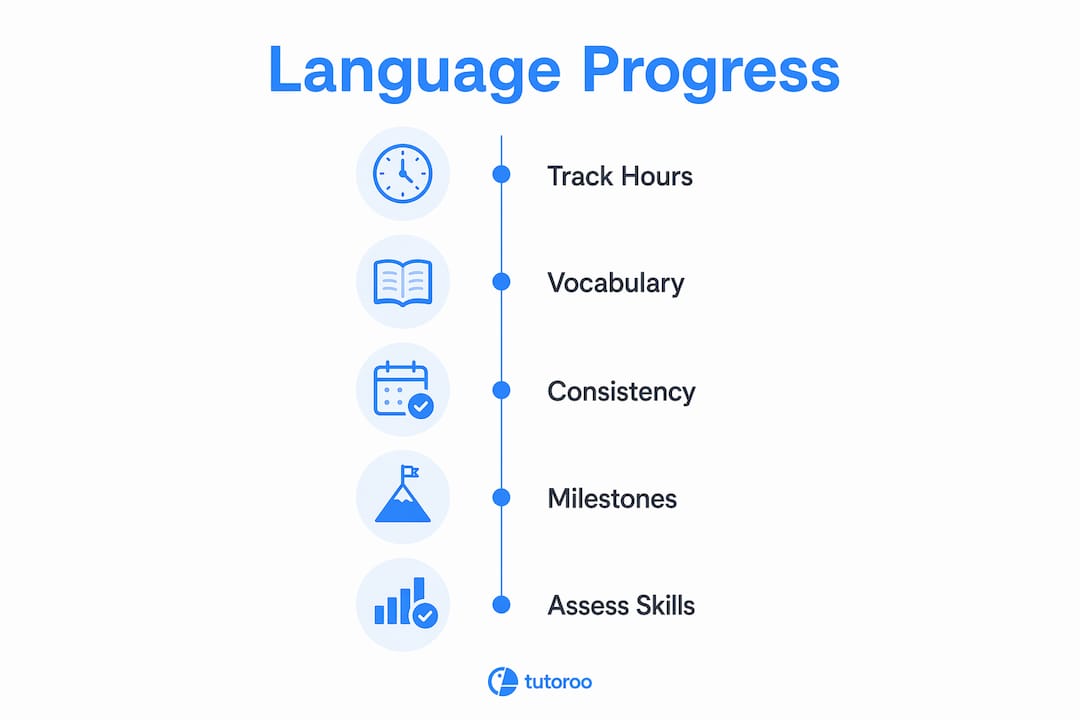
Consistency and real-world milestones
Study streaks and session frequency reveal whether your habits are sustainable. A learner who studies for three hours once a week builds less fluency than one who studies for 30 minutes daily. Real-world milestones matter just as much as logged hours. Personal milestones such as understanding a joke, holding a full conversation, or navigating a social interaction without switching languages are powerful indicators of functional ability. Learners who count immersion activities like watching shows or reading in the target language get a fuller picture of their total input.
Here is a simple overview of the core metrics worth tracking:
| Metric | What it measures | How to track it |
|---|---|---|
| Study hours | Time invested | Daily log or app timer |
| Vocabulary size | Active and passive word bank | Monthly text retests |
| Session frequency | Consistency of habit | Calendar or streak tracker |
| Real-world milestones | Functional communication ability | Personal journal notes |
| Immersion input | Total language exposure | Logged hours including media |
Pro Tip: Link your study hour log directly to CEFR level targets. If you are at 350 hours and aiming for B1, you know exactly how far you have to go.
How can you use practical tools and habits to track your progress efficiently?
The best tracking system is the one you will actually use. Complexity kills consistency.
-
Paper journal. A simple notebook works well for learners who prefer analogue methods. Write the date, time studied, topics covered, and one thing you noticed about your progress. The physical act of writing reinforces reflection.
-
Spreadsheet. A basic spreadsheet in Google Sheets or Excel lets you log hours, vocabulary counts, and milestone dates. You can add charts to visualise growth over weeks and months. This suits learners who like data but want full control over what they record.
-
Dedicated tracking apps. Several apps are built specifically for tracking language learning milestones, logging study sessions, and setting vocabulary goals. Many include built-in reminders and streak counters that reinforce daily habits.
-
Digital planners. Tools like Notion or a calendar app let you combine study scheduling with progress notes. They work especially well for learners who already manage their day digitally.
-
Audio and writing sample folders. Keeping dated recordings of yourself speaking or saved writing samples gives you undeniable proof of development. Dated audio folders show real progress far more clearly than a CEFR label alone.
The single most effective habit is logging immediately after each session. Logging study time right after a session makes tracking a two-minute habit that prevents forgetfulness and keeps your data accurate. Waiting until the end of the week means you will undercount and lose the motivational benefit of seeing daily progress.
Pro Tip: Set a recurring phone reminder for five minutes before you finish each study session. Use those five minutes to log what you did and note one win, no matter how small.

What advanced methods exist to assess language skills beyond basic tracking?
Basic hour logging tells you how much time you have invested. Advanced assessment tells you what that time has actually produced. The distinction matters because time and skill do not always grow at the same rate.
Informal assessments provide a more dynamic view of learner growth than standardised tests alone. They are also far more accessible. Here are the most effective methods:
-
Storytelling exercises. Record yourself telling a short story or describing an image in the target language. Review the recording a month later. Listen for fluency, connector variety (words like "however," "because," and "although"), and how naturally ideas flow.
-
Scenario completion tests. Give yourself a realistic communication scenario, such as ordering food, asking for directions, or handling a complaint. Complete it without hints. Note which parts felt natural and which required effort.
-
Listening retell accuracy. Listen to a short audio clip in the target language, then retell what you heard in your own words. This tests both comprehension and production at the same time.
-
Writing clarity checks. Write a short paragraph on a familiar topic, then review it a week later. Look for grammar patterns you have improved and errors that keep recurring.
-
Pronunciation checks. Record yourself reading a passage aloud and compare it to a native speaker recording of the same text. Focus on rhythm and stress patterns, not just individual sounds.
Weekly five to ten-minute check-ins using metrics like listener retell accuracy, connector variety, and pronunciation clarity maintain a clear view of functional readiness without formal tests. That is a small time investment for a significant insight.
An integrated-skill approach to assessment, combining listening with speaking or reading with writing, better reflects real-world communication ability than isolated grammar tests. This mirrors how language actually works in conversation and is worth building into your monthly review. You can also explore multilingual content benchmarks to understand how vocabulary size and study hours translate into measurable proficiency across different languages.
| Assessment type | Skill tested | Frequency |
|---|---|---|
| Storytelling exercise | Speaking fluency and coherence | Monthly |
| Scenario completion | Functional communication | Monthly |
| Listening retell | Comprehension and production | Weekly |
| Writing clarity check | Grammar and expression | Fortnightly |
| Pronunciation recording | Accent and rhythm | Monthly |
How to interpret your tracked data and adjust your learning plan?
Data without interpretation is just numbers. The real value of tracking comes from what you do with the patterns you find.
-
Identify what is working. If your vocabulary scores improve in weeks when you watch shows in the target language, that is a signal to do more of it. If your speaking fluency stalls despite high study hours, your input may be too passive.
-
Avoid comparing yourself to others. Language acquisition speed varies significantly based on your native language, prior experience, and daily exposure. A learner comparing their 400-hour B1 progress to someone else's 300-hour B1 is comparing incompatible situations.
-
Set short-term goals from your data. Lack of well-defined short-term goals is the biggest hurdle for most learners. Use your tracking data to set goals for the next two to four weeks, not the next year. "Reach 50 new active vocabulary words" is more motivating than "become fluent."
-
Adjust your resources and techniques. If your writing clarity check reveals recurring grammar errors, add a focused grammar resource for that specific pattern. If your listening retell scores are low, increase your daily listening input before the next check.
-
Use progress to prevent burnout. Seeing a chart of your study hours climb, or listening to a recording from six months ago, reminds you that progress is real even when it feels invisible. This is why setting meaningful personal milestones matters more than chasing a generic proficiency label.
The goal is a feedback loop: track, review, adjust, and repeat. Each cycle makes your study plan more targeted and your progress more visible.
Key takeaways
Tracking language progress works best when you focus on a small number of meaningful metrics, build logging into your daily routine, and use your data to set short-term goals rather than chasing abstract proficiency labels.
| Point | Details |
|---|---|
| Log study hours against CEFR targets | Map your hours to A1–C2 benchmarks to know exactly where you stand. |
| Track vocabulary actively and passively | Retest similar texts monthly to measure genuine retention, not just exposure. |
| Use informal assessments weekly | Five to ten-minute check-ins on speaking, listening, and writing reveal more than formal tests. |
| Build logging as a two-minute habit | Log immediately after each session to keep your data accurate and consistent. |
| Set short-term, personal milestones | Replace vague goals with specific targets drawn directly from your tracking data. |
What Tutoroo has learned about tracking progress long term
The learners who make the most consistent progress are rarely the ones with the most elaborate tracking systems. They are the ones who pick two or three metrics they genuinely care about and check in on them regularly without drama.
At Tutoroo, we see this pattern repeatedly across thousands of learners. A student learning French who tracks only their weekly conversation minutes and monthly vocabulary scores often outpaces someone tracking twelve different metrics across four apps. Simplicity creates follow-through. Complexity creates avoidance.
The other thing worth saying plainly: proficiency labels are useful reference points, but they are not the whole story. A learner who can confidently order coffee, argue a point, and laugh at a joke in their target language has achieved something real, regardless of whether a test would call them B1 or B2. Keeping dated audio recordings and writing samples gives you that proof in a way no label can.
Start with one metric this week. Log your study time today. Record yourself speaking for two minutes. That is enough to begin.
— Tutoroo
Tutoroo and personalised language progress
Tracking your progress is most powerful when you have an expert helping you interpret what the data means.

Tutoroo connects learners with over 386,000 private language tutors across the world, covering languages from English and Spanish to Arabic, French, and Chinese. A private tutor does more than teach. They help you set achievable milestones, give you honest feedback on your speaking and writing, and adjust each session based on where your tracking data shows you need the most work. Whether you are looking for an English tutor online or want to work with a specialist in another language, Tutoroo makes it straightforward to find the right match. Find your private tutor and put your tracking insights to work in real, personalised sessions.
FAQ
What is the best way to track language learning progress?
The most effective approach combines logging study hours against CEFR benchmarks, tracking vocabulary growth monthly, and using short informal assessments for speaking, listening, and writing. Keeping it simple with two or three core metrics prevents burnout and keeps tracking consistent.
How many hours does it take to reach each CEFR level?
CEFR hour estimates place A1 at roughly 100 hours, A2 at 200 hours, B1 at 400 hours, B2 at 600 hours, C1 at 800 hours, and C2 at over 1,000 hours. These figures vary depending on your native language and the target language's complexity.
Can I assess language skills without formal tests?
Yes. Weekly five to ten-minute check-ins using storytelling exercises, listening retell tasks, and writing clarity reviews provide a clear view of functional progress without any formal testing. Informal assessments often reveal more about real communication ability than standardised tests do.
How do I stay motivated when progress feels slow?
Set short-term, personal milestones drawn from your tracking data rather than chasing abstract proficiency labels. Keeping dated audio recordings and writing samples gives you tangible proof of development that a CEFR level alone cannot provide.
How often should I review my language learning data?
A weekly five to ten-minute review of your core metrics is enough to spot patterns and adjust your study plan. A deeper monthly review, including vocabulary retests and a recorded speaking sample, gives you a fuller picture of your growth over time.