

A community tutor wins on cost and conversation frequency. A professional teacher wins on structure and credentials. If you want cheap, regular speaking practice, a community tutor usually gets you there faster; if you need a curriculum, exam preparation, or measurable progression, a certified teacher earns their higher rate.
- Cost and frequency favour community tutors — lower hourly rates mean you can book more sessions and rack up practice hours.
- Structure and accountability favour professional teachers — credentials, lesson plans and assessment suit exam prep and long-term skill building.
| Dimension | Community tutor | Professional teacher |
|---|---|---|
| Qualifications | Native/fluent speaker, informal experience | Degree, teaching certificate, formal training |
| Typical cost | Lower hourly rate | Higher hourly rate |
| Format | Conversational, flexible | Structured curriculum, planned progression |
| Outcomes | Fluency, confidence, speaking practice | Exam readiness, CEFR progression, measurable skills |
| Accountability | Informal feedback | Assessment, tracked progress |
Key Takeaways
Community tutors deliver affordable, frequent conversation practice, while professional teachers deliver structured, assessed progress, and combining both produces the strongest outcomes.
| Point | Details |
|---|---|
| Cost gap is real | Community tutors average roughly US$12 to US$18 per hour versus US$28 to US$45 for certified teachers. |
| Frequency beats intensity for fluency | Community tutors get booked around 2.8 times weekly, building conversational momentum through repetition. |
| Structure beats frequency for exams | Professional teachers offer diagnostic assessment and CEFR-tracked progression that casual conversation cannot replicate. |
| Tutoring counts as experience | Document lesson plans, hours and student progress to make tutoring credible on a CV or certification application. |
| Tutoroo simplifies the match | Tutoroo lets you compare verified tutor and teacher profiles, read reviews, and book a trial lesson before paying for a package. |
Table of Contents
- Community tutor vs professional teacher: the basic definitions
- What qualifications and oversight should you expect?
- How much do tutors and teachers cost, and how often should you book?
- How do lesson structure and outcomes actually differ?
- Which learner types suit each option best?
- Does tutoring count as professional teaching experience?
- How do you choose: a checklist for learners and aspiring tutors
- What does the research say about community tutoring, and why does vetting matter?
- A practical note on mixing lesson types
- Find a vetted tutor or teacher without the guesswork
- Where to read more
- Frequently asked questions
- Sources
Community tutor vs professional teacher: the basic definitions
A community tutor is someone who teaches a language conversationally, usually as a native or highly fluent speaker, without formal teaching credentials. They focus on real-world speaking practice, pronunciation, and cultural context rather than a fixed syllabus. You'll find them on marketplaces, in community language exchange groups, or running informal sessions from home.
A professional teacher holds a recognised qualification (a degree, a TEFL or TESOL certificate, or classroom experience) and works from a structured curriculum with defined learning objectives. Professional teachers commonly operate in schools, accredited language academies, or through formal one-on-one tutoring vs teaching arrangements where progress is tracked against a syllabus.
- Community tutors: marketplaces, informal groups, casual practice partners.
- Professional teachers: schools, accredited academies, structured private tuition.
What qualifications and oversight should you expect?
Professional teachers typically bring a degree, a certificate such as TEFL or TESOL, and documented classroom hours. Career comparisons note that teachers usually need formal licensure, while tutors can start with subject expertise or informal certification instead.
Community tutors rarely hold teaching credentials but often bring native or C2-level fluency and genuine cultural knowledge. What matters more than a certificate on a marketplace profile is verifiable trust: identity checks, visible language certificates, a trial lesson, and honest student reviews.
- Check for verified ID and language proficiency certificates.
- Read recent reviews, not just the star rating.
- Book a trial lesson before committing to a package.
Pro Tip: A profile with 20 detailed reviews and a completed trial lesson tells you more than a vague "certified" badge with no evidence behind it.
How much do tutors and teachers cost, and how often should you book?
Pricing tracks credentials closely. Platform data cited in 2025 found community tutors averaged US$12 to US$18 per hour with users booking roughly 2.8 sessions weekly, while certified teachers averaged US$28 to US$45 per hour with closer to 1.2 sessions weekly. The same reporting found hybrid learners, mixing both, showed stronger three-month retention than either group alone.
That price gap shapes strategy. Frequent, low-cost sessions build conversational fluency through repetition; fewer, pricier sessions with a structured teacher build depth per hour.
- Use trial lessons to test fit before buying a package.
- Ask about cancellation windows and refund policy up front.
- Package deals with community tutors often make daily practice affordable, an approach local vs online tutoring compares in more depth.
How do lesson structure and outcomes actually differ?
Community tutors run largely conversational sessions: free talk, pronunciation correction on the fly, and topics driven by your interests rather than a syllabus. Professional teachers start with a diagnostic assessment, set learning objectives, and measure progression against a framework like the CEFR.
Tutoring itself is structurally different from classroom teaching: it's targeted, high-feedback, and supplemental, delivering faster correction loops for the individual learner. In one month, expect improved confidence speaking from either type. By three months, structured teaching typically shows measurable CEFR movement; frequent tutor practice shows smoother, more natural speech. By six months, combining both tends to outperform relying on just one, a pattern this guide to personalised one-on-one lessons explores further.
Which learner types suit each option best?
Community tutors: pros — affordable, flexible scheduling, culturally rich conversation. Cons — no formal assessment, inconsistent lesson planning, variable teaching skill.
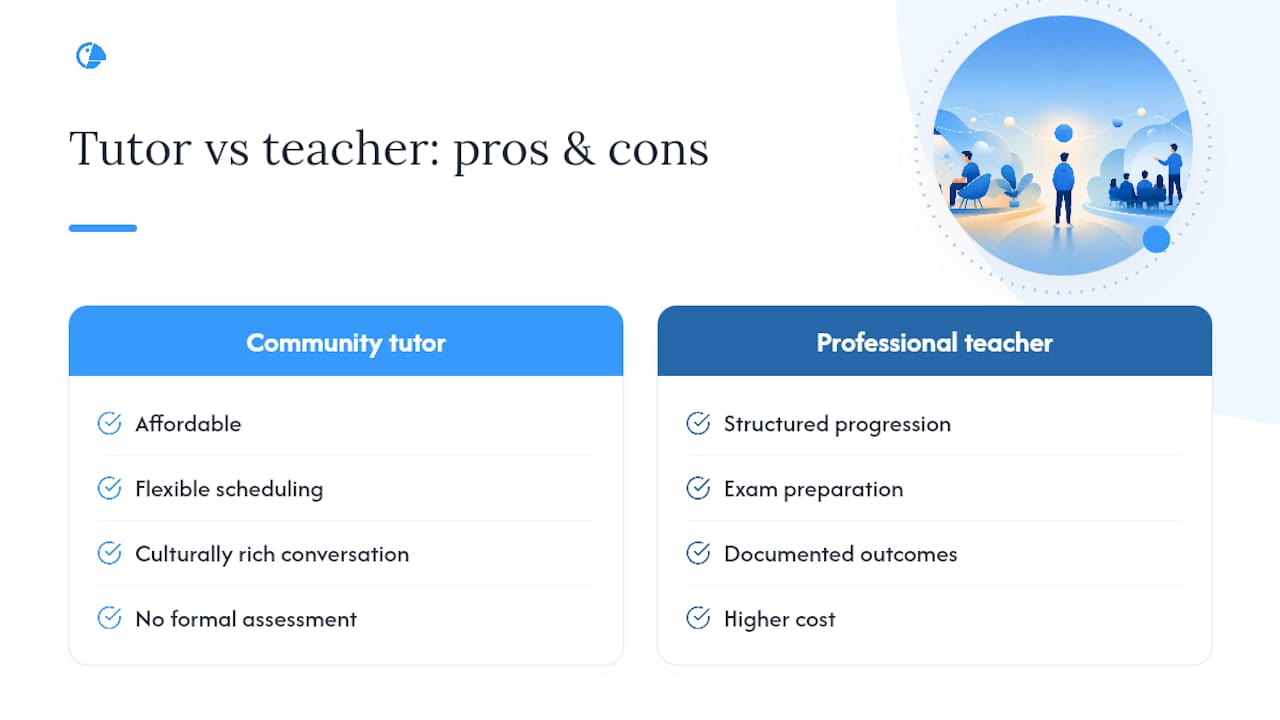
Professional teachers: pros — structured progression, exam preparation, documented outcomes. Cons — higher cost, less scheduling flexibility, sometimes less conversational warmth.
Beginners and casual learners often thrive with community tutors first; exam candidates and learners chasing a specific CEFR level generally need a professional teacher's structure. Travellers wanting fast conversational confidence usually lean tutor first.
Pro Tip: Book a certified teacher for grammar foundations and a community tutor for daily conversation practice — the hybrid approach shows the strongest retention over three months.
Does tutoring count as professional teaching experience?
Yes, with documentation. Tutoring can count as genuine teaching experience if you record hours, student progress, and lesson plans.
- Keep a simple log of lesson plans and topics covered.
- Note measurable student progress, not just attendance.
- Collect written references from regular students.
Employers and certification bodies generally treat documented one-on-one tuition as legitimate, though it rarely substitutes fully for classroom-based teaching practicums required for formal licensure.
How do you choose: a checklist for learners and aspiring tutors
For learners, work through this before booking:
- Define your goal: conversational fluency, exam prep, or general improvement.
- Set a realistic budget and preferred session frequency.
- Decide whether you need structured assessment or flexible conversation.
- Shortlist two or three tutors or teachers and book trial lessons with each.
- Compare feedback quality, not just personality fit.
Before booking, ask directly: What's your teaching background? Do you use structured materials? How do you track progress? What's your cancellation and refund policy?
Watch for these red flags on any profile or during a trial:
- No verifiable reviews or a suspiciously perfect rating with zero detail.
- Vague answers about materials or lesson structure.
- Reluctance to offer any trial lesson at all.
If you're an aspiring tutor rather than a learner, the path usually runs the other way. Start as a community tutor to build hours and confidence, log your outcomes carefully, then pursue a certificate such as TEFL or TESOL through a recognised provider, Eduvos among them, to move toward accredited teaching roles. Many successful language educators built their first hundred hours this way, using tutoring platforms like the one covered in this guide on beginner to advanced tutoring before ever entering a classroom.
What does the research say about community tutoring, and why does vetting matter?
A 2016 synthesis found volunteer and community tutors can produce meaningful learning gains when programmes include training, oversight and ongoing support, not when volunteers are left unsupervised. Separately, one-to-one tuition has been shown to add roughly five months of progress compared with typical classroom pacing, with small-group tuition adding closer to four months. Shared cultural or life experience between tutor and learner also tends to lift engagement, according to policy guidance on community-based tutoring. Vetting, verified credentials, and visible trial outcomes are what turn "someone who speaks the language" into a tutor you can trust with your time and money.
A practical note on mixing lesson types
The strongest results tend to come from combining both roles rather than picking a permanent side. A certified teacher builds the scaffolding; a community tutor keeps you talking often enough that the scaffolding sticks. When you're evaluating either option on a marketplace, spend the extra five minutes checking profile credentials and booking a trial before committing to a package. It costs you little and saves you from months with the wrong fit.

Find a vetted tutor or teacher without the guesswork
Tutoroo connects you directly with tutors and teachers who list their credentials, languages, and availability up front, so you're never choosing blind between a community tutor and a professional teacher.
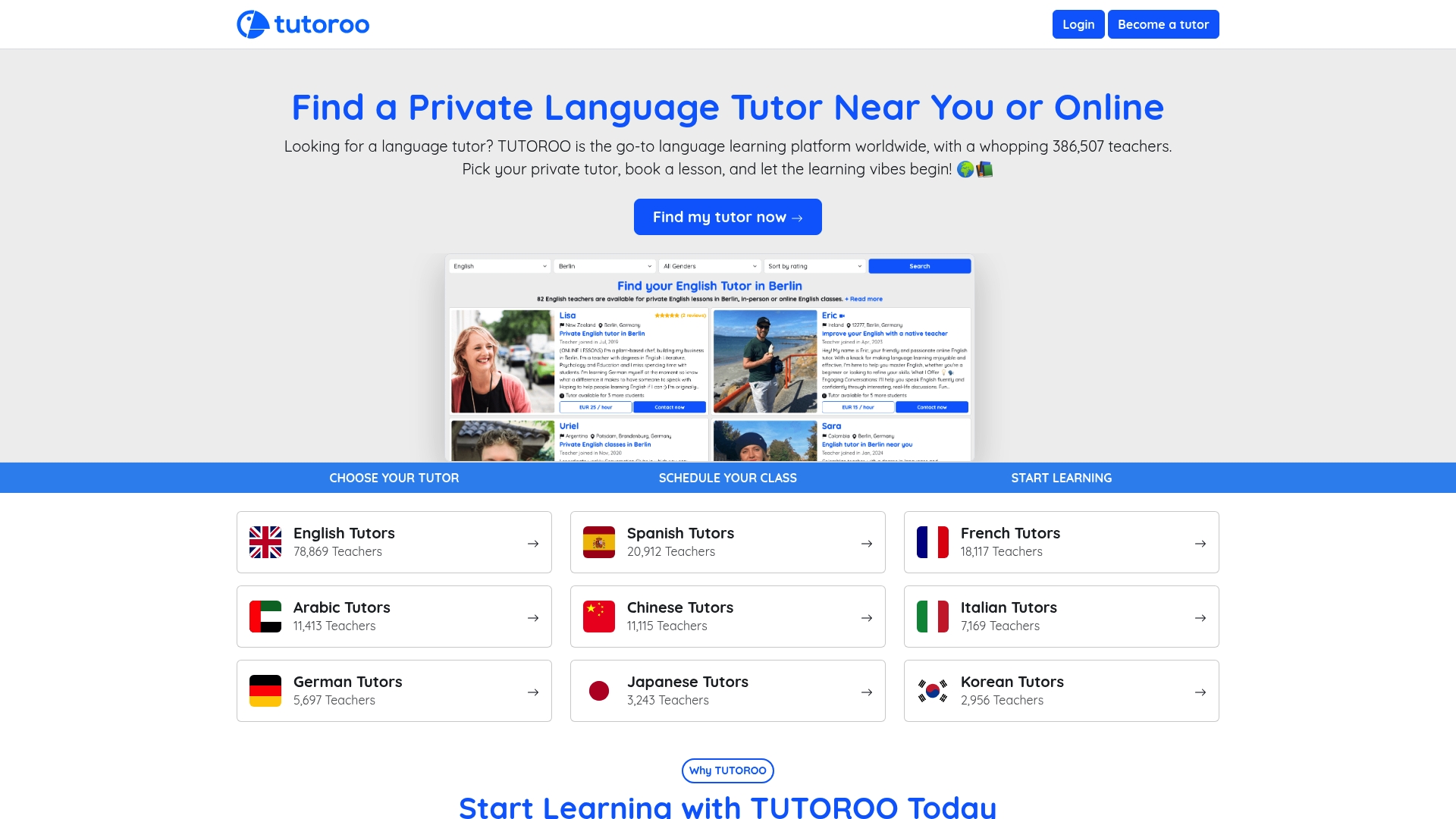
Every profile on Tutoroo shows verified details, student reviews, and lesson history, whether you're after a certified teacher for exam preparation or a native speaker for daily conversation. You can message a shortlist directly, compare their approach, and book a trial lesson before paying for a full package. If you're learning a specific language, landing pages like the Malay tutor directory show exactly how local and online options sit side by side. Search by language and availability now, message two or three tutors who fit your goal, and book a trial lesson this week.
Where to read more
- Journal of Public Scholarship in Higher Education: the core research on volunteer tutoring effectiveness with oversight.
- National Tutoring Authority: clear breakdown of tutoring versus teaching mechanics.
- Cluey Learning: effect-size data on one-to-one and small-group tuition.
- Tutoroo: browse verified tutor and teacher profiles directly.
Frequently asked questions
Is a community tutor as effective as a professional teacher? For conversational fluency and confidence, yes, often just as effective, and sometimes more motivating. For exam preparation or structured skill-building, a professional teacher's credentials and curriculum generally produce more predictable results.
Can I switch between a community tutor and a professional teacher? Yes, and many learners do. A hybrid approach, using a teacher for foundations and a tutor for regular practice, tends to show stronger retention over time.
Do I need a teaching certificate to become a community tutor? No. Community tutoring typically only requires strong fluency and the ability to hold a lesson. A certificate like TEFL or TESOL becomes necessary once you want to move into formal teaching roles.
How do I verify a tutor's credentials on a marketplace platform? Check for verified ID, visible language certificates, detailed student reviews, and always book a trial lesson before purchasing a larger package.
Sources
- Journal of Public Scholarship in Higher Education, Volume 6 (2016)
- Leveraging community-based organizations for high-dosage tutoring
- Tutoring vs. Teaching: Key Differences and When Each Applies | National Tutoring Authority
- Tutoring vs Teaching | Cluey Learning
- Community Tutor vs. Certified Teacher: Which Is Better for Learning? - World Today News