

Explainer articles are the fastest, lowest-friction way to make a single language concept noticeable, understandable, and practiceable. That claim holds whether you are a classroom educator, a private tutor, or a content writer producing resources for learners at any level. The research backs it: explainer guides increase noticing and retention when paired with active tasks such as pretesting and retrieval practice, and cognitive load theory explains precisely why a focused, chunked explanation outperforms a sprawling lesson every time.
Three benefits stand out immediately:
- Clarity and noticing: a single-concept explainer directs attention to the target form, triggering the noticing that acquisition research identifies as a prerequisite for learning.
- Scaffolded practice and retrieval: pairing the explanation with a short task converts passive reading into active processing, which is where durable retention begins.
- Shareable reference for learners and tutors: a well-structured explainer becomes a reusable artefact, something a tutor can assign before a session and a learner can return to a week later for spaced review.
The frameworks that explain why this works include John Sweller's cognitive load theory, the Morphological Congruency Hypothesis (MCH), and the Unified Competition Model (UCM). The Cambridge Applied Psycholinguistics study on English article acquisition shows that L1 background systematically shapes how learners process and produce target forms, which means a well-designed explainer must account for that variation rather than assume a universal starting point.
Key takeaways
Explainer articles work for language concepts because they combine focused input, explicit contrast, and immediate retrieval practice into a single, reusable artefact that learners and tutors can return to across spaced sessions.
| Point | Details |
|---|---|
| Plan the single question | Define one testable question and a success criterion before drafting a word. |
| Write BLUF plus two contrasting examples | State the rule in one sentence, then show a correct and an incorrect form with a one-line annotation. |
| Always include a practice task | A 30–60 second retrieval prompt converts passive reading into durable learning. |
| Design for the learner's L1 background | Learners whose L1 lacks the target feature need more worked examples and explicit contrast. |
| Measure retention at one week | A short follow-up quiz is the only reliable signal that the explainer changed what learners can do. |
Table of Contents
- What is an explainer article, and how does it differ from a lesson or FAQ?
- What are the concrete benefits of explainer articles for language learning?
- When should you choose an explainer over a video, lesson, or FAQ?
- How to plan an effective explainer before you write a word
- Step-by-step writing process for a single explainer
- Which design and format choices make explainers more effective?
- How do you measure whether your explainer is actually working?
- Common pitfalls when writing explainers, and how to fix them
- What does research say about explaining language concepts?
- Tutoroo's perspective on what actually makes explainers worth publishing
- Sources
What is an explainer article, and how does it differ from a lesson or FAQ?
An explainer is a focused, learner-centred piece that answers one testable question and ends with a small practice task. That definition rules out a lot of content that gets mislabelled as an explainer.
A traditional article goes broad: it provides background, narrative, and context. A lesson or interactive module goes deep: it sequences multiple skills, includes graded exercises, and often requires a facilitator. An FAQ answers many questions briefly. An explainer sits in a distinct space: it answers one question thoroughly enough that a learner can immediately do something they could not do before reading it.
The New York Times uses a Q&A-style explainer format shaped by audience research, including Google Trends and reader questions, to ensure each piece addresses a genuine, bounded information need. That editorial discipline translates directly to language education: if your explainer cannot be summarised as a single question a learner would actually type into a search bar, it is probably too broad.
A micro-structure you can copy immediately:
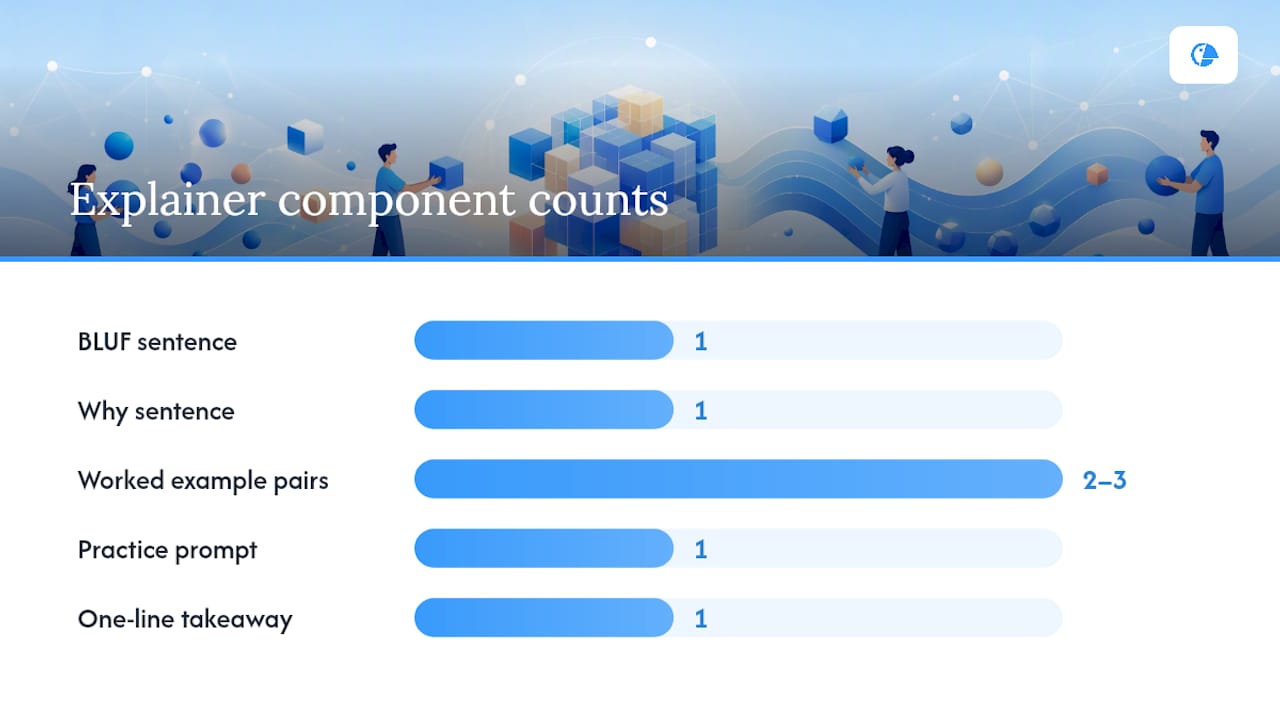
- BLUF (bottom line up front): one sentence stating the rule and when it applies.
- Why it matters: one short paragraph connecting the rule to a real communication problem.
- Worked examples: two or three contrasting pairs showing correct use and common error.
- Practice task: one 30–60 second activity the learner completes before closing the page.
What are the concrete benefits of explainer articles for language learning?
The benefits are specific and research-grounded, not just pedagogical intuition.
- Increases noticing through input enhancement. Highlighting a target form in context draws conscious attention to it. Noticing is widely regarded in second language acquisition research as a necessary condition for intake.
- Reduces extraneous cognitive load. When an explanation covers only one concept, working memory is free to process meaning rather than manage competing information. Sweller's cognitive load framework makes this concrete: extraneous load from poorly organised material actively blocks learning.
- Makes transfer explicit. Annotated examples show learners which cue triggered the correct form, so they can apply the same reasoning in new contexts rather than memorising a single sentence.
- Supports retrieval practice and spacing. A short in-article task creates an initial retrieval event. When learners return to the explainer a week later, that second exposure becomes a spaced-practice session, one of the most reliable levers for durable retention.
Research callout: Glosses and active tasks increase noticing and retention, but only when learners engage actively. Passive reading of an explainer produces what researchers call the illusion of understanding, a feeling of comprehension that evaporates under recall conditions. The practice task is not optional decoration; it is the mechanism that converts reading into learning.
When should you choose an explainer over a video, lesson, or FAQ?
Format choice comes down to matching unit size to learner goal. An explainer suits a single rule or distinction. A full lesson suits a multi-step skill. A video suits pronunciation or gesture. A FAQ suits quick reference across many unrelated questions.
Run these five diagnostic questions before choosing your format:
Can the learner's goal be expressed as one testable question? If yes, an explainer is likely the right fit. If the goal requires mastering three interdependent skills, a sequenced lesson serves better.
Does the concept require visual or audio demonstration? Pronunciation and intonation patterns are better shown in audio with a waveform or IPA annotation than described in prose. Syntax and morphology, by contrast, are well-suited to annotated text.
How much time does the learner have? Explainers are designed to be read and practised in under ten minutes. If the learner has a full hour and a clear skill gap, a structured lesson or a one-to-one tutoring session will produce faster gains.
Will the learner return to this content more than once? Explainers function well as reusable reference artefacts. If the content is one-time orientation material, a video or onboarding module may be more efficient.
Do you have the production resources for video or interactive content? A well-written explainer can be produced in two to four hours. A comparable video requires scripting, recording, and editing. When resources are limited, a strong explainer consistently outperforms a mediocre video.
How to plan an effective explainer before you write a word
Planning is where most explainers fail. Writers jump to drafting before they have defined who they are writing for or what success looks like.
A tight planning checklist covers four things: the target learner (proficiency level and L1 background), the single question the explainer answers, the success criterion (what the learner can do after reading, not just know), and the scope limits (what this explainer deliberately excludes).
Example planning card: English articles for intermediate learners
| Planning element | Detail |
|---|---|
| Target learner | Intermediate (B1), L1 Mandarin background |
| Single question | When do I use the instead of a in English? |
| Success criterion | Learner correctly selects the or a in five new sentences |
| Prerequisites | Basic noun phrase structure |
| Scope limit | Does not cover zero article or proper nouns |
The L1 background matters here because the Cambridge study on English article acquisition found that L1-Mandarin speakers process English articles differently from L1-Croatian speakers, because Mandarin lacks grammatical articles entirely. An explainer aimed at Mandarin-background learners needs more explicit contrast and more worked examples than one aimed at learners whose L1 already marks definiteness morphologically.
Editorial signal: if your planning card lists more than one success criterion, split the explainer into two.

Step-by-step writing process for a single explainer
Follow this sequence and the structure takes care of itself.
- Write the BLUF sentence first. State the rule, the key form, and when it applies. Example: "Use the when both you and your reader already know which specific thing you mean."
- Add one sentence on why it matters. Connect the rule to a real communication breakdown: "Without the, a sentence like 'Pass me book' sounds unnatural and confuses listeners about which book you mean."
- Write two or three worked example pairs. Each pair shows a correct sentence and a common learner error, with a one-line annotation identifying the cue that determines the correct form.
- Write the practice task. One prompt, 30–60 seconds, active production: "Fill in the blank: 'I saw __ dog in the park. __ dog was barking at a cat.' Write your answers before reading on."
- Write the one-line takeaway. Restate the rule in different words so learners encode it twice.
Sample explainer (~150 words): Definite vs indefinite article
The rule: Use a when you introduce something for the first time. Use the when you refer back to it, or when context makes it clear which one you mean.
Why it matters: Getting this wrong is one of the most common signals of non-native English, even at advanced levels.
Examples: ✓ "I saw a film last night. The film was brilliant." ✗ "I saw the film last night." (first mention — reader does not know which film yet)
✓ "Close the door, please." (there is only one door in context) ✗ "Close a door, please." (sounds like any door will do)
Practice: Write two sentences about your morning. Introduce one object with a, then refer to it again with the.
Takeaway: A introduces. The refers back.
Pro Tip: Test your BLUF sentence on someone who has never studied the target language. If they cannot paraphrase the rule back to you in their own words within thirty seconds, rewrite it. This is the fastest way to defeat the curse of knowledge before you publish.
Practical micro-copy tips: anchor new terminology to everyday words ("definiteness" becomes "which one you both already have in mind"), introduce no more than one new term per explainer, and use active verbs in practice prompts ("Write," "Circle," "Choose") rather than passive ones ("Consider," "Think about").
Which design and format choices make explainers more effective?
Visual format should match the linguistic concept, not default to whatever is easiest to produce.
Annotated sentences work best for syntax: highlight the constituent, label it, and show how moving it changes meaning. Colour-coded glosses suit morphology: colour the suffix, bold the stem, and add a one-word label beneath each morpheme. Waveform plus IPA transcription is the right choice for pronunciation: learners need to see the pitch contour and the symbol simultaneously. Micro-charts (simple bar or frequency plots) clarify collocational frequency contrasts, for example showing that make collocates with decision far more often than do does.
| Format type | Best use | Quick production tip |
|---|---|---|
| Annotated sentence | Syntax, word order, clause structure | Use brackets and labels in plain text; no design tool needed |
| Colour-coded gloss | Morphology, affixes, agreement marking | Two colours maximum; always provide a text legend |
| Waveform + IPA | Pronunciation, stress, intonation | Pair with a short audio clip; include a text transcript |
| Micro-chart | Frequency contrasts, collocation patterns | A simple horizontal bar chart in Google Sheets exports cleanly |
Accessibility is not a finishing touch; it shapes the format from the start. Every image needs alt text that describes the linguistic point, not just the visual. HTML markup should use semantic heading levels so screen readers can navigate the structure. Never rely on colour alone to convey meaning: always pair colour with a label, shape, or pattern. Audio content needs a text transcript.
Pro Tip: Keep your explainer to a single scroll on a standard mobile screen. If it requires more, you have likely included two concepts. Split it.
How do you measure whether your explainer is actually working?
Clicks and page views tell you about reach, not learning. Measure both content performance and learning outcomes.
Content-performance KPIs:
- Time on page for readers who open the practice task (a proxy for active engagement rather than passive skimming).
- Scroll depth to the worked examples section (if most readers leave before reaching the examples, the BLUF or "why it matters" section is not holding attention).
- Return visits within seven days (a signal of spaced exposure, which correlates with retention).
Learning-outcome KPIs:
- A two-question pre/post check embedded in the article: one question before the BLUF, one after the practice task. The gap between scores is your immediate learning gain.
- Retention at one week via a short follow-up quiz (three to five items, emailed or linked from the explainer).
- Error-rate drop in subsequent task submissions, trackable if the explainer feeds into a tutor-assigned writing task.
Two simple A/B tests worth running:
- (A) Explainer with practice task vs explainer without. Measure one-week retention. Even a small sample (30–50 readers per variant) will show whether the task is driving the retention gain.
- (B) Annotated example vs unannotated example. Measure time on page and error rate on the post-check. Annotation adds production time; this test tells you whether it pays off for your specific audience.
Common pitfalls when writing explainers, and how to fix them
Pitfall 1: Covering too many rules in one piece. The most common failure mode is an explainer that starts with one concept and accumulates related ones. The fix is mechanical: count the rules in your draft. If there are two, publish two explainers. Scope creep is invisible to the writer and immediately felt by the reader.
Pitfall 2: Examples that confirm rather than contrast. Three correct sentences in a row do not teach a rule; they illustrate it. Learners need to see the error alongside the correct form, with an annotation identifying why the error is wrong. Without contrast, readers experience the illusion of understanding that explainer research warns against.
Pitfall 3: The curse of knowledge. Writers who know a language deeply forget what it felt like not to know it. The result is jargon left undefined, steps assumed rather than stated, and examples that only make sense if you already understand the rule. The fix, as FATFREE's craft guidance recommends, is to test every draft with a naive reader and replace every word they pause on with a simpler alternative.
Red-flag checklist for editorial review:
- More than one new term introduced? Split or cut.
- No practice prompt? Add one before publishing.
- Examples not annotated? Label the cue that determines the correct form.
- BLUF longer than one sentence? Trim it.
- No success criterion in the planning card? Define what the learner can do after reading before you write another word.
What does research say about explaining language concepts?
The evidence base for explainer articles in language education draws on three converging lines of research.
The Cambridge Applied Psycholinguistics study comparing L1-Mandarin and L1-Croatian learners of English found that L1 background systematically affects both online processing and production of English articles, interpreted through the MCH and UCM frameworks. The practical implication: a single generic explainer on English articles will not serve all learners equally. Explainers aimed at learners whose L1 lacks the target feature need more explicit contrast, more worked examples, and a lower assumption of prior noticing.
Sweller's cognitive load theory, summarised accessibly in this overview of working memory limits, establishes that extraneous cognitive load (caused by poor organisation, unnecessary jargon, or competing information) actively blocks learning. Chunking information and limiting new terminology per explainer are not stylistic preferences; they are conditions for the explanation to reach long-term memory at all.
The third line of evidence comes from applied research on glosses and active tasks. Explainer guides paired with pretesting and retrieval practice produce measurably better retention than passive reading alone. Learners who attempt to answer a question before reading the explanation retain the correct answer longer than those who read first.
Practical checklist from research:
- Include 2–4 varied examples, not just one.
- Pair every explainer with an immediate retrieval task.
- Use L1 translanguaging sparingly to clarify abstract distinctions, particularly for learners whose L1 lacks the target feature.
- Provide source trails so readers can verify the reasoning, a principle that explanatory journalism research identifies as central to building reader trust.
Tutoroo's community of a large number of language teachers represents a practical proof point: at that scale, the platform sees firsthand which concepts learners consistently struggle with and which explainer formats tutors find most useful to assign before or after a session.
Tutoroo's perspective on what actually makes explainers worth publishing
The single most underrated discipline in explainer writing is the planning card. Writers who skip it produce explainers that are interesting but not useful, pieces that inform without changing what the learner can do. The planning card forces a success criterion before a word is drafted, and that criterion becomes the quality gate at every revision stage.
The workflow that consistently produces publishable explainers is: plan the single question, draft BLUF first, test with a naive reader, add or sharpen the practice task, publish, then measure retention at one week. Iteration is not a sign of failure; it is the mechanism. An explainer that produces a measurable learning gain after two revisions is more valuable than a polished piece that produces none.
For learners who want to take the concepts in an explainer further, pairing written resources with personalised one-to-one tuition remains one of the most direct paths from noticing to fluency. A tutor can do what an article cannot: respond to the specific error pattern a learner brings to the session, in real time.
Sources
The sources below cover research, craft, and pedagogy, so you can go deeper in whichever direction your work demands.
- How acquirable are English articles for L2 learners? Evidence from online processing and production (Cambridge)
- Why most explanations overload the brain (and how to stop doing that)
- To write a good explainer, forget everything you know » FATFREE
- Why we write explainers: an explainer (New York Times)