

TL;DR:
- Language acquisition is a subconscious process driven by meaningful input, not memorization or grammar drills.
- The most effective learning involves low-anxiety, exposure-rich sessions focused on comprehension and guided interaction.
Language acquisition is the subconscious process of picking up a language through meaningful, comprehensible exposure — and for anyone searching for a private tutor, that distinction shapes everything about what good lessons should look like. Rather than memorising grammar tables, genuine acquisition happens when learners receive input they can mostly understand, in low-anxiety conditions, with guided opportunities to interact. Stephen Krashen's Input Hypothesis established this principle decades ago, and Lancaster University research on memory and language learning confirms that functional fluency typically requires consistent effort over months to years, paced to individual working-memory capacity. Tutoroo connects learners across Australia with a large, global network of tutors who can deliver exactly this kind of personalised, input-rich experience.
Key things to know before you read on:
- Language acquisition is subconscious; language learning is conscious — both matter, but in different ways.
- Input-heavy, meaning-focused lessons consistently outperform grammar-first methods for long-term fluency.
- Realistic adult timelines run months to years, not weeks — any tutor promising otherwise is a red flag.
- The right tutor structures sessions around comprehensible input first, interaction second, and explicit grammar last.
Table of Contents
- What is language acquisition, and how does it differ from learning?
- What does research say about the most effective methods?
- How does this change what you should expect from a private tutor?
- What do acquisition-friendly lessons actually look like?
- A checklist for contacting potential tutors
- Key takeaways
- The Tutoroo perspective on acquisition in practice
- Ready to find a tutor who puts acquisition first?
- Useful sources for further reading
What is language acquisition, and how does it differ from learning?
Language acquisition is the process by which humans gain the ability to perceive, understand, and produce language. Researchers distinguish two overlapping but distinct processes: first-language acquisition and second-language acquisition.
First-language acquisition happens largely unconsciously in infancy and early childhood. Children absorb their native language through constant, meaningful exposure — no textbooks, no conjugation drills. Second-language acquisition covers how children and adults gain additional languages, and while the brain remains capable throughout life, the processes and timelines differ from childhood acquisition.
| Dimension | Acquisition (implicit) | Conscious learning (explicit) |
|---|---|---|
| How it works | Subconscious absorption through meaningful input | Deliberate study of rules and forms |
| Typical tutor approach | Immersion, storytelling, graded listening, scaffolded dialogue | Grammar explanation, translation, drills |
| When it's most useful | Building fluency and natural comprehension | Correcting persistent errors, exam preparation |
| Expected timeline | Months to years of consistent exposure | Faster for rule recall, slower for natural use |
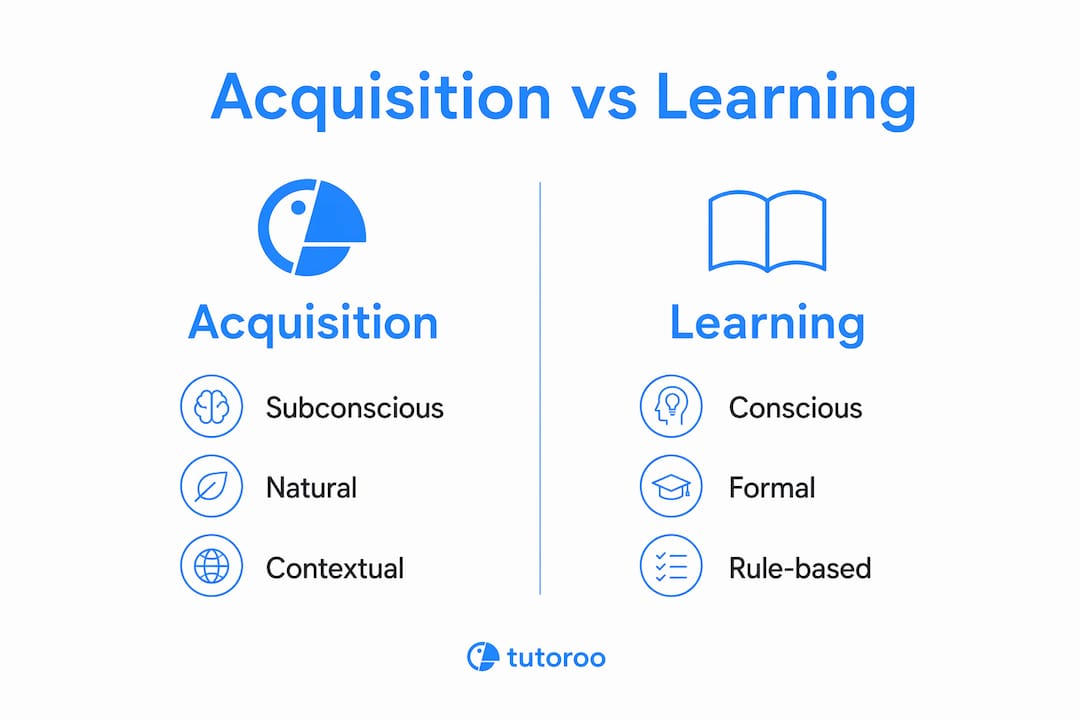
When a tutor advertises an "immersion programme," they are signalling an acquisition-focused approach. A "grammar course" signals explicit learning. Neither is wrong, but understanding the difference helps you brief a tutor with precision and spot whether their methods match your actual goals.
The three main theories behind how we acquire language
Three broad theoretical traditions shape how tutors design lessons. The behaviourist view (B.F. Skinner) holds that language develops through imitation and reinforcement — useful for habit-building but insufficient on its own. The nativist view, associated with Noam Chomsky's Language Acquisition Device and Universal Grammar, argues that humans are born with an innate capacity for language, a position explored in depth by the Stanford Encyclopedia of Philosophy. The interactionist or usage-based view holds that language emerges through meaningful social interaction and pattern recognition over time. Most contemporary tutors draw on all three, combining structured input with real conversation.

What does research say about the most effective methods?
Input-heavy methods — extensive reading, graded listening, and story-based instruction — consistently outperform grammar-first deductive approaches for building vocabulary, comprehension, and implicit acquisition. This is not a fringe position; it reflects the weight of meta-analyses across decades of second-language acquisition research.
Krashen's core claim is that learners acquire language when they receive comprehensible input pitched just above their current level, what he calls i+1. Forcing early grammar analysis can actually impede this natural process by raising anxiety and shifting attention away from meaning. Foundational SLA texts reinforce this: acquisition requires low-anxiety conditions, and speaking often emerges later than listening even under ideal circumstances.
Research note: Lancaster University findings confirm that achieving functional fluency as an adult takes consistent effort over months or years, and that individual working-memory capacity significantly influences how quickly learners can process and retain new input. Shorter, focused sessions with distributed repetition often outperform marathon lessons without review.
Practical reviews synthesising Lightbown and Spada alongside other SLA research recommend a balanced approach: meaningful interaction plus targeted form-focused instruction that follows the learner's natural developmental order. The key word is sequence — input and meaning first, explicit grammar when it serves a real communicative need.
How does this change what you should expect from a private tutor?
Prioritise tutors who plan for input-rich, low-anxiety sessions with staged opportunities for interaction. A tutor who opens every lesson with a grammar explanation and then asks you to produce sentences is working against the acquisition process, not with it.
Questions worth asking before you book:
- "How much lesson time goes to listening and reading versus explicit grammar explanation?"
- "How do you adapt input to my current level — what does i+1 mean in your practice?"
- "What materials do you use for comprehensible input at my stage?"
- "How do you handle vocabulary spacing and retrieval across sessions?"
- "When do you introduce form-focused correction, and how?"
Red flags to watch for: heavy drilling in the first lesson, promises of fluency in weeks, no mention of listening or reading materials, and sessions that feel more like a grammar lecture than a conversation.
Pro Tip: In a demo lesson, notice whether the tutor adjusts their language in real time when you look confused. A skilled tutor scaffolds meaning on the spot — that live adaptation is the hallmark of effective student-tutor interaction and something no fixed audio track can replicate.
For realistic milestones, expect early conversational confidence after several months of consistent sessions, and functional fluency after a year or more depending on the target language's distance from your own. A good tutor communicates these timelines honestly and adjusts pacing to your working-memory capacity rather than a fixed syllabus.
What do acquisition-friendly lessons actually look like?
A well-structured acquisition session moves from comprehensible input to guided interaction, with explicit form-focus appearing only when it serves a communicative purpose.
Beginner session (60 minutes)
The tutor opens with 20 minutes of story listening or a graded reader at a level the learner can follow with roughly 95% comprehension. The next 20 minutes involve a scaffolded dialogue — the tutor asks simple questions about the story, the learner responds with single words or short phrases, and the tutor models correct forms naturally without stopping to explain rules. The final 20 minutes introduce five to eight high-frequency vocabulary items using spaced repetition, tied to the story's context.
Intermediate session (60 minutes)
A short authentic video or podcast excerpt (with transcript) anchors the session. The learner summarises what they understood, the tutor fills gaps through targeted questions, and together they work through a real-world task — composing a short email or planning a conversation scenario. Grammar surfaces only when a recurring error blocks communication.
Advanced session (60 minutes)
The learner brings a piece of authentic content they chose — a news article, a podcast, a social media thread. Discussion is the primary activity, with the tutor pushing for precision and nuance. Form-focused feedback is delivered in writing after the session so it does not interrupt the flow of meaning-making.
Pro Tip: Household content works brilliantly as low-anxiety input. Menus, short recipe videos, local news clips, and everyday emails are instantly useful and carry real cultural meaning — exactly the kind of personalised language learning that accelerates acquisition without feeling like study.
A checklist for contacting potential tutors
Scan tutor profiles for these signals before you reach out:
- Mentions of input-based, comprehension-focused, or immersion-style teaching
- Examples of graded materials or story-based resources they use
- A stated approach to vocabulary retention (spaced repetition, contextual review)
- Acknowledgement that fluency takes time and is paced to the learner
- Availability for a trial or demo lesson before committing
Short trial-lesson request (copy and adapt): "Hi, I'm looking for a tutor who uses comprehensible input and meaning-focused activities rather than grammar-first drilling. I'd love to book a 30-minute trial lesson to see how you adapt your teaching to my current level. Could you tell me briefly what a typical session looks like for a [beginner/intermediate] learner?"
Longer brief (for a more detailed introduction): "I'm an adult learner aiming for conversational fluency in [language] within [timeframe]. I've read about the importance of comprehensible input and low-anxiety interaction, and I'd like a tutor who structures lessons around listening and reading first, with guided speaking opportunities as I build confidence. I'm happy to discuss your approach to vocabulary spacing and how you track progress. Please let me know if you offer trial lessons and whether you work online or in person."
Before booking, confirm: the platform you'll use (online or in-person), the cancellation policy, whether a trial lesson is available, and how the tutor handles lesson notes and homework.
Key takeaways
The single most important thing to demand from a private tutor is a session structure that prioritises comprehensible input and guided interaction over early grammar drills.
| Point | Details |
|---|---|
| What acquisition is | The subconscious process of gaining language through meaningful, comprehensible exposure — distinct from conscious rule-based learning. |
| Most effective methods | Input-heavy approaches (extensive reading, graded listening, scaffolded dialogue) consistently outperform grammar-first instruction for fluency. |
| Realistic adult timelines | Functional fluency typically requires consistent effort over months to years, shaped by individual working-memory capacity. |
| Key tutor-selection questions | Ask how much lesson time goes to listening and reading, how the tutor adapts to your level, and when explicit grammar appears. |
| Finding the right tutor | Tutoroo connects learners with over 386,000 tutors worldwide, making it practical to find and trial an input-focused tutor across a wide range of languages. |
The Tutoroo perspective on acquisition in practice
The gap between acquisition theory and what actually happens in a private lesson is where most learners lose time. Tutors who genuinely understand the language development process do not treat grammar as the entry point — they treat meaning as the entry point, and let grammar emerge from it. That shift sounds subtle, but it changes everything about how a session feels and what a learner retains a week later.
At Tutoroo, we see this play out consistently across our global tutor community. Learners who connect with tutors prioritising rich, contextualised input — stories, real conversations, authentic materials pitched at the right level — report faster progress and, crucially, more confidence to actually use the language outside lessons. The research supports this, and so does the lived experience of learners across dozens of languages on the platform.
The advice we'd offer any tutor-seeker: use the trial lesson as a diagnostic, not just a meet-and-greet. Notice whether the tutor listens more than they lecture, whether they adjust their language when you hesitate, and whether you leave the session feeling curious rather than overwhelmed. Those signals tell you more about a tutor's acquisition literacy than any credential on their profile.
Ready to find a tutor who puts acquisition first?
Knowing what language acquisition is gives you a real advantage when searching for a private tutor. You can now read between the lines of tutor profiles, ask the questions that matter, and recognise a genuinely input-rich lesson when you experience one.
Tutoroo makes that search practical. With over 386,000 language tutors available for one-on-one lessons online or in person, you can filter by language, availability, and teaching approach, then book a trial lesson before committing to a longer programme. Whether you're learning Spanish, French, Mandarin, Arabic, or any of the dozens of languages on the platform, there's a tutor whose methods align with how acquisition actually works.
Start by finding your language tutor on Tutoroo, and use the trial-lesson message template above to open the conversation on the right foot.
Useful sources for further reading
-
Krashen, S. — Input Hypothesis (sdkrashen.com): The foundational text on comprehensible input and the acquisition-learning distinction. Essential background for any learner or tutor wanting to understand why meaning-focused input drives fluency. Suitable for both learners and tutors.
-
Lancaster University — memory and language learning (lancaster.ac.uk): Research on working-memory constraints and realistic adult timelines. Useful for setting expectations and designing paced lesson schedules. Primarily for tutors and motivated learners.
-
Principles and Practice in Second Language Acquisition — Krashen (library.unmas.ac.id): The full theoretical framework covering affective filter, order of acquisition, and the role of low-anxiety conditions. Background theory for interested learners; practical reference for tutors.
-
Scott H. Young — evidence synthesis on language learning (scotthyoung.com): An accessible review of SLA research including Lightbown and Spada, covering the balance between input, interaction, and form-focused instruction. Recommended starting point for adult learners.
-
Language acquisition — meta-overview (simplypsychology.org): Clear summaries of critical-period theory, cognitive perspectives, and the interplay of biological and social factors. Good introductory reading for learners new to the field.
-
Stanford Encyclopedia of Philosophy — innateness and language (plato.stanford.edu): Rigorous treatment of nativist theory, Universal Grammar, and the debates that shape how tutors frame innate versus learned language capacity. For tutors and theoretically curious learners.
-
Language learning methods ranked (learnables.me): Practical comparison of input-heavy versus grammar-first approaches, with evidence summaries. Useful quick reference for tutor-seekers comparing lesson styles.