

A concrete, step-by-step exam-readiness plan combined with one-to-one tutoring is the most reliable way to convert diagnostic weaknesses into a passing score. The fastest route looks like this:
- Take a full diagnostic mock test on day one. Score every section, note where points are lost, and use that data to drive every decision that follows.
- Run at least one full timed mock per week from week three onward, scoring it against official rubrics and logging errors after each attempt.
- Meet with a specialist tutor two to three times per week during an intensive eight-week plan, or one to two times per week across a twelve-week programme, focusing each session on the skill dragging your overall score down.
Structured, targeted one-to-one tutoring significantly improves pass rates because it combines tailored practice, immediate feedback, and exam simulation that self-study rarely delivers. For learners in Australia, Tutoroo connects you with exam-specialist tutors for IELTS, TOEFL, Cambridge English, DELE, HSK, and more.
Key takeaways
A step-by-step exam-readiness plan built around one-to-one tutoring, weekly timed mocks, and disciplined error logging gives language learners the clearest path to a reliable passing score.
| Point | Details |
|---|---|
| Diagnostic first | Take a full mock test on day one to set your baseline and direct tutor time to the weakest skill. |
| Choose your timeline | Follow an eight-week intensive or twelve-week progressive plan, re-diagnosing at the four-week mark. |
| Mock-test benchmark | Aim for 3–4 consecutive passing full mocks under timed conditions before declaring readiness. |
| Score validity | IELTS and TOEFL scores typically expire after a couple of years, while Cambridge certificates generally carry lifetime validity. |
| Tutoroo match | Use Tutoroo to find an exam-specialist tutor in Australia and book a trial diagnostic session to start. |
Table of Contents
- What does a step-by-step exam readiness timeline look like?
- How do you use one-to-one tutoring most effectively?
- How do you choose the right exam tutor in Australia?
- How should you schedule and review full practice tests?
- What should you do in the final 7–10 days before your exam?
- How long do language exam scores actually last?
- Why one-to-one tutoring outperforms generic drills
- Tutoroo makes it straightforward to follow this plan in Australia
- Sources
What does a step-by-step exam readiness timeline look like?
Both the ETS eight-week TOEFL prep planner and the ETS three-month study plan follow the same logic: foundations first, strategy second, timed simulation third. Pick the timeline that matches your deadline.
intensive eight-week plan
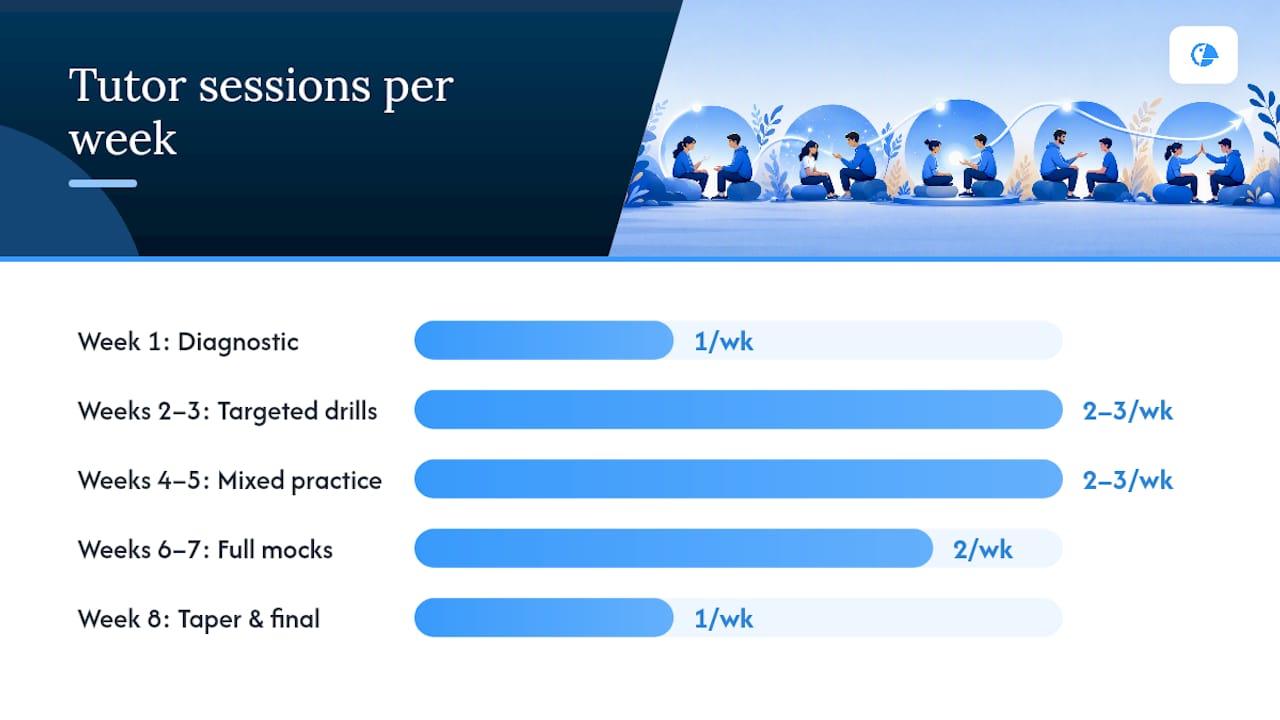
| Week | Focus | Tutor sessions | Mock tests |
|---|---|---|---|
| 1 | Full diagnostic mock; baseline scoring; identify weakest section | 1 diagnostic session | 1 full untimed familiarisation |
| 2–3 | Targeted skill drills on weakest area; vocabulary and grammar foundations | 2–3 sessions/week | 1 timed section test |
| 4–5 | Mixed-skill practice; introduce timed writing and speaking tasks | 2–3 sessions/week | 1 full timed mock |
| 6–7 | Full timed mocks; error logging; tutor feedback on mock results | 2 sessions/week | 1–2 full timed mocks |
| 8 | Taper: light drills, 1 final mock early in the week, rest | 1 session | 1 final timed mock |
Twelve-week progressive plan
The three-month structure stages learning more gently, which suits learners who are working or studying alongside exam prep.
- Month 1 (Weeks 1–4): Foundations. Complete a diagnostic mock on day one. Spend the rest of the month building vocabulary, grammar, and listening comprehension. Run one timed section test per week.
- Month 2 (Weeks 5–8): Strategy. Shift to exam-specific techniques: skimming for Reading, note-taking for Listening, template structures for Writing, and fluency drills for Speaking. Run one full timed mock every two weeks.
- Month 3 (Weeks 9–12): Simulation. Treat every week as exam week. Run a full timed mock weekly, review errors with your tutor, and taper in the final week.
Pro Tip: Re-diagnose at the four-week mark regardless of which plan you follow. If your weakest section has improved, shift tutor time to the next lowest-scoring skill.
How do you use one-to-one tutoring most effectively?
Begin the relationship with a diagnostic and a specific target score tied to your actual application, whether that is a visa, university admission, or professional registration. Vague goals produce vague preparation.
A productive sixty-minute session typically runs like this:
- Warm-up (5 min): Review homework errors from the previous session.
- Focused skill work (20 min): Drill the single weakest sub-skill identified in the last mock.
- Timed task (25 min): Complete one exam-format task under real conditions, no pauses.
- Feedback and homework (10 min): Tutor marks the task against the official rubric, assigns targeted independent practice.
Pro Tip: The "2 Sigma" principle from educational research suggests that high-dosage, individualised tuition accelerates error correction far faster than group methods. Ask your tutor to correct errors the moment they occur rather than saving all feedback for the end — zero-latency correction is one of the clearest advantages of one-on-one learning.
Between sessions, build independent practice around three habits: use Anki for spaced-repetition vocabulary, record your own speaking responses and listen back critically, and maintain an error log where every mistake is categorised by skill and error type. Devote most of your solo study time to the skill your diagnostic flagged as weakest, not equal time across all four skills.
How do you choose the right exam tutor in Australia?
The right tutor is not simply a fluent speaker of the target language. They need verifiable, exam-specific experience.
Selection criteria:
- Specialisation in your specific exam (IELTS, TOEFL, Cambridge B2/C1/C2, DELE, HSK)
- Demonstrated familiarity with the marking rubric and official scoring guides
- Verifiable student reviews or references from exam candidates
- Willingness to offer a trial diagnostic session before committing
Questions to ask in a trial session:
- Which mock tests do you use, and are they from the official provider?
- How do you structure feedback on Writing and Speaking tasks?
- Can you show me how you score a sample response against the official rubric?
- Have you prepared candidates sitting exams at Australian test centres?
Red flags to watch for:
- No mock testing in the lesson plan
- Generic lesson materials not tailored to your target exam
- Inability to explain the marking criteria for Writing or Speaking
- No structured homework or error-logging system
When you find a promising tutor, brief them clearly: share your diagnostic scores, your target score, your exam date, and a sample of your error log. A tutor who asks for this information before the first session is already demonstrating the right instincts. Exam-focused tutoring works best when the learner and tutor align on measurable milestones from the outset.
How should you schedule and review full practice tests?
Consistent passing scores on 3–4 consecutive full-length, timed mock exams under strict conditions is the clearest benchmark for genuine readiness. Getting there requires disciplined mock-test practice.
Rules for a valid mock test:
- Complete all sections in the official order with no pauses between them.
- Use only materials allowed in the real exam.
- Replicate the physical environment: quiet room, same time of day as your scheduled exam.
- Score against the official rubric immediately after finishing.
Run full timed mocks once per week from the midpoint of your plan. In the weeks before, prioritise focused micro-tasks (a single Writing task, a Listening section) rather than full tests, so fatigue does not distort your baseline data.
Scoring tracker template:
After each mock, log every error by category (vocabulary gap, grammar, timing, misread question), share the log with your tutor before the next session, and schedule a targeted drill on the top error type within 48 hours. Official materials from ETS, Cambridge, and IELTS give the closest format and scoring fidelity for this process.
What should you do in the final 7–10 days before your exam?
The final week is about performance, not learning. Stop introducing new techniques or vocabulary lists.
Final-week schedule:
- Days 1–2: One full timed mock each day, scored immediately. Share results with your tutor.
- Days 3–5: Light timed drills only — one Writing task, one Speaking response per day. No full mocks.
- Days 6–7: Rest, light reading in the target language, and a single tutor check-in for confidence and pacing strategy.
Test-day checklist:
- Valid photo ID accepted by the test centre
- Confirmed transport and arrival time (aim for 30 minutes early)
- Allowed materials only (pencils, water, earplugs if permitted)
- Eight hours of sleep the night before
- A light meal before the exam, not a heavy one
- For online tests: stable internet connection, cleared desk, working headset tested the evening before
Mental preparation matters as much as technical readiness. Practise a slow breathing reset (four counts in, four counts out) to use between sections. Agree on a pacing strategy with your tutor beforehand — for instance, how many minutes to spend per Reading question before moving on.
How long do language exam scores actually last?
Planning around score validity is as important as the preparation itself. IELTS scores expire after two years, and TOEFL scores follow the same two-year window. Cambridge English certificates (B2 First, C1 Advanced, C2 Proficiency) carry lifetime validity and never expire.
- If you need a score for an Australian visa or university application, calendar your exam date so results arrive with at least three months of buffer before the application deadline.
- Register early and plan for possible retakes — popular test centres in Australian cities book out weeks in advance.
- Always confirm the specific exam accepted by your receiving institution or the Department of Home Affairs before booking. IELTS suits most Australian immigration pathways and universities; TOEFL is common for US institutions; Cambridge certificates work well for long-term credential needs given their permanent validity.
Why one-to-one tutoring outperforms generic drills
Generic practice materials give you questions. A skilled tutor gives you a diagnosis, a correction, and a reason — in real time, every session.

The mechanism behind tutoring gains is precise: when a tutor catches a grammar error or a Speaking hesitation the moment it happens, the learner's brain processes the correction while the context is still active. That immediacy is something a practice app cannot replicate. Tutors who mirror actual exam conditions in sessions — using official prompts, timing responses, and scoring against the real rubric — help learners build both skill and the composure to perform under pressure.
Realistic progress pacing matters too. A learner moving from IELTS 6.0 to 7.0 typically needs eight to twelve weeks of consistent, targeted work. Set measurable milestones with your tutor at the start: a specific sub-score target for each skill, reviewed at the four-week mark and again two weeks before the exam. That structure keeps motivation steady and makes it easy to spot when a change of focus is needed.
Tutoroo makes it straightforward to follow this plan in Australia
Finding a tutor who genuinely knows your target exam — its rubric, its timing, its Australian test-centre quirks — used to mean weeks of searching. Tutoroo shortens that to a single search.
With a large number of language teachers on the platform, Tutoroo lets you filter by exam type, language, location (in-person across Australian cities or fully online), and availability. You can message tutors directly, share your diagnostic scores and target, and arrange a trial diagnostic session before committing to a full programme. There are no lock-in contracts — you pay your tutor directly after each session. Find an exam-specialist tutor on Tutoroo and book a trial diagnostic session to start your plan this week.
Sources
Use these sources for valid mock tests, official scoring guides, and format-accurate sample questions:
- IELTS — your results / IELTS scoring in detail
- TOEFL iBT® student test prep planner (ETS PDF)
- How to get language certified in 2026: Practical guide — StudyVerso