

TL;DR:
- Exam-focused tutoring is tailored to explore specific exam patterns, pacing, and scoring strategies rather than broad subject mastery. It involves diagnostic testing, targeted instruction, timed practice, and continual score tracking to improve performance under real test conditions. Success depends on consistent practice, strategic feedback, and understanding the exam's unique rules, not the tutor's price or content coverage.
Most students assume tutoring is just extra help with schoolwork. That assumption costs them marks. What is exam-focused tutoring, exactly? It is a specialised form of academic support built around a specific exam, its format, its timing, and the reasoning patterns the test actually rewards. Unlike general subject tutoring, it does not aim to deepen your understanding of every concept across the curriculum. It trains you to perform on a defined test, under real conditions, within a fixed window of time. This article unpacks how it works, what the research says about its benefits, and how you can use it to your best advantage.
Table of Contents
- Key takeaways
- What is exam-focused tutoring?
- The exam-focused tutoring workflow
- The benefits of exam-focused tutoring
- How exam-focused tutoring works in practice
- Common challenges and how to overcome them
- My perspective on what actually makes exam tutoring work
- Find a tutor matched to your exam goals
- FAQ
Key takeaways
| Point | Details |
|---|---|
| Exam tutoring targets the test itself | It focuses on format, timing, and scoring patterns, not broad subject mastery. |
| Diagnostics drive everything | Initial full-length tests reveal content gaps and pacing issues that generic study misses. |
| Timed practice builds stamina | Repeated exposure to timed sections prepares students for real test-day conditions. |
| Dosage matters more than price | Consistent tutoring minutes produce better outcomes than expensive but infrequent sessions. |
| Feedback loops accelerate progress | Regular score tracking and tutor recalibration keep improvement on the right trajectory. |
What is exam-focused tutoring?
Exam-focused tutoring is specialised academic support designed for a defined standardised exam within a fixed testing window. Think SAT, ACT, selective school entry tests, or scholarship exams. The tutor's job is not to teach you everything about mathematics or English. The job is to teach you how this particular exam rewards reasoning, manages time, and penalises common mistakes.
That distinction matters more than most students realise. According to exam-focused methodology, test success depends on understanding how exams reward reasoning patterns and penalise issues like time mismanagement. A student who knows a maths concept thoroughly can still score poorly if they run out of time in section three. A student who understands the question structures and pacing demands of the test can often outperform someone with deeper content knowledge.
Here is what separates exam-focused tutoring from regular subject tutoring:
- Format mastery. The tutor teaches you the specific question types, section lengths, and structure of the exam, so nothing on test day feels unfamiliar.
- Timing as a skill. Pacing is treated as something you practise and improve, not an afterthought.
- Scoring logic. You learn what the test rewards, including which question types carry more weight and how partial attempts are handled.
- Strategic decision making. Students learn when to skip, when to guess, and how to triage difficult questions under pressure.
- Targeted content review. Content gaps are addressed only where they affect exam performance, not across every topic in the curriculum.
General subject tutoring, by contrast, builds conceptual depth over time. Both have value. But if you have a test in twelve weeks and a score target to hit, exam preparation tutoring is the more direct path.
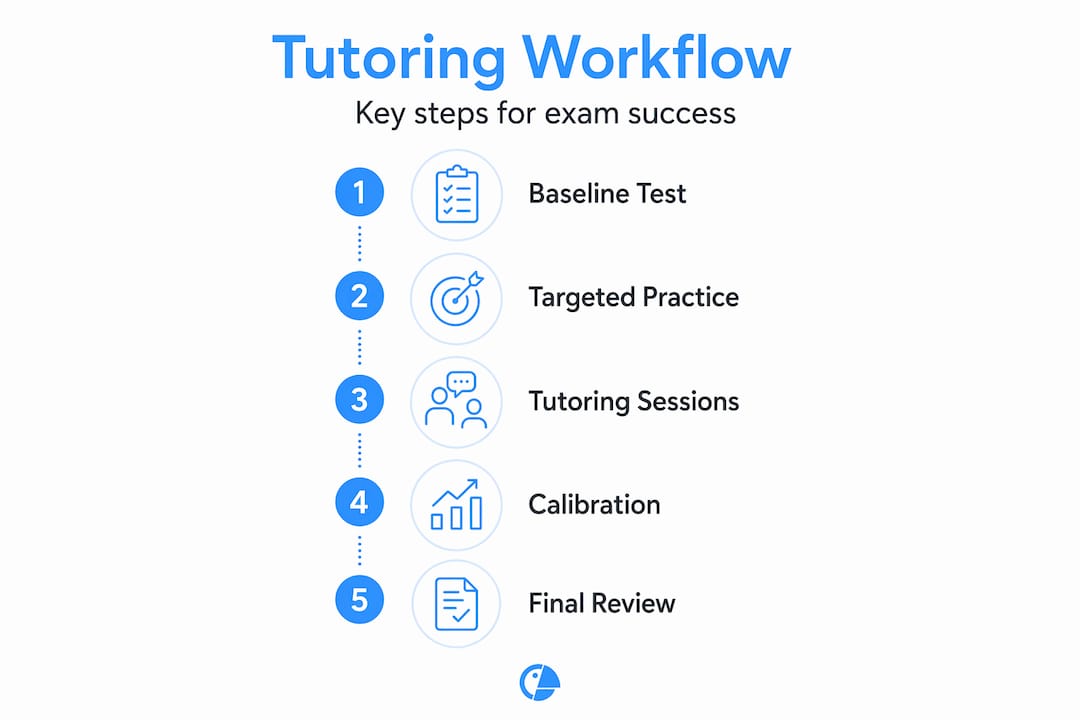
The exam-focused tutoring workflow
The methodology behind effective exam tutoring follows a clear and repeatable cycle. Understanding this cycle helps you evaluate any tutor you work with and know whether their approach is genuinely structured.
-
Diagnostic testing. The process begins with a full-length practice test under timed conditions. This is not a warmup. It is a precise measurement tool. The results reveal where content gaps exist, where pacing breaks down, and which question types cause the most errors.
-
Error categorisation. A skilled tutor does not just mark answers right or wrong. Mistakes are classified as content gaps, misapplication under pressure, misreading of questions, or pacing issues. Each category requires a different fix.
-
Targeted instruction. Based on the diagnostic, the tutor builds a plan. If the student misreads geometry questions under time pressure, that is different from not knowing the geometry at all. The instruction targets the specific failure mode.
-
Timed practice sections. Students work through real sections under actual time limits. This reveals stamina issues and pacing errors that untimed revision simply cannot expose.
-
Full-length practice tests. Periodically, a complete timed test is used to measure progress and uncover any new weak spots that have emerged as earlier ones improve.
-
Score tracking and plan adjustment. The tutor monitors results across sessions and recalibrates the plan. If reading comprehension scores have improved but maths is now the gap, the focus shifts accordingly.
Pro Tip: Take at least two full-length practice tests during your tutoring period. Research-supported advice from College Board recommends one several months out and one roughly two weeks before exam day. This baseline-and-calibration approach gives your tutor the clearest possible picture of where to direct your remaining time.
The benefits of exam-focused tutoring
The evidence for personalised tutoring is well established. One-to-one tutoring produces approximately five additional months of learning progress on average compared with no tutoring at all. That is a significant advantage before a high-stakes exam.
But average gains are not guaranteed. The same research notes that tutoring impact varies considerably depending on how well instruction is targeted to the individual student. A generic tutoring programme that reviews everything equally will not produce the same result as one driven by diagnostic data.
"A consistent tutoring dosage and structured practice-feedback loops are more critical than price when aiming for exam performance improvements." — Overdeck Family Foundation
This is a genuinely useful finding for students deciding how to invest their time and money. Research from the Overdeck Family Foundation found that lower-cost tutoring models at around $1,200 per student produced results comparable to programmes costing $2,000 or more, provided the programme was designed for sufficient and consistent practice. You do not need the most expensive tutor. You need the right structure, applied with enough frequency.
Beyond raw score gains, exam-focused tutoring delivers several compounding benefits that general study simply cannot match.
Students build genuine confidence through repeated, successful exposure to real exam conditions. Test anxiety decreases when the format feels familiar rather than threatening. Pacing improves because students have practised under time pressure dozens of times before sitting the actual exam. And strategic thinking sharpens because students learn to make deliberate decisions about how to allocate their time across a section. Read more about personalised learning gains and why the research behind individual tuition is worth understanding before you choose your approach.

How exam-focused tutoring works in practice
The theory is clear. The application varies by exam, student, and timeline. Here is how a typical tutoring cycle looks across different test preparation contexts.
| Exam type | Diagnostic benchmark | Key tutoring focus | Calibration point |
|---|---|---|---|
| SAT / ACT | Official full-length practice test | Reading strategy, maths pacing, question triage | Second full test two weeks before exam |
| Selective school entry | School-style reasoning test | Abstract reasoning, verbal skills, writing speed | Mock test under full school conditions |
| Scholarship exams | Past paper under timed conditions | Extended writing, problem solving, reading speed | Past paper from most recent year |
| Language proficiency | Simulated listening and speaking test | Vocabulary under pressure, pronunciation patterns | Recorded practice interview |
A research-supported approach involves baseline testing months out, followed by targeted tutoring cycles, then a final recalibration test shortly before exam day. This structure prevents the common mistake of treating every session the same regardless of progress.
Scheduling matters too. Higher tutoring dosage correlates directly with greater learning gains. Two or three sessions per week, each with structured timed practice, will outperform weekly sessions of the same total duration. Frequency creates momentum and keeps skills sharp between sessions.
Tutors who specialise in exam preparation also tailor their strategies to the specific format. An SAT tutor will train you differently to a selective school tutor. The question types, time pressure, and scoring logic differ significantly. This is the heart of what customised exam tutoring means in practice. Explore how tutors transform exam preparation across different test formats and subjects for a broader view of what expert-led support looks like in 2026.
For IB students, a structured exam-style practice workflow is particularly useful for understanding how to move from concept knowledge to exam performance.
Common challenges and how to overcome them
Even with a strong tutor, students can undermine their own progress. Knowing where things typically go wrong makes it easier to avoid those patterns.
- Skipping timed practice. Many students prefer untimed review because it feels less stressful. But timed sections reveal stamina issues and pacing breakdowns that untimed study simply cannot show. If you avoid the discomfort of the clock during preparation, you will meet it unprepared on test day.
- Treating sessions passively. Sitting through a tutoring session is not the same as learning from it. Students who ask questions, challenge their own errors, and articulate their reasoning aloud improve faster than those who passively receive corrections.
- Ignoring shifting weak spots. As one area improves, another often becomes the limiting factor. Students who lock their focus onto their original weak areas and stop monitoring can miss this shift entirely.
- Undervaluing strategy over content. Many students believe studying more content is always the answer. It rarely is, once a baseline of knowledge is in place. Test-taking strategy and timing often produce faster score gains.
- Letting anxiety go unaddressed. Test anxiety is real and it affects performance measurably. A good tutor will address it directly through repeated realistic exposure, not just reassurance.
Pro Tip: After each tutoring session, spend five minutes writing down the one thing you got wrong that surprised you most. That single habit builds active feedback loops and helps you and your tutor track which error types keep recurring, even as overall scores improve.
My perspective on what actually makes exam tutoring work
I've seen students invest months into tutoring and walk away with minimal score gains. And I've seen others improve dramatically in six weeks. The difference almost never comes down to how smart the student is or how expensive the tutor was.
What I've found is this: students who treat the exam format as something to be studied in its own right, separate from the content, consistently outperform those who just try to know more. The exam is a game with specific rules. Learning those rules is not cheating. It is the most honest form of preparation.
In my experience, the underestimated elements are pacing drills and mental stamina. Students can know every formula but still collapse in the final thirty minutes of a long test because they have never trained for that duration under pressure. Repeated timed practice is the solution, and it should be built into every session from week one, not treated as something to add later.
The other thing I'd push back on is the idea that diagnostic testing is optional. It is the backbone of the entire process. Without it, tutoring is guesswork. With it, every session has a purpose. I've also found that private tutoring best practices consistently point to the same conclusion: frequency and structured feedback matter far more than the hourly rate.
Choose your tutor based on whether they use diagnostics and track your scores session by session. Everything else is secondary.
— Tutoroo
Find a tutor matched to your exam goals
Preparing for a specific exam opens doors to opportunity, and having the right tutor beside you makes the difference between hoping for a good result and being genuinely ready for it.

Tutoroo connects students with private tutors across a wide range of subjects and exam types, including English exam preparation, language proficiency tests, and selective school entry programmes. Whether you prefer online sessions or local in-person lessons, Tutoroo's community of over 386,000 tutors worldwide makes it straightforward to find someone who specialises in exactly the format you are preparing for. Visit Tutoroo to explore your options, compare tutor profiles, and book your first session with flexibility built in from the start.
FAQ
What is exam-focused tutoring?
Exam-focused tutoring is specialised academic support designed around a specific standardised exam, targeting its format, timing, and scoring logic rather than broad subject content. It trains students to perform under real test conditions within a fixed timeframe.
How does exam-focused tutoring differ from regular tutoring?
Regular tutoring builds deep subject knowledge over time, while exam-focused tutoring targets the specific question types, pacing demands, and strategies rewarded by one particular exam. The focus is performance on the test, not general mastery of a subject.
How many practice tests should I take during tutoring?
Research-supported guidance recommends at least two full-length practice tests: one several months before exam day to establish a baseline, and one approximately two weeks before the exam for final calibration and focus adjustment.
Does more expensive tutoring produce better results?
Not necessarily. Studies show that lower-cost tutoring models can match higher-cost programmes when they are designed around consistent practice dosage and structured feedback. Frequency and targeting matter more than price.
What makes an exam-focused tutor effective?
An effective exam-focused tutor uses diagnostic testing to identify specific error types, builds a targeted plan based on results, and tracks score progress across sessions. Recalibration as the student improves is what separates strong tutors from average ones.