

TL;DR:
- Scheduling enhances language acquisition by promoting consistent, spaced practice that improves memory retention and fluency. Flexible routines built around daily sessions and realistic commitments lead to higher scores and lower stress, fostering sustainable progress. Personalization and feedback-driven practice further optimize learning outcomes over the long term.
Scheduling is the single most powerful factor in language acquisition, transforming sporadic motivation into consistent, retention-building practice. The role of scheduling in language learning goes far beyond writing study times into a calendar. It determines how well your brain encodes vocabulary, how quickly you build fluency, and whether you stick with the process long enough to see real results. Tools like Anki and Quizlet have made spaced repetition accessible to millions of learners, and the science behind them is clear: structured, timed practice outperforms unplanned study every time.
How does scheduling improve memory retention and fluency?
Spaced repetition is the most research-supported scheduling technique in language education. Studies show it delivers 74% higher retention on final tests compared to cramming, with equal total study time. That figure means you can learn the same material in the same hours and remember dramatically more of it, simply by spreading sessions out.
The mechanism behind this is what researchers call "desirable difficulties." When your brain struggles to retrieve a word or grammar rule, that effort strengthens the memory trace. Massed practice, studying everything in one long sitting, removes that struggle and produces weaker long-term retention. Distributed practice, spacing study across multiple shorter sessions, is rated the most effective learning technique across hundreds of studies.
Fluency also depends on automatic retrieval, the ability to produce language without consciously searching for words. Automatic retrieval builds through repeated, spaced exposure over time. A learner who studies Spanish for 20 minutes every day will develop faster automatic recall than one who studies for two hours once a week, even if the total time is identical. Habitual routines reduce reliance on willpower by anchoring practice to consistent contextual cues, such as studying after your morning coffee or during your lunch break.
Pro Tip: Set a recurring alarm labelled with your target language name. The cue alone begins to wire your brain for practice mode before you even open an app.
What are effective scheduling techniques for language learners?
The most effective scheduling approaches share one quality: they are built around your real life, not an idealised version of it. Here are the techniques with the strongest evidence behind them.
- Short daily sessions. Fifteen to thirty minutes of daily practice consistently outperforms infrequent marathon sessions. Your brain consolidates language during sleep, so frequent short sessions give it more consolidation opportunities across the week.
- Time blocking. Assign specific time slots to specific tasks, such as vocabulary review from 7:00 to 7:20 am and speaking practice from 7:20 to 7:40 am. Time blocking combined with task batching minimises context switching and sharpens focus during demanding language tasks.
- Interleaving. Mix different practice types within a session rather than drilling one skill repeatedly. Alternating between reading, listening, and writing in a single sitting forces your brain to switch retrieval strategies, which deepens learning.
- Flex blocks. Build buffer time into your weekly schedule. Flex blocks increase adherence by 40% compared to rigid plans, because they give you a recovery slot when life interrupts your routine.
- Deliberate error correction. Schedule short, feedback-intensive practice bursts focused on your specific weaknesses. Spending 10 minutes correcting recurring grammar errors is more productive than 30 minutes of passive review.
The importance of study schedules lies not in their rigidity but in their regularity. A schedule you follow 70% of the time beats a perfect plan you abandon after two weeks. Consistency, even imperfect consistency, is what drives acquisition.
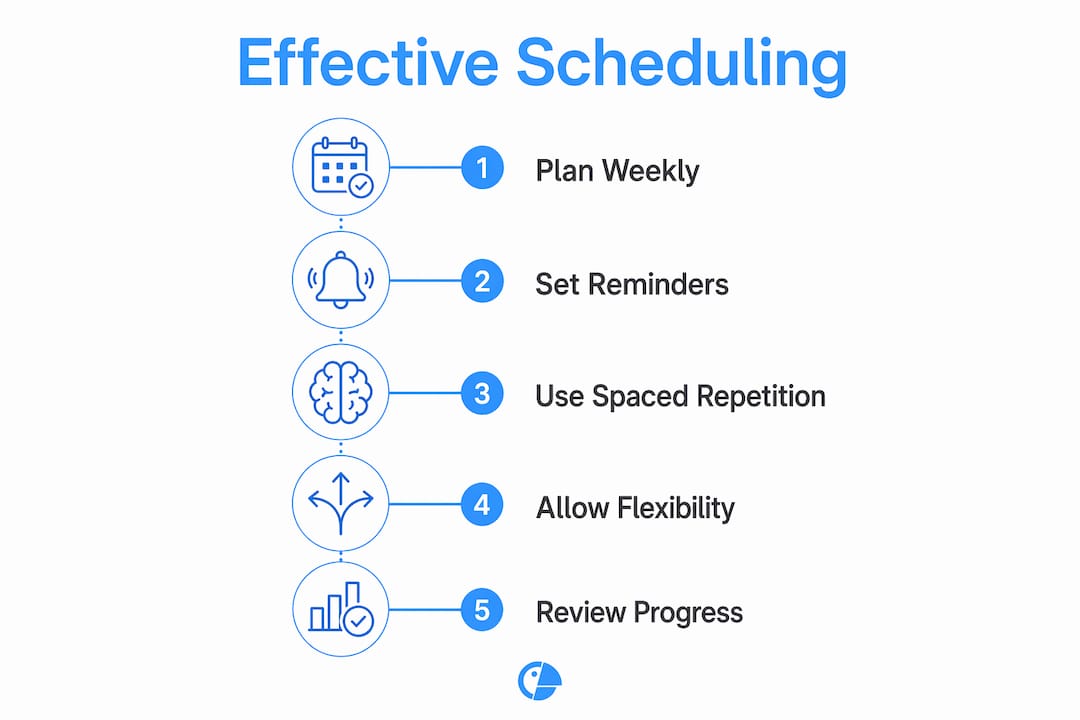
Pro Tip: Plan your language study sessions for the week every Sunday evening. A five-minute planning habit removes daily decision fatigue and makes it far easier to start each session.
How to personalise your language learning schedule
No single scheduling technique fits every learner. Strategic method selection depends on your energy levels, professional demands, and specific language goals. Here is a practical process for building a schedule that actually fits your life.
-
Map your energy peaks. Identify the two or three times in your day when your focus is sharpest. Reserve these slots for your most demanding tasks, such as grammar study or speaking practice with a tutor. Use lower-energy periods for passive activities like listening to podcasts in your target language.
-
Define your skill priorities. Are you learning French for travel, business Mandarin for work, or conversational Arabic for family? Your goal shapes your schedule. A traveller needs heavy speaking and listening practice. A business learner needs formal writing and reading. Align your session types with your actual purpose.
-
Balance input and output. Effective schedules mix receptive skills (reading, listening) with productive skills (speaking, writing). A common mistake is over-scheduling passive input and under-scheduling active speaking practice, which is where fluency is actually built.
-
Design for your realistic self, not your ideal self. Most learners fail by creating schedules that assume perfect conditions. Scheduling for your realistic self means accounting for work deadlines, social commitments, and low-energy days. Build in lighter sessions for busy weeks rather than skipping entirely.
-
Review and adjust fortnightly. Track which sessions you complete and which you skip. If you consistently skip Thursday evening practice, move it. A schedule that adapts to your feedback is far more sustainable than one carved in stone.
For a working professional learning Japanese, a realistic weekly structure might look like this: 20 minutes of Anki vocabulary review each morning, one 45-minute tutor session on Wednesday evenings, and a 30-minute podcast listen during the Friday commute. That totals roughly three hours per week, which is enough to make steady, measurable progress.
Rigid vs. flexible scheduling: which works better?

The evidence strongly favours flexible scheduling over rigid timetables for language learners. Students with flexible schedules score 12% higher on exams and report 34% less stress than those following fixed, inflexible plans. That stress reduction matters because anxiety directly impairs language production and memory encoding.
The table below compares both approaches across the factors that matter most to learners.
| Factor | Rigid scheduling | Flexible scheduling |
|---|---|---|
| Adherence over 4+ weeks | Lower; missed sessions create guilt spirals | Higher; flex blocks absorb disruptions |
| Stress levels | Higher exam-related anxiety | 34% lower reported stress |
| Learning outcomes | Inconsistent; dependent on perfect conditions | 12% higher exam scores on average |
| Resilience to life disruptions | Poor; one missed day can derail the plan | Strong; built-in recovery time |
| Motivation over time | Declines as rigidity feels punishing | Sustained; learners feel in control |
Rigid schedules do have one advantage: they remove the need to make daily decisions about when to study. For learners who struggle with procrastination, a fixed time can be a useful anchor. The solution is to combine both approaches. Fix your study windows but allow flexibility within them, swapping a grammar session for listening practice when energy is low, for example.
Language fluency requires sustained exposure over months or years. A flexible schedule is the structure most likely to survive that timeline intact.
Practical tips for a sustainable language learning schedule
Building a schedule is straightforward. Keeping it going for six months is where most learners struggle. These tips address the specific points where routines tend to break down.
- Start smaller than you think you need to. Beginning with 15 minutes a day feels almost too easy. That is the point. Small wins build the habit before you increase the load.
- Use spaced repetition apps. Anki, Quizlet, and similar tools automate the scheduling of vocabulary review, removing the cognitive burden of deciding what to study. They surface the words you are about to forget at exactly the right moment.
- Attach study to an existing habit. Pairing language practice with something you already do, such as your morning coffee or your evening walk, dramatically increases follow-through. Behavioural science calls this "habit stacking."
- Set a session goal, not a time goal. "Review 20 new words" is more motivating than "study for 30 minutes." Completion feels rewarding and gives you a clear stopping point.
- Track your streak, but forgive breaks. Apps like Duolingo use streaks to motivate daily practice. The danger is that one missed day feels catastrophic. 70% adherence to a realistic plan is more effective than 100% adherence to an overambitious one. Missing a day is not failure. Quitting is.
For learners who want structured accountability, working with a private tutor adds a layer of external commitment that self-study cannot replicate. Knowing a session is booked makes it far harder to skip. Tutoroo's flexible tutoring approach shows that learners who combine scheduled self-study with regular tutor sessions progress measurably faster than those relying on solo practice alone.
Pro Tip: After each study session, write one sentence in your target language summarising what you practised. This forces active recall and gives you a personal record of progress to look back on.
Key takeaways
Consistent, flexible scheduling is the foundation of effective language acquisition, and the research confirms that how you structure practice matters as much as how long you study.
| Point | Details |
|---|---|
| Spaced repetition drives retention | Scheduling review sessions with tools like Anki delivers 74% better retention than cramming. |
| Flexibility beats rigidity | Flexible schedules produce 12% higher scores and 34% less stress than rigid timetables. |
| Short daily sessions outperform marathons | Fifteen to thirty minutes daily builds fluency faster than infrequent long study blocks. |
| Personalise to your realistic self | Design your schedule around your actual energy and commitments, not your ideal conditions. |
| Flex blocks protect adherence | Building buffer time into your weekly plan increases the likelihood of sticking with it by 40%. |
Tutoroo's take on scheduling and language learning
Scheduling changed everything for the learners we work with at Tutoroo. Not because they suddenly had more time, but because they stopped wasting the time they already had.
The most common mistake we see is learners designing schedules for a version of themselves that does not exist. The version that wakes up energised every morning, never has a late work meeting, and always feels motivated. Real language learning happens in the gaps of a real life. The learners who make the most progress are the ones who accept that and plan accordingly.
Flexibility is not the same as lack of structure. The best schedules we have seen are firm about when practice happens and loose about exactly what form it takes. If you had a draining day and cannot face grammar drills, listen to a podcast in your target language instead. You are still building exposure. You are still moving forward.
The other insight worth sharing is that feedback-driven practice inside scheduled sessions matters far more than the length of those sessions. Twenty minutes of focused error correction with a tutor who knows your specific weaknesses will do more for your progress than an hour of passive review. Schedule quality, not just quantity.
If you are struggling with consistency, start with one non-negotiable session per week. One fixed point in your schedule that you protect regardless of what else is happening. Build from there. Momentum is easier to maintain than it is to restart.
— Tutoroo
Build your schedule with Tutoroo's private tutors
Knowing the principles of effective scheduling is one thing. Having a tutor who helps you apply them to your specific goals is another entirely.

Tutoroo connects you with over 386,000 private language tutors worldwide, covering languages from Spanish and French to Arabic, Mandarin, and Malay. Every tutor on the platform sets their own availability, which means you can find someone whose schedule fits yours, whether you study early mornings, late evenings, or weekends. Sessions are conducted online or in person, and your tutor tailors each lesson to your current level and goals. If you are ready to bring structure, accountability, and expert guidance to your language learning, find your tutor at Tutoroo today.
FAQ
How does scheduling improve language learning outcomes?
Scheduling improves language learning by creating the regular, spaced practice that the brain needs to consolidate vocabulary and grammar into long-term memory. Spaced repetition alone delivers 74% better retention compared to cramming with the same total study time.
How many minutes a day should I study a language?
Fifteen to thirty minutes of daily practice is more effective than longer, infrequent sessions. Short daily sessions give your brain more opportunities to consolidate new language during sleep.
What is the best scheduling technique for busy learners?
Time blocking combined with flex buffers works best for busy learners. Assign fixed windows for study, then build in one or two recovery slots each week to absorb unexpected disruptions without derailing your routine.
Should I use a rigid or flexible study schedule?
Flexible schedules produce better results for most learners. Research shows they lead to 12% higher exam scores and 34% lower stress compared to rigid plans, and they are far more sustainable over the months required to reach fluency.
How do I stop skipping language study sessions?
Attach study to an existing daily habit, set a session goal rather than a time goal, and build flex blocks into your weekly plan. Research confirms that 70% adherence to a realistic schedule outperforms perfect adherence to an overambitious one.