

TL;DR:
- Exam readiness for language learners is demonstrated by consistent passing scores on full-length, timed practice exams under exam conditions. It requires strong skills in comprehension, recall, practice, and confidence, not just feeling comfortable with the material. Preparing early with targeted, regular practice and mastering exam format reduces anxiety and ensures true performance readiness.
Exam readiness for language learners is defined as the ability to consistently achieve passing scores across all sections of a full-length, timed practice exam that replicates actual test conditions. This is not the same as feeling comfortable with the material. True language proficiency test readiness means your performance holds up under pressure, without notes, without extra time, and across every skill the exam assesses. Tools like timed mock exams, targeted vocabulary study, and apps such as Anki or Quizlet all play a role. This guide breaks down exactly how to measure your readiness and build it systematically before test day.
What is exam readiness for language learners?
Exam readiness is the point at which a learner can perform consistently well under real test conditions, not just during relaxed study sessions. The industry term for this state is test preparedness, and it covers four core components: comprehension, recall, practice, and confidence. Each component must be strong before you can call yourself truly ready.
Comprehension means you understand the language at the level the exam demands. Recall means you can retrieve vocabulary, grammar rules, and structures quickly under time pressure. Practice means you have rehearsed the exact format and question types the exam uses. Confidence means you can manage nerves and maintain performance when it counts.
Many learners mistake familiarity with readiness. Feeling comfortable reading a passage at home is very different from completing a timed reading section with no dictionary and a clock running. Effective exam preparation for language learners requires closing that gap deliberately.
How do you know if you are ready for your language exam?
The clearest signal of readiness is objective, not subjective. True readiness requires passing scores on 3–4 consecutive full-length, timed mock exams that reproduce actual test conditions. That means no dictionaries, no pausing the timer, and no replaying audio in the listening section.
Here is a practical four-step process to assess your current level honestly:
- Take a full-length mock exam under strict conditions. Set a timer, remove all aids, and complete every section in one sitting. This reveals your real performance, not your best-case performance.
- Score each section separately. Reading and listening scores often look stronger than writing and speaking scores. Readiness is not uniform across skills, and learners are frequently underprepared for productive tasks even when receptive skills feel solid.
- Repeat the process three to four times. One good result could be luck. Consistent results across multiple attempts confirm genuine readiness.
- Record your speaking responses. Playing them back reveals hesitations, errors, and pacing issues that feel invisible in the moment.
Learners who rely on informal practice or partial tests tend to overestimate readiness, particularly in speaking and writing. A single strong session can create false confidence that collapses on exam day.
Pro Tip: Use the official practice materials from your exam provider, such as Cambridge English, IELTS, DELF, or JLPT, to ensure your mock exams match the real format exactly.

What study strategies actually build exam readiness?
Structured preparation is the foundation of language exam readiness. Begin structured preparation 6–8 weeks before general assessments and 3–6 months before major certifications such as IELTS, DELF, or the HSK. Starting earlier gives you time to address weak areas properly rather than patching them at the last minute.
The most effective language exam study techniques share one quality: they are specific, not broad. Short, consistent daily sessions of 20–30 minutes produce better retention than occasional three-hour marathons. Frequency builds memory pathways; length alone does not.
Build your preparation around these four pillars, drawn from research on effective preparation:
- Comprehension: Work through authentic texts and audio at your target exam level. Use graded readers, past exam papers, and podcasts designed for learners.
- Recall: Use spaced repetition tools like Anki or Quizlet to lock in vocabulary and grammar patterns. Review material at increasing intervals rather than in one block.
- Practice: Complete timed exercises for every section type your exam includes. Practise writing under time limits. Record spoken responses and review them critically.
- Confidence: Track your scores across mock attempts. Seeing measurable improvement is one of the most reliable ways to reduce anxiety before the exam.
In the final 2–4 weeks, shift your focus to exam-specific vocabulary tied directly to the themes your exam covers. Broad immersion is less effective at this stage than targeted word lists built around topics like health, environment, or civic life, depending on your exam.
Pro Tip: Keep a dedicated error log. Every time you get a question wrong in practice, write down the reason. Reviewing patterns in your mistakes is faster than re-studying entire topics.
Why does exam format mastery reduce anxiety?
Anxiety in language exams most often comes from uncertainty. Understanding exam structure and timing replaces fear with confidence, because the test stops feeling like an unknown event and starts feeling like a familiar task. This is one of the most underused strategies in language learner exam preparation.
Deconstruct your exam before you sit it. Know the number of sections, the question types in each, the time allocated, and how marks are distributed. For IELTS, that means understanding the difference between Academic and General Training modules. For DELF B2, it means knowing exactly how the oral production component is scored.
Here are practical steps to build format mastery and manage exam anxiety:
- Time every practice task from day one. Timing production tasks builds pace awareness and prevents the panic of running out of time mid-section.
- Seek specific feedback. A language tutor or study partner who can identify recurring error patterns gives you far more useful information than a general score.
- Practise speaking on camera or with a voice recorder. Reviewing your own recordings builds familiarity with your spoken output and reduces the shock of hearing yourself under exam conditions.
- Simulate the full exam environment. Sit at a desk, not on a sofa. Use the same type of pen you will use on the day. These small details reduce novelty and lower stress.
Anxiety often stems from fear of the unknown. Understanding exam question weightage and timing can change this fear into confidence. — Planning for Language Certificates
The role of mock exams in building this familiarity is well established in high-stakes test preparation. Each full simulation reduces the cognitive load of the actual exam, freeing up mental energy for the language itself.
How to build a personalised study plan for your exam
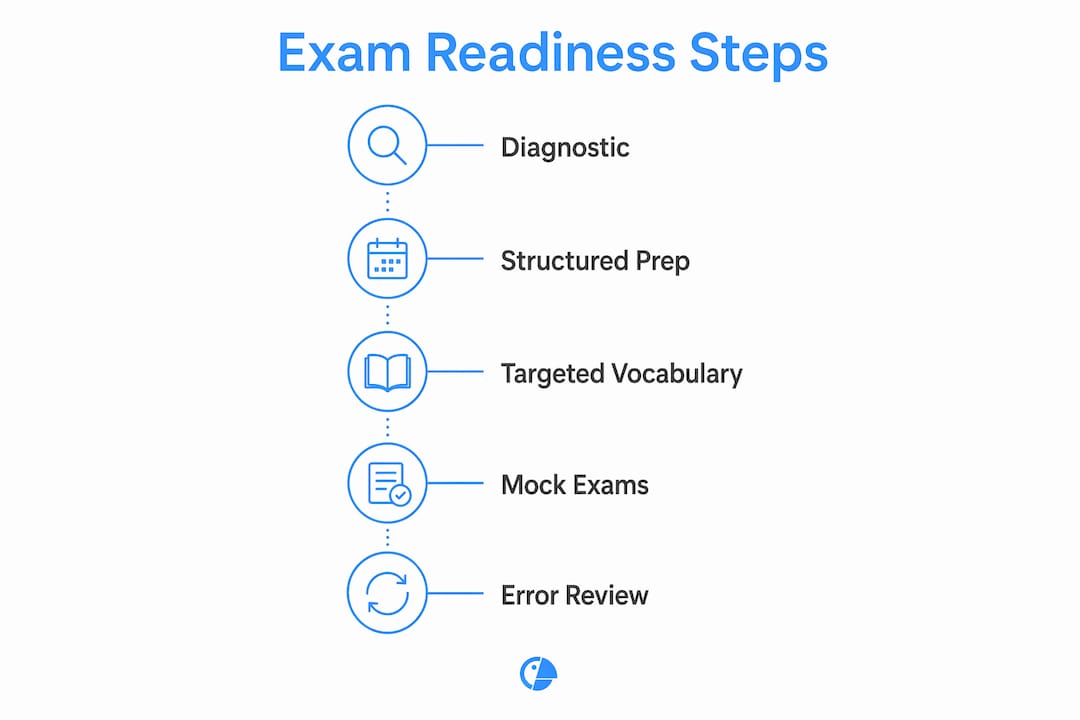
A personalised study plan turns good intentions into measurable progress. The most effective plans follow four stages: diagnostic, targeted practice, mock testing, and final review. Each stage has a different focus, and skipping any one of them creates gaps that show up on exam day.
The table below maps each stage to its purpose and recommended tools:
| Stage | Focus | Recommended Tools |
|---|---|---|
| Diagnostic | Identify weak sections and skill gaps | Official past papers, timed self-assessment |
| Targeted Practice | Strengthen specific weak areas | Anki, Quizlet, graded readers, tutor sessions |
| Mock Testing | Simulate real exam conditions repeatedly | Full-length past papers, recorded speaking tasks |
| Final Review | Consolidate exam vocabulary and error patterns | Error log, exam-specific word lists, light revision |
Balance receptive skills (reading and listening) with productive skills (writing and speaking) throughout your plan. Most learners naturally spend more time on receptive tasks because they feel easier. Productive skills require deliberate, timed practice to improve. A language learning checklist can help you track progress across all four skill areas week by week.
Adjust your plan after each mock exam. If your writing scores are improving but your listening scores are stagnant, shift time allocation accordingly. A static plan that ignores your actual results is less useful than a flexible one that responds to evidence.
A targeted exam revision plan avoids the trap of general cramming by keeping every study session tied to a specific gap or skill. That specificity is what separates learners who improve steadily from those who plateau despite putting in hours.
Key takeaways
Exam readiness for language learners is built through consistent mock exam performance, targeted study, and genuine familiarity with the exam format across all four language skills.
| Point | Details |
|---|---|
| Readiness requires consistent mock results | Pass 3–4 consecutive timed mock exams under real conditions before considering yourself ready. |
| Productive skills need extra attention | Writing and speaking are frequently underprepared; practise both under timed conditions every week. |
| Start preparation early | Begin 6–8 weeks out for general exams and 3–6 months out for major certifications like IELTS or DELF. |
| Target weak areas, not broad topics | Use an error log and adjust your study plan based on mock exam results, not general feelings of readiness. |
| Format mastery reduces anxiety | Knowing your exam's structure, timing, and scoring turns uncertainty into confidence before test day. |
What Tutoroo has learned about real exam readiness
The most common misconception we see among language learners is that studying hard equals being ready. It does not. Readiness is a measurable state, and the only reliable way to confirm it is through repeated, full-length, timed mock exams. Learners who skip this step often walk into their exam having studied for weeks but never having experienced what it actually feels like to complete every section against a clock with no safety net.
We have also noticed that the final two to four weeks before an exam are frequently wasted on broad revision. At that stage, targeted vocabulary tied to your specific exam themes will move your score far more than re-reading general grammar notes. The learners who perform best are the ones who treat those final weeks as a sharpening phase, not a cramming phase.
Managing expectations matters too. Progress in language learning is rarely linear. Some mock exams will feel worse than the one before. That is normal, and it does not mean you are not improving. What matters is the trend across multiple attempts, not any single result. Staying motivated through that process is genuinely hard, and we think it deserves more attention than most exam guides give it. Pairing focused study with proper rest and a realistic mindset is not soft advice. It is how you actually perform on the day.
— Tutoroo
How private tutoring accelerates your exam preparation
Reaching true language proficiency test readiness is faster with expert support behind you.

Tutoroo connects language learners with over 386,000 private language tutors online and in person, across English, Spanish, French, Arabic, Chinese, and many more languages. A private tutor can run realistic mock exam sessions, identify your specific error patterns, and build a study plan that targets exactly what your exam demands. Whether you are preparing for IELTS, DELF, JLPT, or another certification, Tutoroo makes it straightforward to find a tutor who knows your exam inside out. Flexible scheduling means you can fit focused, consistent sessions around your existing commitments, keeping your preparation on track from the first lesson to the final review.
FAQ
What does exam readiness mean for language learners?
Exam readiness means consistently achieving passing scores on full-length, timed mock exams that replicate actual test conditions across all language skills. It goes beyond general knowledge to include pace management, format familiarity, and performance under pressure.
How many mock exams should i complete before my language test?
Passing scores on 3–4 consecutive timed mock exams are the standard benchmark for confirming readiness. One strong result is not enough to confirm consistent performance.
How far in advance should i start preparing for a language exam?
Begin structured preparation 6–8 weeks before general assessments and 3–6 months before major certifications such as IELTS, DELF, or HSK. Starting earlier gives you time to address weak areas without last-minute pressure.
Why do learners often feel ready but underperform on exam day?
Learners tend to overestimate readiness based on informal or partial practice, particularly in speaking and writing. Full simulated tests under strict conditions reveal the performance gaps that relaxed study sessions hide.
Does understanding the exam format really reduce anxiety?
Understanding exam structure, question types, and timing directly reduces anxiety by replacing uncertainty with familiarity. Each full mock exam lowers the cognitive load of the real test, freeing up mental energy for the language itself.