

For most adult learners with a clear goal, a Portuguese tutor is worth paying for. A tutor is worth it when you want to speak, when you need feedback on your pronunciation, or when you are working to a deadline such as a move, a trip or an exam. It is worth less when you just want a casual introduction, are on a tight budget, or have not yet decided how serious you are. This guide explains where the value comes from, where it doesn't, and how to decide.
TL;DR
- One-to-one tutoring is strongest for speaking, pronunciation and fast personal feedback. Research on tutoring points to more observable development than self-study or group teaching.
- It is not the only route. Group classes can be more motivating for outgoing learners, and apps or courses can cover vocabulary and grammar cheaply.
- The best value comes from a hybrid: a tutor for conversation and correction, with self-study for repetition between lessons.
- Choose the dialect (Brazilian or European) first, then test two or three tutors against specific goals before you commit to a block of lessons.
- Measure progress against concrete "I can..." targets, not the number of hours you have logged.
Table of Contents
- What a tutor gives you that an app cannot
- What the research says about one-to-one lessons
- How much does Portuguese tutoring cost in the US?
- How long does it take, and where do tutors save time?
- When tutoring is worth it, and when it isn't
- Choosing a tutor: dialect, experience and fit
- How to tell whether your tutoring is working
- Our perspective
- Find a Portuguese tutor on TUTOROO
- Getting the most from every lesson
- FAQ
- Sources
What a tutor gives you that an app cannot
Apps are good at repetition. They drill vocabulary, keep a streak going and cost little. What they cannot do is listen to you say saudade or pão and tell you which part of the sound is off, then adjust the next ten minutes around your mistakes.
The American Council on the Teaching of Foreign Languages (ACTFL) is the professional body for language educators in the US. It says language instruction should be guided by a qualified educator, and that technology used in isolation is not supported by research as a way to acquire a language. That doesn't make apps useless. It means they work best as a supplement to a human who responds to you.
In practice, a good tutor does four things:
- Sets tasks at your level. ACTFL describes how teachers can design speaking tasks pitched at a learner's current proficiency, drawing on the learner's own interests and experiences, so practice feels low-stakes but pushes you towards the next level.
- Corrects in real time. You hear the right form straight after your own attempt, while it is still fresh.
- Builds lessons around your reason for learning. A nurse preparing to work with Brazilian patients, a traveller heading to Lisbon and a parent speaking with in-laws in São Paulo do not need the same vocabulary.
- Keeps you accountable. A booked hour with a real person is harder to skip than an app notification.
What the research says about one-to-one lessons
The evidence is encouraging, with some honest limits.
One academic comparison of learning outcomes found that one-to-one tutoring produced significantly more microgenetic development (observable changes in what a learner knows) than self-study or group-based methods. In plain terms, learners changed more, and faster, when someone was working with them individually.
A 2025 comparative study of individual and group learning adds some nuance. It reports that one-to-one tutoring is highly effective for pronunciation and personalised skill-building, but that some students find group settings more motivating because of the social interaction and peer learning. The same study suggests personality matters: shy learners may get more from the safe, private setting of a one-to-one lesson, while extroverted learners can thrive on group energy.

So the honest answer is not "tutoring always wins". It is that tutoring wins when your priorities are speaking confidence, accurate sounds and a plan built around you. If you want to explore the trade-offs further, our guides to group versus private language lessons and what one-on-one language teaching involves go into more detail.
How much does Portuguese tutoring cost in the US?
Prices vary widely, and they should be checked against what a tutor actually offers rather than taken from an average. Three things move the price most:
- Where the tutor lives. Online lessons let you hire a tutor in Brazil or Portugal, where living costs differ from those in New York or San Francisco. In-person lessons in a major US city usually cost more than online ones, because the tutor is paying for travel time and local rent.
- Experience and credentials. A professional teacher with exam-prep experience will usually charge more than a conversation partner who is a native speaker with no teaching background. Neither is automatically better. It depends on what you need.
- Lesson length and volume. Shorter lessons are easier to fit in and let you try a tutor cheaply. Regular weekly lessons give the best results but add up over months.
On Tutoroo, tutors set their own schedules and rates and are paid directly by their students. Students pay an introduction fee when they connect with a tutor they have chosen. Because rates are set tutor by tutor, the profile you are looking at is the only reliable guide to what you will pay. A very low rate can still be a good deal, but check it alongside experience and reviews rather than on its own.
A simple way to judge the cost
Ignore the hourly rate for a moment and ask what you are buying. If a tutor charges more, but you reach a conversation-ready level in four months instead of ten, the total spend can be lower. Estimate your own numbers:
- Decide how many lessons per week you realistically can keep up (one or two is typical).
- Multiply by the tutor's rate and by the number of weeks until your deadline.
- Compare that total with the cost of the alternative: a course, a group class, or a trip where you can't communicate.
If the total stays within a budget you can sustain without stress, the value is there. If it doesn't, scale down to fortnightly lessons or a group class rather than quitting.
How long does it take, and where do tutors save time?
Portuguese is generally considered one of the more approachable languages for English speakers. The US State Department's Foreign Service Institute places it in its easiest group of languages for English speakers, meaning less study time than languages such as Japanese or Arabic. The shared Latin roots mean that many words are recognisable on sight.
The hard parts are different. Nasal vowels (mãe, não), the many verb conjugations, and the gap between how words are spelled and how they are spoken can trip up self-taught learners. Those are exactly the areas where a human listener catches problems early, before they become habits. A learner who has practised a sound incorrectly for six months has to unlearn it first.
When tutoring is worth it, and when it isn't
Here is a quick way to decide.
| Your situation | Tutor | Group class | Course or app |
|---|---|---|---|
| Moving to Brazil or Portugal within a year | Best fit | Good support | Useful extra |
| Preparing for a work or business conversation | Best fit | Limited | Useful extra |
| Preparing for a proficiency exam | Best fit | Good if exam-focused | Useful extra |
| Nervous about speaking | Best fit | Can feel exposed | Good first step |
| Want social energy and peers | Possible | Best fit | Limited |
| Curious, just starting out, low budget | Optional | Good | Best fit |
| Learning for a child | Often a strong fit | Good | Limited alone |
Tutoring is especially worth it when:
- You have a deadline or a concrete reason, such as a relocation, family, work or an exam.
- You have already tried self-study and stalled, particularly on speaking.
- You are afraid of speaking in front of others and need a private place to make mistakes.
- You want lessons built around a niche: legal Portuguese, medical vocabulary, or a specific regional accent.
Tutoring is less worth it when:
- You have not tried the language yet and just want a taste. A free app or a library course costs nothing and can tell you whether you enjoy it.
- You can't commit to regular lessons. An occasional lesson with big gaps in between means a lot of time re-learning.
- You want a classroom feel and the company of other learners. Group classes may suit you better.
Many learners do best with a mix: one tutor lesson a week to speak and get corrected, plus short daily practice on their own.
Choosing a tutor: dialect, experience and fit
The research on personality and tutoring has a practical lesson. Results depend on the learner's personality, how openly learner and teacher communicate, and how well the teacher adapts. So the right tutor is not simply the one with the best credentials. It is the one you can talk to comfortably and who adjusts to you.
Pick your dialect first
Brazilian and European Portuguese differ in pronunciation, some vocabulary and a few grammar habits. Both are understood across the Portuguese-speaking world, but if you are moving to São Paulo, a tutor from Rio will suit you better than one from Porto, and vice versa. Decide which variety you need and look for a tutor who speaks it natively.
Check what experience means for you
A native speaker is a good start, but teaching is a separate skill. Ask whether the tutor has taught beginners, whether they have prepared learners for your exam, and whether they explain grammar in English when you are stuck. Our site doesn't require native-speaker tutors to hold formal qualifications, so profile details, reviews and a trial conversation are your best evidence.
Run a short trial
Book two or three short lessons with different tutors before you commit. During each one, notice:
- Did the tutor ask about your goals, or jump straight into a textbook?
- Did you speak for most of the lesson?
- Were corrections clear and kind?
- Did you leave with something specific to practise?
We describe a structured version of this in our guide to finding the right Portuguese tutor in three trial lessons, built around "Can Do" goals.
How to tell whether your tutoring is working
The hours you have logged are not the measure. ACTFL's guidance says learners can monitor progress towards learning targets through formative feedback and self-assessment. It also says feedback matters most when it is specific, timely and tied to the learner's goals and target level.
Turn that into a routine:
- Write three or four "I can..." goals at the start, for example "I can order a meal and ask about ingredients" or "I can introduce my job and my team."
- Ask for specific feedback at the end of each lesson: two things you did well, and one thing to fix next week.
- Record yourself once a month saying the same short passage. Listening back after a few months is often the clearest evidence of improvement.
- Review the goals every four to six weeks. If you are ticking them off, keep going. If nothing has moved, change the plan, or the tutor.
A good tutor welcomes this. If the lessons feel pleasant but you can't point to anything you can now do that you couldn't before, it's time to talk about changing the approach.
Our perspective
At TUTOROO, we see language learning as more than grammar tables. It opens doors to culture, connection and opportunity, and Portuguese is a good example: it links Brazil's music and cooking, Portugal's history and the voices of Angola, Mozambique and Cape Verde. Learners who connect with a person from those places tend to stay curious for longer than those who study alone.

That is why we built a marketplace around direct, one-to-one relationships. Students can search by language, location and availability, message tutors directly and decide for themselves who feels right. Tutors set their own schedules and are paid directly by their students. We think that transparency suits both sides. The student chooses a tutor, not an algorithm, and the tutor builds a lasting relationship rather than a short, anonymous booking.
Our honest advice is to treat tutoring as an investment in speaking. If your goal is a firm foundation in vocabulary, an app or a course may do the job for less. If your goal is to speak with people, a tutor is the quickest path we know.
— TUTOROO
Find a Portuguese tutor on TUTOROO
If you have decided that one-to-one lessons fit your goals, you can browse Portuguese tutors on TUTOROO, compare profiles, message tutors directly and choose the dialect and schedule that suit you. Lessons can be held online or locally, depending on where the tutor is based.
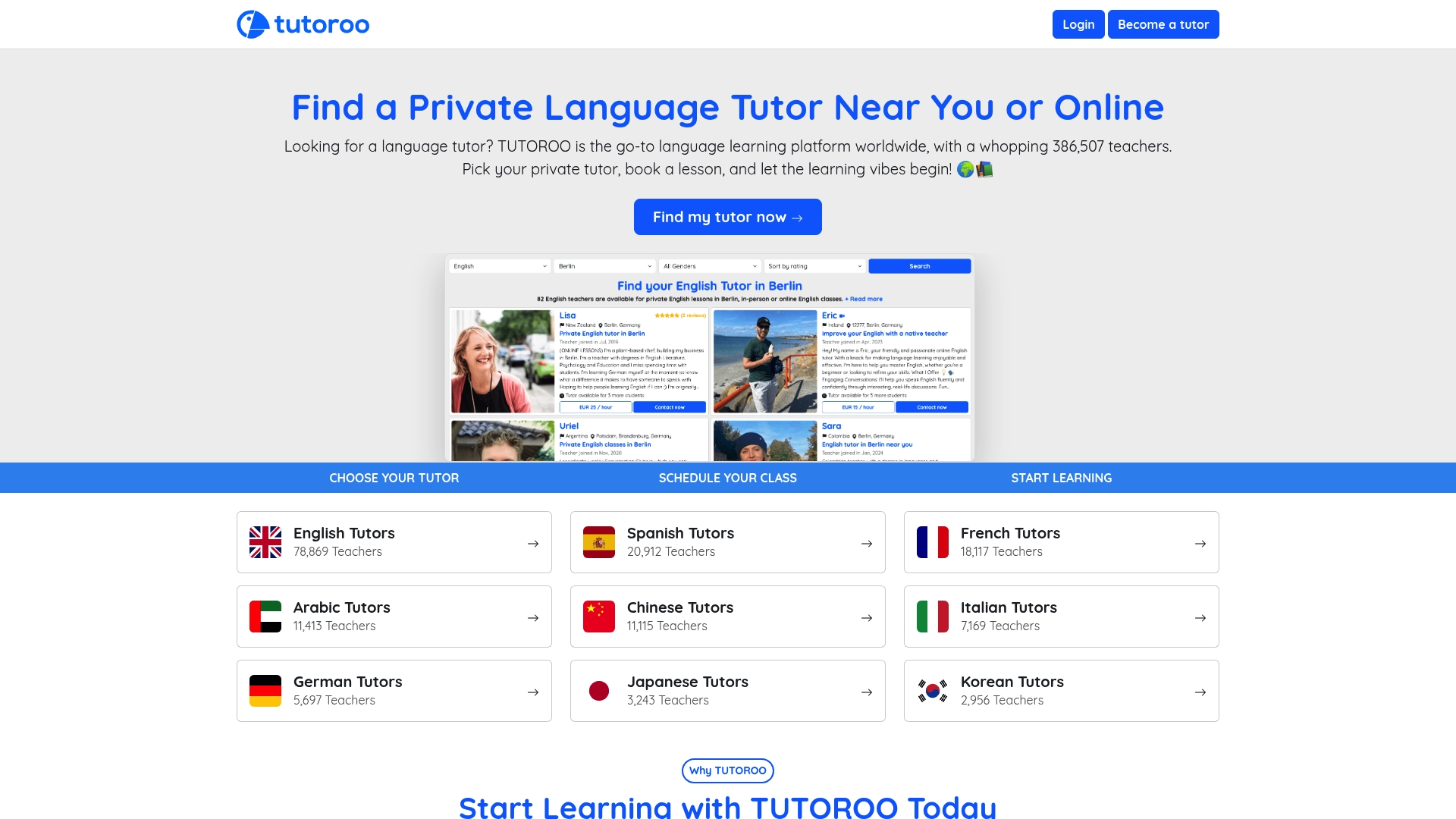
If you would like to see how a first booking works before you choose, our post on booking one-on-one Portuguese lessons walks you through it. Learners comparing several languages can also start from the TUTOROO home page, which covers English, Spanish, French, Japanese, Mandarin, German, Italian and Portuguese.
Getting the most from every lesson
Paying for a tutor is only half of the value. The other half is how you use the hour.
- Prepare something to say. Even three sentences about your week give the tutor material to correct.
- Ask for the lesson in Portuguese as early as you can. Beginners can start with greetings and classroom phrases, then extend them.
- Keep a mistakes notebook. Write down each correction and review it before the next lesson.
- Practise between sessions. Ten minutes a day of listening or flashcards keeps the material alive.
- Be honest about what isn't working. A good tutor would rather change the pace than lose a student.
For more on why this style of learning works, you can read our overview of personalised learning gains from one-on-one tutoring.
FAQ
Is learning Portuguese worth it?
For most people with a real reason, yes. Portuguese connects you with Brazil, Portugal and several African nations, and it is widely considered approachable for English speakers. It pays off most when you tie it to a goal such as travel, family, work or a move.
Is it worth getting a language tutor?
It is worth it when you want to speak, need pronunciation feedback or have a deadline. Research on one-to-one tutoring links it with more observable learning development than self-study, although some learners prefer the energy of a group. If you are just exploring, try free resources first.
Should I choose a Brazilian or European Portuguese tutor?
Choose the variety you will actually use. Brazilian Portuguese suits learners heading to Brazil or working with Brazilian communities in the US, and European Portuguese suits those moving to Portugal. Both are understood by speakers of the other, so the choice is about sound and vocabulary rather than being right or wrong.
How often should I have lessons?
One lesson a week is a sensible start for most adults, with short daily practice in between. Two a week can speed things up if you have a deadline. Consistency matters more than intensity, so choose a rhythm you can keep for months.
Can a tutor replace a course or an app?
Not entirely, and it doesn't need to. A tutor is best for speaking, correction and personal goals, while a course or app is good for repetition. Combining them gives most learners the best value for money.
Sources
- ACTFL: The Role of Technology in Language Learning
- ACTFL: Design Communicative Tasks
- ACTFL: Provide Effective Feedback
- A Comparison of Learning Outcomes (2023)
- A comparative study of individualized and group-based learning (2025)