

Pick the variety you need (Brazilian or European Portuguese), write down one measurable goal, then book a short trial lesson to test the fit before committing to a package. A platform like Tutoroo makes this fast because you can message several tutors and compare their answers before paying for a course.
TL;DR:
- Choosing a tutor based on their teaching evidence and goal-fit experience is more effective than relying solely on native speaker status.
- Setting specific, measurable Can-Do goals and asking tutors how they will structure lessons ensures clear progress tracking.
- Learning European or Brazilian Portuguese should be decided before searching, as the differences significantly impact vocabulary, pronunciation, and listening comprehension.
- Testing three trial lessons with different tutors within the same week provides the best indication of the right fit and lesson quality.
- Price varies widely depending on qualifications and specialization, but value is better judged by progress toward your goals rather than hourly rate.
Table of Contents
- What criteria should you compare when you choose a Portuguese tutor?
- How do you set a measurable learning outcome before picking a tutor?
- Brazilian or European Portuguese: which should you learn?
- How many trial lessons do you need before deciding on a tutor?
- What should you expect to pay, and what actually drives the price?
- How do you contact tutors and book your first lesson?
- How does Tutoroo make this easier?
- What learners get wrong when choosing a tutor
- Ready to find your Portuguese tutor?
- Sources
- FAQ
What criteria should you compare when you choose a Portuguese tutor?
Every tutor profile looks impressive at first glance. Photos, warm bios, a string of five-star reviews. The trick is knowing which details actually predict a good lesson and which are just decoration.
Work through these criteria in order, because each one filters out mismatches before you spend a cent.
- Variety match first. Confirm whether the tutor teaches Brazilian Portuguese (PT-BR) or European Portuguese (PT-PT), and check it lines up with why you're learning, not just what the tutor happens to speak.
- Teaching evidence, not just native fluency. Ask what a typical lesson looks like, how they correct mistakes, and whether they can explain grammar rules in plain terms rather than just "that's how it sounds right."
- Goal-fit experience. A tutor who has coached people through the same situation you're facing, whether that's a work relocation, a family reunion, or an oral exam, will anticipate the vocabulary and pressure points you'll actually hit.
- Availability and logistics. Check time zone overlap, whether lessons run online or in person, minimum notice for cancellations, and how make-up lessons work.
- Price and package clarity. Look for a stated per-lesson rate and clear terms on packages, rather than vague "contact for pricing" with no detail once you message.
- Trust signals on the profile. Genuine student reviews, a short audio or video introduction, and any verification badges tell you more than a polished bio ever will.
Native-speaker status feels like the obvious first filter, but it's actually the least reliable one. Someone who grew up speaking Portuguese in Lisbon or São Paulo can still struggle to explain why a verb takes the subjunctive, or fail to notice that you keep mispronouncing the same vowel. Teaching skill matters more than native fluency because a good tutor adapts material, gives correction you can actually use, and breaks patterns down instead of just modelling them and hoping you copy correctly.
Goal-fit experience is the criterion most learners skip, and it's the one that saves the most time. A tutor who mainly teaches conversational hobbyists will structure lessons very differently to one who regularly preps clients for the CAPLE exam or for a client-facing job in Lisbon. Ask directly: "Have you worked with students preparing for [your specific situation]?" A confident, specific answer beats a generic "yes, of course."
Pro Tip: Message three tutors with the exact same question about your goal and compare the replies side by side. The differences in depth and specificity will tell you more about teaching quality than any star rating.
Price transparency deserves a closer look too. A tutor who quotes a flat per-lesson rate and explains package discounts upfront is signalling that they run an organised practice. Vague pricing, or pricing that only appears after several back-and-forth messages, is often a sign the lesson structure is equally loose.
How do you set a measurable learning outcome before picking a tutor?
Vague goals produce vague progress. "I want to get better at Portuguese" gives a tutor nothing to plan against, and it gives you no way to know if six months of lessons actually worked. The fix is borrowing from how language proficiency is formally measured.
The ACTFL proficiency guidelines use a Can-Do framework: instead of vague level labels, you define specific tasks a learner should be able to complete independently, then check progress against those tasks. This approach exists because self-reported confidence is a poor measure of real ability, and a task you can point to gives both you and your tutor a shared target to hit.
Here's what that looks like translated into everyday learning goals:
- Beginner, travel focus: "I can order food, ask for directions, and handle a basic hotel check-in in Portuguese without switching to English."
- Intermediate, family focus: "I can hold a fifteen-minute phone conversation with my partner's grandparents about daily life and family news."
- Intermediate, professional focus: "I can participate in a work meeting in Portuguese and summarise the key points afterwards in writing."
- Advanced, exam focus: "I can write a structured 300-word opinion essay in Portuguese with correct use of the subjunctive and compound tenses."
Notice none of these say "fluent" or "conversational," because those words mean something different to everyone. Each one describes an observable task with a clear pass or fail.
Once you've picked a goal like this, turn it into a short brief you can paste into a message to any tutor you're considering: "I'm learning [PT-BR or PT-PT]. I'm currently at [beginner/intermediate/advanced] level. My goal is [specific Can-Do statement]. I can commit to [X] lessons per week of [duration], in [your time zone]. Can you tell me how you'd structure the first month towards this goal?"
That single paragraph does more filtering than a dozen profile scans, because it forces every tutor to respond with an actual plan rather than a generic sales pitch.
Brazilian or European Portuguese: which should you learn?
This decision should come before you look at a single tutor profile, because it changes almost everything downstream: vocabulary, pronunciation drills, even which listening materials a tutor assigns for homework. Linguistic research treats Brazilian and European Portuguese as distinct competences, not just accents of the same thing, with real differences in grammar patterns, verb usage, and everyday vocabulary.
The gap runs deeper than most learners expect. Scholarly reviews point to systematic phonological and lexical differences between the two varieties, including how vowels get reduced or dropped in connected speech. European Portuguese tends to compress unstressed vowels heavily, which is part of why learners trained on Brazilian media often find a conversation in Porto harder to follow than expected, even with a decent vocabulary.
Match the variety to your actual goal, not to whichever tutor happened to message you back first. Planning a move to Lisbon, dealing with Portuguese in-laws from the Azores, or applying for Portuguese citizenship all point towards PT-PT. Business in São Paulo, a partner from Rio, or most Portuguese-language content on streaming platforms point towards PT-BR.
When you message a tutor, ask them directly to confirm which variety they teach and how they'd help you cope with the other one if you'll encounter both. During a trial lesson, run a quick listening check: ask them to speak at a natural conversational pace for thirty seconds about something ordinary, then ask you to summarise it. If you're learning European Portuguese, this test matters even more, since the reduced vowel patterns that trip up learners rarely show up in slowed-down textbook audio.

How many trial lessons do you need before deciding on a tutor?
Three. That's the practical rule, and it's grounded in something more solid than gut feeling. A randomised study of remote language tutoring found that tutor effects explained roughly 15% of the variation in outcomes, even though the average gain across all students was modest. In plain terms: which tutor you pick matters more than most learners assume, and testing that fit early protects both your time and your money.
During a 20 to 30 minute trial lesson, watch for three things. Does the lesson follow a clear structure, or does it wander from topic to topic with no plan? Does the tutor correct your mistakes in a way you can actually apply next time, or just repeat the correct version and move on? And is there a genuine balance between you speaking and the tutor speaking, rather than a lecture with occasional questions?
The three-session decision rule gives you checkpoints instead of a single gut call:
- After lesson one: you should be able to state, in your own words, what the tutor's plan is for your first month.
- After lesson two: you should have experienced at least one round of targeted correction or a practice drill aimed at a specific weak spot, not just general conversation.
- After lesson three: you should be able to point to one concrete thing you can now do that you couldn't do before lesson one.
If you can't tick off any of those three, that's your signal to have a direct conversation with the tutor about restructuring lessons, or to start trialling someone else. Tutor-to-tutor variation is real, and lessons that stay unfocused past the third session rarely improve on their own.
Pro Tip: Book your three trial lessons with different tutors in the same week rather than spacing them a month apart. Back-to-back comparison makes the differences in teaching style far more obvious than trying to remember details from a lesson three weeks ago.
Red flags worth acting on immediately include a tutor who never asks about your specific goal, one who spends the trial mostly talking about themselves, or one who can't explain why they made a particular correction when you ask. None of these are dealbreakers on their own, but two or more together are a strong sign to keep looking.
What should you expect to pay, and what actually drives the price?
Portuguese tutoring rates vary widely depending on the tutor's location, experience, and specialisation, and price alone tells you very little about lesson quality. What matters more is understanding which factors push a rate higher and whether those factors matter for your goal.
Certification and formal teaching qualifications tend to raise price, as does specialisation in a narrow area like business Portuguese or exam preparation for CAPLE or CELPE-Bras. A tutor who has built a course specifically around exam criteria is doing more preparation work behind the scenes than one running general conversation practice, and that shows up in the rate.
Package structures also shape what you actually pay per lesson. Buying a block of ten or twenty lessons upfront usually brings the per-lesson cost down compared to booking one at a time, though it locks you into a tutor before you've fully tested the fit, which is exactly why the trial-first approach matters more than the discount.
On frequency: two lessons a week of 45 to 60 minutes tends to produce more measurable progress than one longer weekly session, mostly because proficiency gains vary by how often skills get reinforced rather than by total hours alone. If your schedule only allows one lesson a week, that's still workable, but it's worth telling your tutor so they can adjust homework to cover the gap between sessions.
Don't judge value purely on the hourly figure. A slightly more expensive tutor who consistently hits your Can-Do goals in three months is cheaper, in every sense that matters, than a budget option that leaves you circling the same plateau for a year.

How do you contact tutors and book your first lesson?
Once you've settled on a variety and a measurable goal, the actual outreach should take you fifteen minutes, not a week of second-guessing.
- Send your brief. Use the template from earlier: variety, current level, specific goal, lesson frequency, and your time zone. Send the same version to two or three tutors so you can compare replies fairly.
- Ask about the practical details before booking. Confirm what materials they use, their cancellation policy, whether they set homework between lessons, and how they give feedback.
- Prepare for the trial itself. Write down two or three sentences about why you're learning Portuguese and what you want to be able to do in six months, so the tutor has something concrete to plan against from minute one.
- Book the paid lesson only after the trial checkpoint. Use the three-session rule as your decision point rather than committing to a large package on lesson one.
Preparation matters more than most learners expect. A tutor who receives a clear brief before the first lesson can walk in with a rough plan already, instead of spending the first fifteen minutes just figuring out your level.
How does Tutoroo make this easier?
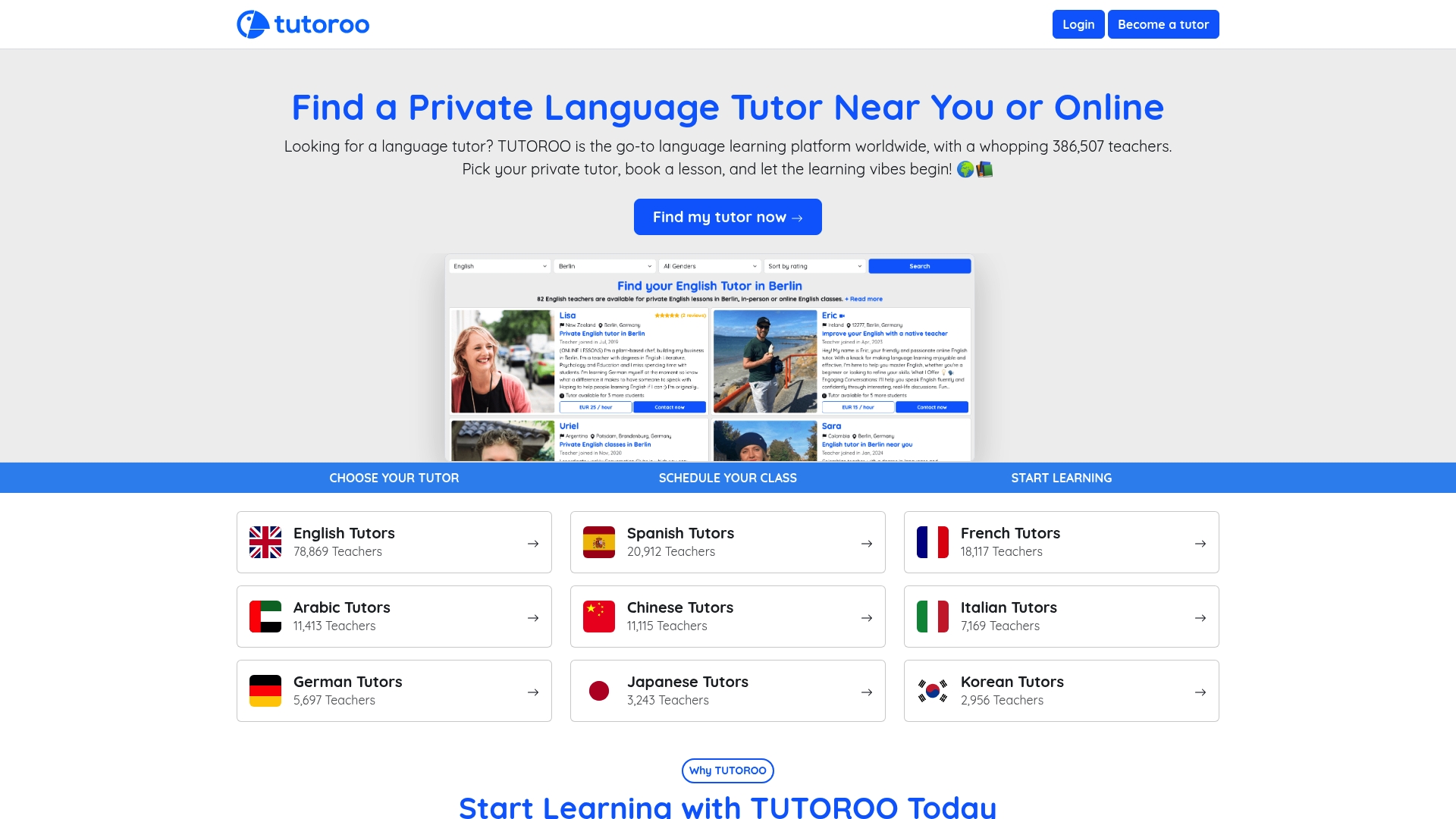
Tutoroo runs on a straightforward idea: give learners direct access to a large pool of tutors and let them handle the comparing themselves, without a rigid curriculum forced on top. The platform connects students with a community of over 386,000 language teachers worldwide, covering Portuguese alongside dozens of other languages, so narrowing down to tutors who teach specifically PT-BR or PT-PT is a filtering exercise, not a search for a needle in a haystack.
The messaging system is where the three-session rule actually becomes practical. You can send your brief to several Portuguese tutors at once, compare how they respond, and book trial lessons without navigating a rigid enrolment process. Profiles show tutor location, availability, and lesson format, so you can decide upfront whether you want online or in-person tutoring and filter accordingly.
Because tutors set their own schedules and communicate directly with students, rescheduling around time zones or a busy week is a conversation, not a support ticket. That flexibility is exactly what the trial-first approach needs to work in practice.
What learners get wrong when choosing a tutor
The biggest mistake is treating the search like shopping for a static product instead of testing a working relationship. A five-star profile tells you almost nothing about whether a tutor's explanation style will click with how you learn.
The second mistake is skipping the variety question entirely, assuming "Portuguese is Portuguese." It isn't, and discovering that six lessons into a course aimed at the wrong dialect wastes real time.
The third is buying a large package before running a trial, locking in cost before confirming fit. My practical tip: treat the first three lessons as a test, not a commitment, and don't feel awkward about walking away if the fit isn't right.
— TUTOROO
Ready to find your Portuguese tutor?
Tutoroo works differently from a fixed-curriculum language school: instead of enrolling in a set course, you message real tutors directly, compare their teaching approach against your specific goal, and book a trial before committing to anything larger. That direct-matching model is what makes the three-session decision rule practical in the first place, rather than a nice idea you never quite get to use.
Browse Portuguese tutors online to filter by variety, availability, and specialisation, then send your brief to two or three who look like a fit. If you're weighing up how tutor matching actually works before diving in, that's worth a quick read too. Once you've picked someone whose trial lesson ticked the right boxes, book the next lesson directly through their profile and keep the momentum going.
Sources
- ACTFL proficiency guidelines overview
- Remote tutoring in language: Evidence from Paraguay (2026)
- Brazilian vs. European Portuguese | Middlebury Language Schools blog
- The debate on Brazilian and European Portuguese (De Gruyter Brill, 2022)
FAQ
How much does a Portuguese tutor cost?
Rates vary by tutor experience, specialisation, and package size, with certified tutors and exam-prep specialists typically charging more than general conversation tutors. Tutoroo doesn't publish a fixed rate because pricing is set directly by each tutor, so check individual Portuguese tutor profiles for current rates.
What is the most effective way to learn Portuguese?
Regular one-on-one lessons built around a specific, measurable goal tend to outperform passive study or app-only learning, especially when paired with real conversation practice. Setting a Can-Do style outcome, as recommended in the ACTFL framework, gives both you and your tutor something concrete to work towards rather than a vague sense of "getting better."
What is the best platform to learn Portuguese?
The right platform depends on whether you want a fixed course structure or direct access to individual tutors you can compare and trial yourself. Tutoroo suits learners who want to message tutors directly, test fit through trial lessons, and choose based on their own specific goal rather than a pre-built curriculum.
How many years does it take to learn Portuguese fluently?
There's no fixed timeline, because progress depends on lesson frequency, prior language experience, and how the word "fluent" is defined for your own goals. Proficiency guidance from ACTFL notes that progression rates vary significantly by language and by how consistently a learner practises, which is exactly why setting a specific Can-Do goal matters more than chasing a vague fluency label.