
There is no single national qualification for a private language tutor in the United States. What you need depends on the setting: a public school asks for a state licence, a language institute usually asks for a degree and a certificate, and a private one-on-one tutor can start without either. On TUTOROO, tutors register themselves and set their own schedules, and native speakers do not need formal qualifications to teach. Learners choose a tutor by language, location, availability and fit with their goals.
This guide sets out what each setting expects, which credentials carry weight, and how to match a tutor's background to what you want to achieve, whether you are learning or planning to teach.
TL;DR
- No federal or national licence is needed to tutor a language privately. Employers and schools set their own requirements, and they vary a great deal.
- Public K-12 teaching is different: it needs a bachelor's degree, a state teaching licence and usually a licensure exam.
- For language schools and online English teaching, the common benchmark is a bachelor's degree plus an accredited 120-hour TEFL or TESOL certificate.
- For one-to-one tutoring, fluency, lesson-planning skill, experience and learner feedback often matter as much as paper credentials.
- On TUTOROO, native speakers can register without formal qualifications, so learners can pick the tutor whose profile suits their goal.
Table of Contents
- Is a licence or degree legally required to tutor a language?
- What U.S. employers typically ask for
- Qualifications by setting
- School teaching: the licensed route
- Do you need a degree to teach a language?
- TEFL, TESOL and other certificates
- Skills that matter as much as credentials
- How learners can match a tutor to a goal
- If you want to become a tutor
- Find a language tutor on TUTOROO
- FAQ
- Sources
Is a licence or degree legally required to tutor a language?
For private tutoring, generally not. The U.S. Bureau of Labor Statistics (BLS) describes tutor requirements as varying by employer: some employers ask for no credentials, others prefer a bachelor's degree, ideally in the subject being tutored, and some prefer teaching experience or a state-issued teaching certification.
A TEFL provider makes the same point for English: a degree is generally not legally required to tutor privately in most places, although schools and some platforms may ask for one. Another guide adds that there is no legal requirement to hold a certification to tutor English privately.
The word "private" matters here. A licence becomes mandatory when you teach in a public school, not when you meet a learner one to one in a cafe or on a video call.
What U.S. employers typically ask for
The BLS says tutors typically need some college coursework in the subjects they want to teach. It also notes two special cases:
- Test-prep tutors usually must have scored highly on the standardised tests they help students prepare for.
- Student tutors, such as college peers, may need a minimum grade point average or high grades in the subjects they tutor.
So for a learner preparing for an exam such as the TOEFL or IELTS, a tutor's own results and exam experience are a sensible thing to look for. For a learner who wants conversation practice before a trip, they matter far less.
Qualifications by setting
The table below pulls the main settings together. "Licence" means a state-issued teaching credential, not a certificate from a course provider.
| Setting | Typical expectation | Source |
|---|---|---|
| Private one-to-one tutoring | Varies; often no formal credential, fluency and experience count | BLS |
| Adult ESL at private institutes, community programs, business English, exam prep | Bachelor's degree plus accredited 120-hour TEFL/TESOL certificate; no state licence | OnTESOL |
| Some private language schools in the US | A TESOL certificate, typically an intensive course of 100+ classroom hours with practical training | TESOL International Association |
| Public adult basic education and ESL | At least a bachelor's degree and a teaching certificate | BLS |
| Community college | Often a master's degree (30 to 36 credit hours) | TESOL International Association |
| K-12 public school | Degree, state licence, student teaching and exams | NC State |
The pattern is simple: the more formal the institution, the more formal the paperwork. One-to-one tutoring sits at the flexible end.
School teaching: the licensed route
Some learners and parents wonder whether a tutor needs the same credentials as a classroom teacher. They do not, but it helps to know what the school route involves.
Louisiana, for example, defines certification as the process that legally authorises people to teach in K-12 schools and lists a World Language Certificate among its standard teaching certificates. In North Carolina, teaching French or Spanish in K-12 requires a bachelor's degree in the content area from an accredited teacher-preparation programme, student teaching, a 2.75 GPA, passing Praxis II scores and a passing edTPA portfolio.
The LangCred credentialing body says that in most states a bachelor's degree is needed for a language teaching credential, that teaching experience or approved teacher-education training is often required, and that proof of proficiency in English and in the language taught must be submitted.
For less commonly taught languages the route can be harder still. An ACTFL journal article reports that in Minnesota there are no certification programmes for many languages, such as Hmong and Somali, so teachers rely on alternative pathways such as a portfolio reviewed by a panel. This is one reason private tutoring matters for these languages: a fluent speaker can teach where formal pathways barely exist.
Adult ESL is a patchwork. A state-by-state brief on adult ESL credentialing found that requirements vary widely: some states require a specific certification, some an endorsement on a K-12 licence, some offer an optional certificate, and some have no special requirements. The brief dates from 2008, so check your state education department for current rules.

Do you need a degree to teach a language?
For private tutoring, a degree is a plus, not a gate. The TESOL International Association explains that a bachelor's degree is usually a prerequisite for TESOL training programmes, and a master's degree is required to teach in higher education and community colleges. Many direct students and tutoring marketplaces, on the other hand, prioritise certification, experience and reviews over a degree.
If you are a prospective tutor, a degree in the language, linguistics or education strengthens your profile. If you do not have one, you can still teach, and your fluency, patience and track record carry the weight.
TEFL, TESOL and other certificates
These acronyms confuse almost everyone, so here is the short version. TEFL means teaching English as a foreign language, usually to people living outside English-speaking countries. TESOL means teaching English to speakers of other languages and is often used for learners inside English-speaking countries. One guide recommends TEFL for students outside English-speaking countries and TESOL for learners inside them. Both certificates relate to English only. Tutors of Spanish, French, Japanese or Mandarin have their own routes, usually proven fluency plus teaching experience.
Three routes are commonly described for English teachers:
- A state ESL endorsement added to a U.S. teaching licence, for public schools.
- An accredited TEFL or TESOL certificate of at least 120 hours, for language schools, teaching abroad and online work.
- A university TESOL certificate or master's degree.
These come from a certification guide that also notes there is no single national ESL licensing board. Public-school roles need a state-issued endorsement, which involves a bachelor's degree, a teaching licence, approved preparation and a licensure exam such as the Praxis ESL test, while language-school and online work typically uses a 120-hour certificate.
Two points are worth knowing before you invest in a course. First, TESOL notes that for most U.S. schools, TESOL certificates alone do not count toward employment qualifications the way EAL endorsements do, which is why endorsements are the preferred route for school-based teaching. Second, the 120-hour certificate is described as the industry standard for online English teaching, though some online platforms accept tutors without a bachelor's degree if they have at least six months of experience and a teaching certificate.
Does a certificate raise what you can charge?
It can. One TEFL provider says a certificate can make a tutor easier to hire and justify a higher rate, and reports online rates of $15 to $40 an hour and in-person rates of $25 to $60 for private English tutors in 2026. Rates differ by city, language and learner, so treat these as a rough range, not a promise. The same source separates two ideas: being legally allowed to tutor, and being able to get hired at a decent rate. A recognised certificate is one way to show seriousness to parents and adult learners.
Skills that matter as much as credentials
Credentials show that someone studied teaching. They do not show that a tutor can help you. LangCred observes that alongside academic background and language proficiency, practical skills such as public speaking, lesson planning, classroom management and technology can be acquired through traditional or alternative teacher programmes and online courses.
In a one-to-one setting, these are the skills that tend to show up in a good lesson:
- Fluency and accent fit. Native or near-native command of the language, and a variety (for example Latin American or European Spanish) that suits where you will use it.
- Lesson planning. A clear route from where you are to your goal, with homework and review.
- Adapting to the learner. A practical guide stresses that ESL learners are not a single group: children aged 5 to 12 need 10 to 15 minute activities with games and visuals, teenagers often prepare for IELTS or TOEFL, adults want goal-oriented practical lessons, and business English learners take focused 30 to 45 minute sessions.
- Cultural knowledge. Idiom, etiquette and the everyday habits that make a language feel alive.
How learners can match a tutor to a goal
Instead of asking "is this tutor qualified?", ask "what do I need this tutor to be good at?" The answer changes with your goal.
Travel or conversation. You need a fluent speaker who is patient, relaxed and happy to role-play real situations such as ordering food, asking directions or booking a room. A native speaker from the region you are visiting is ideal. Formal teaching credentials are a bonus.
Exam preparation. Look for a tutor with experience of your specific test and, as the BLS notes for test-prep tutoring, a strong record on that standardised test. A certificate or degree in language teaching adds structure.
Children. Parents often prefer a tutor with teaching experience and a gentle, game-based approach. Short activities and visuals suit younger learners.
Business language. Professional experience in the field counts, along with a tutor who can focus sessions on meetings, emails and presentations.
Beginner versus advanced. Beginners benefit from clear explanation and structure. Advanced learners often want a tutor who can polish nuance, correct subtle errors and discuss complex topics.

On TUTOROO you can browse tutors by language, location and availability, message them directly and talk through your goal before you commit. Our guide on why tutor credentials matter for language learners and the piece on why certified language tutors matter for skill and confidence go deeper on reading a tutor's background.
If you want to become a tutor
Aspiring tutors often ask where to begin. A practical order looks like this:
- Decide your language and learner. Children, exam candidates and business professionals all need different lessons.
- Build your credentials at your own pace. A degree in the subject or education helps, and a 120-hour certificate is the common benchmark for English teaching at language schools and online. If you teach another language, document your fluency and any teaching or tutoring experience.
- Write a profile that shows your strengths. Lead with your language background, your teaching style and the learners you enjoy working with.
- Set your availability and start lessons. Early lessons, reviews and repeat students build your reputation faster than any single qualification.
TUTOROO lets tutors register, set their own schedules and receive payment directly from students. Our step-by-step guide to understanding the requirements for language tutoring covers the basics, and the section on creating your tutor profile and building credibility shows how to present what you have.
Our view on tutor qualifications
We built TUTOROO around a simple belief: the best language tutor is the one who fits your goal, your schedule and your personality. A large worldwide community of tutors means you are not limited to whoever lives down the road, and you can talk with a tutor directly before you start.
Formal credentials have real value, and many of our tutors hold them. But languages are also carried by the people who live them. Native speakers bring authentic pronunciation, everyday idiom and cultural immersion that no syllabus fully captures, and that is why TUTOROO welcomes native speakers without requiring formal qualifications.
For learners, that means choice: a certified teacher for exam preparation, a native conversation partner for a trip, a patient guide for a child. For tutors, it means flexibility: set your own schedule and receive payment directly from your students.
TUTOROO
Find a language tutor on TUTOROO
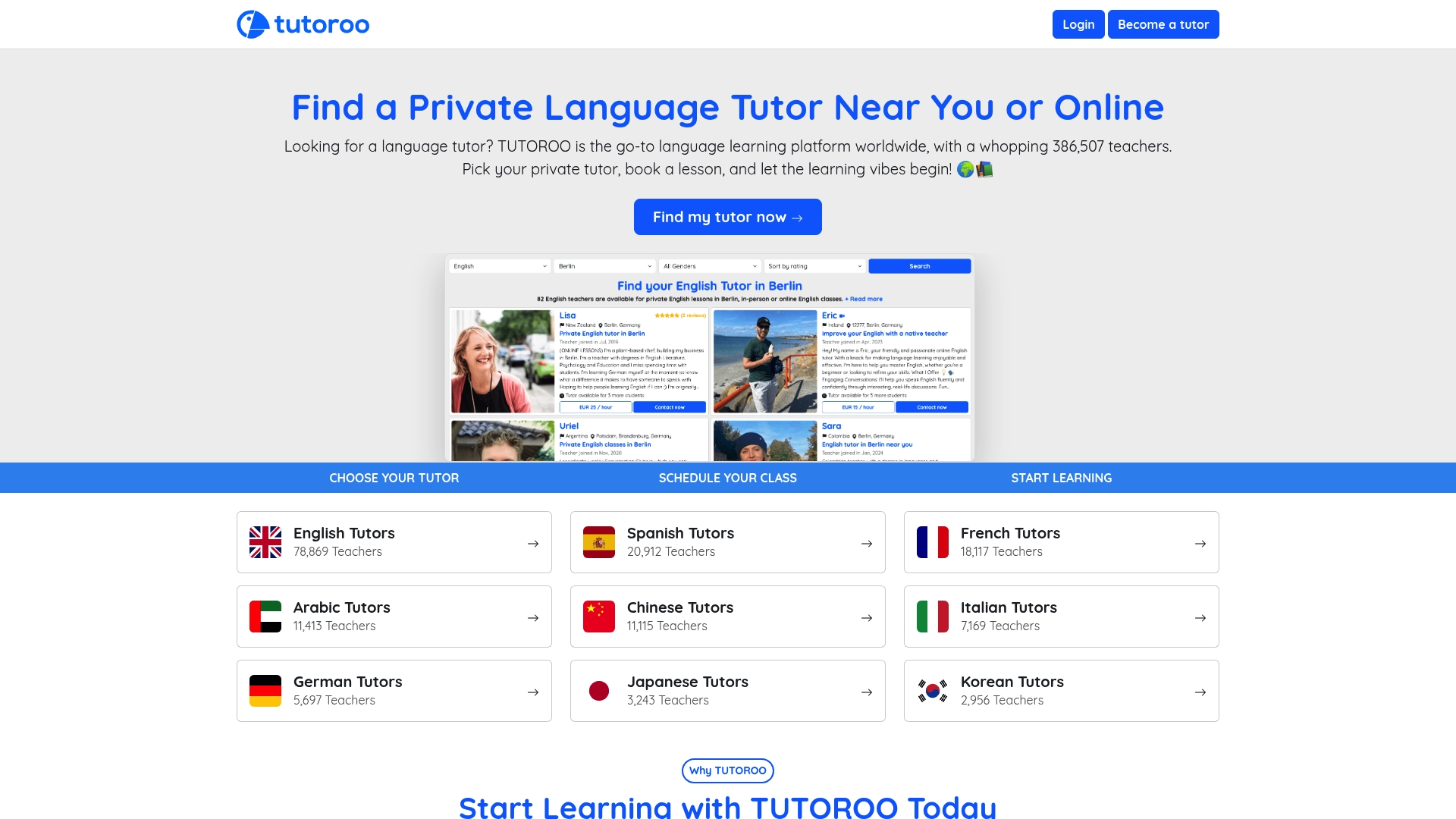
If you are ready to start, TUTOROO connects you with private language tutors for one-to-one lessons, in person or online. Tutors are available in English, Spanish, French, Japanese, Chinese or Mandarin, German, Italian and Portuguese, among many other languages. You pay an introduction fee to be matched with the tutor you choose, and lessons are then paid directly to your tutor. Start your search on TUTOROO or go straight to English tutors, French tutors or German tutors.
FAQ
What do you need to be a language tutor?
For private tutoring, usually fluency in the language, the ability to explain it clearly and some way to show your experience. Formal requirements depend on the employer: the BLS says some employers require no credentials while others prefer a degree or teaching certification. On TUTOROO, native speakers can register without formal qualifications.
What degree do you need to be a language teacher?
To teach in a K-12 public school, a bachelor's degree is part of the state licence route, often in education or the language itself. Community colleges often look for a master's degree. For private tutoring, no particular degree is required, although a degree in the language or in teaching strengthens a profile.
Can you teach a language without a degree?
Yes, in private tutoring. A degree is generally not legally required to tutor privately in most places. Some schools and online platforms ask for one, so a fluent speaker without a degree often starts with one-to-one tutoring, where experience and learner feedback build credibility.
Is a TEFL or TESOL certificate worth getting?
It is useful if you plan to teach English at language schools or online, where an accredited 120-hour certificate is the common standard. It can also support a higher hourly rate. Check your state's rules first if you aim to teach in public schools, because those need a state licence or endorsement.
Sources
- Tutors: Occupational Outlook Handbook, U.S. Bureau of Labor Statistics
- Adult Basic and Secondary Education and ESL Teachers, U.S. Bureau of Labor Statistics
- Questions on Language Teacher Credentialing, LangCred
- Adult ESL teacher credentialing and certification, CAL Solutions
- Turning Obstacles into Opportunities, ACTFL
- Beginning Your Career, TESOL International Association
- Bulletin 746, Louisiana Standards for State Certification
- Foreign Language Education Advising, NC State
- Accredited TEFL / TESOL Certification Courses in the United States, OnTESOL
- ESL Certification: How to Get Certified to Teach English, Premier TEFL
- Private English Tutor Rates: A Complete Pricing Guide, Premier TEFL
- How to Tutor English as a Second Language, Zutor
- Tutoring English Online, The TEFL Org