

TL;DR:
- Choosing the right lesson plan depends on aligning detailed, semi-detailed, or UbD frameworks with specific teaching contexts and goals.
- Flexible, adaptive plans enhance authentic language learning by balancing clear objectives with responsiveness to student needs.
Choosing the right lesson plan can feel like standing in front of a wall of keys, unsure which one opens the door. For language educators and tutors, the range of available frameworks is genuinely broad, and selecting one that fits your students, your goals, and your teaching style takes real knowledge. Effective lesson plans balance clear objectives, engaging methods, assessment alignment, and adaptability to support diverse learners. This article maps the most useful types of language lesson plans, compares their strengths, and offers practical guidance so you can choose, combine, and adapt with confidence.
Table of Contents
- Key takeaways
- How to evaluate types of language lesson plans
- 1. Detailed lesson plans
- 2. Semi-detailed lesson plans
- 3. Understanding by Design (UbD) lesson plans
- 4. Daily lesson plans
- 5. Weekly lesson plans
- 6. Unit lesson plans
- 7. Content-area and grade-level lesson plans
- 8. Communicative Language Teaching (CLT) lesson plans
- 9. Task-Based Language Teaching (TBLT) lesson plans
- 10. Comparing lesson plan types: what suits which context
- What experience has taught us about lesson planning
- Find the right tutor to bring your lesson plans to life
- FAQ
Key takeaways
| Point | Details |
|---|---|
| Lesson plan types vary by detail | Detailed, semi-detailed, and UbD plans suit different experience levels and teaching contexts. |
| Planning horizon shapes scope | Daily, weekly, and unit plans serve different purposes and should align with cumulative learning goals. |
| CLT and TBLT drive communication | Communicative and task-based approaches prioritise real-world interaction over grammar drills. |
| Mixing frameworks adds strength | Combining UbD's backward design with task-based cycles keeps outcomes clear and lessons engaging. |
| Adaptability is non-negotiable | The most effective lesson plans are treated as living documents, not fixed scripts. |
How to evaluate types of language lesson plans
Before exploring specific frameworks, it helps to know what makes a lesson plan genuinely useful for language teaching. Not every plan suits every context, and a checklist designed for a secondary school classroom will not serve a private ESL tutor in the same way.
When assessing any plan, consider the following factors:
- Level of scripting and detail: Does the plan fully script teacher talk, or does it outline key steps and leave room for responsiveness?
- Alignment with learning objectives: Does every activity connect back to a measurable outcome?
- Flexibility for diverse learners: Can the plan be adapted quickly if students need more or less challenge?
- Teaching style compatibility: Does the structure suit an interactive, student-centred approach or a more structured, direct one?
- Planning horizon: Is the plan designed for a single class period, a week, or a longer unit?
- Resources and preparation time: What materials are required, and how much time do they take to prepare?
- Promotion of communicative competence: Does the plan actively create opportunities for students to use the language, not just study it?
These criteria apply across all the lesson plan types explored below. Use them as a filter when you are deciding which framework fits a particular group of learners or a specific teaching goal.
Pro Tip: When evaluating a new plan format, pilot it with one group before rolling it out broadly. Small adjustments early save significant rework later.
1. Detailed lesson plans
A detailed lesson plan is fully scripted. It maps out teacher questions, anticipated student responses, timing for each activity, and specific language or instructions to use. This level of planning leaves very little to chance, which makes it particularly well suited for complex lessons, new teachers, or situations where consistency across multiple educators matters.
The strength of a detailed plan is its reliability. When you have prepared thoroughly, you are less likely to lose time mid-lesson or miss a key teaching moment. The weakness is rigidity. A script that cannot bend when students ask an unexpected but brilliant question can actually work against authentic language learning. Knowing when to put the script aside is a skill in itself.
Detailed plans are also useful for preparing language lessons that introduce complex grammatical structures or culturally specific content where precision matters.
2. Semi-detailed lesson plans
Semi-detailed plans outline the major objectives and key steps of a lesson without scripting every moment. They give educators a clear map without locking them into specific language or exact sequences. This balance suits experienced educators who can read the room and adapt as the class unfolds.
Think of a semi-detailed plan as a jazz score rather than classical sheet music. The structure is there. The freedom is also there. For language tutors working in one-on-one settings, semi-detailed plans are often the most practical choice because a single student's pace and comprehension can shift the lesson direction entirely.
This plan type supports diverse learners well because the built-in flexibility makes it easier to extend an activity that is generating excellent language production or cut one that is not landing.
3. Understanding by Design (UbD) lesson plans
Understanding by Design takes a backward design approach that reverses the usual planning sequence. Rather than starting with activities and working toward outcomes, UbD starts with the desired learning results, then determines acceptable evidence, and only then plans the learning experiences.
For language curriculum design, this is particularly powerful. It forces you to ask: what will students actually be able to do with this language by the end of the unit? That question prevents lessons from filling time with activities that feel productive but do not build transferable skills. UbD's backward design ensures instruction aligns tightly with measurable learning goals, preventing wasteful tasks and producing meaningful outcomes.
Pro Tip: When using UbD, write your assessment task before you plan a single activity. If you cannot clearly picture how students will demonstrate the learning, the objective itself may need refining.
| Plan type | Scripting level | Planning effort | Flexibility | Best suited for |
|---|---|---|---|---|
| Detailed | High | High | Low | New teachers, complex content |
| Semi-detailed | Medium | Medium | High | Experienced educators, one-on-one tutoring |
| UbD | Low to medium | High upfront | Medium | Unit planning, outcome-focused curricula |
4. Daily lesson plans
A daily plan covers a single class period. It includes specific objectives for that session, the sequence of activities, timing, materials needed, and a check for understanding at the close. Its scope is narrow by design, which makes it highly focused but also limited in terms of showing cumulative progress.

Daily plans work best when they sit within a larger unit structure. On their own, daily and weekly plans risk isolating practice without building toward transferable skills. A student who completes a great lesson on conditional sentences on Thursday but has no unit plan connecting it to broader communication goals may not retain or apply that knowledge beyond the session.
5. Weekly lesson plans
A weekly plan spans five or more class periods and typically includes introductory content early in the week, practice activities mid-week, and some form of review or assessment by the end. This scope allows educators to build momentum across sessions and see how earlier lessons scaffold later ones.
For language tutors, a weekly plan helps maintain consistency in vocabulary exposure and grammatical recycling. Students benefit from seeing the same language across multiple contexts in a short span of time, which accelerates retention.
Pro Tip: Map your weekly plan on Sunday evening, but leave one session slot marked "flexible." Real learning rarely moves at the pace you expect, and having a built-in buffer keeps you on track without cutting content.
6. Unit lesson plans
Unit plans span weeks or months and serve as the backbone of language curriculum design. They guide pacing, define cumulative assessments, and connect individual lessons to broader communicative goals. Without a unit plan, daily and weekly lessons can feel disconnected, and students may struggle to see how individual skills build toward fluency.
A well-constructed unit plan for, say, a B1 Spanish group might cover travel vocabulary, requesting and giving directions, handling transactions, and a final assessed role-play at a simulated airport or market. Every daily plan feeds that culminating task.
7. Content-area and grade-level lesson plans
Content-area plans tailor language teaching to a specific subject, such as science or history, and are common in CLIL (Content and Language Integrated Learning) settings. Grade-level plans account for the cognitive and linguistic development stages of a particular student group.
Both plan types require educators to adapt language complexity, task difficulty, and assessment to suit the audience. A lesson on describing scientific processes for Year 9 students looks very different from the same topic for adult professional learners. Matching plan design to learner profile is one of the most direct ways to improve engagement.
8. Communicative Language Teaching (CLT) lesson plans
CLT focuses on interaction through everyday situations to enhance engagement and authentic language use. In a CLT lesson, students might practise making invitations, handling complaints, or describing locations, always within a communicative context rather than a decontextualised drill.
The structure of a CLT lesson typically moves from presentation of a communicative situation to guided practice and then free production. What distinguishes it from traditional grammar lessons is that the purpose of language use drives the activity. Students are not learning to conjugate a verb. They are learning to make a restaurant booking, with conjugation as a tool rather than the goal.
This approach generates genuine learner engagement because students can immediately see how the language connects to real life. It is one of the most popular ESL lesson types globally, and for good reason.
9. Task-Based Language Teaching (TBLT) lesson plans
TBLT is a natural extension of communicative principles, and it has a clear three-phase structure. The pre-task, task, and review cycle begins with the teacher framing the task and activating prior language knowledge. Students then complete a meaningful real-world task, after which the teacher focuses on the language that emerged during performance.
What makes TBLT particularly effective is the concept of a "gap." Tasks are built around information, opinion, or reasoning gaps, which create genuine communicative need. An information gap task might have two students each holding different parts of a travel itinerary and needing to share information to complete a booking. An opinion gap might ask students to debate which city would be a better location for a conference.
The choice of gap type matters. Different gap types produce distinct interaction patterns, which shapes what language surfaces during the review phase and what the teacher can usefully address. This is one of the details that separates a thoughtfully designed TBLT lesson from one that simply calls itself "task-based."
TBLT lessons centred on meaningful real-life tasks enhance learner motivation and fluency by focusing on communication before explicit language instruction. They work beautifully alongside practice activities that reinforce the language from the task cycle.
Pro Tip: During the TBLT review phase, resist the urge to correct every error. Focus on the language that directly prevented communication or that students clearly needed but lacked. Selective feedback is far more memorable than exhaustive correction.
10. Comparing lesson plan types: what suits which context
Choosing between these frameworks is rarely about picking the "best" one. It is about matching the plan's characteristics to your specific teaching context, learner profile, and goals.
| Plan type | Detail level | Best horizon | Engagement potential | Assessment alignment |
|---|---|---|---|---|
| Detailed | High | Daily | Moderate | High |
| Semi-detailed | Medium | Daily/Weekly | High | Moderate |
| UbD | Variable | Unit | High | Very high |
| CLT | Low to medium | Daily/Weekly | Very high | Moderate |
| TBLT | Medium | Daily/Weekly | Very high | High |
A few practical pointers for selecting and combining plan types:
- New educators benefit most from detailed plans that reduce cognitive load during delivery.
- Experienced tutors working one-on-one gain the most from semi-detailed or TBLT plans that allow real-time responsiveness.
- Combining UbD's backward design with a TBLT activity structure gives you the best of both approaches: clear outcome alignment and rich communicative interaction.
- Avoid planning daily lessons in isolation from a unit-level framework. Accumulative language acquisition requires a longer view.
- Review and revise plans after delivery. Notes taken in the moment are worth far more than a tidy plan that was never updated.
For a closer look at how these plan types translate into private lesson formats, it is worth exploring how individual tutoring settings call for their own adaptations. Project-based extensions, such as those found in project-based worksheets, can also complement communicative and task-based approaches effectively.
What experience has taught us about lesson planning
I have seen educators at every level of experience fall into the same trap: treating lesson plans as performance scripts rather than teaching tools. The plan becomes the goal, and the students become the audience. That inversion costs a great deal of authentic learning.
What I have learned, working alongside hundreds of language tutors and educators, is that the most effective teachers hold their plans loosely. They know the plan thoroughly, and precisely because of that, they can deviate from it without losing direction. Structure and flexibility are not opposites. They are partners.
My perspective on communicative and task-based approaches is unambiguous: they produce better long-term outcomes than grammar-centred plans for the vast majority of learners. But they require more from the teacher. You need to be able to listen to what students produce, identify the language gap in real time, and shape your feedback around what actually happened in the room. That is a skill, and it develops with practice.
The UbD framework, when applied honestly, is also genuinely transformative. Starting with the end in mind is not just a planning technique. It is a habit of thought that improves every decision you make in the classroom or tutoring session. If you have not tried writing your assessment before your first lesson activity, do it once. The clarity it creates is immediate.
Plans should be revised after every use. A lesson plan that looks the same after ten deliveries as it did before the first one has not been used. It has been performed.
— Tutoroo
Find the right tutor to bring your lesson plans to life
Thoughtful lesson planning opens doors to richer, more meaningful language learning experiences. But the real magic happens when an expert tutor applies those plans with genuine care for each learner's goals and pace.
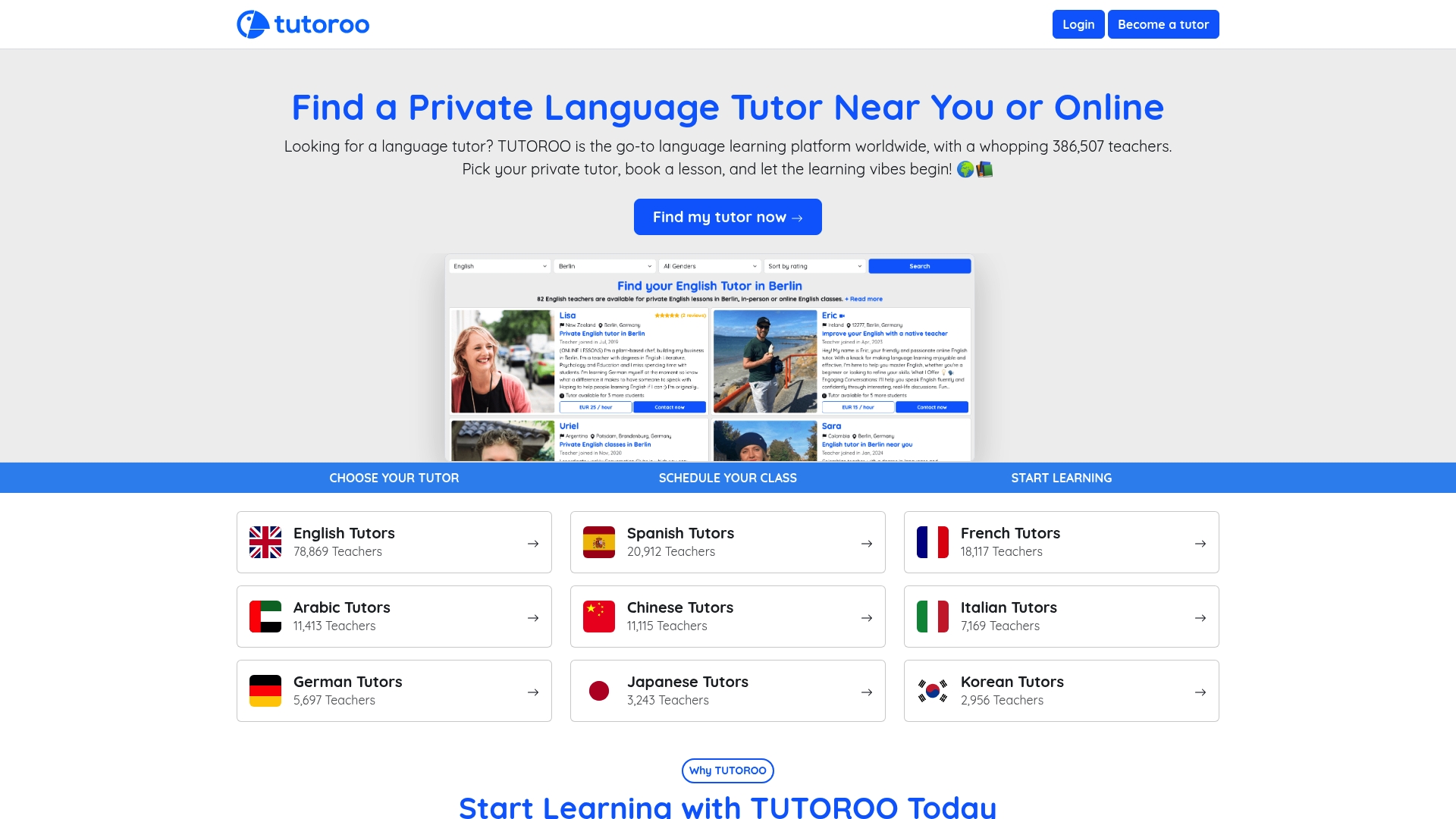
Tutoroo connects students with private language tutors across the globe, offering personalised one-on-one sessions that can be tailored to any lesson framework, whether you favour communicative approaches, structured UbD units, or task-based cycles. With over 386,000 tutors available for in-person or online sessions, finding the right fit is straightforward. Explore private language tutors on Tutoroo and discover a teaching partnership built around authentic progress and real connection.
FAQ
What are the main types of language lesson plans?
Language lesson plans are broadly classified by detail level (detailed, semi-detailed, UbD) and by planning horizon (daily, weekly, unit). Communicative and task-based lesson types add further variety by focusing on real-world interaction and skill transfer.
What is the difference between CLT and TBLT lesson plans?
CLT uses everyday communicative situations as the context for language practice, while TBLT structures lessons around a specific real-world task with pre-task, task, and review phases. Both prioritise communication over grammar drills, but TBLT is more tightly structured around task completion.
When should an educator use a UbD lesson plan?
UbD works best for unit-level planning where clear outcome alignment is needed. It is especially useful when educators want to prevent disconnected daily activities and ensure all lessons build toward a measurable communicative goal.
How many types of lesson plan should a tutor use?
Most experienced tutors draw on two or three plan types depending on context. A semi-detailed daily plan combined with a UbD unit framework and TBLT activities covers most one-on-one tutoring scenarios effectively.
Can lesson plan types be combined?
Yes, and combining them often produces stronger results. Pairing UbD's backward design with TBLT's task cycle maintains outcome clarity while maximising student interaction and real-world language use.