

For study in the United States, TOEFL iBT is the safer default and IELTS Academic is a widely accepted alternative. Both tests are taken by students aiming at US universities, so the better choice usually comes down to two things: what your target programmes list, and which format plays to your strengths. The TOEFL iBT was redesigned on 21 January 2026, so much of the advice online, including older "which is easier" comparisons, no longer describes the test you would sit today.
This guide compares the two exams as they stand now, explains the scoring, shows what real US universities ask for, and gives you a simple way to decide.
TL;DR
- Check your programmes first. Most US universities accept both tests, but requirements differ by school and by degree, so the admissions page of each target programme settles the question.
- TOEFL iBT is the most widely accepted test among US R1 doctoral institutions, with IELTS Academic second, according to a 2026 survey.
- The formats feel different. IELTS has a live examiner for Speaking and a 0 to 9 band scale. The updated TOEFL is adaptive, uses a prerecorded interviewer and reports on a 1 to 6 scale.
- "Easier" depends on you. Strengths in speaking style, reading habits and typing speed matter more than any general ranking.
- Start preparing for the current version. Practise on materials built for the post-January 2026 TOEFL, not older books and videos.
Table of Contents
- The short answer: how the two tests compare
- How the IELTS Academic test is built
- How the updated TOEFL iBT works
- Which is easier, IELTS or TOEFL?
- Scoring: bands, scales and the 7.5 question
- What US universities actually ask for
- How to choose: a five-step decision
- Preparing for either test with a private tutor
- Our perspective
- Frequently asked questions
- Sources
The short answer: how the two tests compare
| IELTS Academic | TOEFL iBT (from 21 January 2026) | |
|---|---|---|
| Sections | Listening, Reading, Writing, Speaking | Reading, Listening, Writing, Speaking |
| Speaking | Face-to-face interview with an examiner, 11 to 14 minutes | Listen and Repeat, then Take an Interview with a prerecorded interviewer |
| Score scale | Bands 0 to 9 | 1 to 6 in half-bands, with the older 0 to 120 score still available during a two-year transition |
| Question style | Mixed question types, including short written answers | Adaptive tasks, including Complete the Words and Build a Sentence |
| Typical US use | Accepted at many universities, second most accepted in the survey below | Most widely accepted among US R1 institutions in the same survey |
The formats and scales above come from IELTS.org's test format page and ETS's updated TOEFL overview. Always confirm the current version on the official pages before you book.
How the IELTS Academic test is built
IELTS Academic has four sections. According to IELTS.org, Listening takes about 30 minutes with 40 questions, Reading takes 60 minutes with 40 questions, Writing takes 60 minutes with two tasks, and Speaking takes 11 to 14 minutes.

The Writing paper is where many candidates feel the pressure. Task 1 asks for at least 150 words describing visual information, such as a chart or diagram. Task 2 asks for at least 250 words on a point of view, an argument or a problem, and it counts twice as much as Task 1. In practice, that means your essay carries most of your Writing band, so it deserves most of your practice time.
The Speaking test is a conversation with a trained examiner. That suits learners who read social cues well and speak more naturally with a real person than with a screen. It can also feel less predictable, because the follow-up questions depend on what you say.
How the updated TOEFL iBT works
The TOEFL changed on 21 January 2026. Before that date, it used integrated tasks in which you read, listened, then spoke or wrote about what you had taken in. Speaking allowed up to 30 seconds to prepare and one minute to answer, as ETS explains in its before-and-after comparison.
The new version uses a different set of task types. ETS lists them as Complete the Words, Read in Daily Life, Read an Academic Passage, Listen and Choose a Response, Listen to a Conversation, Listen to an Announcement, Listen to an Academic Talk, Build a Sentence, Write an Email, Write for an Academic Discussion, Listen and Repeat, and Take an Interview.
Two features stand out for anyone comparing it with IELTS:
- Speaking is fully recorded. In Take an Interview, a prerecorded interviewer asks four questions and you have 45 seconds for each response. There is no live examiner.
- The tasks are shorter and more varied. Instead of one long essay and one long reading text, you move through many smaller tasks, including building sentences and completing words in a passage.
If you learned about the TOEFL from a friend who sat it in 2024 or 2025, treat what they told you as history.
Which is easier, IELTS or TOEFL?
There is no honest universal answer, and anyone who gives you one is guessing. What the evidence does show is that difficulty depends on the reader.
A 2024 study in Language Testing in Asia with 54 students compared perceptions of reading difficulty. Among humanities and arts students, 69% found the TOEFL reading text easier than their course readings, against 58% for IELTS. Among social-science students, the figures were 35% for TOEFL and 61% for IELTS. For natural-science, engineering and mathematics students, they were 16% and 30%. The sample is small and the study was run in South Korea, so read it as a sign that your own field shapes how a test feels, not as a ranking.
Speaking style matters too. Harvard's graduate school guidance on interpreting language scores notes that some speakers perform well in a structured test but not in unpredictable situations, while others are better at impromptu speaking and freeze in a structured format. It also notes that unfamiliarity with a test's structure can lower a score.
A practical way to think about it:
- You speak better to a person: IELTS may suit you, since the examiner interview is live.
- You prefer a calm, predictable speaking format: the recorded TOEFL interview may feel less stressful.
- You write long, structured essays comfortably: IELTS Task 2 rewards that skill.
- You do better with many short tasks than with long ones: the updated TOEFL may feel more natural.
The best test for you is the one where your skills show up clearly, and the only way to find out is to try a full practice paper from each.
Scoring: bands, scales and the 7.5 question
The two tests do not report scores the same way, and the TOEFL scale is mid-transition.
IELTS reports bands from 0 to 9. IELTS.org describes band 7 as "good" English: an operational command of the language with occasional inaccuracies, inappropriate usage or misunderstandings, and generally good handling of complex language and detailed reasoning. So a 7.5 sits between good and very good, and it is a strong score that meets the requirements of most programmes. Some postgraduate programmes and fellowships ask for it specifically, as shown below.
TOEFL now reports on a 1 to 6 scale in half-bands, while the older 0 to 120 total remains available during a two-year transition. ETS's 2026 score-linking table maps band 4.5 to a legacy total of 86 and above, band 5 to 95 and above, band 5.5 to 107 and above, and band 6 to 114 and above.
So what is IELTS 7.5 in TOEFL terms? A single neat figure is risky. The IELTS research report on aligning scores across tests provides concordance tables between IELTS Academic and TOEFL iBT, but cautions that scores should not automatically be treated as interchangeable. A better guide is how universities pair them. Boston University's College of Engineering, for instance, asks applicants seeking teaching or research fellowships for TOEFL 100 or 5.0, or IELTS 7.5. In that setting, 7.5 sits alongside a TOEFL of about 100 on the old scale, or 5.0 on the new one.
The lesson: do not convert scores yourself. Look at what each programme lists for the test you plan to take, and check which scale it uses.

What US universities actually ask for
Both tests are accepted widely in the United States, but TOEFL has the larger footprint. A 2026 survey of US Carnegie R1 institutions found 32 different English-proficiency tests used in admissions. The most accepted were TOEFL iBT, IELTS Academic, the Duolingo English Test and PTE Academic, in that order. Cut scores varied from one institution to another. ETS itself claims that nine out of ten US universities prefer TOEFL, which is the test owner's own claim rather than an independent figure.
The British Council, which co-owns IELTS, says most US universities accept a minimum IELTS score of 6.0 to 6.5 for undergraduate courses and 6.5 to 7.5 for postgraduate programmes, and tells applicants to confirm with their universities.
Here is how a handful of real institutions set their requirements:
| Institution | TOEFL | IELTS Academic |
|---|---|---|
| Arizona State University, undergraduate, exams from 21 January 2026 | 3.5 overall and 3.5 in each section | 6.0 |
| University of Nebraska at Omaha, general admission | 3.5 | 6.0 |
| University of Nebraska at Omaha, engineering | 4.0 | 6.5 |
| University of Nebraska at Omaha, English major | 5.0 | 7.0 |
| University of West Alabama, undergraduate | 90 or 4.5 | 6.5 |
| Pepperdine University, Seaver College | 85 | 6.5 |
| Boston University College of Engineering, graduate | 90 or 4.5 | 7.0 |
Three patterns are worth noticing. First, every one of these schools accepts both tests, so you are rarely forced into one. Second, the bar rises with the programme: engineering and English majors ask for more than general admission. Third, some schools publish TOEFL thresholds on the old 0 to 120 scale and others on the new 1 to 6 scale, so read the fine print. Pepperdine also requires scores to be within two years of your application and does not accept TOEFL MyBest Scores, which is the kind of detail that can cost you a retake.
At least one school, the University of West Alabama, notes that lower scores may still qualify for admission with ESL support. If you are close to a cut-off, ask the admissions office what options exist.
For guidance on how institutions should read scores, ETS advises using both total and section scores. That is a hint for you: a balanced profile is safer than a high total with one weak skill.
How to choose: a five-step decision
- List your target programmes and open each one's English proficiency page. Note which tests it accepts, the minimum overall score and any section minimums.
- Check the scale. If a programme quotes TOEFL on the 1 to 6 scale, prepare for the current format. If it quotes 0 to 120, check whether it applies to older scores or still applies now.
- Consider other destinations. If you may also apply to the UK, Canada or Australia, or need a test for immigration or work, IELTS is often the more flexible choice. For US-only study, TOEFL has the broader acceptance.
- Take one practice test of each, timed and under realistic conditions, and compare section by section where you lose marks.
- Match the test to your weakest section. If speaking to a screen unsettles you, or if you tend to freeze with a live examiner, that single factor can decide it.
If you are still torn, the likely winner is whichever test lets your strongest skills carry the score. For broader background on how these exams fit together, our guide to examples of language proficiency tests is a good starting point, and exam readiness for language learners covers how to plan your preparation.
Preparing for either test with a private tutor
The two exams reward different habits, and that is where one-to-one coaching earns its place. A tutor can run a diagnostic on your first session, show you which section drags your score down, and then give you the specific practice that fits it: timed Task 2 essays for IELTS, fast sentence-building and recorded responses for the new TOEFL, or live speaking rehearsal for an examiner interview.
Our article on when TOEFL tutoring pays off for students looks at how a short, focused block of lessons can fit around a diagnostic and the new 1 to 6 scale. Our piece on how tutors transform language exam preparation explains what good exam coaching looks like, and lessons that build real speaking skills is useful whichever speaking format you face.
TUTOROO connects learners with private English tutors for personalised, one-to-one lessons, online or locally, and lets you message tutors directly before you decide. You can browse English tutors on TUTOROO, compare their profiles and agree your schedule with the tutor you choose.
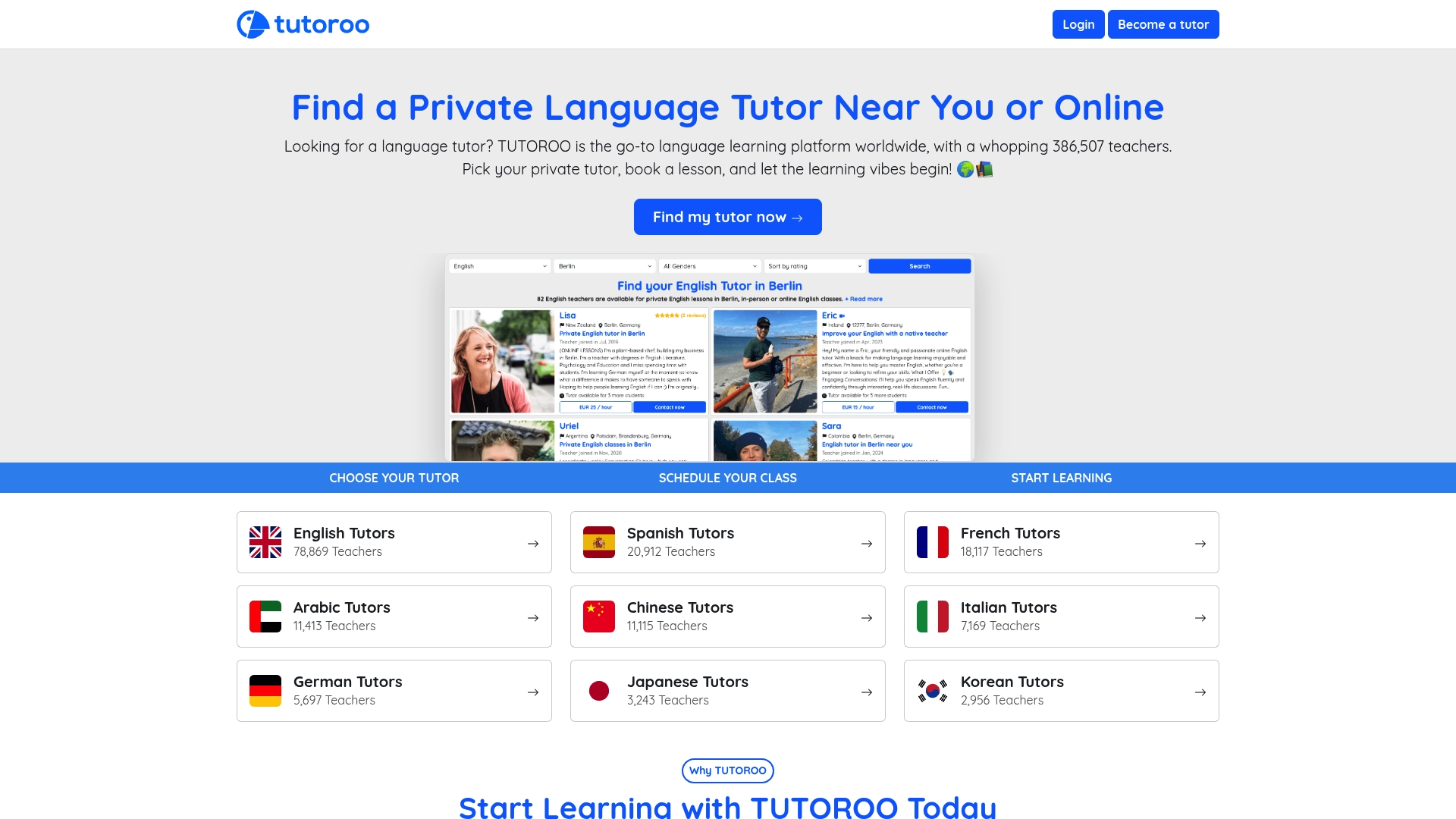
When you contact a tutor, tell them which test you are taking, your target score, your test date and the programmes you are applying to. That lets them build a plan around your real deadline rather than a generic course.
Our perspective
We see the same pattern again and again: learners spend weeks asking which test is easier, and far less time asking which test is right for them. The honest answer is that the exam you can perform well in, on a given day, in front of a given format, is the exam that helps you most.
That is why we think preparation is personal. Two students aiming for the same university can need completely different support. One speaks fluently but loses marks on structured essays. Another writes beautifully and struggles to answer out loud against a timer. A private tutor can hear that difference in the first lesson and adjust, in a way that a fixed course or a shared video cannot.
At TUTOROO, we connect learners with expert tutors who offer personalised tuition, online or locally, and we keep the process simple: find a tutor, message them, agree how you will work together. Tutors set their own schedules, and students pay them directly for ongoing lessons, so the relationship stays between you and the person helping you improve.
Whichever test you choose, the goal is the same: to walk into the room with confidence, because you have already practised in the format you will face. Language opens doors to culture, connection and opportunity, and a good exam result is simply one of the first doors.
TUTOROO
Frequently asked questions
Is the TOEFL harder than the IELTS?
Not necessarily. It depends on your strengths and your field of study. In a small 2024 study, students from different academic areas judged the reading difficulty of each test very differently. The updated TOEFL also changed on 21 January 2026, so older comparisons may not apply.
Is IELTS accepted in the USA?
Yes, widely. A 2026 survey of US R1 doctoral institutions found IELTS Academic to be the second most accepted English test after TOEFL iBT. The schools listed above all accept it, though minimum scores vary by programme, so check the page for your own course.
What is 7.5 in IELTS equivalent to in TOEFL?
There is no single official conversion that suits every purpose. Research tables exist, but their authors caution against treating scores as interchangeable. One US university pairs IELTS 7.5 with TOEFL 100 on the old scale, or 5.0 on the new one, for fellowship applicants. Always use the figures your programme publishes.
Is 7.5 a good IELTS score?
Yes. IELTS describes band 7 as good English with only occasional inaccuracies, and 7.5 sits above it. It meets or exceeds the typical postgraduate range of 6.5 to 7.5 quoted by the British Council for US universities. Some programmes still want section minimums, so look at each skill as well as the overall band.
Should I take IELTS or TOEFL for the USA?
Start with the requirements of your target programmes. If they accept both, take a practice test of each and pick the one where your section scores are stronger. If you are only applying to US schools, TOEFL has the broader acceptance, but IELTS is a sound choice at the many universities that list it.
Sources
- Updated TOEFL iBT Test Overview (ETS)
- Test Content and Structure of the TOEFL iBT Test (ETS)
- Comparability of reading tasks in high-stakes English tests (Language Testing in Asia, 2024)
- Interpreting language scores for admissions (Harvard GSAS, 2026)
- IELTS scoring in detail: band scores explained
- A banded score scale for the TOEFL iBT test (ETS, 2026)
- Aligning scores of language proficiency tests (IELTS research report, 2025)
- A survey of English language proficiency tests in US R1 institutions (2026)
- Study in the U.S.: The TOEFL Test (ETS)
- IELTS score requirements for USA universities (British Council)
- English Language Proficiency Admission (Arizona State University)
- English Proficiency (University of Nebraska at Omaha)
- English Language Proficiency Evaluation (University of West Alabama)
- English Proficiency (Pepperdine University, Seaver College)
- International Students (Boston University College of Engineering)
- Setting TOEFL iBT Score Requirements (ETS)