

You can reach travel-level Spanish within a few months, hold a genuine conversation within about half a year to a couple of years, and reach professional fluency in one and a half years or longer. The gap comes down to one thing above all else: how many hours you put in, and how consistently. Everything below breaks that arithmetic down properly.
TL;DR:
- Reaching conversational fluency typically requires 180 to 365 hours of study, achievable in 12 to 18 months with daily practice of 30 minutes to one hour.
- Total hours needed for specific CEFR levels are nearly fixed, but spreading practice over a longer period with consistent sessions improves retention and speaking ability.
- Daily micro-practice, especially speaking and listening, accelerates progress more effectively than sporadic or marathon study sessions.
- Engaging with a tutor early and maintaining regular practice routines significantly shortens the time to speak confidently, often within a year for common goals.
- Intensive immersion of four to five hours a day can reach B2 to C1 in just a few months, closely matching formal classroom benchmarks.
Table of Contents
- How long to learn Spanish at each CEFR level
- How many hours a day turns into how many months
- Why two learners with the same hours reach different results
- What three realistic learner timelines actually look like
- How to shrink the calendar without cutting corners
- Why tutoring shortens the gap between understanding and speaking
- Start speaking Spanish from week one, not month six
- Where these timelines and hour estimates come from
- Sources
How long to learn Spanish at each CEFR level
The Common European Framework of Reference (CEFR) is the scale most language schools, universities, and tutoring platforms use to describe ability, running from A1 (beginner) to C2 (mastery). Knowing which level you actually need saves you from over-training for a holiday or under-training for a job interview.
At the bottom end, A1 typically requires about 80 to 100 hours of study, enough for ordering food, asking directions, and introducing yourself. That is genuinely achievable in a few months at an hour a day. B1 and B2, the levels most people mean when they say "conversational," sit much further along, and the Foreign Service Institute (FSI) benchmarks put professional working proficiency (roughly C1) at 600 to 750 class hours for English speakers, since Spanish falls into the FSI's easiest language category.
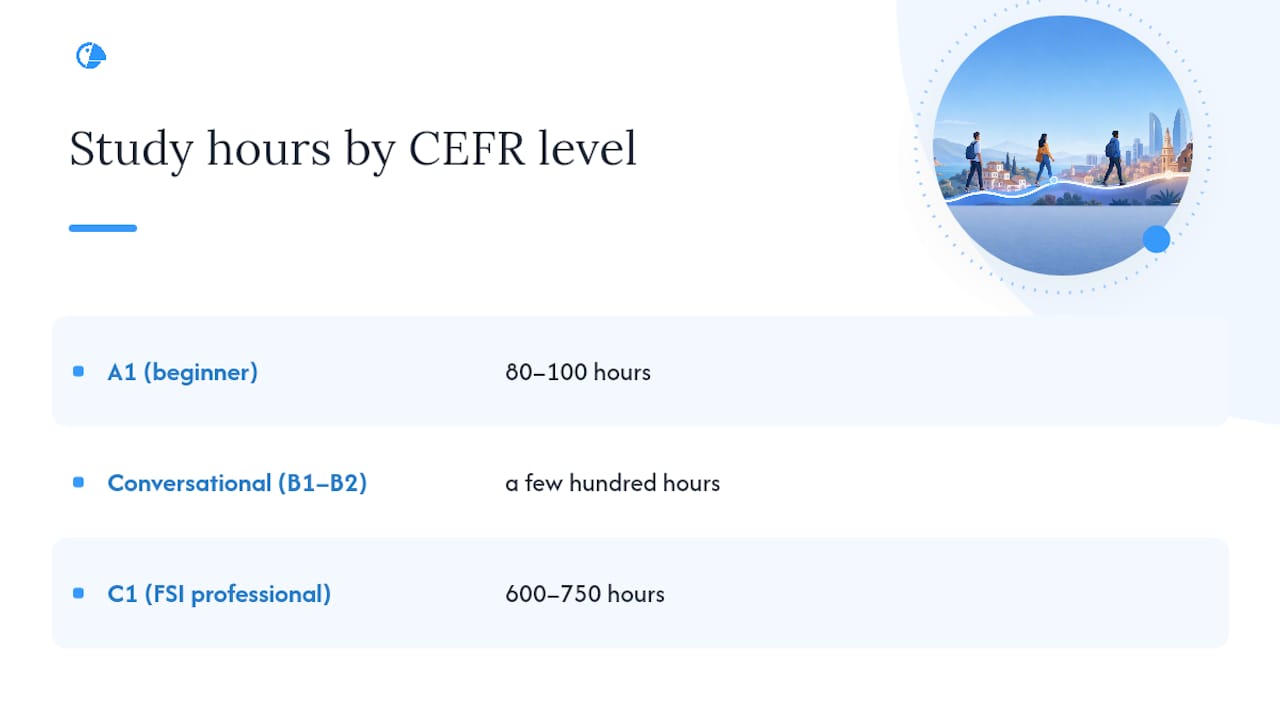
Course providers report conversational ability arriving well inside that FSI ceiling, often within a few hundred hours, because everyday conversation demands less grammatical precision than professional or academic Spanish. Pick the level that matches what you'll actually use, not the most impressive-sounding one, before you build a study timetable around it.
How many hours a day turns into how many months
Once you know the target hours, the calendar question is just division, with one catch: self-study is not the same as classroom time. FSI figures assume intensive, instructor-led immersion. Learning alone with an app tends to run 1.5 to 2 times less efficient hour for hour, so the calendar stretches out even when the hour count on paper looks identical.
Here's what different daily commitments look like annualised, before applying that self-study penalty:
- 15 minutes a day — roughly 90 hours a year, enough for A1 in 12 to 14 months
- 30 minutes a day — roughly 180 hours a year, reaching B1 in around 18 months and B2 in 27 to 40 months
- 1 hour a day — roughly 365 hours a year, reaching B1 in under a year and B2 in roughly 13 to 20 months
- 2 hours a day — roughly 730 hours a year, capable of reaching C1 inside 12 to 18 months with consistent practice
- 4 to 5 hours a day (immersion) — 600+ hours achievable in under six months, the pace of full-time language school
Notice that doubling your daily time doesn't halve your timeline exactly. Fatigue, diminishing returns on long single sessions, and the need for genuine speaking practice all bend the curve. Thirty minutes a day for two years still beats two hours a day for three months if the shorter sessions are more consistent.
Why two learners with the same hours reach different results
Total hours studied predicts a lot, but it's not the whole story. Two people can log the identical 300 hours and land at very different conversational levels, and the reasons are well documented.
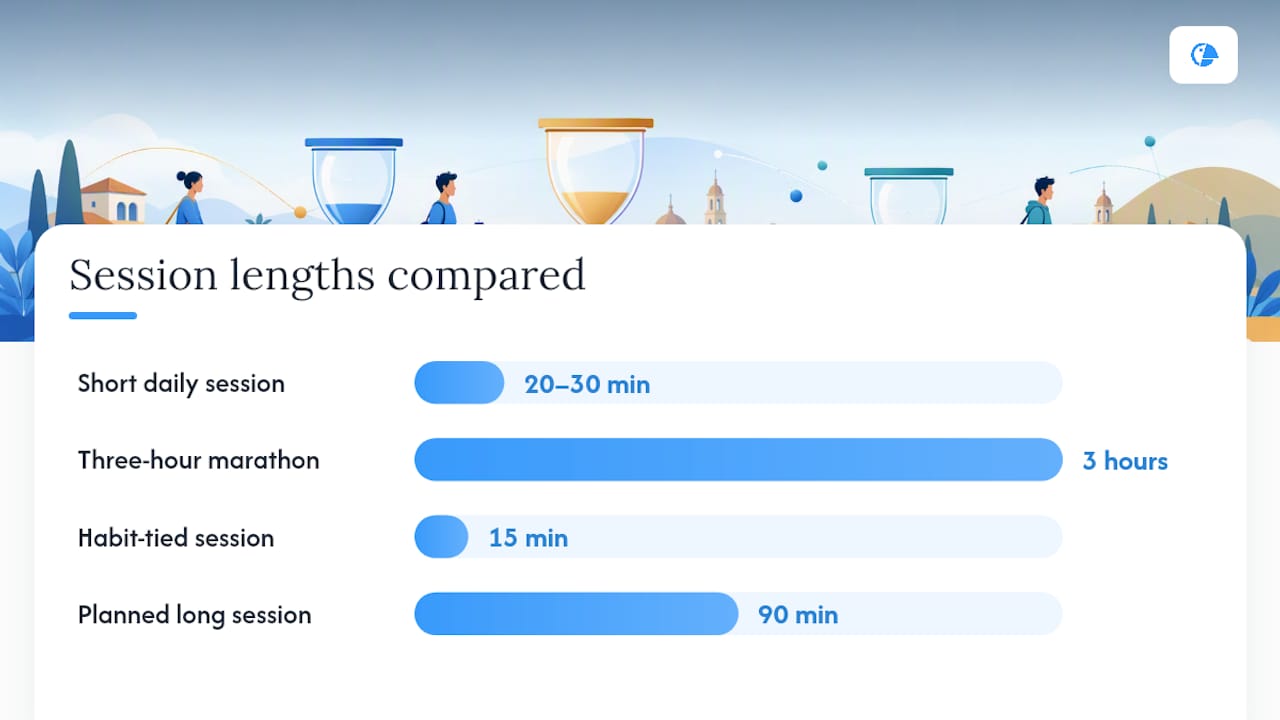
Consistency beats intensity almost every time. Psychology Today's review of language acquisition research found that short daily sessions of 20 to 30 minutes produce stronger retention than sporadic weekend cramming, because spaced repetition builds memory traces that massed practice simply doesn't. A learner who studies every day is quietly outperforming someone doing three-hour Saturday marathons, even at a lower weekly total.
A handful of other variables shift the timeline meaningfully:
- Input-to-output balance: heavy listening and reading builds comprehension, but speaking ability only improves with active speaking practice, not passive exposure.
- Prior Romance language experience: learners who already know French, Italian, or Portuguese progress faster through early stages thanks to shared cognates and grammar patterns.
- Immersion frequency: someone speaking Spanish with a real person twice a week will out-pace someone doing solo app drills five times a week.
- Feedback quality: corrections from a tutor catch errors before they calcify into habits that are hard to unlearn later.
- Habit sustainability: the "best" method is worthless if you abandon it in week three.
Pro Tip: If you can only change one habit, change this: move your Spanish practice to the same time every day, even if it's only 15 minutes. Tying it to an existing routine, like your morning coffee, beats scheduling a "better" 90-minute session you'll skip half the time.
What three realistic learner timelines actually look like
Abstract hour tables are useful, but seeing them applied to real routines makes the numbers land differently. Here are three common learner profiles and where their schedules actually take them.
-
The traveller with eight weeks' notice. Aiming for A1, studying 1.5 hours a day mixing an app, a phrasebook, and a couple of tutor sessions for pronunciation. That's roughly 85 hours in eight weeks, right in the A1 zone. The trade-off: this learner can order food and ask for directions confidently, but real conversation stalls the moment a native speaker replies quickly.
-
The busy professional with a one-year target. One weekly one-hour tutor lesson plus 20 minutes of daily flashcards and podcast listening, totalling around 350 hours over 12 months. That lands solidly in B1, edging toward B2 if the tutor sessions focus on speaking rather than grammar drills. The common misestimate here is assuming the weekly lesson alone will get them there. It's the daily micro-practice between lessons that does most of the work.
-
The intensive student on a study-abroad style schedule. Four to five hours a day of classes, homework, and immersion for three to four months, totalling 500 to 700 hours. This routine can realistically hit B2 to C1, matching the FSI's original classroom benchmark almost exactly, because it mirrors the exact conditions those hours were measured under.
The trade-off across all three: total hours needed stays roughly fixed for a given goal, but intensity decides whether you spread it over four months or four years.
How to shrink the calendar without cutting corners
The hours don't move much, but the calendar time absolutely can. Prioritising the right 20% of the language, according to the Pareto principle applied to vocabulary, covers the vast majority of everyday communication needs. Learning the 500 most frequent Spanish words gets you further than randomly working through a 3,000-word list in alphabetical order.
A few techniques consistently compress timelines for the same total hour count:
- Pair listening with transcript review, since podcasts alone build comprehension but do little for your own speaking output.
- Use spaced repetition software for vocabulary instead of re-reading lists, which fades from memory almost as fast as it goes in.
- Treat weekly conversation practice as non-negotiable, not optional, because speaking is the skill that lags hardest behind comprehension.
- Try shadowing (repeating audio aloud in real time) and graded readers pitched slightly above your current level.
- Stack your Spanish habit onto an existing one, like commuting or making coffee, so it survives busy weeks.
Pro Tip: Shadowing feels awkward at first because you're mimicking rhythm and intonation before you fully understand every word. That discomfort is the point. It trains your mouth and ear together, which flashcards never touch.
Why tutoring shortens the gap between understanding and speaking
Comprehension and production are different skills, and the gap between them is where most self-taught learners get stuck. You can understand a podcast at B2 level while still freezing up mid-sentence in a real exchange, because recognising Spanish and producing it under time pressure draw on different mental muscles. Structured conversation practice with feedback closes that gap faster than passive input, since a tutor catches the same three mistakes before they become permanent habits.
Tutoroo connects learners with tutors across more than 386,000 profiles worldwide, which matters more than it sounds. It means you can match on availability, price, and teaching style rather than settling for whoever happens to be free. A practical model that suits most of the timelines above: one weekly hour-long lesson focused entirely on speaking, paired with daily 15 to 20 minute solo practice on vocabulary and listening between sessions. Set a concrete goal with your tutor at the start (ordering food, holding a work call, discussing news) and let each lesson build toward it. The homework between sessions is where the hour count actually accumulates.
— TUTOROO
Start speaking Spanish from week one, not month six
Most study plans delay real conversation until learners "feel ready," which is exactly backwards. Tutoroo lets you book a native or fluent Spanish tutor, online or locally, from your very first week, so speaking practice happens alongside vocabulary building instead of after it.
A realistic starter setup: one weekly one-hour lesson with a tutor you've chosen based on your specific goal, whether that's travel Spanish, workplace fluency, or exam preparation, plus daily micro-practice on your own. Paired with the structured study routines covered earlier, that combination consistently moves learners from A2 to conversational B1 inside a year without requiring hours you don't have. Tutoroo's messaging system lets you sort tutors by availability and price before booking, and lessons run locally or online depending on what suits your schedule. If you're ready to put a real number on your own timeline, find a Spanish tutor on Tutoroo and book your first lesson this week.
Where these timelines and hour estimates come from
The hour benchmarks throughout this article draw on the Council of Europe's own CEFR level descriptions, which define A1 through C2 in terms of real-world task ability rather than grammar checklists alone. The FSI's Category I hour estimates remain the most widely cited professional benchmark for English speakers learning Spanish, based on decades of intensive government language training.
For the calendar conversions and conversational-level estimates, Pimsleur's breakdown of fluency timelines offers a useful counterpoint to the FSI's classroom-only figures, since most learners study alone or part-time rather than in full immersion. The consistency research behind the daily-practice recommendation comes from Psychology Today's review of spaced learning, and the vocabulary prioritisation advice follows the Pareto principle as applied to language acquisition. Together they explain not just how many hours Spanish takes, but why two learners with identical hour counts can land at very different levels.
Sources
- Twilingua — How long to learn Spanish (FSI data summary)
- Pimsleur blog — How long does it take to speak Spanish fluently?