

Online Chinese tutors typically charge between US$15 and US$25 an hour at the entry level, US$25 to US$40 for experienced tutors, and up to US$85 for specialist exam coaches, according to italki's pricing breakdown. In-person tutoring usually costs more across the same tiers, mostly because of travel time and local demand. If you're learning for travel or casual conversation, a lower-priced tutor will serve you well. If you're prepping for the HSK exam or need business Mandarin fast, budget for a higher rate and look for a tutor with formal qualifications.
Here's the quick version before we get into the detail:
- Budget online tutors: US$4 to US$15/hr, often non-native speakers or students building experience
- Standard online tutors: US$15 to US$40/hr, the range most learners land in
- Premium/specialist tutors: US$40 to US$85/hr, certified teachers or exam specialists
- In-person lessons: add roughly US$10 to US$20 to any of the above
A quick reality check on the numbers: TutorOcean's marketplace data puts the average online Chinese tutor fee near US$23 an hour, while ZipRecruiter's wage data shows Chinese-language tutors in the United States earning a similar low-to-mid US$20s hourly rate. Those two figures landing in the same neighbourhood is a good sign the US$20 to US$25 mark is a genuinely representative "typical" rate, not a marketing average designed to look cheap.
Key Takeaways
Chinese tutor cost depends far more on qualifications, format, and lesson frequency than on any single "average" figure, so budget by goal, not by headline price.
| Point | Details |
|---|---|
| Online rates run US$4 to US$85/hr | Most learners land in the US$15 to US$40 range for standard, qualified tutors. |
| In-person costs US$10 to US$20 more | Travel time and local cost of living push face-to-face rates higher everywhere. |
| Shorter lessons cost more per hour | A 30-minute session often has a higher effective hourly rate than a 60-minute one. |
| Exam prep needs a higher floor | Budget at least US$25 to US$30/hr for genuine HSK exam coaching. |
| Tutoroo covers every price tier | Search Mandarin tutor listings by goal and message candidates directly to compare trial lessons before booking. |
Table of Contents
- Chinese tutor cost by lesson format and length
- What actually makes Chinese tutor rates go up or down
- How much should you actually pay for your goals?
- Where to find a Chinese tutor and how to cut the cost
- Finding the right tutor at your price point on Tutoroo
- Why price-first thinking beats vague budgeting advice
- Ready to book a Chinese tutor that matches your budget?
- Sources
Chinese tutor cost by lesson format and length
The headline hourly figure only tells you half the story. What actually determines your monthly spend is the combination of format, session length, and how often you book.
Online lessons dominate the market because they cut out a tutor's biggest overhead: travel. A tutor working from home in a lower cost-of-living region can charge less and still take home a comfortable wage, which is part of why Languatalk's research found that accessing tutors based outside major Western cities often reduces hourly fees without any drop in native-speaker quality. Entry-level online tutors, often university students or newly qualified teachers, sit around US$4 to US$15 an hour. Experienced, degree-qualified tutors with several years of teaching behind them charge US$20 to US$40. At the top end, tutors with HSK examiner experience or specialist business-Mandarin backgrounds can ask US$50 to US$85.
In-person lessons cost more almost everywhere, and the reasons are straightforward:
- Travel time gets paid. A tutor who spends 40 minutes commuting either side of your lesson is effectively working a 100-minute session for the price of 60 minutes, so that time gets built into the rate.
- Local cost of living sets a floor. A tutor in a major metropolitan area with high rent needs to charge more than one in a smaller regional centre just to make the work worthwhile.
- Materials and space cost money. In-home tutors often bring printed workbooks, flashcards, or whiteboards, and that overhead shows up in the invoice.
Community reporting on forums like Reddit's language-learning community supports this qualitatively, with many learners describing mid-range prices as the normal cost for private online lessons, aligning with marketplace averages.
Session length changes your effective hourly rate more than most learners expect. A tutor charging US$30 for a 60-minute lesson isn't necessarily charging US$15 for 30 minutes; many set a flat 30-minute rate closer to US$18 to US$20 to cover the fixed cost of preparing and starting each session. Here's how that plays out for a mid-range tutor charging a base hourly rate:
- 60-minute lesson: set at the hourly rate
- 45-minute lesson: typically slightly less than the hourly rate, resulting in a comparable effective hourly cost
- 30-minute lesson: typically priced higher per hour than longer sessions to cover preparation time.
That's why shorter lessons often cost more per hour once you do the maths, even though the total invoice looks smaller.
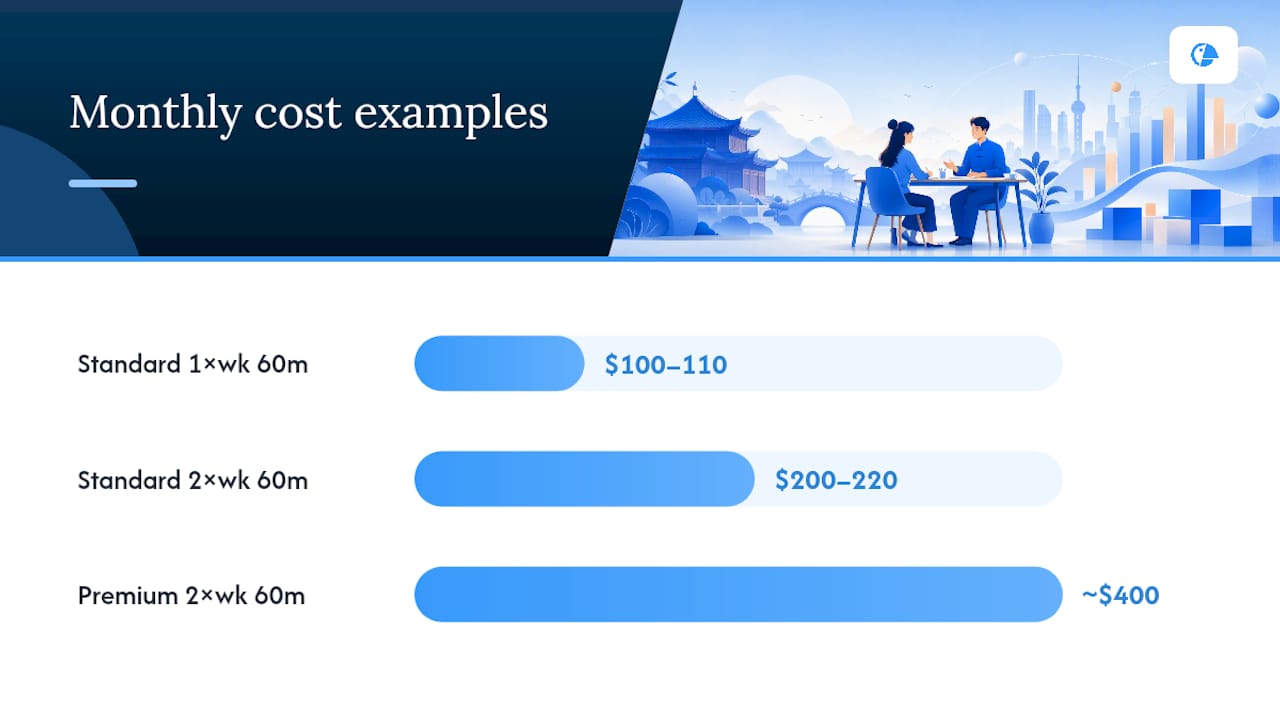
Turning that into a monthly budget: if you book one 60-minute lesson weekly at a US$25/hr standard tutor, you're looking at roughly US$100 to US$110 a month. Bump that to twice weekly and you're at US$200 to US$220. A premium exam-prep tutor at US$50/hr, booked twice weekly, lands closer to US$400 to US$440 a month. None of these numbers include one-off costs like textbooks or exam registration fees, which we'll cover shortly.
What actually makes Chinese tutor rates go up or down
Two tutors can offer identical 60-minute conversation lessons and charge wildly different prices. The gap almost always comes down to four things.
Qualifications and certification are the clearest signal. A tutor holding a recognised teaching certificate, or one who has completed formal language training at a diplomatic or academic institution, can justify a premium because that credential is verifiable. On the exam side, tutors who prepare students for the HSK, the standard proficiency exam for Mandarin, often charge more because exam-focused coaching requires familiarity with a specific test format and scoring rubric that general conversation tutors don't need.

Native speaker status matters, but it's not automatic. A native Mandarin speaker with no teaching background may charge less than a non-native tutor who has years of classroom experience and a linguistics degree. What you're really paying for is teaching skill and structure, not just an accent. That said, native speakers do tend to command a premium for advanced conversation, idiom, and cultural nuance work, where lived experience is genuinely hard to substitute.
Specialisation adds a surcharge. Business Mandarin, exam prep, and tutoring for young children are three distinct skill sets, and tutors who've built a reputation in one of them price accordingly:
- Exam-prep specialists (HSK levels 4 to 6) often sit at the upper end of the standard tier or into premium pricing
- Business Chinese tutors with corporate experience frequently charge 20 to 40% more than general conversation tutors
- Tutors experienced with young learners sometimes charge a modest premium for the extra planning and patience the format demands
Location still matters for in-person lessons. A tutor in a capital city with a high cost of living needs a higher hourly rate to make the same real income as one in a regional town. This is the single biggest reason in-person rates vary more than online rates from one city to the next.
Pro Tip: Ask a prospective tutor whether their rate includes lesson materials and prep time, or whether those are billed separately. A "cheap" hourly rate that excludes materials can end up costing more than a slightly higher all-inclusive rate once you add up the extras.
PayScale's hourly rate data confirms this pattern across the US tutoring market generally: the spread between entry-level and experienced tutors is driven almost entirely by qualifications and specialisation, not by raw supply and demand.
How much should you actually pay for your goals?
Matching your budget to your actual learning goal saves you from two common mistakes: overpaying for casual conversation practice, or underpaying when you need serious exam results fast.
1. Budget tier (US$4 to US$15/hr). Suits absolute beginners, casual learners practising for travel, or anyone wanting low-stakes conversation partners. Tutors here are often students, recent graduates, or native speakers building teaching experience. Expect solid conversation practice and basic grammar correction, but don't expect structured curriculum design or exam coaching.
2. Standard tier (US$15 to US$40/hr). This is where most serious learners belong. Tutors typically hold a degree, have several years of teaching experience, and can build a structured lesson plan around your goals, whether that's HSK 1 to 3, workplace conversation, or general fluency. Over three to six months of consistent weekly lessons, expect measurable progress: moving up one or two HSK levels, or going from halting sentences to comfortable small talk.
3. Premium tier (US$40 to US$85/hr). Reserved for tutors with formal certification, HSK examiner experience, or specialist business/academic backgrounds. If you're preparing for HSK 4 through 6 in a compressed timeframe, or need Mandarin for high-stakes professional use, this tier reduces the total hours needed because the tutor's structure and feedback are simply more efficient.
For serious exam preparation, a minimum rate for tutors with exam experience is advisable. Cheaper tutors lacking exam-format familiarity may require more hours, which can increase overall cost despite lower hourly fees.
Sample monthly budgets vary with study patterns and tutor rates, with more frequent sessions and premium tutors increasing overall spend.
Most learners underestimate how much frequency matters compared to hourly rate. Two 30-minute lessons a week with a standard tutor often beat one 60-minute lesson with a premium tutor for building conversational fluency, simply because spaced, regular practice sticks better than a single weekly cram session.

Where to find a Chinese tutor and how to cut the cost
Online marketplaces are the fastest route to a shortlist of qualified tutors, but they're not the only option. University Chinese-language departments often keep noticeboards or informal referral lists connecting students with tutoring work, and these tutors sometimes charge less than marketplace listings because they haven't built a formal profile or reputation yet. Community noticeboards, local Chinese cultural associations, and even language-exchange meetups can turn up native speakers happy to tutor informally at lower rates than platform-listed professionals.
Once you've got candidates, a few concrete strategies bring the total cost down without sacrificing progress:
- Book lesson packs instead of paying per session. Many tutors discount 10 or 20-lesson bundles by 10 to 15% compared to one-off bookings.
- Try group lessons for conversation practice. Splitting an hourly rate three or four ways makes premium tutors affordable for casual speaking practice, even if one-on-one still suits grammar-heavy study better.
- Book shorter, more frequent sessions. Two 30-minute lessons a week often cost less in total than one 60-minute lesson while delivering more consistent practice.
- Use conversation-only tutors for speaking practice. A native speaker without formal teaching credentials charges less and still sharpens fluency, provided you're pairing it with structured grammar study elsewhere.
Before committing to any tutor, run through a short evaluation checklist: ask for a trial lesson (many tutors offer a discounted or free first session), request a sample lesson plan so you know what structure to expect, and check reviews where available. Trustpilot's review data on established platforms shows just how much reputation and past-student feedback shape whether a price feels fair. It's also worth asking upfront about the tutor's cancellation and rescheduling policy, since these vary enormously. Some tutors require 24 hours' notice or forfeit the fee; others are far more flexible for regular students.
Pro Tip: Always ask about rescheduling terms before you book a pack of lessons, not after. A 10-lesson bundle at a discount is only a bargain if you can actually reschedule around your own life without losing sessions.
For a step-by-step approach to vetting candidates properly, this guide to hiring the right language tutor walks through the questions worth asking before your first paid lesson.
Finding the right tutor at your price point on Tutoroo
Tutoroo connects learners with a community of more than 386,000 language tutors worldwide, including Mandarin specialists spanning every price tier discussed above, from conversation-focused native speakers to certified exam coaches. Because the platform lists tutors across both local, in-person availability and online sessions, you can compare formats directly instead of guessing at what a face-to-face lesson might cost versus a video call with the same tutor.
Searching the Chinese and Mandarin tutor listings works best when you filter by your actual goal rather than just price. If you're after budget-tier conversation practice, filter for availability and message a few native speakers directly to ask about their experience level. If you need premium exam coaching, look for tutors who list HSK preparation explicitly in their profile and ask about their track record with previous students at your target level.
Tutoroo's direct messaging system lets you ask a prospective tutor about their lesson structure, materials, and rescheduling policy before you commit to anything, which mirrors the evaluation checklist covered earlier. Most tutors on the platform are open to a trial lesson, giving you a low-risk way to confirm that a US$20/hr tutor and a US$40/hr tutor actually deliver a noticeably different experience for your specific goals.
Pro Tip: Message two or three tutors in your target price tier before booking. Comparing how they respond and what they propose for a first lesson tells you more about fit than the hourly rate alone ever will.
Why price-first thinking beats vague budgeting advice
Most advice on hiring a Chinese tutor tells you to "find someone who fits your learning style" before mentioning a single number. That's backwards. Price sets the boundaries of what's realistic before style even enters the conversation, and learners who skip that step tend to either overpay for casual practice or underpay for exam prep, then wonder why progress stalls.
The conventional wisdom oversells native-speaker status as the main price driver. Our research points elsewhere: structure, certification, and lesson consistency matter more than accent alone. A well-trained non-native tutor with a clear HSK curriculum often delivers better exam results than an untrained native speaker charging the same rate.
If there's one thing worth prioritising first, it's matching frequency to goal before chasing the "best" tutor. Two consistent 30-minute sessions a week with a solid standard-tier tutor will usually outperform one expensive weekly lesson, and it costs less too. Get the rhythm right, then worry about premium credentials.
— TUTOROO
Ready to book a Chinese tutor that matches your budget?
Unlike browsing scattered classified ads or waiting on a language school's fixed course fees, Tutoroo lets you compare Mandarin tutors across every price tier in one place and message them directly before you spend a cent. You get to see actual availability, ask about rescheduling terms, and request a trial lesson, all before committing to a lesson pack.
If you've read through the pricing breakdowns above and landed on a tier that fits your goals and budget, the next step is simple: browse the Chinese and Mandarin tutor profiles on Tutoroo, shortlist two or three tutors in your price range, and send a message asking about their availability and lesson structure. From there, booking a trial lesson is the fastest way to confirm you've found the right fit before locking in a longer-term schedule.