

Hebrew conversation lessons work best when you talk for most of the hour, a tutor answers you in real time, and every lesson is built around the situations you will actually face. A private tutor gives you that: your own speaking time, corrections as you go, and a plan that follows your goal, whether that is ordering in a Tel Aviv café, talking with family, or reaching a university level. On TUTOROO you can search a community of over 386,000 language teachers by language, location and availability, so finding a Hebrew tutor who fits your week is a short search rather than a long project.
TL;DR
- Conversation lessons put speaking and listening first. Reading and grammar support the dialogues rather than replacing them.
- Beginners start with greetings, a polite request to repeat, and short exchanges about coffee, directions and introductions.
- Progress is measured in what you can do: a simple exchange, then a story in the past tense, then an opinion in the moment.
- A one-to-one tutor adjusts level, topic and pace every lesson, which suits travel, family, exam and work goals alike.
- Between lessons, a short daily routine of listening, repeating and recording yourself makes the next lesson more productive.
Table of Contents
- What Hebrew conversation lessons actually cover
- The first dialogues every beginner should practise
- Why one-to-one lessons suit conversation practice
- Practising between lessons
- Matching lessons to your goal
- Choosing the format and level
- Find your Hebrew tutor on TUTOROO
- Our perspective
- For tutors and educators: tailoring conversation practice
- FAQ
- Sources
What Hebrew conversation lessons actually cover
A conversation lesson is built around talking. You and the tutor work through a situation (meeting someone, booking a table, explaining your weekend), and the grammar and vocabulary you need come up as the conversation requires them. That is different from a classroom course that walks through a textbook chapter by chapter, although the two share the same ladder of levels.
Universities that teach Hebrew describe that ladder clearly. Middlebury Language Schools in the United States defines five Hebrew levels using the ACTFL guidelines (the American Council on the Teaching of Foreign Languages scale of Novice, Intermediate, Advanced). Level 1 is for learners with no prior instruction. Levels 2 to 4 move from Novice High and Intermediate Low towards Advanced Low and Mid. Level 5 expects Intermediate High or better and works with extensive reading and cultural and literary texts.
Tel Aviv University's international programme starts with a beginner's level of about 400 words covering meeting people, home life, shopping and directions. It runs through 11 levels. Levels 4 and 5 add short oral lectures, such as making a complaint, persuading someone or describing a place, and the top levels target newspapers, scientific material and literature at university standard.
Put those together and you get a practical picture of what a tutor does at each stage.
| Stage | What you do in lessons | What you can do afterwards |
|---|---|---|
| Beginner | Greetings, introductions, numbers, ordering, asking the way, in short present-tense sentences | Handle a simple exchange and ask someone to slow down |
| Lower intermediate | Talk about your day, last weekend and plans; phone calls, shopping, appointments | Tell a short story and follow a slower conversation |
| Intermediate | Give opinions, explain problems, compare options, work with longer audio | Hold a conversation on familiar topics without switching to English |
| Advanced | Debate, idioms, news, work and academic topics, natural-speed listening | Follow native-speed speech and argue a point |
The level names matter less than the question your tutor keeps asking: what do you want to be able to say by the end of this month?
The first dialogues every beginner should practise
Beginners do not need hundreds of words. They need a small set of phrases they can use immediately, plus a safety net for when they get lost. A good first lesson often covers these:
- Greeting and asking after someone: shalom (hello), ma nishma? (how's it going?), ani beseder, toda (I'm fine, thank you).
- Politeness: toda raba (thank you very much), bevakasha (please, you're welcome), slicha (excuse me, sorry).
- The safety net: ani lo mevin (said by a man) or ani lo mevina (said by a woman) for "I don't understand", efshar lachzor al ze? for "can you repeat that?", and le'at yoter, bevakasha for "slower, please".
- Everyday needs: kama ze ole? (how much is it?), eifo hasherutim? (where is the bathroom?), chesbon, bevakasha (the bill, please).
- Leaving: lehitra'ot (see you).
Notice that Hebrew verbs and adjectives change with the gender of the speaker and the person addressed. Ma shlomkha? is how you ask a man how he is, and ma shlomekh? is how you ask a woman. Hearing both forms side by side from a live tutor, and being corrected the moment you pick the wrong one, is one of the quickest ways to make them automatic.
Three starter dialogues
Practise these aloud, playing both roles, and then change one detail each time (your name, your city, the size of the coffee) so that you are responding instead of reciting.
- Introducing yourself. Greet, ask the other person's name, give yours, say na'im me'od (nice to meet you).
- Ordering a coffee. Ask politely for a coffee, ask the price, pay, say thank you.
- Asking for help. Say you did not understand, ask for a repeat, ask for slower speech, and check you have it right.
The third dialogue is the one that keeps every conversation alive. Learners who can calmly ask for a repeat stay in the conversation, instead of freezing and switching back to English.
Why one-to-one lessons suit conversation practice
Speaking is a skill built by doing it, and the amount you speak in each lesson is the thing to protect. In a private lesson the hour belongs to you. Your tutor hears your particular mistakes, such as a swallowed guttural sound, a wrong gender ending or a past-tense verb you keep avoiding, and brings them back in the next role-play until they stick.
A private lesson also moves at your speed. If you have a trip in six weeks, the tutor builds dialogues for airports, taxis and restaurants. If you are talking with a partner's relatives, the dialogues are about family, food and holidays. We go further into how to make the most of lesson time in our guide on language lessons that build real speaking skills, and into formats and routines in online conversation lessons.
What a good 60-minute lesson looks like
The shape varies by tutor, but a strong conversation lesson tends to include:
- Warm-up (5 to 10 minutes). Free talk about your week, in Hebrew, at whatever level you have.
- Target situation (20 minutes). A role-play on a chosen topic, such as booking a doctor's appointment, with the tutor playing the other part.
- Language focus (15 minutes). The tutor picks up the three or four errors from the role-play and drills them in new sentences.
- Second run (10 minutes). You repeat the role-play with changes, so the new language is used straight away.
- Plan (5 minutes). You agree on a few phrases to practise before the next session.
Because you and the tutor can message each other on TUTOROO, you can agree the topic in advance, so the lesson starts with the situation you care about and not with small talk about what to cover.
Practising between lessons
Conversation lessons are most productive when each one builds on short, regular practice. Twenty minutes a day beats a two-hour burst before the lesson. A simple routine:
- Listen first. Choose a short dialogue or a few minutes of slow Hebrew audio and listen without reading along. Then listen again with the text.
- Repeat in small pieces. Take one sentence, say it aloud, then say it again at the speed of the recording.
- Record yourself. Use your phone, play the model and your recording one after the other, and compare one thing at a time: a vowel, a consonant, or the rhythm of the sentence.
- Talk to yourself about your day. Describe breakfast, your commute or tomorrow's plans in Hebrew, out loud. Note the words you were missing and bring them to your tutor.
- Keep a two-line log. Write down one sound you want to fix and one phrase you want to use next time.
The point of the log is the next lesson: your tutor can start from exactly what you could not say.
Matching lessons to your goal
The same language can be taught very differently depending on why you are learning it. Tell your tutor your goal in the first message, and ask for lessons built around it.
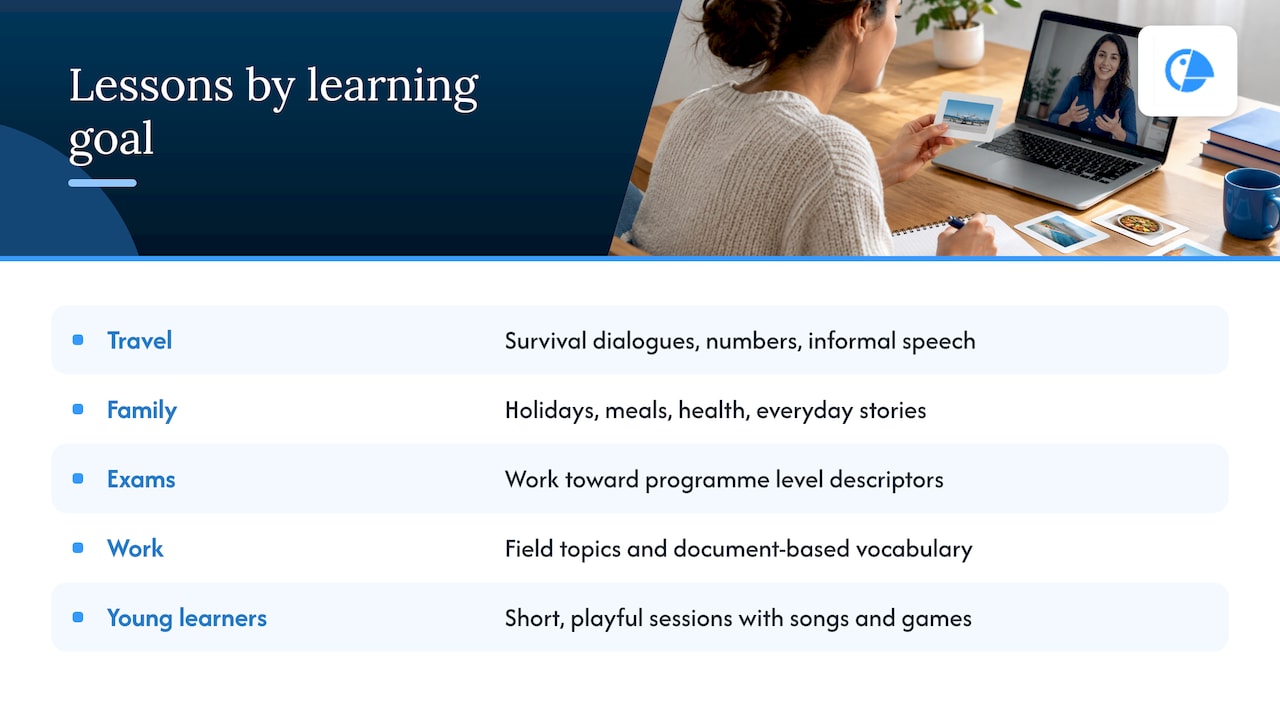
Travel. Focus on survival dialogues: airports, hotels, taxis, markets, restaurants, directions and asking for help. Expect to learn the numbers early, since prices and times depend on them. Everyday Israeli speech is quick and informal, with words such as yalla (let's go), sababa (great) and achla (awesome) that textbooks may skip, so ask your tutor to include them.
Family and community. If you want to speak with relatives or join a community, the focus is on warm everyday conversation: holidays, meals, asking about someone's health, telling stories. Many learners in the United States come to Hebrew through family or community ties, and a tutor can focus on listening and natural phrasing rather than formal grammar.
Exams and study. If you are preparing for a university placement, a language programme or a course, ask the tutor to work towards the level descriptors used by the programme. The Middlebury and Tel Aviv University pages above show how institutions describe each stage, which gives you and your tutor a concrete target such as holding a short oral presentation.
Work. Choose topics from your field: meetings, emails you would read aloud, phone calls, small talk with colleagues. The tutor can draw up a vocabulary list from your own documents.
Children and teenagers. Parents and educators looking for Hebrew lessons for a young learner should look for a tutor who builds short, playful conversation: songs, games and role-play. Shorter sessions, more often, usually suit younger learners better than long ones.
Choosing the format and level
Three choices shape your lessons.
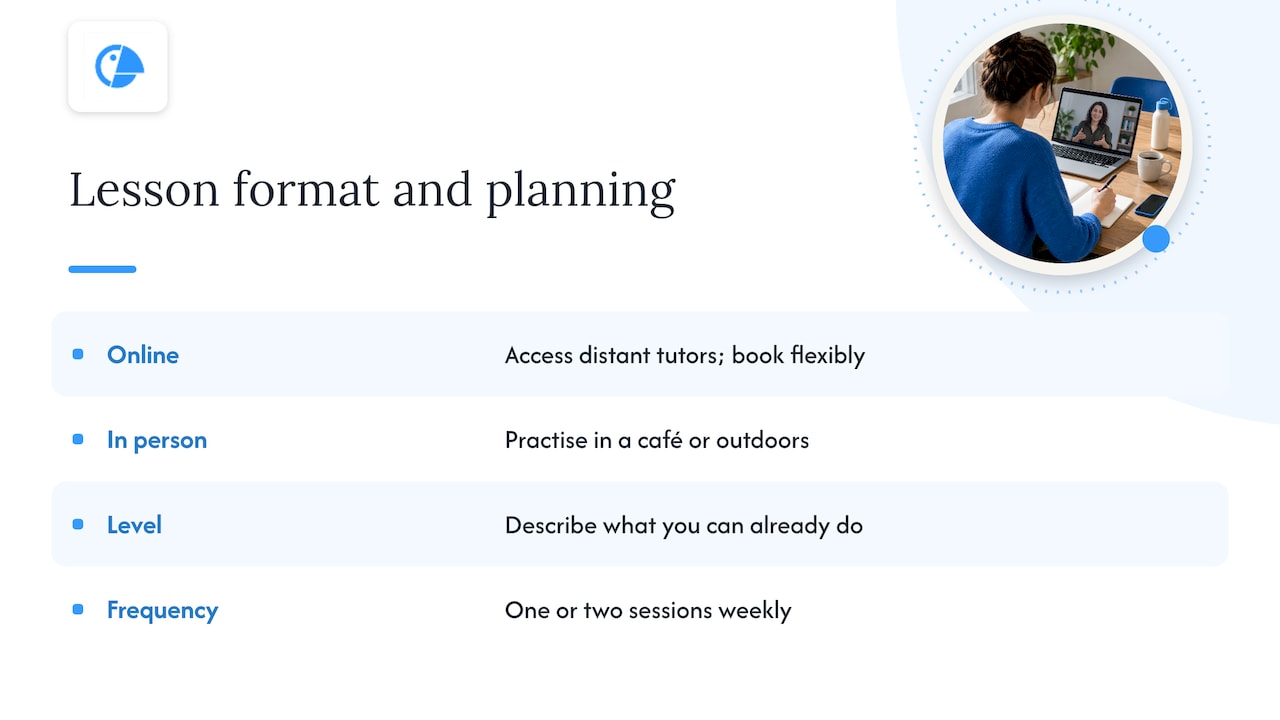
Online or in person. Online lessons give you access to tutors well beyond your town, which matters for a language where native speakers may not live nearby, and they make it easy to book around work and school. In-person lessons suit learners who want to practise in a real setting, such as a café or a walk. TUTOROO lets you work with tutors either locally or online.
Level. If you are unsure, describe what you can already do rather than naming a level. "I can read the letters but cannot hold a conversation" tells a tutor far more than "beginner". The Middlebury and Tel Aviv University descriptors are handy for self-assessment: if you can handle introductions, shopping and directions, you are past the first stage.
Frequency. Regular lessons, even short ones, build speaking habits faster than occasional long ones. Many learners choose one or two sessions a week and add the daily practice routine above.
Our guide on how to choose a Hebrew tutor goes through what to look for in a profile and what to ask in a first message.
Find your Hebrew tutor on TUTOROO
If you are ready to start speaking, you can browse Hebrew tutors on TUTOROO and choose by availability, location and whether you want lessons online or in person. You message the tutor directly to agree your goals and schedule. Students pay an introduction fee when they connect with a tutor, and lessons themselves are then paid directly to the tutor, with no further platform charges.
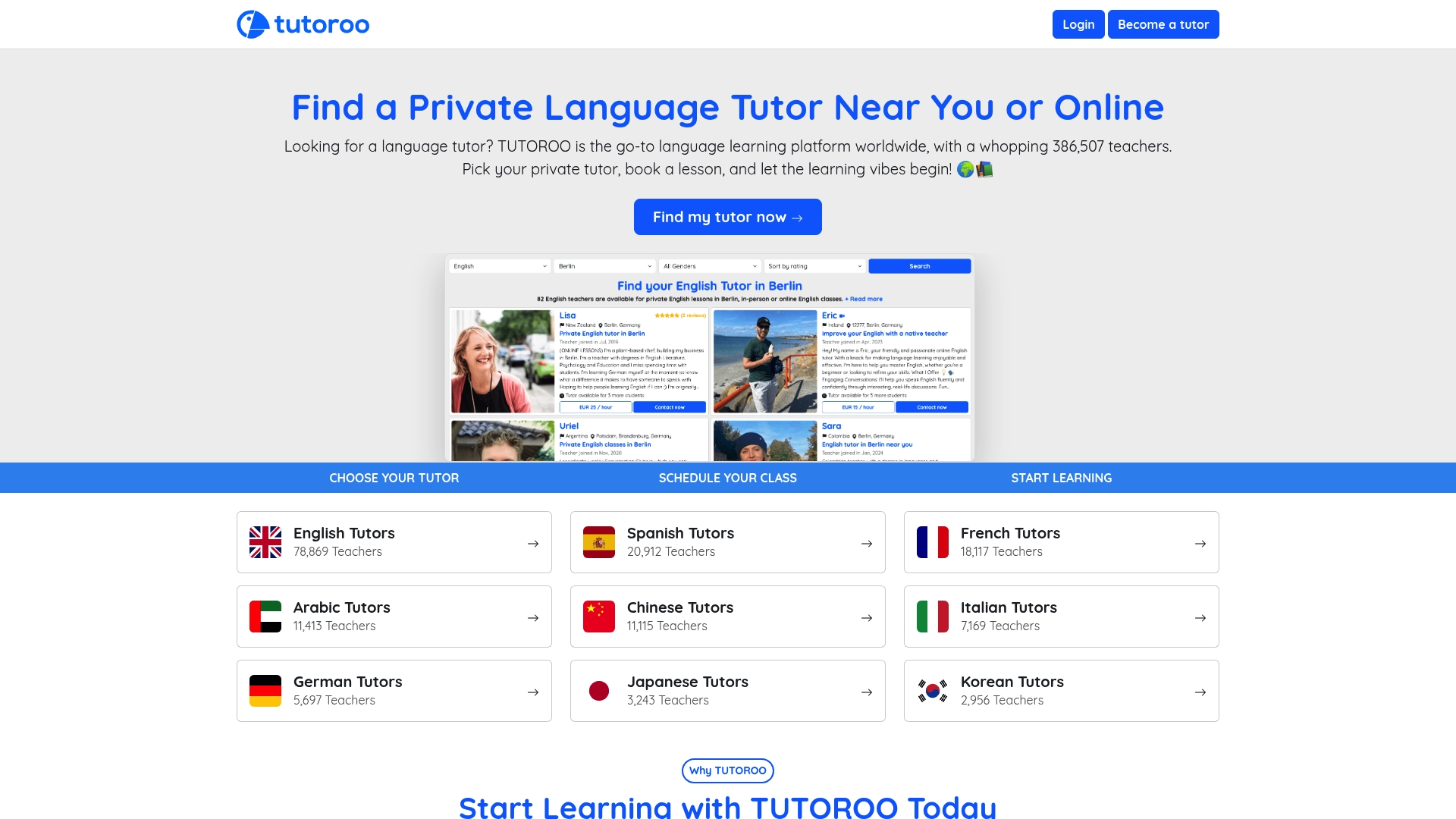
You can also see the full range of languages we offer on the TUTOROO home page.
Our perspective
We built TUTOROO around a simple idea: people learn to speak by speaking with other people. A tutor who is a real person, in your time zone or in your town, gives you what an app screen cannot: someone who listens, answers and brings you back to the phrase you almost had.
Hebrew is a good example. Its sounds, its gendered verbs and the gap between textbook and street speech are all easier to absorb in conversation. When a tutor can hear you say ani lo mevin with the wrong ending and fix it in the moment, you carry the correction into every conversation after that.
That is why we focus on connecting you directly with your tutor. You can find people by language, location and availability, message them before you commit, and shape lessons around your own goals, from a first trip to Israel to a family dinner conducted in Hebrew. Tutors set their own schedules and are paid directly by students for their lessons, which keeps the relationship personal and flexible.
Language opens doors to culture, connection and opportunity. A Hebrew conversation lesson is the first step through one of them.
TUTOROO
For tutors and educators: tailoring conversation practice
If you teach Hebrew or are an educator planning lessons, the same principles apply from the other side of the table. Start with a short conversation to find out what the learner can already say. Choose one situation per lesson and run it twice, the second time with a changed detail. Correct a small number of errors rather than everything. Offer both masculine and feminine forms, so learners hear how Hebrew addresses different people. And give a short, specific task for the week.
Tutors who want flexible teaching work can register on TUTOROO, set their own schedule and receive payments directly from students.
FAQ
How long does it take to hold a simple conversation in Hebrew?
It depends on how often you practise and on your starting point. Many learners manage greetings and simple requests in the first weeks, and short conversations on familiar topics after a few months of regular lessons and daily practice. A tutor can give you a realistic estimate once they have heard you speak.
Do I need to learn the Hebrew alphabet before conversation lessons?
Not necessarily. Many tutors start with spoken phrases written in English letters (transliteration) and introduce the alphabet alongside, so you can speak from the first lesson. If you want to read Hebrew signs, menus or messages, tell your tutor and they will build the alphabet into your plan.
Are online Hebrew conversation lessons as effective as in-person ones?
Online lessons give you the same live speaking, listening and correction, and they widen the choice of tutors to people anywhere in the world. Choose in-person if you prefer to practise in a real-life setting, and online if you want more choice of tutor and easier scheduling.
Can I prepare for a trip to Israel with conversation lessons?
Yes. Tell your tutor your travel dates and plans, and ask for dialogues on airports, transport, hotels, restaurants and shopping, plus the informal expressions you will hear on the street. Practise each situation aloud until you can respond without reading.
How do I find a Hebrew tutor on TUTOROO?
Go to the Hebrew tutors page, browse the profiles, and message a tutor whose availability and approach suit you. You can say what level you are at and what you want to be able to say, and agree lesson times directly.
Sources
- Hebrew Level Descriptions | Middlebury Language Schools
- Hebrew curriculum | Tel Aviv University International