

The fastest way to choose a Hebrew tutor is to name your goal, screen a shortlist of profiles for qualifications and verified reviews, message your top picks for a quick interview, then book a trial lesson before you commit to anything longer. A trial lesson of 25 to 50 minutes is the evidence-backed standard for testing fit, according to Stanford University's tutoring toolkit, and it works because it exposes teaching style, pace and personality before you've spent real money on a course. Platforms like Tutoroo make this sequence quick because profile filters, messaging and scheduling all sit in one place.
Here's what to do right now:
- Write down your specific goal (travel, conversation, liturgical reading, or academic study).
- Search filtered tutor profiles that show qualifications and verified reviews.
- Message two or three shortlisted tutors with the same set of questions.
- Book a 25 to 50 minute trial lesson with your strongest candidate.
Pro Tip: Don't skip the interview step to save time. A five-minute message exchange often reveals more about teaching style than a full profile bio does.
Key Takeaways
Choosing the right Hebrew tutor comes down to clarifying your goal, screening profiles for verified qualifications, and confirming fit through a 25 to 50 minute trial lesson before committing further.
| Point | Details |
|---|---|
| Clarify your goal first | Name your specific aim (travel, conversation, academic, liturgical) before searching profiles. |
| Screen for verified signals | Prioritise qualifications, verified reviews and a clear lesson structure over a generic bio. |
| Use the trial lesson properly | Book a 25 to 50 minute trial to test rapport, pacing and feedback style before paying for a package. |
| Watch payment and cancellation terms | Confirm fees, cancellation policy and payment method before booking beyond the trial. |
| Start with Tutoroo | Filter Hebrew tutor profiles by specialisation and availability, then message and trial your shortlist directly. |
Table of Contents
- Why choose a private Hebrew tutor instead of group classes or apps?
- Step by step: how to choose the right Hebrew tutor
- What to look for on a tutor's profile (quick checklist)
- How to run an effective trial lesson and what to evaluate
- Pricing, session length and scheduling expectations
- Red flags: when to keep looking
- How Tutoroo helps you find a Hebrew tutor
- Expected duration of the entire tutoring process from initial search to achieving goals
- Tips for assessing tutoring styles and teaching methods to find a good match
- Advice on technology and tools for effective online Hebrew tutoring
- Overview of common payment methods and security tips when paying tutors
- Guidance on negotiating rates and packages with tutors
- Sources
Why choose a private Hebrew tutor instead of group classes or apps?
Private tuition gets you to a specific goal faster than group classes or apps because the entire lesson bends around what you need, not a fixed curriculum. If you're prepping for a trip to Tel Aviv, reading from a siddur, or cramming for a university exam, a one-to-one tutor can build every session around that outcome. Private, one-to-one Hebrew tutoring offers personalised lesson plans, immediate corrective feedback, cultural context and flexible scheduling, all things a language app or a twelve-person class simply can't replicate.
The practical benefits stack up:
- Personalised pacing — you move on only once a concept sticks, not when the syllabus says to.
- Immediate feedback — pronunciation and grammar mistakes get corrected in real time, not weeks later.
- Cultural context — a tutor who's lived the language explains idioms and customs an app never will.
- Scheduling flexibility — lessons fit around your week, not a fixed classroom timetable.
Pro Tip: If your goal is liturgical, ask directly about experience teaching Torah or siddur reading. A tutor who's strong in modern conversational Hebrew isn't automatically comfortable with biblical vocalisation or trope.
Step by step: how to choose the right Hebrew tutor
Work through six steps in order: clarify your goal, search, shortlist, interview, trial, then decide. Each step takes minutes, not days, and skipping one is usually what leads to a mismatch three lessons in.
- Clarify your goal. Are you learning for an upcoming trip, a bar or bat mitzvah, university coursework, or general fluency? Write it in one sentence, because you'll reuse it when messaging tutors.
- Search filtered profiles. Look for tutors who list Hebrew specifically, not just "Middle Eastern languages," and filter by availability that matches your week.
- Shortlist three to five tutors. Read their bios for specialisation, not just friendliness. A profile that mentions travel Hebrew, academic Hebrew, or biblical Hebrew as a distinct offering is a good sign.
- Interview before booking. Send the same short message to each shortlisted tutor. Useful questions include:
- "What's your usual teaching method for a beginner with my goal?"
- "Have you taught liturgical or biblical Hebrew before?"
- "What's your cancellation and rescheduling policy?"
- "What platform or tools do you use for online lessons?" A tutor who answers specifically and quickly is a stronger signal than one who sends a generic reply days later.
- Book a trial lesson. The Stanford tutoring toolkit recommends a trial of 25 to 50 minutes as standard practice across tutoring programs, long enough to sample teaching style without committing to a full package.
- Decide using a short checklist. Did the tutor listen to your stated goal? Did they correct you clearly without discouraging you? Was the pacing right for your level?
If two or three shortlisted tutors all pass steps four and five, book trials with each rather than settling for the first available slot. You'll learn more from comparing two trial lessons back to back than from reading ten more profiles.
What to look for on a tutor's profile (quick checklist)
Profiles that show clear qualifications, verified reviews and a defined lesson structure correlate with better matches and fewer wasted lessons, according to Stanford's guidance on tutor selection. Treat the profile as a screening tool, not just a bio to skim.
Check for these signals before messaging:
- Certification or formal training in teaching Hebrew as a second language.
- Years of tutoring experience, ideally with students who share your goal.
- Whether the tutor is a native speaker, a trained teacher, or both, since each brings different strengths.
- A clear description of how lessons are structured, not just "conversational practice."
- Verified student reviews rather than a bare star rating with no comments.
- Sample materials or a sample lesson plan you can look at before booking.
- Transparent fees and a stated cancellation policy.
Watch for the opposite too. A profile with zero reviews, a vague one-line lesson description, or no visible pricing is worth a pause. None of these are automatic disqualifiers, but stacked together they're a reason to keep looking before you book.
How to run an effective trial lesson and what to evaluate
Use the trial lesson to test rapport, teaching method, pace and material relevance, not to squeeze in as much content as possible. A 25 to 50 minute session, the length most tutoring programs recommend, is enough time to see how a tutor teaches without either of you overcommitting.
Before the lesson starts:
- Confirm the technology works. Test your camera, microphone and whatever video platform the tutor uses.
- State one clear objective for the trial, such as "I want to see how you teach the aleph bet" or "show me how you'd start conversation practice."
- Ask the tutor to demonstrate a short teaching segment, then practise speaking and listening yourself.
- Request specific corrective feedback and note how clearly it's delivered.
- Ask what homework or practice they'd expect between lessons.
Right after the trial, ask yourself:
- Did the tutor clarify next steps for ongoing lessons?
- Did the lesson actually match the goal you stated?
- Was correction clear and encouraging rather than vague or overly critical?
- Did the tutor show a structured plan, or improvise the whole session?
Before you log off, confirm the ongoing price, preferred schedule and whether the trial counts toward a package. A structured lesson plan and clear feedback method during a short trial is one of the better predictors of results over a longer course.
Pricing, session length and scheduling expectations
Most Hebrew tutors price lessons either by the hour or through discounted packages of prepaid sessions, and session length usually runs 30 to 90 minutes depending on your goal. Conversation practice often suits shorter, more frequent sessions, while grammar-heavy or exam-prep work benefits from longer blocks.
When comparing tutors, weigh these factors:
- Packages vs hourly — packages usually cost less per lesson but require upfront commitment; hourly gives more flexibility if your schedule is unpredictable.
- Session length by goal — 30 to 45 minutes suits casual conversation practice; 60 to 90 minutes suits grammar drills or academic prep.
- Extras — some tutors charge separately for custom materials or exam-specific prep.
- Experience-driven pricing — a tutor with specialised liturgical or academic experience often charges more than a general conversation tutor.
Ask directly about payment methods, cancellation windows, whether the trial price differs from ongoing lessons, and whether block bookings come with a discount.
Red flags: when to keep looking
If more than one of these appears during your search, politely decline and move on. There are plenty of qualified tutors, and a bad match early on costs you more time than restarting the search.
- Evasive or vague answers about qualifications → ask once more directly; if it's still unclear, move on.
- No trial offered → ask for a short paid trial; if refused, keep looking.
- Unclear cancellation terms → get it in writing before booking a package.
- Consistently late or generic replies → treat as a preview of ongoing responsiveness.
- No lesson plan or stated goals for your first session → ask for one; if they can't provide it, that's a sign.
- No verified reviews at all → weigh this against other strong signals, but don't ignore it entirely.
How Tutoroo helps you find a Hebrew tutor
Tutoroo speeds up every step above by putting profile filters, messaging and flexible scheduling in one place, so you're not juggling emails across five different tutors. Tutoroo connects students with private language tutors worldwide, and its Hebrew tutor listings let you filter by availability and specialisation before you send a single message.
The platform's design matches the checklist you've just worked through:
- Detailed profiles show experience, teaching approach and reviews so you can screen before messaging.
- Direct messaging lets you run your interview questions with multiple tutors at once, side by side.
- Flexible scheduling covers both local, in-person lessons and fully online sessions.
- Transparent fees and cancellation terms are stated upfront, so there's no guesswork before you book a trial.
Because Tutoroo's community spans a large global network of tutors, you're more likely to find someone who specialises in exactly what you need, whether that's travel Hebrew, biblical reading, or exam prep, rather than settling for whoever happens to be available nearby.
Expected duration of the entire tutoring process from initial search to achieving goals
Finding a tutor and booking a trial usually takes a few days to a week if you follow the shortlist and interview steps in order. Reaching a specific goal takes considerably longer, and the timeline depends heavily on what you're chasing.
Travel-focused learners aiming for practical phrases and basic conversation often see meaningful progress within four to eight weeks of consistent weekly lessons. Academic learners preparing for coursework or an exam typically need a full semester of structured sessions, especially if grammar and reading comprehension are involved. Liturgical or biblical Hebrew, with its distinct vocalisation and vocabulary, tends to take longer again, often several months of steady practice before a learner can read fluently from a text.
The search and screening phase is the part you can compress. Clarifying your goal before you start looking, then running trials with two or three shortlisted tutors in the same week, can cut weeks off the process compared to messaging tutors one at a time and waiting for replies before moving to the next.
Once you've settled on a tutor, expect the first two or three lessons to involve some recalibration. Even a well-matched tutor needs a session or two to properly gauge your level and adjust pacing. Don't mistake this settling-in period for a bad match. It's normal, and it's exactly why the trial lesson exists as a lower-stakes first step rather than a full commitment.
Tips for assessing tutoring styles and teaching methods to find a good match
Teaching style matters as much as subject knowledge, and the trial lesson is your best window into it. Some tutors lean heavily on structured grammar drills and written exercises. Others favour immersive conversation from the first lesson, correcting errors as they arise rather than front loading rules.

Neither approach is inherently better. What matters is whether it matches how you actually learn. If you're the kind of person who needs to understand a grammar rule before using it confidently, a drill-heavy tutor will suit you better than one who throws you into conversation immediately. If you learn by doing and get frustrated with too much theory, the reverse is true.
Pay attention to how a tutor responds to mistakes during the trial. Some correct every error immediately, which can feel thorough but occasionally interrupts flow. Others let you finish a thought before correcting, which builds confidence but risks letting habits form. Ask which approach they use and whether they'll adjust it if it isn't working for you.
Structured lesson planning is another marker worth watching closely. A tutor who can describe how a typical lesson unfolds, rather than improvising session to session, tends to produce steadier progress over a short course. Ask to see how they'd structure your first month of lessons. A vague answer here is often a preview of how the lessons themselves will feel.
Advice on technology and tools for effective online Hebrew tutoring
Online Hebrew lessons need a bit more technical preparation than an in-person session, mostly because Hebrew's script and right-to-left direction can trip up software that wasn't built with it in mind. A stable internet connection and a working webcam and microphone are the baseline. Beyond that, a few specifics matter.
Make sure whatever video platform your tutor uses displays Hebrew script clearly, including vowel points (nikkud) if you're working with biblical or liturgical texts. Some screen-sharing tools render Hebrew fonts poorly or reverse the text direction, which makes following along frustrating. Ask your tutor which platform they use and whether it handles Hebrew text reliably before your first trial.
A second screen or split-screen setup helps enormously if you're working from a shared document or digital textbook while also seeing your tutor's face. It's not essential, but it makes note taking during the lesson much smoother.
For practice between lessons, a simple Hebrew keyboard layout enabled on your phone or laptop lets you message your tutor in Hebrew script rather than transliteration, which speeds up reading recognition over time. If liturgical reading is your goal, ask whether your tutor shares scanned pages or digital texts you can annotate directly, since working from the same visual source during the lesson makes corrections far easier to follow.
Overview of common payment methods and security tips when paying tutors
Most tutors accept payment through the platform they're listed on, direct bank transfer, or a payment app, and each comes with different levels of built-in protection. Paying through a platform's own system, where available, generally gives you a paper trail and some recourse if a lesson doesn't happen as agreed.
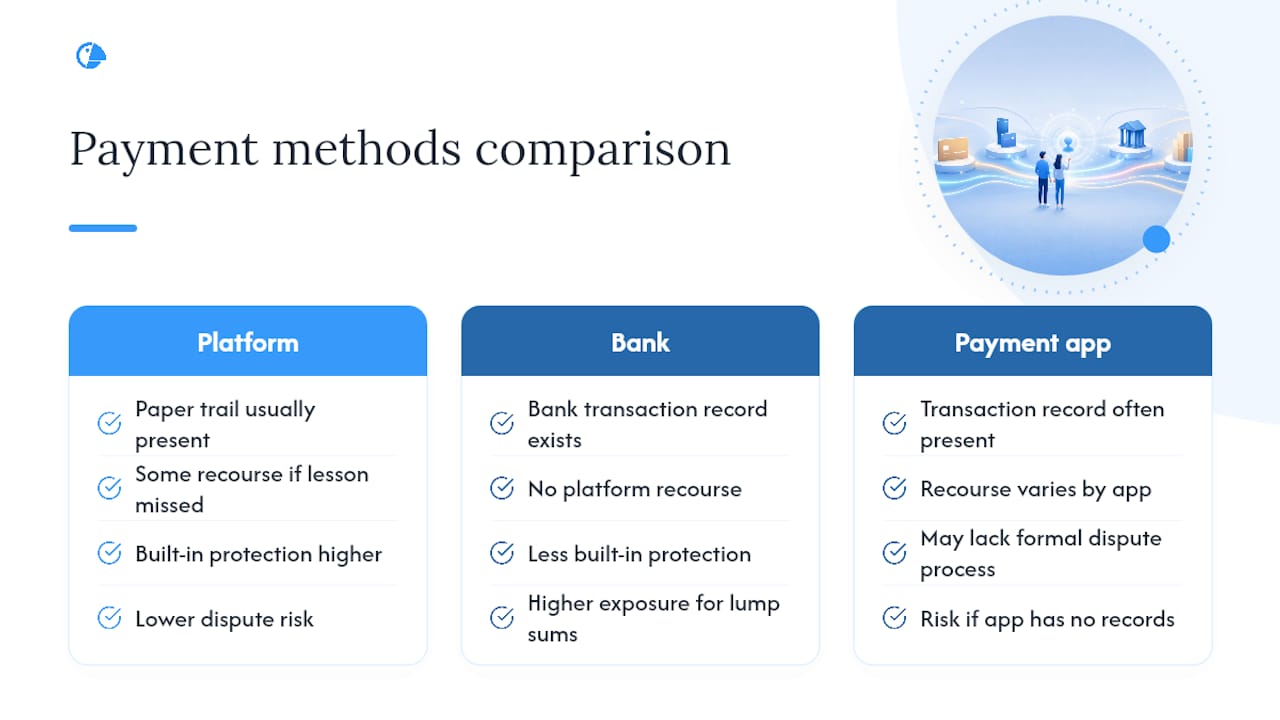
A few practical habits protect you regardless of payment method. Avoid paying for large blocks of lessons upfront before you've completed a trial and at least one or two paid sessions, since that limits your financial exposure if the match turns out to be wrong. Keep records of what you've paid for and when, particularly if you're buying a package with a set number of lessons rather than paying per session.
Be cautious of any tutor who pushes hard for an unusual payment method, insists on a single lump sum for many months of lessons before you've even had a trial, or asks you to pay through a channel that offers no transaction record. None of these are automatically dishonest, but they're worth asking about directly. A tutor with nothing to hide will usually explain their payment process clearly and without pressure.
Guidance on negotiating rates and packages with tutors
Hebrew tutoring rates aren't usually fixed the way a retail price is, and there's often more room to negotiate than learners assume, particularly around package deals. If a tutor's hourly rate feels high for your budget, ask directly whether they offer a discount for booking a block of lessons upfront, such as ten sessions instead of paying week to week.
Many tutors will adjust pricing for consistency. A student who commits to a regular weekly slot for a set number of months is generally a more attractive booking than one who books sporadically, and some tutors will reflect that in the rate if you ask.
It's reasonable to mention your budget honestly during the interview stage, before you've booked a trial. A tutor who can't work within your range will usually say so quickly, which saves you from an awkward conversation later. If a tutor's specialisation genuinely matches a niche need, such as advanced liturgical reading, expect less room to negotiate. That kind of expertise is harder to find and priced accordingly.
Don't negotiate away the trial lesson itself. A short trial at a fair or reduced rate is a reasonable ask, but pushing a tutor to work for free before you've even confirmed fit isn't a good start to the relationship.
Author perspective: a practical tip from experience
The single biggest time-saver is preferring a tutor who asks about your specific goal, your trip, your Torah portion, your exam, over one who pitches a generic syllabus. A tutor who asks questions before answering yours is already showing you how they'll teach.
Suggested next step: get started on Tutoroo
Skip the weeks of trial and error. Tutoroo is the quickest way to browse vetted Hebrew tutors, filter by availability and specialisation, and message your shortlist directly before booking anything. If liturgical or biblical Hebrew is your focus, this faith learner's guide to reading biblical Hebrew pairs well with a tutor search once you know what you're aiming for.

Search Hebrew tutor profiles now, filter by the specialisation that matches your goal, and message two or three tutors today. Most are happy to arrange a short trial lesson at a reduced rate, so there's little downside to testing the fit before you commit to anything longer.
Sources
- Stanford University — Toolkit for tutoring programmes: Section 3.1 (process for choosing a tutor)
- The ultimate guide to learning Hebrew with a private tutor — TalkPal