

Consistent, measurable speaking improvement comes from following a clear sequence: set specific goals, sharpen pronunciation, build fluency and flow, expand your vocabulary, practise daily, manage anxiety, and seek real conversation with fluent speakers. Each step builds on the last, and skipping ahead rarely works. The good news is that structured monthly challenges progressing from pronunciation through to spontaneous fluency produce measurable gains, even for learners starting from scratch.
Your step by step roadmap to better English speaking
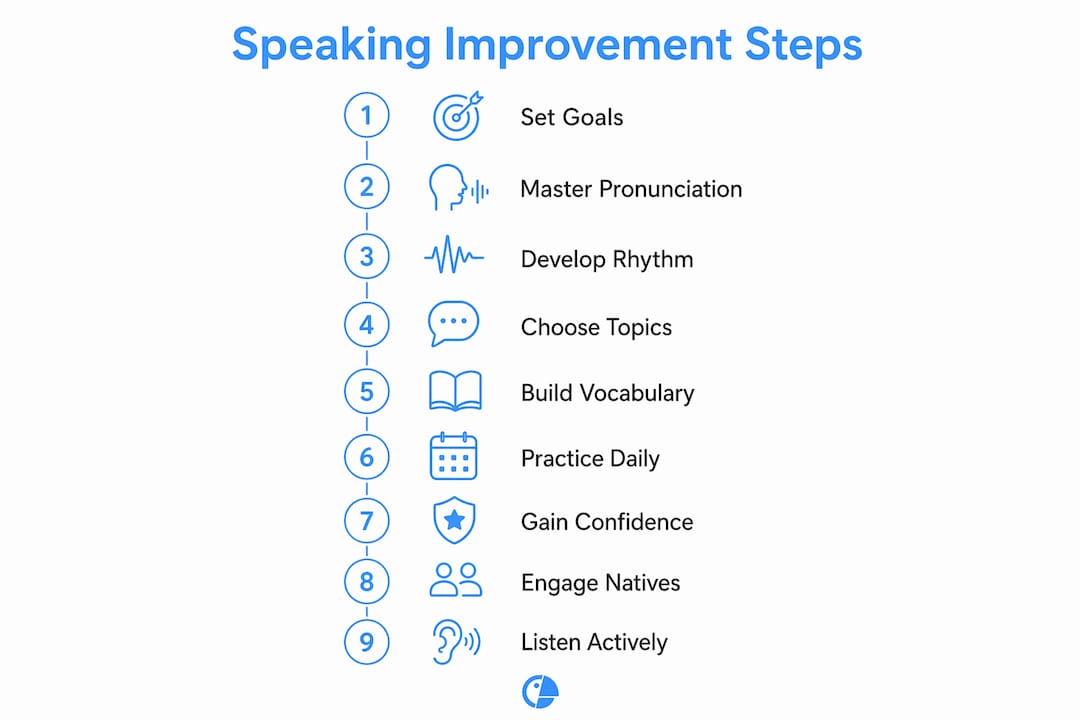
Before diving into each step, here is the full sequence at a glance:
- Set specific, measurable goals so you know exactly what progress looks like
- Master pronunciation and clarity through targeted drills and mouth muscle training
- Develop flow and rhythm using shadowing, pacing, and deliberate pausing
- Choose and master topics to build confidence through familiarity
- Expand vocabulary and personal style by learning phrases in context, not in isolation
- Practise daily with short, focused sessions rather than occasional long ones
- Build confidence by recording yourself, reviewing honestly, and embracing imperfection
- Speak with native or fluent speakers to develop real interactive communication skills
- Listen actively to absorb natural rhythm, intonation, and phrasing
- Use technology and apps to supplement live practice between sessions
Every item on this list gets its own dedicated section below, with practical techniques you can apply today.
1. How to speak clearly: mastering pronunciation and clarity
Pronunciation is the foundation everything else rests on. If listeners struggle to understand you, fluency and vocabulary count for very little. The goal at this stage is not a perfect accent but clear, consistent articulation.

Start with minimal pairs: word pairs like ship and sheep, or bit and beat, that differ by a single sound. Practising these trains your ear and your mouth simultaneously. Tongue twisters such as "She sells seashells" are genuinely useful here, not just novelty exercises. They force your mouth muscles to move in unfamiliar ways, which builds the physical coordination that clear speech requires.
Common challenges for English learners include the th sounds (as in think and this), the short i versus long ee distinction, and word stress patterns. Recording yourself reading a short passage and comparing it to a native speaker recording reveals gaps you simply cannot hear in real time.
- Practise minimal pairs for 5 minutes daily
- Use tongue twisters to build mouth muscle coordination
- Record and compare your pronunciation to a native speaker model
- Focus on one problem sound per week rather than trying to fix everything at once
- Pay attention to word stress, not just individual sounds
Pro Tip: Exaggerate sounds deliberately when you first practise them. Your mouth needs to learn new muscle positions, and exaggeration accelerates that process far faster than cautious, tentative attempts.
2. Developing flow: how to build a natural speaking rhythm
Fluency is not about speaking fast. It is about speaking at a pace your listener can follow, with natural pauses that give your words room to land. Speaking at 130–150 words per minute with deliberate pauses improves clarity and reduces filler words like "um" and "uh." Two to three weeks of focused pace work produces a noticeable shift.
Shadowing is one of the most effective fluency tools available. Choose a short audio clip of a native English speaker, listen once, then speak along in real time, matching their rhythm, stress, and intonation as closely as you can. It feels awkward at first. That awkwardness is the learning happening.
- Shadow native audio for 5–10 minutes daily, starting with slow, clear speech
- Record yourself reading the same passage at different speeds and listen back
- Practise deliberate pausing at punctuation marks to break the habit of rushing
- Use a metronome app to build awareness of your natural pace
- Gradually increase difficulty by shadowing faster, more conversational audio
Pro Tip: Choose audio from a speaker whose accent and style you genuinely admire. Motivation matters when you are repeating the same 30 seconds of audio for the fifth time.
3. Choosing and mastering topics to speak confidently
Confidence in speaking comes partly from language skill and partly from knowing your subject. When you choose topics you already understand well, your brain spends less energy searching for ideas and more energy on how to express them clearly.
Start with three or four topics you genuinely enjoy: your work, a hobby, your city, or a current interest. Prepare a short list of key vocabulary and useful phrases for each topic before you practise speaking about it. This preparation is not about scripting what you will say. It is about removing the friction of hunting for words mid-sentence.
- List your three most comfortable topics and prepare 10–15 key phrases for each
- Practise speaking about each topic for two minutes without stopping
- Gradually add one new topic per week to expand your range
- After each session, note which words or phrases you struggled to recall
- Align your topic choices with your real-world speaking goals (job interviews, travel, social situations)
Pro Tip: Topic mastery is a confidence multiplier. Once you can speak fluently about five or six subjects you know well, the mental habit of "I can do this" starts to transfer to unfamiliar topics too.
4. Building your personal style: vocabulary and expressive speech
Learning vocabulary in isolation, word by word, is one of the least efficient approaches available. Words live in context, and learning them in phrases, collocations, and full sentences makes them far easier to recall under the pressure of real conversation. Instead of memorising "happy," learn "I'm really pleased with how that went" or "That genuinely made my day."
Expressing opinions and emotions is where personal style develops. Learners who stick to safe, simple sentences often plateau because they never push themselves to say something more nuanced. Try replacing "I like it" with "What I find interesting about it is..." or "It's not really my thing, but I can see why people enjoy it." These small shifts build a speaking voice that sounds like a person, not a phrasebook.
- Learn vocabulary in full phrases and collocations, not as isolated words
- Keep a personal phrase bank of expressions you want to use more often
- Practise expressing opinions on everyday topics using varied sentence starters
- Read aloud from well-written English sources to absorb natural phrasing patterns
- Review your phrase bank weekly and actively use three new expressions per day
"Let your personality come through. You will establish better credibility if your personality shines through, and your audience will trust what you have to say if they can see you as a real person." — Marjorie North, Harvard DCE
5. Practising daily: how short sessions build lasting fluency
Short, focused daily speaking practice builds motor coordination and fluency more efficiently than infrequent long sessions. The reason is simple: speech is a physical skill, and physical skills improve through repetition spread across time, not through occasional bursts of effort.

Experts recommend a 15-minute daily session structured into four focused blocks: a warm-up, a targeted drill, a live or simulated conversation, and a brief review. That structure keeps each session purposeful rather than aimless. For learners who feel they do not have time, even a consistent 10-minute routine outperforms a two-hour session once a fortnight.
A sample short daily session:
- Minutes 1–3 (warm-up): Read a short passage aloud, focusing on clear articulation
- Minutes 4–7 (drill): Practise one specific skill, such as minimal pairs, shadowing, or pacing
- Minutes 8–12 (conversation): Speak freely about a chosen topic, or use a language app for prompted conversation
- Minutes 13–15 (review): Record one minute of free speech, listen back, and note one thing to improve tomorrow
Consistency over intensity is the principle that separates learners who plateau from those who keep progressing. A feedback loop of practice, recording, review, and adjustment prevents poor habits from becoming permanent and keeps improvement moving in a clear direction.
6. Building confidence: managing speaking anxiety and achieving fluency
Speaking anxiety is almost universal among language learners, and it rarely disappears on its own. What changes is your relationship with it. The physiological sensations of nerves, a faster heartbeat and slightly trembling hands, are the same sensations as excitement. Reframing them as readiness rather than fear is a genuine technique, not just positive thinking.
Recording and reviewing your speaking practice is one of the most effective ways to reduce anxiety over time. The initial shock of hearing your own voice is a cognitive bias, not an accurate reflection of how others hear you. Consistent self-review corrects that perception and builds honest confidence grounded in real evidence.
- Start with low-stakes speaking: talk to yourself, record voice memos, narrate your day in English
- Gradually increase exposure by joining online conversation groups or language exchange communities
- Use outline notes rather than full scripts when preparing to speak, as over-preparation from notes builds natural responsiveness
- Set small, specific goals for each session so progress feels tangible
- Track your progress with a simple weekly log noting what improved and what to work on next
Pro Tip: Imperfection is not the enemy of fluency. Speakers who accept mistakes as data rather than failures recover faster, experiment more, and ultimately progress further than those who aim for perfection before opening their mouth.
7. Why speaking with native speakers accelerates your progress
Real conversation with native or fluent English speakers develops a set of skills that solo practice simply cannot replicate. Interactive communication includes asking questions, responding to suggestions, seeking clarification, and negotiating meaning. These are distinct subskills that only emerge through genuine dialogue, and they are critical for real-world fluency.
The practical challenge is finding those opportunities. Language exchange partners, conversation groups, community classes, and online tutoring platforms all provide access to fluent speakers. The key is regularity. A weekly conversation session with a fluent speaker, combined with your daily solo practice, creates a feedback loop that accelerates progress far beyond either approach alone. Tutoroo connects learners with private English tutors who provide exactly this kind of structured, personalised conversation practice.
Toastmasters clubs, which operate across Australia, offer another avenue for regular speaking practice in a supportive, structured environment. The combination of prepared speeches and impromptu speaking exercises mirrors the demands of real communication more closely than most classroom settings.
8. How listening practice directly supports your speaking
Listening and speaking are not separate skills. Every hour you spend listening to natural English speech builds the internal model your brain draws on when you speak. Learners who read extensively in their target language develop stronger writing; learners who listen extensively develop stronger speaking, particularly in rhythm, intonation, and natural phrasing.
Active listening is more effective than passive exposure. Watch a short video clip, pause it, and try to repeat the last sentence exactly as the speaker said it. Notice where their voice rises and falls, where they pause, and which words they stress. The British Council's free speaking resources organise listening and speaking practice by CEFR level, from A1 through to B2, which makes it straightforward to find material pitched at the right level of challenge.
Podcasts, audiobooks, and interview-format content work particularly well because the speech is natural and varied. Aim for at least 20–30 minutes of active listening daily, and treat it as an integral part of your language skills development rather than optional background noise.
9. Which apps and tools genuinely help with speaking practice?
Technology works best as a supplement to live practice, not a replacement for it. That said, several tools provide genuine value for speaking skills development between tutoring sessions or conversation exchanges.
Speech recognition tools built into platforms like Google Assistant and Apple's Siri give immediate feedback on whether your pronunciation is clear enough to be understood by a machine, which sets a useful baseline. Apps that use spaced repetition for vocabulary, such as Anki, help you retain the phrases and collocations you are actively trying to use in speech. Video call platforms make language exchange partnerships accessible regardless of where you live in Australia.
Deliberate practice requires structured, measured focus on specific subskills rather than random conversation. The best apps support that structure by prompting you to speak on a specific topic, recording your response, and providing feedback on pace, clarity, or vocabulary range. Look for tools that offer this kind of targeted feedback rather than simply logging your practice time. Pairing any app with a structured learning guide keeps your technology use purposeful and connected to your broader goals.
Key takeaways
Consistent, deliberate practice across pronunciation, fluency, vocabulary, and real conversation is the most reliable path to measurable speaking improvement.
| Point | Details |
|---|---|
| Daily practice beats long sessions | Fifteen minutes of focused daily practice, structured into four blocks, builds fluency faster than occasional lengthy sessions. |
| Pace and pausing matter | Speaking at 130–150 words per minute with deliberate pauses reduces filler words and improves clarity. |
| Record yourself regularly | Self-review corrects distorted self-perception and builds genuine confidence over time. |
| Interactive skills need real dialogue | Asking, responding, and negotiating meaning only develop through genuine conversation with fluent speakers. |
| Structure your sessions | A four-block routine of warm-up, drill, conversation, and review keeps each session purposeful and progressive. |
Ready to speak with confidence? Find your English tutor on Tutoroo

The steps in this guide work best when you have a real person to practise with, someone who can hear what you actually sound like, correct what you cannot catch yourself, and push your conversation into territory that genuinely challenges you. Tutoroo connects learners across Australia with over 386,000 private language tutors worldwide, offering one-on-one lessons online or in person, at times that suit your schedule.
Whether you are building pronunciation from the ground up or refining your fluency for professional settings, a private tutor provides the personalised feedback that accelerates every step of the process. Find your English tutor on Tutoroo and start your first lesson today.