

For corporate language training, we recommend personalised, role-aligned tutoring accessed through a marketplace such as TUTOROO, which gives you a large network of tutors to match against your teams' roles. Anchor every purchase to a proficiency framework such as the Global Scale of English (GSE) or CEFR. Course duration, not total hours, is the strongest predictor of measurable improvement.
TL;DR:
- Use private tutoring for urgent executive or customer service needs, group lessons for shared vocabulary, and independent study only as a supplement.
- Run a pilot with one functional cohort, two or three job tasks, baseline and exit assessments, and KPIs such as call handling time or client feedback.
- Reject suppliers without transparent pricing, tutor verification, lessons tailored to roles, admin controls, or a pilot; attendance alone cannot show improved workplace communication.
- Compare total costs beyond lesson rates, including matching fees, materials, cancellations, staff time, and administration; agree payment responsibility and required receipts before launch.
Table of Contents
- How do one-to-one, group, blended and self-study delivery models compare?
- Which criteria should you use to shortlist a platform?
- How do you run a pilot and measure the impact?
- What should a procurement checklist include?
- What does the research say about sustained, role-aligned training?
- What does business language tutoring really cost?
- How do payment methods and billing work for businesses?
- What security and privacy issues matter when engaging tutors?
- How do you select tutors for business language needs?
- What does a successful corporate language engagement look like?
- What features help you manage accounts and coordinate several learners?
- Our perspective: how we support corporate language goals
- How can you start a corporate pilot with TUTOROO?
- FAQ
- Sources
How do one-to-one, group, blended and self-study delivery models compare?
Business language tutoring platforms deliver training in several ways, and the right choice depends on who is learning and why.
- One-to-one tutoring: a single learner works with a private tutor on their own tasks. It suits executive coaching, pre-negotiation preparation and customer-facing staff who need to speak confidently within weeks.
- Small-group lessons: a cohort of colleagues shares a tutor. It works well for onboarding, team meetings and shared vocabulary, and it spreads the cost across several learners.
- Blended learning: tutor sessions are paired with independent practice between lessons. A mixed model instruction study of business management students found that certain blended models outperformed control groups in measured tests.
- Self-study: apps and recorded content that learners complete alone. It scales cheaply but offers the least accountability.
Scheduling is the practical divider. One-to-one lessons bend around a busy calendar, while groups need a shared time slot. Motivation follows the same pattern: a tutor who expects you next Tuesday is harder to ignore than an app notification. As a rule, choose one-to-one for high-stakes roles, groups for shared skills, and self-study only as a supplement. For examples of how live lessons play out, see these online tutoring examples.
Which criteria should you use to shortlist a platform?
A shortlist should reward platforms that can prove learning happened, not just that lessons were attended. Industry leaders report that sustaining learner motivation is the biggest challenge and that successful programmes co-design solutions with employers, integrate with an LMS and measure business-relevant outcomes. Use these checks when you score suppliers:
- Progress reporting and diagnostic profiling aligned to GSE or CEFR, so a learner's level is described in a shared language rather than in a vague "intermediate".
- Placement testing and manager-facing dashboards that show where each learner started and where they are now.
- Custom content and role-based lesson design, so a sales team practises negotiation and a support team practises difficult calls.
- LMS integration, admin controls and exportable reports, so results sit alongside your other training data.
- Pricing clarity and tutor verification: you should know what a lesson costs, what happens if one is cancelled, and how tutors are vetted.
Experts also advise prioritising providers that offer transparent progress reporting and diagnostic profiling rather than relying on participation metrics alone. Attendance tells you people turned up. It says nothing about whether their emails or meetings improved.
Pro Tip: Ask every supplier to show a sample progress report for a real, anonymised learner. A vendor who cannot produce one has told you what you need to know.
How do you run a pilot and measure the impact?
Treat the first engagement as a pilot with a defined end, not an open-ended subscription. A sound pilot looks like this:
- Cohort: a small group of learners from one function, so results are easy to compare.
- Targets: two or three specific business tasks, such as running a client call or writing a project update.
- Baseline and exit assessments: test everyone at the start and end against GSE or CEFR, or an equivalent scale.
- Duration: an initial pilot window, which matches this business English tutoring example of career-relevant gains.
- Translation to KPIs: link level gains to measures managers already track, such as call handling time, meeting participation or client feedback.
Structure the weeks so engagement stays steady rather than front-loaded. Short, regular sessions beat an intensive burst followed by silence, because the research points at duration, not hours, as the lever that matters.
Course duration is the strongest predictor of learning gains, outperforming total hours of study. Plan a pilot long enough for progress to show, and resist the urge to compress it.
What should a procurement checklist include?
Keep the final decision simple. A supplier must clear every must-have before price is discussed.
- Must-have: standardised placement and progress reporting aligned to GSE or CEFR.
- Must-have: flexible delivery, with both one-to-one and group options, and role-based content.
- Must-have: admin dashboards and LMS integration.
- Deal-breaker: opaque pricing, or no pilot option.
A supplier that fails a must-have is a risk to your outcomes, however attractive the rate looks. A supplier that refuses a pilot is asking you to commit before you can verify anything, and that alone is reason to walk away.
Pro Tip: Score each supplier against the checklist in a shared spreadsheet before any demo. It stops a polished presentation from outweighing missing capabilities.
What does the research say about sustained, role-aligned training?
Three findings carry most of the weight. First, course duration outperforms total hours as a predictor of improvement. Second, programmes aligned to standardised diagnostic frameworks support targeted instructional decisions at critical proficiency transitions, notably from A2+ to B1. Third, practice built into real work pays off: a mixed-methods study of a workplace-oriented learning model reported significant improvements in communicative performance when activities were integrated into authentic professional tasks.
Course duration is the single strongest predictor of improvement in language training; diagnostic profiling at proficiency transitions (A2+ to B1) is crucial for targeted interventions.
The practical reading is straightforward: spread training over weeks, test at the transitions where learners tend to stall, and build lessons around the work people actually do.
What does business language tutoring really cost?
Total cost is more than the hourly rate, so ask for every line before you sign. A realistic budget covers these items:
- Lesson fees: set by each tutor, and they vary by language, experience and location. On our marketplace, tutors set their own rates, so you compare profiles rather than accept a fixed price list.
- Introduction fee: we charge a matching fee when a learner connects with a tutor. Ongoing lessons are then paid directly to the tutor with no further platform charge.
- Materials: many tutors build lessons around your own documents, emails and scripts, which keeps material costs low. Confirm whether any workbooks or licensed content are extra.
- Cancellation terms: each tutor sets expectations for late cancellations. Agree these in writing before the pilot starts so no one is surprised by an invoice.
- Internal costs: the hours your staff spend in lessons, plus the admin time to coordinate them.
Specific rates differ from tutor to tutor, so we do not quote a single figure here. Request quotes for your target languages and compare them against the outcomes you want, not against the cheapest hour. A cheap lesson that does not move a learner up a level costs more than a pricier one that does.
How do payment methods and billing work for businesses?
Our model keeps billing simple. A learner or organisation pays an introduction fee to be matched with a chosen tutor, and tutors then receive payment directly from students for ongoing lessons. For a business, that means a matching fee and lesson payments that follow the arrangement you agree with each tutor.
For procurement teams, a few questions are worth settling early:
- Who pays the tutor? Decide whether individual learners claim lesson costs back or a central budget holder pays on their behalf.
- What documentation do you need? If your finance team requires invoices or receipts for each lesson, ask tutors to provide them from day one.
- How are cohorts handled? For a small group, agree on one payer so the team does not generate separate payments for each learner.
- What triggers a review? Set a point, such as the end of the pilot, when you check spend against the progress reports.
Clear answers up front keep finance comfortable and learners focused on lessons rather than paperwork. If your organisation needs a particular payment arrangement, raise it before you commit, not after the first month.
What security and privacy issues matter when engaging tutors?
Any platform that puts your employees in direct contact with outside tutors raises fair questions about data and conduct. Handle them deliberately.
- Limit what you share. Lessons rarely need confidential material. Use sanitised examples of contracts, pitches and emails instead of live client documents.
- Keep contact on the platform. Our messaging system lets learners and tutors communicate in one place, which leaves a clearer record than scattered personal channels.
- Agree ground rules. Tell learners what they may and may not discuss, and put a short confidentiality note in the tutor brief.
- Check tutor profiles. Review each tutor's profile and history before a match, and take a trial lesson before committing a whole cohort.
- Review your own policies. Your data protection and acceptable use rules apply to training too, so check that lesson tools, recordings and shared files sit within them.
Where a particular legal or regulatory requirement applies to your industry, confirm it with your own legal or compliance team rather than assuming a platform covers it. The simplest protection is also the strongest: if a document would worry you in a stranger's hands, do not use it in a lesson.
How do you select tutors for business language needs?
A good business tutor is not simply a fluent speaker. Native speakers are welcome on our marketplace, and tutors are not required to hold formal certification, so your selection process has to do the vetting. Look for these qualities:
- Industry familiarity. A tutor who understands finance, logistics or healthcare vocabulary will waste less of your learners' time.
- Willingness to use real tasks. Ask how they would turn your team's emails, calls and presentations into lesson material.
- Assessment habits. The best tutors check progress against a framework instead of relying on feel.
- Clear scheduling. Check availability against your learners' working hours, including time zones for distributed teams.
- Communication style. Executives often want direct feedback, while newer learners need encouragement. Match the tutor to the person.
Best practice is a short trial lesson with two or three candidates before you decide. Give each the same scenario, such as handling a tough client question, and compare how they coach. For ideas on lessons that develop real speaking confidence, see our post on language lessons that build real speaking skills.
What does a successful corporate language engagement look like?
Rather than invent a showcase client, here is the pattern the research and industry guidance describe, which you can use as a template.
The strongest engagements start with a co-designed plan. Industry leaders report that successful programmes are built with employers, integrated with the learning system and judged on business-relevant outcomes. In practice, that means a team lead agrees two or three target tasks with the tutor, such as leading a weekly client call, and the learners are assessed against a framework before and after.
Say a customer support team begins a pilot (an illustrative scenario, not a reported result). Each learner takes a placement test, then meets a tutor weekly for role-play drawn from real tickets. A mid-point check at the A2+ to B1 transition adjusts the lesson plan for anyone who has stalled. At the end, an exit assessment and manager feedback show who has moved up and who needs more time.

The lesson is consistent: duration, role-based content and honest measurement drive the result, not the novelty of the tool. Our own analysis of international platforms explores why flexible, tutor-led formats tend to speed progress. Beyond measurable gains, learning another language also benefits engagement and the wider organisation.
What features help you manage accounts and coordinate several learners?
Running training for a team is an administrative job as much as a teaching one, so look for tools that reduce the load on whoever coordinates it.
- Tutor discovery by language, location and availability. You can search our tutor network and shortlist by what your cohort needs.
- Direct messaging. One channel for scheduling, changes and quick questions between learners and tutors.
- Scheduling flexibility. Tutors set their own availability, so you can place lessons around shift patterns and time zones.
- Mixed delivery. Run one-to-one lessons for senior staff and group sessions for shared skills under the same programme.
- Consistent reporting. Ask each tutor to use the same GSE or CEFR-based progress notes, so a manager reading ten reports sees the same structure.
Be clear about what you need before you sign up. If you require a central dashboard, LMS integration or consolidated reporting for a large cohort, state that in your brief and ask how it will be handled. A good supplier will tell you plainly what is built in and what a tutor or coordinator will manage by hand, and that honesty is worth more than a long feature list.
Our perspective: how we support corporate language goals
We connect organisations with private tutors for one-to-one and cohort lessons, and we built our marketplace around scheduling flexibility. In a pilot, you can typically expect quick matching, lesson plans adapted to your roles and help coordinating the practical details. We think the best corporate programmes are personal, measured and long enough to matter, and a tutor network lets you meet all three.
— TUTOROO
How can you start a corporate pilot with TUTOROO?
Strong pilots begin with a clear match, and we can help you find one. Tell us the languages, roles and schedules involved, and we will help you connect with tutors for one-to-one or small-group lessons. Our network covers English, Spanish, French, Japanese, Chinese/Mandarin, German, Italian and Portuguese, with lessons available online or locally.
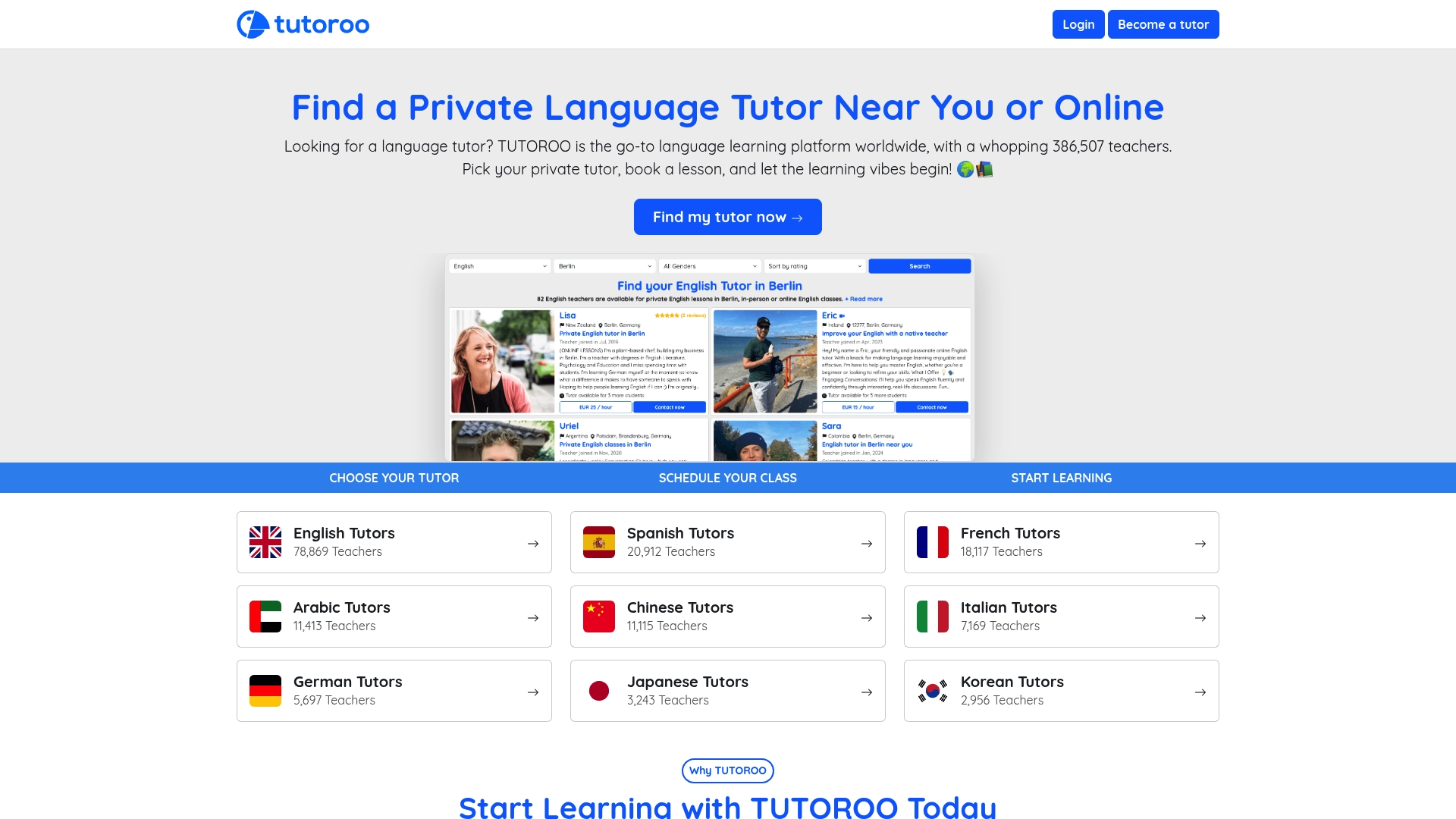
Ready to test it with your team? Browse tutors and request a corporate match at Tutoroo, and start with a pilot built around your own goals.
FAQ
What are some good platforms for finding language tutors?
Marketplaces that list private tutors by language, location and availability are a practical choice for business teams. Our platform connects you with a large network of tutors for one-to-one lessons, online or in person. Compare profiles and take a trial lesson before committing a team.
What is the most effective language learning platform for businesses?
The most effective option is the one that matches lessons to learners' roles and measures progress against a framework such as GSE or CEFR. Course duration is the strongest predictor of improvement, so choose a platform that supports sustained engagement. Personalised tutoring is a strong fit for that.
How long should a corporate language pilot run?
An initial pilot gives learners time to show measurable progress. Use a baseline and exit assessment to judge the result. Longer is better than shorter, because duration drives gains.
How should we check tutor quality?
Review profiles, then run a short trial lesson with two or three candidates using the same business scenario. Compare how each tutor gives feedback and whether they track progress against a framework. Choose the one who best fits the learner's role.
Sources
- Demonstrating ROI on Corporate Language Training
- Bridge
- [Integrating Ubiquitous Language Learning into the Workplace: A Lifelong Learning Model for Corporate Employees in Multinational Companies | International Journal of Language and Ubiquitous Learning](https://research.adra.ac.id/index.php/ijlul/article/view/3006?articlesBySimilarityPage=3)