

TL;DR:
- Global tutor networks connect learners worldwide with qualified, native-speaking tutors, providing personalized, flexible lessons across time zones. Research shows they outperform passive methods by significantly improving fluency, confidence, and career readiness within weeks of consistent engagement. Their scalability and cultural diversity empower learners to curately tailor their language journey, unlocking motivation and genuine connection.
Most people assume that a language app or a weekly classroom session is enough to reach real fluency. Research tells a different story. Personalised human tutoring delivered through global networks can produce measurable language skill gains over a relatively short period, far outpacing passive methods. Whether you are preparing for an exam, planning to work abroad, or simply want to hold a genuine conversation, the gap between casual practice and structured, personalised guidance is enormous. This article reveals exactly what global tutor networks are, what the evidence says about their impact, and how you can get the most out of them.
Table of Contents
- What are global tutor networks and how do they work?
- Proven benefits: What the research shows
- Flexibility and personalisation: Why the network matters
- Limitations and how to get the best results
- The unseen advantage: What most learners miss about global tutor networks
- Connect with the right tutor for your goals
- Frequently asked questions
Key Takeaways
| Point | Details |
|---|---|
| Faster, measurable progress | Sustained tutoring through global networks often leads to real improvements in language skills and confidence within weeks. |
| Flexibility at your fingertips | Choose tutors and schedule lessons anywhere, anytime, with features like session recording and tutor switching supporting busy lives. |
| Personalised learning for any goal | Global networks match you to tutors that fit your aims, whether for travel, work, or exams. |
| You need regular engagement | The biggest gains come with a consistent routine and clear objectives, not just occasional lessons. |
What are global tutor networks and how do they work?
At first glance, "global tutor network" might sound like marketing language. In practice, it describes something quite specific and genuinely useful. A global tutor network is an online platform that connects learners with qualified or native-speaking tutors from countries all around the world, matching them based on proficiency level, learning goals, preferred language, and practical logistics like time zone and availability.
What makes this "global" in a meaningful sense is the sheer breadth of choices available to you. Rather than being limited to whoever teaches at your local community centre, you can connect with a tutor in Tokyo, Buenos Aires, or Nairobi. Global networks let learners quickly find tutors who fit their proficiency level, goals, and logistics, which is something no single local school or freelance tutor can replicate on their own.
The matching process on most global networks is far more nuanced than simply picking from a list. Platforms typically allow learners to filter by native language, teaching style, specialisation (business language, exam preparation, conversational fluency), lesson length, and price. Once matched, lessons usually happen via video call, with features like shared documents, whiteboards, and recorded sessions making the experience rich and flexible.
Key features of global tutor networks include:
- Round the clock availability across time zones, so you can book a lesson before work, after dinner, or on a weekend
- A wide range of specialisations, from IELTS preparation to business French to conversational Japanese
- Flexible lesson formats including one on ones, intensive short courses, and casual drop in sessions
- Access to tutors with diverse accents and cultural backgrounds, which broadens your listening comprehension
- Tools such as session recordings, shared notes, and progress tracking that support self directed learning between lessons
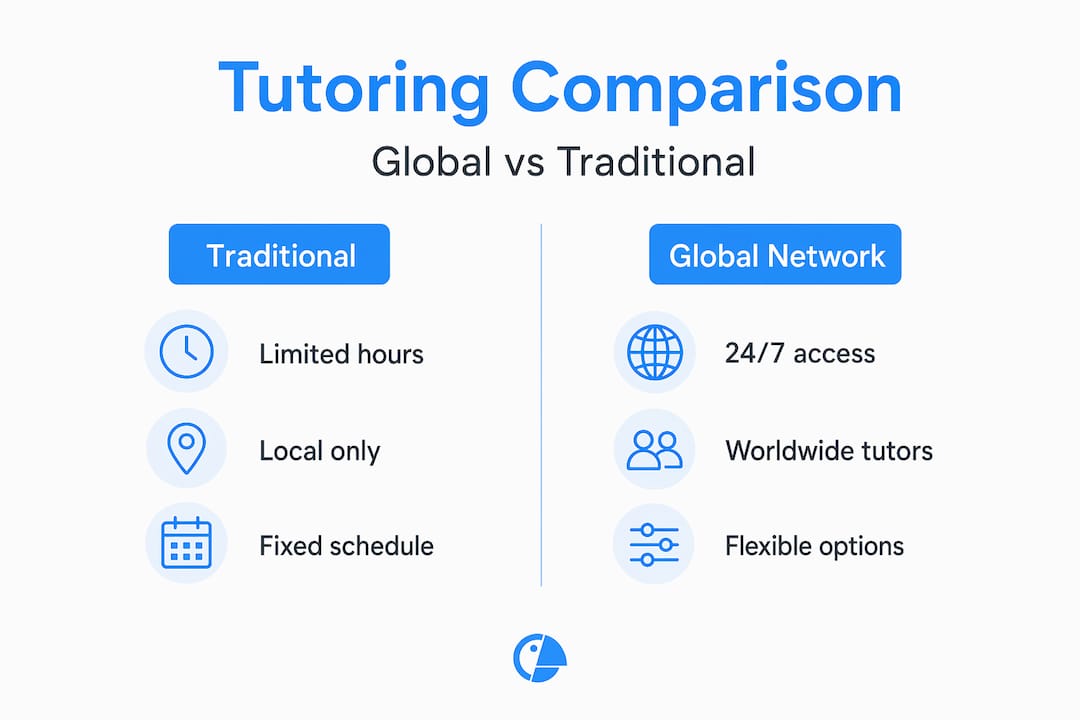
For a clearer picture, here is how global tutor networks compare to traditional tutoring arrangements:
| Feature | Traditional tutoring | Global tutor network |
|---|---|---|
| Availability | Limited by local hours | 24/7 across time zones |
| Tutor diversity | Restricted to local supply | Hundreds of certified tutors globally |
| Personalisation | Moderate, based on tutor expertise | High, with goal and style matching |
| Tech features | Minimal | Recording, shared docs, progress tracking |
| Specialisations | Generalist focus | Broad range, including niche goals |
| Flexibility | Fixed schedule | Short term bookings, easy rescheduling |
Understanding these differences is the first step in finding your ideal tutor rather than just accepting whoever happens to be available near you.
Proven benefits: What the research shows
Now that you understand what global tutor networks are, let's look at what the research really tells us about their impact.
The evidence for personalised, sustained tutoring is striking. A major study found that one in three learners improved by a full CEFR level after 24 or more lessons, while 94% felt more fluent and 97% felt more confident after 12 weeks of structured sessions. The CEFR, or Common European Framework of Reference for Languages, is the standard scale used globally to measure language ability, running from A1 (beginner) to C2 (mastery). Moving up even one level represents a significant, real world shift in what you can do with a language.
"Learners who engaged in personalised tutoring reported not just language gains, but meaningful improvements in confidence and career readiness, particularly those who committed to sustained, regular engagement."
The benefits are not limited to those who already have strong foundations. Separate research shows that tutoring benefits are strongest for learners who are not receiving other supports and who maintain sustained attendance. In other words, if you are learning largely on your own and you commit to regular sessions, the impact can be particularly profound.
Key research backed benefits of global tutor networks:
- Measurable fluency gains even within 12 weeks of consistent lessons
- Confidence building that transfers beyond the classroom into real conversations and professional settings
- CEFR level advancement for learners who complete 24 or more sessions
- Career readiness improvements, including better performance in job interviews and workplace communication
- Stronger outcomes for independent learners who lack access to other language support systems
- Sustained motivation driven by the personal connection and accountability a tutor provides
📊 94% of learners felt more fluent after 24 or more lessons with a personalised tutor.
The private tutoring advantages here extend well beyond what any app or classroom can replicate. Apps reward streaks and gamification. Tutors notice when your pronunciation slips on a specific vowel sound, when your grammar wobbles under pressure, or when you freeze looking for vocabulary in a high stakes moment. That kind of targeted, responsive feedback is what genuinely accelerates progress.
Pro Tip: Aim for at least two sessions per week rather than cramming. Research consistently shows that sustained, regular engagement outperforms intensive bursts followed by long gaps. If you are unsure where to begin, browse real tutoring success stories to see how other learners structured their journeys.
Flexibility and personalisation: Why the network matters
With the evidence in mind, let's explore why the scale and flexibility of a network give you advantages you simply cannot access locally.

The word "network" is doing a lot of work here, and it is worth appreciating why. A single tutor, even a brilliant one, is limited by their schedule, their expertise, and their availability. A network of thousands of tutors operating across every time zone removes those constraints entirely. If you work night shifts, travel frequently, or live in a rural area with limited local options, a global network is not just convenient. It is genuinely transformative.
Personalisation within a global network goes deeper than simply choosing your lesson time. You can match based on your learning style (structured grammar focus vs. free flowing conversation practice), your specific goal (preparing for the IELTS Academic vs. learning enough Spanish to travel through South America), and even cultural preferences like whether you want a tutor who uses humour and informal language or one who takes a more structured, textbook approach. Platforms designed with faster learning on global platforms in mind allow you to switch tutors without starting from scratch, because your progress history and goals travel with you.
Flexibility also supports learners whose lives do not follow a predictable pattern:
- Travellers can continue lessons from anywhere in the world using only a phone and internet connection
- Working professionals can book early morning or late evening sessions around demanding schedules
- Exam candidates can ramp up frequency in the weeks before a test and scale back afterwards
- Parents can fit lessons during school hours or nap times without commuting to a tutoring centre
- Students can supplement classroom learning with targeted one on one support in areas where they struggle
Here is a direct comparison of what local only tutoring offers versus what a global network makes possible:
| Dimension | Local tutor only | Global tutor network |
|---|---|---|
| Schedule options | Fixed, often daytime only | Flexible, including evenings and weekends |
| Speciality range | Limited to local experts | Extensive, including niche exam or industry focus |
| Lesson medium | Primarily in person | Video, audio, messaging, hybrid |
| Tutor adaptability | Depends on one individual | Switch tutors to match evolving needs |
| Cultural exposure | Usually single accent and background | Multiple accents, dialects, and perspectives |
Recording functions, short term bookings, tutor switches and flexible scheduling let learners adapt to real life interruptions without losing momentum. This is particularly valuable for anyone whose life is unpredictable, because the biggest risk to language learning is not a bad lesson. It is stopping altogether because something got in the way.
Pro Tip: Use recorded sessions to review vocabulary and phrases from previous lessons during your commute or downtime. Even 10 minutes of passive revision reinforces retention and keeps momentum alive between formal sessions.
Limitations and how to get the best results
With flexibility and scale come new opportunities, but also some risks if you are not prepared. Here is how to turn advantages into real progress.
Global tutor networks are powerful, but they are not magic. Access alone does not produce results. The research is clear that improvements are most significant with sustained attendance and can be less meaningful if the learner lacks structure or regular lessons. Booking occasional sessions without a clear direction is unlikely to produce the fluency gains that structured, committed learners experience.
Common pitfalls to watch for include booking sessions inconsistently and losing the habit, treating tutoring as supplementary when it works best as a centrepiece of your practice, failing to communicate specific goals to your tutor so lessons feel generic, and switching tutors too frequently before a real working relationship develops.
The good news is that all of these are avoidable with a bit of intentional planning. Here is what learners who see the strongest results actually do:
- Set a clear goal before your first lesson. Is it conversational confidence? Business writing? A specific exam score? Share this with your tutor so every session is purposeful.
- Book a consistent weekly slot rather than searching for gaps whenever you feel motivated.
- Ask your tutor to track your progress and review it together every four to six weeks so you can see measurable movement.
- Complete any between session tasks your tutor assigns, whether that is reviewing vocabulary, watching a film in the target language, or practising writing.
- Engage with the value of international tutor communities beyond individual lessons, including language exchange groups, forums, or cultural events your tutor might recommend.
- Resist the urge to skip sessions when life gets busy. Even a shorter check in lesson maintains the momentum you have built.
Pro Tip: At the end of each lesson, ask your tutor one direct question: "What should I focus on before our next session?" That single habit keeps you active between lessons and signals to your tutor that you are a committed, engaged learner, which in turn motivates them to invest more deeply in your progress.
The unseen advantage: What most learners miss about global tutor networks
Most conversations about global tutor networks focus on outcomes: CEFR levels, fluency scores, exam results. These matter. But there is a quieter, often overlooked dimension that changes everything for sustained language learning, and it has very little to do with test scores.
The real power of a global tutor network is not simply access. It is agency. For the first time, learners are not assigned to whoever is available or affordable nearby. They actively curate their own learning experience, choosing a tutor whose background, teaching style, and personality genuinely resonates with them. That sense of ownership changes your relationship with the language itself. It no longer feels like something happening to you. It becomes something you are pursuing on your own terms.
There is also a hidden benefit that rarely appears in research summaries: exposure to varied accents, dialects, and cultural frames of reference. A tutor from Mexico City will introduce you to Spanish differently than a tutor from Madrid or Buenos Aires. A tutor from Lagos, Nairobi, or Singapore brings you into a version of English that opens your ear and your mind to the language as it actually lives in the world. This is not a minor detail. Cultural fluency, the ability to understand context, humour, and tone rather than just vocabulary, is what separates a technically proficient speaker from someone who can genuinely connect.
Tutoring across borders also unlocks a motivation that purely local options struggle to match. When your tutor is based in a country you dream of visiting, working in, or connecting with, the lesson is not just a grammar exercise. It is a living preview of the experience you are working towards. That emotional connection sustains engagement far more reliably than any gamification feature or achievement badge ever could.
We encourage every learner to broaden their criteria when choosing a tutor. Rather than simply searching for the highest rated option in the most familiar accent, consider what a tutor from a different cultural background might bring to your experience. The serendipity of cross cultural connection is one of the most underestimated engines of language progress available to learners today.
Connect with the right tutor for your goals
Having covered the benefits and unique dynamics of global tutor networks, here is how you can put this into practice and get started.
Whether you are preparing for an international exam, building confidence for travel, or advancing in a multilingual workplace, the right tutor can make the difference between slow progress and genuine fluency. TUTOROO connects you with over 386,000 qualified language tutors across the globe, available across every time zone and specialising in dozens of languages.
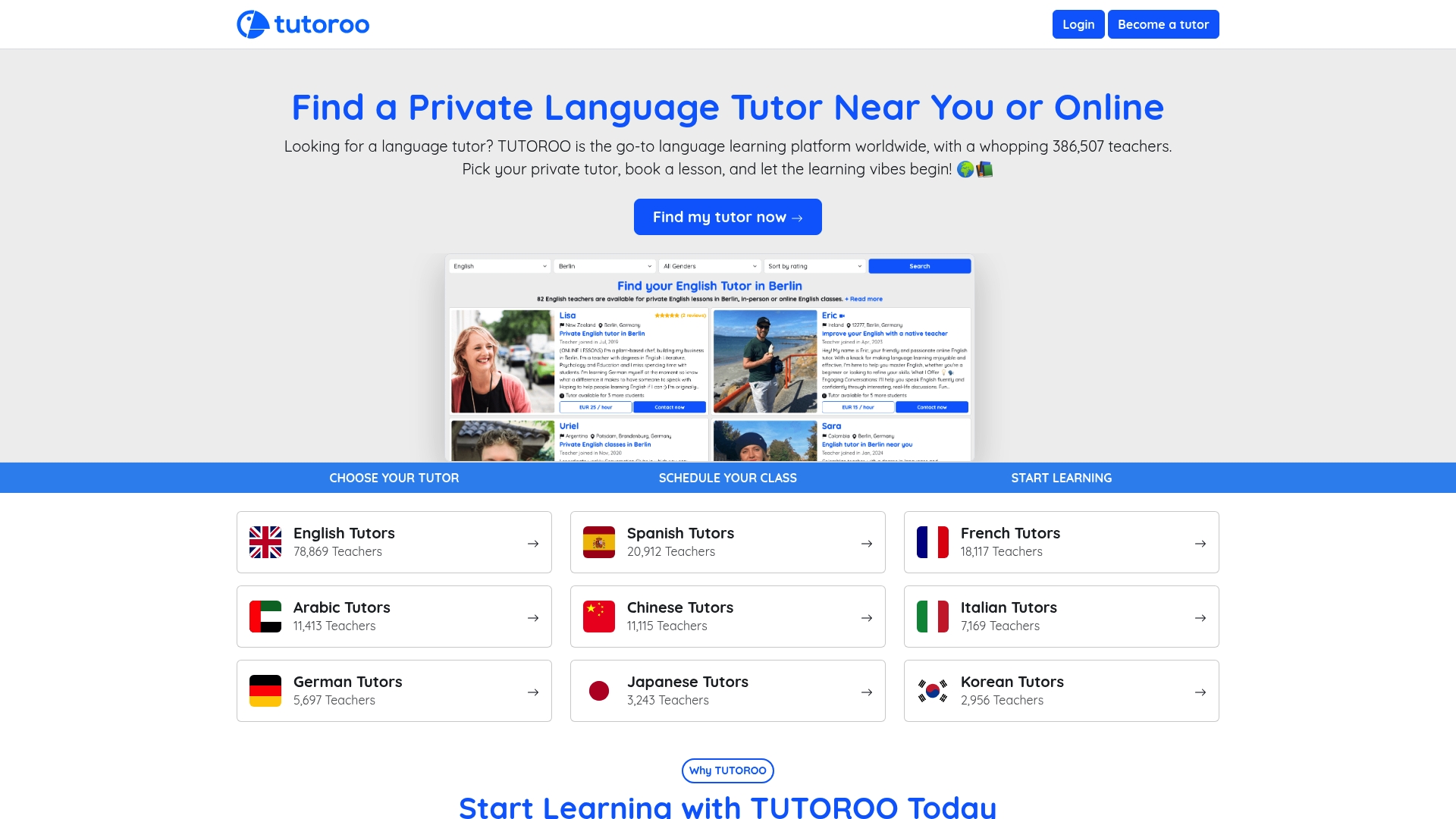
You can find your ideal language tutor based on your language, your schedule, and your specific learning goals, with no long term commitment required. If English is your focus, you can also explore English tutors from a wide range of backgrounds and teaching styles. Your next lesson, and the confidence it builds, is closer than you think.
Frequently asked questions
How quickly can I improve with a global tutor network?
Many language learners see greater fluency and confidence in as little as 12 weeks of regular sessions, with one in three improving by a full CEFR level after 24 or more lessons. Personalised tutoring leads to major skill gains when lessons are regular and sustained.
Can I switch tutors easily if my needs or schedule change?
Yes. Global networks are designed for flexibility, and recording functions and flexible tutor changes support interrupted or changing schedules without losing your progress or starting over from scratch.
Is online tutoring as effective as in person lessons?
For learners seeking flexibility and a wide range of tutors, online global tutor networks have proven highly effective. Effectiveness is high especially with intense and sustained implementation, even for learners who have not had prior tutoring support.
What types of goals can I pursue with a global tutor?
You can personalise lessons for travel, work advancement, exam preparation, or everyday conversation skills. The right tutor match allows you to focus precisely on what matters most to you at any given stage of your learning journey.
Do I need technical skills to benefit from a global tutor network?
No. Basic internet browsing skills are enough to get started. Platforms are designed for straightforward access and provide support at every step so you can focus entirely on the language, not the technology.