

TL;DR:
- Native speaker status alone does not guarantee effective language teaching, as pedagogical experience matters more. Native speakers provide cultural depth and informal language exposure, while non-native teachers often explain grammar more clearly due to their learning experience. Combining both teacher types optimizes language learning by leveraging their distinct strengths and addressing their limitations.
Most language learners, and many institutions, assume that a native speaker automatically makes the best teacher. It feels intuitive. Who better to teach French than someone who grew up speaking it at the dinner table? But research is telling a more complicated story. The role of native speakers in teaching is genuinely valuable, but it is neither absolute nor unconditional. This article unpacks what the evidence actually shows, where native speakers shine, where they fall short, and how educators, learners, and curriculum developers can make smarter decisions based on all of it.
Table of Contents
- Key takeaways
- What research says about native speakers in teaching
- What native speakers uniquely bring to learning
- Limitations of relying solely on native speakers
- Making the most of both native and non-native teachers
- Tutoroo's perspective on native speaker teaching
- Find your ideal tutor with Tutoroo
- FAQ
Key takeaways
| Point | Details |
|---|---|
| Native status alone is insufficient | Pedagogical competence and experience predict teaching effectiveness far more reliably than native speaker status. |
| Native speakers offer irreplaceable cultural depth | Authentic idioms, humour, tone, and conversational rhythm open doors to cultural fluency that textbooks cannot replicate. |
| Non-native teachers often explain grammar better | Their own learning experience gives them empathy and explicit rule knowledge that many native speakers lack. |
| Learners benefit most from both teacher types | Co-teaching models combining native and non-native instructors produce more balanced, effective learning outcomes. |
| Hiring criteria need reform | Recruitment decisions should prioritise qualifications and experience rather than accent or country of origin. |
What research says about native speakers in teaching
The belief that native speakers are inherently superior teachers is sometimes called "native speakerism," and it has attracted serious academic criticism in recent years. A 2026 study of EFL learners at Saudi universities found that native speaker status had no significant effect on student learning progress overall. The findings showed that pedagogical competence and teaching experience were the primary predictors of instructional effectiveness, not whether the teacher grew up speaking the language at home.
What the study did reveal was a more nuanced picture of learner preferences. Students valued native speakers most for pronunciation modelling and speaking practice. Non-native English speaking teachers, on the other hand, were often preferred for grammar instruction and error correction. This makes intuitive sense. A teacher who once struggled to memorise irregular verb conjugations is far better placed to explain why those rules trip learners up.
Scholars have made similar observations beyond this single study. Experts consistently highlight that qualified local teachers who understand second language acquisition are often more effective than native speakers with limited pedagogical training. The critical variable is not the teacher's mother tongue. It is whether they understand how language is learned, how to sequence instruction, and how to respond to a student who is genuinely confused.
"The issue is not whether teachers are native or non-native speakers but whether they are good teachers." This framing, shared widely in applied linguistics circles, cuts straight to what actually matters in the classroom.
A few key contrasts worth understanding:
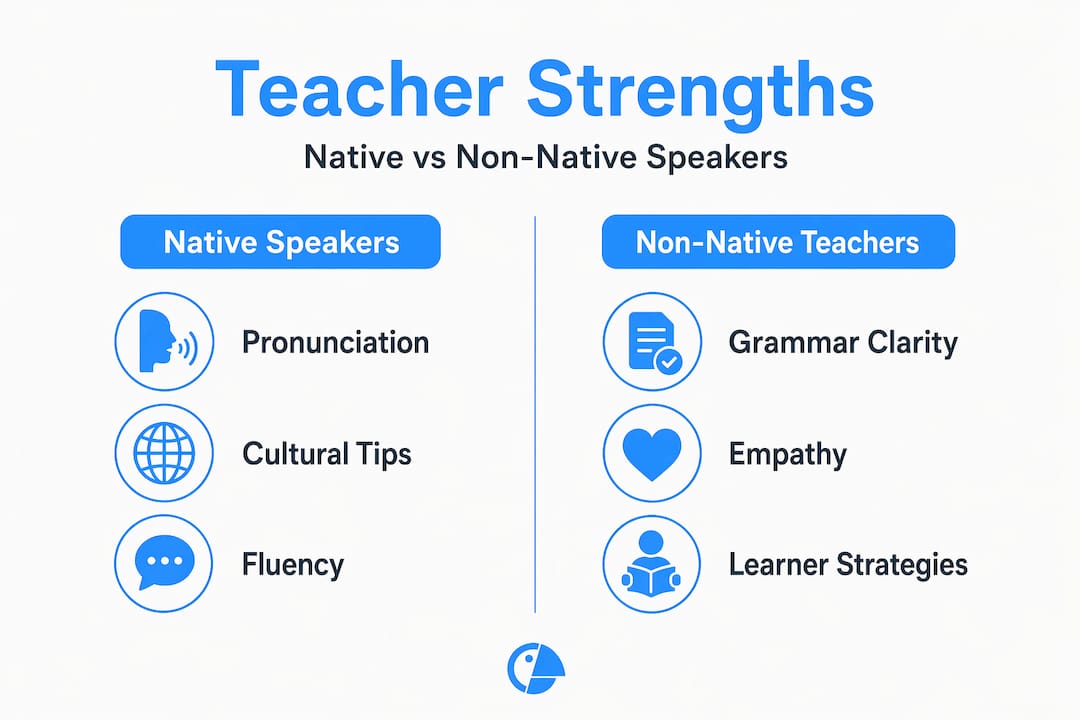
- Pronunciation and accent: Native speakers model natural prosody, stress patterns, and intonation in ways that recorded audio rarely replicates.
- Grammar explanation: Non-native teachers frequently demonstrate superior pedagogical clarity when explaining grammatical rules, drawing on their own learning journey.
- Cultural context: Native speakers carry lived cultural knowledge that enriches language learning beyond what any curriculum document can contain.
- Learner empathy: Teachers who learned the target language as adults often show greater empathy for the frustrations and confusion learners experience.
The takeaway is not that native speakers are overrated. It is that their value lies in specific, identifiable areas rather than teaching as a whole.
What native speakers uniquely bring to learning
The role of native speakers in language learning goes well beyond correct pronunciation. When you practise with a native speaker, you are gaining access to a living, breathing version of the language that no textbook can fully capture.
Here is where native speakers genuinely shine:
-
Real-time feedback and micro-corrections. During authentic conversation, native speakers provide immediate feedback on phrasing, word choice, and rhythm that helps learners avoid cementing errors into habit. This kind of organic correction is qualitatively different from a teacher marking a written exercise in red pen.
-
Exposure to informal registers. Textbooks tend to teach formal, standardised language. Native speakers naturally introduce slang, colloquialisms, contractions, and the subtle differences between what is technically correct and what actually sounds natural to a local ear.
-
Cultural immersion through language. Native speakers expose learners to authentic social interactions, including idioms, humour, irony, and unspoken social expectations that are woven into how a language is actually used. A phrase like "no worries" in Australian English carries layers of cultural attitude that go well beyond its literal meaning.
-
Motivational uplift. Successfully holding a conversation with a native speaker, especially an unscripted one, builds confidence in ways that classroom role-plays rarely do. Learners often describe these interactions as turning points in their fluency development.
-
Language revitalisation. For endangered or minority languages, native speakers are crucial for creating real-world language environments and mentoring new generations of speakers. The Menominee immersion programme in the United States demonstrates how native speaker involvement normalises language use in community settings in ways that structured lessons alone cannot achieve.
Pro Tip: If you are a learner practising with a native speaker, resist the urge to stay in your comfort zone. Ask them to use natural speech, not simplified versions. The discomfort of not catching every word is precisely where fluency growth happens.
You can learn more about what native-speaking tutors offer beyond the classroom to understand how these benefits translate into one-on-one learning environments.
Limitations of relying solely on native speakers
Acknowledging the genuine strengths of native speakers in teaching does not mean treating native speaker status as a hiring qualification in itself. There are real, well-documented gaps that educators and learners need to understand.

The most significant limitation is grammatical explanation. David Bailey observes that native speakers are commonly hired for their communication skills but often cannot explain grammatical rules effectively. This is not a character flaw. It is simply the reality of implicit versus explicit knowledge. Native speakers absorbed their language unconsciously as children. They know that a sentence sounds wrong without necessarily knowing why, which makes explaining the rule to a learner genuinely difficult.
Consider this comparison:
| Teaching area | Native speaker | Non-native speaker |
|---|---|---|
| Pronunciation modelling | Strong natural advantage | May have accented but still accurate models |
| Grammar explanation | Often struggles with explicit rules | Typically stronger due to formal study |
| Cultural knowledge | Deep, lived experience | Varies, but often supplemented through study |
| Learner empathy | May underestimate difficulty | Usually high, based on personal experience |
| Pedagogical training | Varies widely | Varies widely, often formally trained |
Non-native teachers frequently display greater empathy and understanding of learner struggles, precisely because they have experienced those struggles themselves. A teacher who once wrestled with subjunctive mood or tonal pronunciation brings a perspective that a native speaker simply cannot replicate through good intentions alone.
There is also the matter of institutional hiring bias. Research shows that recruitment criteria reform is urgently needed in many educational settings, where native speaker status continues to outweigh demonstrated qualifications and teaching experience in hiring decisions. This disadvantages highly trained non-native teachers and does learners no favours.
Pro Tip: For curriculum developers reviewing hiring criteria, consider building evaluation rubrics that assess pedagogical knowledge, lesson planning skills, and ability to explain grammar explicitly. These are better predictors of classroom outcomes than accent or country of origin.
Making the most of both native and non-native teachers
The most effective approach to language education does not ask which teacher type is superior. It asks how both can be deployed to their fullest strengths. Here is how educators, learners, and curriculum developers can put this into practice.
For educators and institutions:
- Implement co-teaching models that pair native and non-native instructors, allowing each to lead the areas where they have a natural advantage. Co-teaching models integrating both teacher types produce more balanced and effective learning environments than either alone.
- Reform hiring criteria to prioritise formal qualifications, demonstrated understanding of second language acquisition, and teaching experience. Native speaker status can be noted as an asset in specific contexts, such as pronunciation coaching, but should not function as a prerequisite.
- Design curricula that explicitly assign native and non-native teacher roles based on instructional goals rather than prestige or assumption.
For language learners:
- Seek out native speaker conversation practice specifically for fluency, pronunciation, and cultural immersion. Use these interactions to explore informal language, slang, and the rhythms of natural speech.
- Work with qualified non-native teachers for structured grammar instruction, error analysis, and building explicit language knowledge. The two types of learning are complementary, not competing.
- Use resources like audiobooks for language learners to supplement live interaction with exposure to natural speech patterns in varied contexts.
For curriculum developers:
- Build programmes that clearly articulate what each teacher role is expected to achieve. Native speaker involvement is most powerful when it is structured around conversational fluency and cultural authenticity rather than general instruction.
- Create space for non-native teacher expertise in grammar teaching, learner support, and test preparation. Recognise these as equally valuable contributions to the learning programme.
- Encourage ongoing professional development for all teachers, native and non-native alike. A native speaker who has trained in pedagogy and second language acquisition is a genuinely powerful teaching asset. Untrained native speakers, however well-intentioned, are not. Read the guide to hiring a language tutor for practical advice on evaluating teacher quality.
Tutoroo's perspective on native speaker teaching
I have worked closely with language learning communities across the globe, and the debate over native versus non-native teachers is one I see play out constantly, in curriculum meetings, in hiring decisions, and in the questions learners ask when choosing a tutor.
What I have come to believe firmly is this: native speaker status is a feature, not a qualification. It shapes what a teacher can offer, but it does not determine whether they can teach. I have seen learners transform their fluency through conversation with a native-speaking tutor who had no formal training. I have also seen learners struggle for months with a native speaker tutor who could not explain why their sentences kept sounding unnatural.
The non-native teachers I have seen succeed most often share two qualities: genuine empathy for the learner's confusion, and explicit knowledge of how the language works. Both of these qualities come from having learned the language, not inherited it. That experience is not a weakness. It is a pedagogical asset that deserves far more recognition than it typically receives.
My honest recommendation is to stop thinking in terms of native versus non-native altogether. Think instead about what the learner needs at this stage in their development. Conversation confidence? Find a native speaker who loves talking. Grammar clarity? Find a trained teacher who has studied the language deeply. Cultural fluency? A native speaker who can share lived experience is irreplaceable. The best learning programmes weave all of this together rather than defaulting to whichever teacher type sounds most prestigious.
— Tutoroo
Find your ideal tutor with Tutoroo
Whether you are looking to practise authentic conversation with a native speaker or build your grammar foundations with a highly trained teacher, finding the right match makes all the difference.
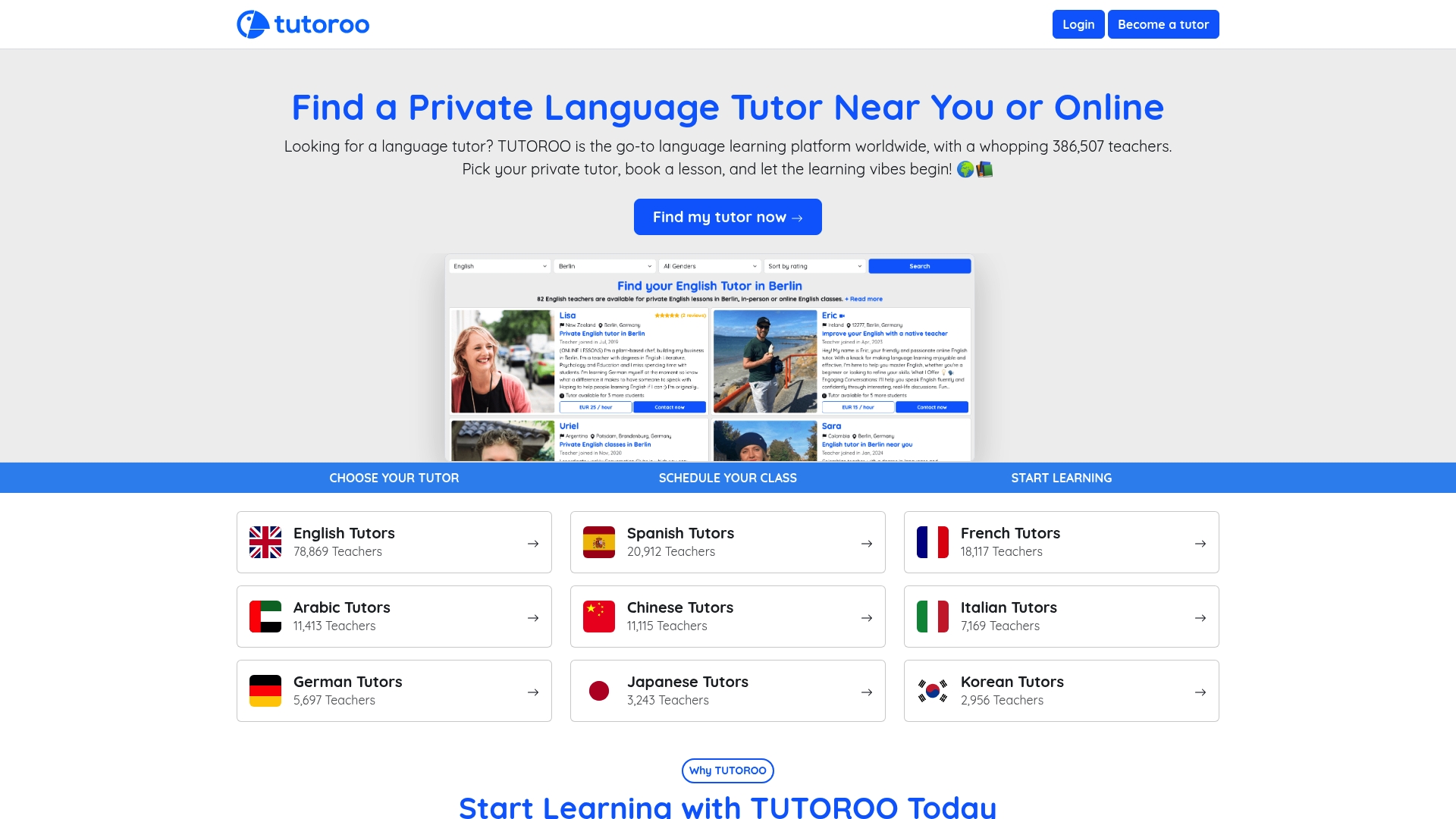
Tutoroo connects learners with over 386,000 language tutors worldwide, spanning English, Spanish, French, Mandarin, Arabic, and many more languages. You can search for private language tutors by location, availability, and language background, filtering for native speakers or qualified instructors depending on your current learning goals. Prefer online lessons? In-person sessions in your city? Tutoroo accommodates both. If you are specifically focused on English, explore English tutors online to find a tutor whose strengths match exactly what you need right now.
FAQ
Does native speaker status make someone a better language teacher?
Not automatically. Research shows that pedagogical competence and teaching experience are stronger predictors of effectiveness than native speaker status alone.
What do native speakers offer that non-native teachers cannot?
Native speakers provide authentic pronunciation models, exposure to informal registers, and deep cultural knowledge that is absorbed through lived experience rather than formal study.
Are non-native teachers better at explaining grammar?
Generally, yes. Non-native teachers often have explicit knowledge of grammatical rules because they studied them deliberately, giving them clearer explanatory tools than many native speakers possess.
How can learners get the best of both teacher types?
Learners benefit most from combining native speaker conversation practice for fluency and cultural immersion with structured instruction from a trained teacher for grammar and accuracy. The two approaches work best in parallel.
Should institutions reform how they hire language teachers?
Yes. Research consistently shows that hiring based on nativeness rather than qualifications disadvantages skilled non-native teachers and does not reliably improve learner outcomes.