

TL;DR:
- Studying languages abroad provides rapid fluency and cultural competence through full immersion. Living inside the language accelerates proficiency much faster than classroom learning, with measurable improvements in weeks rather than months. Housing choices and active daily engagement are critical for maximizing immersion outcomes and building cross-cultural skills.
Studying languages abroad is the most direct path to rapid fluency and genuine cultural competence, because it replaces controlled classroom exercises with real-world communication every single hour of every day. Language immersion, the formal term for this approach, means living inside a language rather than studying it from a distance. The CEFR (Common European Framework of Reference for Languages) provides the global benchmark for measuring those gains. Research from Sprachcaffe shows that 4–6 weeks of immersion can match an entire academic year of classroom learning. That single fact reframes the question from "should I go?" to "how soon can I leave?"
Why study languages abroad rather than in a classroom?
Full immersion accelerates language acquisition in a way no classroom can replicate. Oral proficiency gains that take 32–40 weeks in a traditional setting arrive in just 4–6 weeks when a learner is surrounded by the target language around the clock. The reason is cognitive, not motivational.

In a classroom, the brain treats a new language as a subject. Abroad, it treats it as a survival tool. Daily necessity-based interactions force the brain to stop translating and start thinking directly in the target language. Ordering food, asking for directions, and negotiating rent all demand real responses in real time. That pressure is the engine of fluency.
The CEFR framework makes these gains measurable. Learners in intensive immersion programmes typically advance one CEFR sub-level within 2–4 weeks. That is the difference between understanding a conversation and actually participating in one.
Immersion vs classroom: a pace comparison
| Learning context | Time to one CEFR sub-level | Estimated weekly hours of exposure |
|---|---|---|
| Classroom only | 10–15 weeks | 3–5 hours |
| Online self-study | 8–12 weeks | 5–8 hours |
| Full immersion abroad | 2–4 weeks | 60–80 hours |
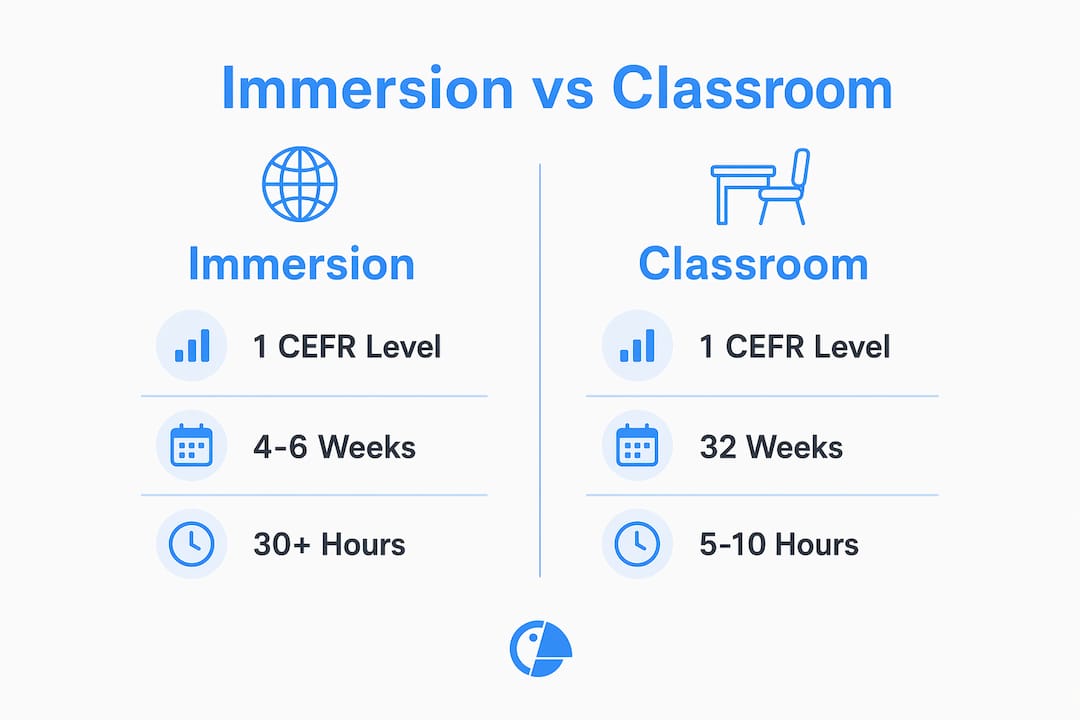
The table above shows why studying languages in foreign countries produces results that feel almost unfair to those who stayed home. Exposure volume is the variable that changes everything.
Pro Tip: Maximise your immersion time by committing to a "no native language" rule for at least the first four hours of each day. Start with low-stakes interactions like buying coffee or asking shop staff for recommendations. Building that habit early accelerates the cognitive shift from translation to direct thinking.
What are the cultural and personal growth benefits?
The benefits of studying languages abroad extend well beyond vocabulary and grammar. Cultural competence, defined as the ability to communicate and behave effectively across different cultural contexts, is the outcome that employers in global industries consistently seek. AIFS Abroad research confirms that studying abroad builds the adaptability and cross-cultural communication skills that globalised workplaces prize most.
CIS University and AIFS Abroad both highlight that living inside a foreign culture teaches you things no textbook covers: unspoken social rules, humour, body language, and the emotional texture of daily life. These are the signals that separate a competent speaker from a truly fluent one. A French speaker who has lived in Lyon reads a room differently from one who has only studied in Sydney.
Personal growth is equally significant. Independence, open-mindedness, and global friendships are consistent outcomes reported by students who complete immersion programmes. These are not soft benefits. They are the foundations of professional adaptability.
Key personal and professional benefits of studying languages abroad include:
- Career advantage: Cross-cultural communication skills are directly valued in international business, diplomacy, education, and healthcare.
- Confidence: Navigating daily life in a foreign language builds a resilience that transfers to professional settings.
- Global network: Friendships formed abroad create lifelong professional and personal connections across borders.
- Cognitive flexibility: Managing two or more languages strengthens memory, problem-solving, and multitasking capacity.
- Cultural empathy: Living inside another culture builds genuine understanding, not just awareness.
For a deeper look at how language immersion works in practice, the measurable gains and the mechanisms behind them are worth understanding before you book your flight.
What challenges do learners face during language immersion?
Language immersion is not a passive experience. The most underestimated barrier is language fatigue, the mental exhaustion that comes from processing a new language for 12 or more hours a day. Many learners arrive expecting a holiday with grammar lessons. They find something closer to a cognitive marathon.
The brain consumes significantly more energy when operating in a non-native language. Concentration drops, comprehension slows, and frustration rises. Learners who do not anticipate this often interpret fatigue as failure and pull back from social interaction precisely when they need it most.
The second major challenge is the fear of making mistakes. Necessity-driven communication is the most effective antidote. When you must communicate to eat, travel, or work, accuracy becomes secondary to function. That shift from textbook precision to survival communication is where real confidence is built. Virginia O'Connor, a language learning specialist cited by UCEAP, recommends practising in leisure settings like markets, sports clubs, and community events, where the stakes are low and the language is authentic.
Here are the most effective practices for sustaining immersion progress:
- Start small with social stamina. Treat language fatigue like physical training. Begin with 30-minute conversations and extend duration gradually over the first two weeks.
- Spend half your leisure time in unstructured local environments. Markets, parks, and community sport expose you to slang, filler language, and speech rhythm that formal study never covers.
- Join a local club or class. Cooking classes, football teams, and community groups provide structured social interaction with a shared focus, which reduces the pressure of pure conversation.
- Keep a daily language journal. Write three new phrases you heard that day in context. This cements vocabulary acquired through real experience rather than repetition drills.
- Schedule genuine rest. Cognitive recovery is part of the learning process. Two hours of complete mental rest each day prevents the burnout that derails immersion programmes in week three.
Pro Tip: If you feel your progress stalling around week two, that is normal. It is the point where the brain is reorganising, not retreating. Push through by reducing formal study and increasing unstructured social time. The breakthrough typically follows within days.
For practical strategies on overcoming speaking fears during immersion, experienced learners share what actually works in real environments.
Does housing choice affect immersion quality?
Housing is the most consequential decision a language learner makes before arriving abroad, and most people treat it as an afterthought. The choice of where you sleep determines how many hours per day you actually use the target language.
The common options are student dormitories, international share houses, local share houses, and host family arrangements. Each produces a very different immersion outcome.
Choosing housing that mandates target language use maximises fluency progression more than any other single decision. Living with other international students creates a comfortable but counterproductive environment. When everyone defaults to English as the shared language, the immersion hours outside class drop to near zero.
Housing options and immersion quality compared
| Housing type | Target language use | Immersion quality | Best for |
|---|---|---|---|
| Host family | High (daily household interaction) | Excellent | Beginners and intermediate learners |
| Local share house | Moderate to high | Very good | Intermediate learners |
| International dormitory | Low (English default) | Poor | Social connection only |
| Solo apartment | Variable (depends on social habits) | Moderate | Advanced learners with strong discipline |
Host family arrangements consistently produce the strongest results for learners below B2 level on the CEFR scale. Meals, household routines, and family conversations provide structured daily immersion that no classroom replicates. Local share houses offer similar benefits with more independence. The key principle is simple: living with locals promotes active language use, while international roommates create the conditions for native-language fallback.
Practical tip: When selecting a host family or local share house, ask the programme coordinator whether the household speaks any English at home. A family that switches to English when conversation gets difficult provides far less immersion value than one that patiently works through the language barrier with you.
Key takeaways
Studying languages abroad accelerates fluency through full immersion, cultural engagement, and daily necessity-driven communication in ways that classroom learning cannot match.
| Point | Details |
|---|---|
| Immersion pace is measurably faster | Four to six weeks abroad equals a full academic year of classroom learning for oral proficiency. |
| CEFR progress is rapid | Intensive immersion produces one CEFR sub-level of advancement in just 2–4 weeks. |
| Cultural competence is a career asset | Employers in global industries actively seek adaptability and cross-cultural communication skills. |
| Housing choice drives immersion hours | Living with locals or a host family maximises daily target language use and fluency gains. |
| Language fatigue is manageable | Treating cognitive recovery as part of the programme prevents burnout and sustains long-term progress. |
Tutoroo's perspective: what immersion really demands
The conversation around studying languages abroad tends to focus on the upside, and the upside is real. What gets left out is the preparation gap. Most learners who struggle in immersion programmes do not struggle because the method fails. They struggle because they arrived with too little foundation to take advantage of it.
Immersion rewards those who already have a working vocabulary and basic conversational confidence. Without that base, the first two weeks become an overwhelming experience of nodding along without comprehension, which builds anxiety rather than fluency. The learners who thrive are the ones who spent three to six months before departure working with a native-speaking tutor, building the exact vocabulary and listening patterns they would encounter daily.
There is also a post-immersion trap that nobody warns you about. You return home with dramatically improved fluency, and then, without daily exposure, the gains erode faster than they were built. The learners who maintain their progress are the ones who continue regular conversation practice with a native speaker after returning. That is not a luxury. It is the difference between a temporary experience and a permanent skill.
The cultural growth is not automatic either. Spending time abroad while socialising exclusively with other international students produces a pleasant experience and very little cultural competence. The learners who come back genuinely changed are the ones who chose local housing, joined community activities, and accepted the discomfort of being the person in the room who understands the least. That discomfort is where the real learning lives.
— Tutoroo
How Tutoroo can support your language learning journey
Whether you are preparing for an immersion programme or continuing your progress after returning home, working with a native-speaking tutor accelerates every stage of the process.

Tutoroo connects learners with over 386,000 private language tutors worldwide, covering languages from Spanish and French to Arabic, Mandarin, and beyond. One-on-one lessons with a native speaker build the conversational confidence and vocabulary that make immersion programmes dramatically more effective from day one. After you return, regular sessions with a private language tutor maintain the fluency you worked hard to build. Tutoroo lessons are available online or in person, fitting around study schedules and professional commitments. Find a tutor who matches your language, level, and goals at Tutoroo.
FAQ
How long does it take to become fluent studying abroad?
Full immersion programmes produce oral proficiency gains equivalent to a full academic year within 4–6 weeks. Reaching conversational fluency depends on starting level, housing choice, and daily social engagement.
What is the CEFR and why does it matter for immersion?
The CEFR (Common European Framework of Reference for Languages) is the international standard for measuring language proficiency across six levels from A1 to C2. Intensive immersion typically advances a learner by one CEFR sub-level every 2–4 weeks.
Is studying languages abroad worth it for career development?
Yes. Cultural competence and adaptability built through immersion are directly valued by employers in global industries including business, education, healthcare, and diplomacy.
What is language fatigue and how do you manage it?
Language fatigue is the mental exhaustion from processing a new language for extended periods each day. Managing it like a physical training programme, starting with shorter interactions and building gradually, prevents burnout during the critical early weeks of immersion.
Should I live with locals or other international students abroad?
Living with locals or a host family produces significantly better immersion outcomes. International share houses often default to English as the shared language, which reduces active target language use outside formal classes.