

Personalised curriculum design is a data-informed, structured plan that adapts content, pacing, instructional methods and feedback to one individual learner's strengths, needs and goals. The U.S. Department of Education's Office of Educational Technology defines personalisation as adjusting these exact elements to each learner rather than delivering a fixed, one-size-fits-all programme. In one-on-one language tutoring, this means your tutor builds a living plan around you, not around a generic textbook sequence. Vygotsky's zone of proximal development underpins the approach: instruction lands in the productive space just beyond what you can already do, where real growth happens. Tutoroo connects students across Australia with private language tutors who work this way, matching you with someone who will design, deliver and continuously refine a curriculum built around your goals.
The sections below cover the core components of a personalised plan, the evidence behind it, how tutors build one step by step, what you should expect as a student, realistic timelines and costs in Australia, and the questions to ask before you commit to a tutor.
Table of Contents
- What does personalised curriculum design actually include?
- Why the evidence supports a personalised approach
- How a tutor builds a personalised curriculum step by step
- What you should expect from your tutor's personalised curriculum
- Realistic timelines and Australian cost considerations
- How to evaluate a prospective tutor: questions to ask and red flags
- Key takeaways
- Why personalised curricula matter more than most students realise
- Find a tutor who will build your personalised curriculum
- Useful sources and further reading
What does personalised curriculum design actually include?
A personalised curriculum is not simply a list of topics. According to the Office of Educational Technology, the elements a tutor should adapt include:
- Learning goals and objectives — specific, measurable outcomes tied to your real-world purpose (travel, work, an exam, cultural connection)
- Diagnostic assessment — a baseline check of your current level, gaps and learning preferences before the first lesson
- Content selection — texts, audio, video and tasks chosen because they match your interests and level
- Instructional activities — role-plays, grammar drills, conversation practice or writing tasks selected to close specific gaps
- Pacing and sequencing — the order and speed at which new material is introduced, adjusted as you progress
- Formative and summative assessment — short checks during lessons plus milestone reviews every four to eight weeks
- Feedback cycles — timely, specific feedback on errors rather than generic praise
- Optional technology — spaced repetition tools, learner analytics and adaptive learning techniques that support retention between sessions
A practical example: a beginner Spanish learner aiming for conversational confidence might follow a 12-week arc where weeks 1–3 focus on core pronunciation and survival vocabulary, weeks 4–7 on present-tense conversation and listening, and weeks 8–12 on past-tense narration with real-world role-plays. Each module feeds the next.
The tutor designs and adjusts the curriculum; you contribute your goals, interests and consistent effort. That partnership is what makes the plan work.
Pro Tip: Ask your tutor to share a written outline of your curriculum before your second lesson. A tutor who can hand you a four-to-eight-week plan with clear goals is already working at a higher level than most.
Why the evidence supports a personalised approach
Higher engagement, faster mastery and better real-world transfer are the three headline benefits of personalised curriculum design for language learners. Research published in the Educational Psychology Review argues that personalised approaches increase training transfer and performance by adapting tasks to predicted efficiency and learner preference, and that these gains depend on repeated measurement rather than a single diagnostic at the start.
The core benefits in practice:
- Engagement — content tied to your interests keeps motivation alive across a long learning arc
- Targeted sequencing — you spend time on gaps, not on material you already know
- Faster mastery — instruction pitched at your zone of proximal development accelerates acquisition
- Real-world relevance — customised lesson plans connect language to the contexts you actually need it in
Evidence note: The Springer Nature dynamic framework recommends assessing learner characteristics on multiple timescales, from weekly vocabulary checks to monthly fluency reviews, so that instruction adapts continuously rather than once at enrolment.
Backward design, a method endorsed by curriculum design practitioners, reinforces these gains by keeping every lesson anchored to the final goal. A tutor who identifies the end outcome first and then builds backwards creates a curriculum where each session has a clear purpose.
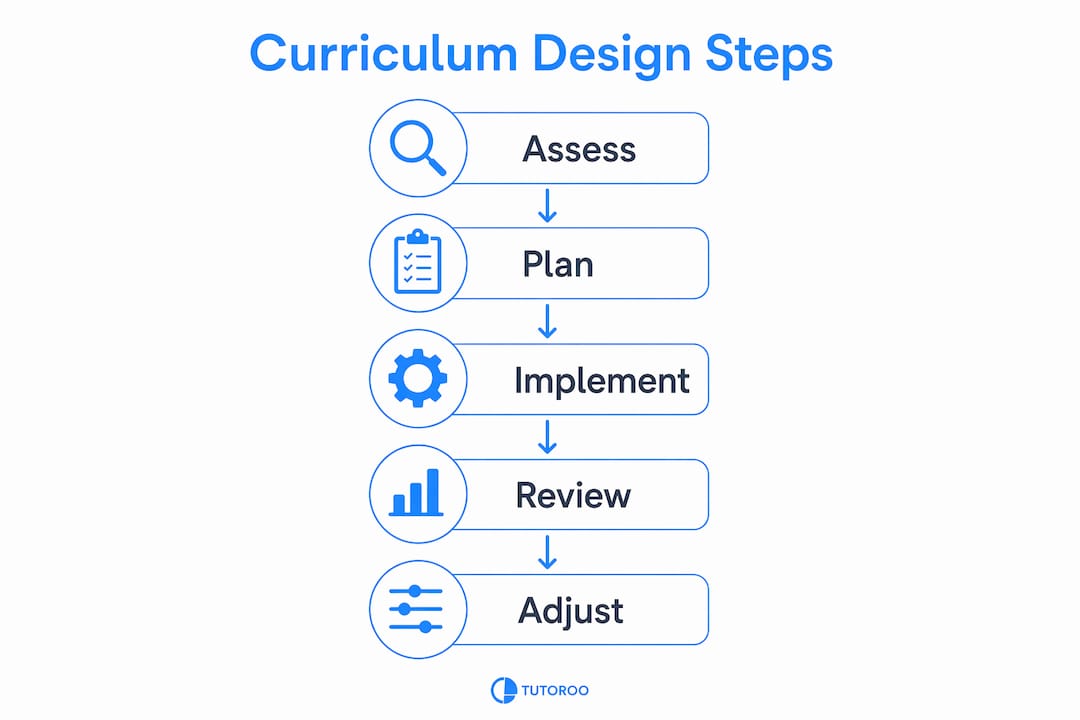
How a tutor builds a personalised curriculum step by step
The most effective tutors follow a cyclical design process rather than a fixed plan. Here is the sequence you should expect:
- Diagnostic session — the tutor assesses your current level, learning history, goals and preferences through conversation, a short written task and listening exercises.
- Goal setting with backward design — working from your stated end goal (e.g., IELTS Band 7, conversational French for a Paris trip), the tutor maps the skills and knowledge needed, then sequences lessons to build toward them.
- Unit design — the tutor creates four-to-eight-week units with specific weekly deliverables, chosen materials and planned activities.
- Formative checks — short in-lesson checks (a quick oral summary, a gap-fill, a spontaneous role-play) reveal what is sticking and what needs reteaching.
- Revision cycles — every four to eight weeks, the tutor reviews progress against goals, adjusts pacing and redesigns upcoming units based on what the data shows.
A clear long-term arc also benefits the tutor. Experienced educators note that a structured curriculum map reduces micro-planning pressure and lets tutors focus on teaching quality in the session itself.
For a few months, a practical rhythm is one hour-long lesson per week plus some additional independent practice. This general timeframe aligns with common recommendations for meaningful progress in self-directed study and works well in private tutoring contexts.

Pro Tip: Build a retrieval loop into your homework. Instead of re-reading notes, ask your tutor to set active recall tasks: explain a grammar rule in your own words, self-quiz on new vocabulary, or record a short voice memo summarising the lesson. Spaced repetition algorithms like FSRS can schedule these reviews automatically so nothing fades between sessions.
Different learner characteristics shift on different timescales. Vocabulary retention is worth checking weekly; speaking fluency monthly; grammar accuracy per unit. Ask your tutor to be explicit about which they are tracking and when.
What you should expect from your tutor's personalised curriculum
A well-structured private tutoring relationship delivers specific, tangible outputs. Before your third lesson, you should have received:
- A written summary of your diagnostic results
- A clear statement of your learning goals for the next four to eight weeks
- A lesson plan or unit outline showing the sequence of topics and skills
- Homework tasks that include retrieval practice, not just reading or watching
A typical 60-minute session structure:
- Check-in on homework and retrieval tasks (10–15 minutes)
- Focused skill practice on the week's target (30–35 minutes)
- Tutor feedback with specific corrections (10 minutes)
- Homework briefing with a retrieval task for the coming week (5 minutes)
Checklist: is your tutor delivering a personalised curriculum?
- Did they run a diagnostic before designing your plan?
- Can they name your specific learning goals for this month?
- Do lessons follow a logical sequence rather than feeling random?
- Do they adjust the plan when you master something faster or slower than expected?
- Do they set homework with active recall, not just passive review?
If the answer to any of these is no after four sessions, raise it directly. A good tutor will welcome the conversation.
Realistic timelines and Australian cost considerations
Typical milestone timeline:
| Intensity | Weekly hours | 8–12 week milestone | 12-week milestone |
|---|---|---|---|
| Light | 1–2 hrs (lessons only) | Noticeable confidence in target skill area | Measurable level gain in one skill |
| Moderate | 3–4 hrs (lessons + practice) | Clear progress across two to three skill areas | Half a CEFR level gain |
| Intensive | 4–6 hrs (lessons + structured practice) | Measurable gains across all four skills | Full CEFR level gain possible |
The 12-week, four-to-six-hour-per-week guideline aligns with the moderate-to-intensive tiers above for meaningful short-term progress.
Key cost drivers for private tutoring in Australia:
- Tutor experience and qualifications (rates vary widely across the market)
- Lesson length and frequency (60-minute weekly lessons vs. twice-weekly 90-minute sessions)
- Online vs. in-person delivery (in-person often carries a travel or venue premium)
- Whether curriculum planning is included or charged separately as a one-off fee
- Language rarity (tutors in less common languages may charge a premium)
Planning tip: Two 45-minute sessions per week often produces faster progress than one 90-minute session, because spaced practice between shorter lessons strengthens retention. If budget is a constraint, prioritise frequency over session length.
How to evaluate a prospective tutor: questions to ask and red flags
Ask these questions in your first message or introductory call:
- How do you assess a new student before designing their lesson plan?
- What does a typical four-to-eight-week plan look like for a student at my level?
- How do you measure progress, and how often do you review the plan?
- How do you adapt lessons when a student is struggling or advancing faster than expected?
- What does homework look like, and does it include active recall or self-testing?
Red flags to watch for:
- No mention of a diagnostic or baseline assessment
- Generic worksheets with no explanation of why they suit your goals
- Inability to describe measurable goals for the next month
- No process for reviewing or updating the plan
- Resistance to sharing a written outline of upcoming lessons
A tutor who cannot answer questions 1 and 3 above with specifics is unlikely to deliver a genuinely personalised curriculum. Platforms like GeniusHub Learning in maths tutoring show that tutor-managed personalisation works best when tutors can articulate their diagnostic and planning process clearly. The same standard applies in language tutoring.
Key takeaways
Personalised curriculum design works because it adapts content, pacing and feedback to one learner's needs continuously, not just at the start, making every lesson more targeted and every hour of practice more productive.
| Point | Details |
|---|---|
| Definition | A data-informed plan adapting content, pacing, methods and feedback to one learner's goals. |
| Core components | Diagnostic assessment, clear goals, sequenced units, formative checks and retrieval-based homework. |
| Evidence base | Repeated measurement and dynamic adaptation, not a one-off diagnostic, drive the strongest gains. |
| Cyclical process | Review and revise the plan every four to eight weeks; a static plan loses alignment quickly. |
| Tutoroo | Connects Australian students with private language tutors who deliver personalised, iterative lesson plans. |
Why personalised curricula matter more than most students realise
The gap between a tutor who "teaches the language" and one who builds a genuine personalised curriculum is wider than it looks from the outside. Most students who have had a frustrating tutoring experience describe the same thing: lessons that felt disconnected, homework that was just a worksheet, and no clear sense of whether they were actually progressing. That is not a tutor quality problem. It is a curriculum design problem.
What the research makes clear is that the diagnostic is not a formality. It is the foundation. A tutor who spends the first session asking about your goals, testing your current level and probing your learning history is doing something structurally different from one who opens a textbook and starts at chapter one. The former is building a curriculum; the latter is delivering a syllabus that was designed for someone else.
The other thing students underestimate is the value of the revision cycle. A plan that was accurate in week one will be wrong by week six, because you will have grown unevenly. Some skills will have accelerated; others will have stalled. A tutor who checks in, notices the gap and redesigns the next unit accordingly is the one who will actually get you where you want to go. Ask for that process explicitly, and if a tutor cannot describe it, keep looking.
Find a tutor who will build your personalised curriculum
The clearest path to a genuinely personalised language learning experience is finding a tutor who treats curriculum design as part of the job, not an afterthought. Tutoroo gives you direct access to over 386,000 private language tutors across a wide range of languages, with profiles that let you assess experience, teaching style and availability before you send a single message.
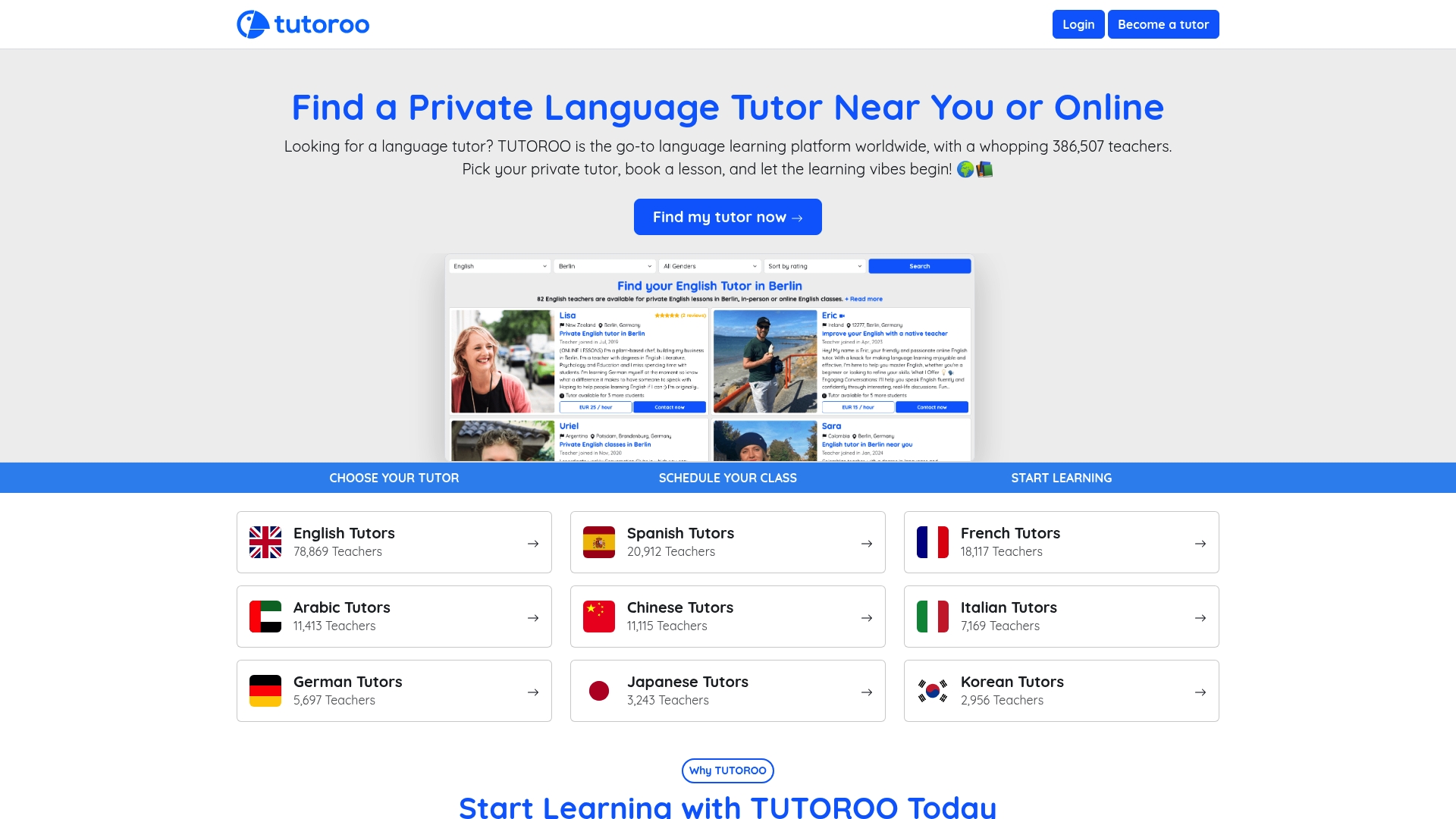
Search by language, filter for tutors with experience in customised lesson planning, and use the interview questions from the section above in your first message. Ask for a sample four-to-eight-week plan. A tutor who responds with a clear outline is already showing you how they work. Whether you are looking for English tutoring or lessons in another language, Tutoroo's messaging system makes it straightforward to connect, schedule and get started with a tutor who will design a plan built around you.
Useful sources and further reading
- Office of Educational Technology, U.S. Department of Education — definition of personalisation in learning
- Developing Personalized Education: A Dynamic Framework, Educational Psychology Review (Springer Nature) — evidence for repeated measurement and dynamic adaptation
- Curriculum Design Frameworks and Best Practices, NKU — backward design and goal-first sequencing
- Curriculum Design and Student Learning, Wake Forest University SPS — cyclical review and iterative curriculum adjustment
- The Personal Curriculum: How to Design Your Own Self-Education Syllabus, GLASP — practical 12-week unit and weekly hour guidelines
- Succeed faster with a tailored curriculum in tutoring, Tutoroo Blog — practical steps for building a tailored plan with a private tutor
- One-on-one tutoring: personalised learning gains explained, Tutoroo Blog — evidence on why individual tutoring accelerates language acquisition