

A proper tutor background check covers four things: identity verification, criminal history searches across multiple jurisdictions, a sex offender registry check, and education or employment verification. If you're a family, tutoring programme, or platform ordering that check through a consumer-reporting agency, one legal step overrides everything else: you must give the tutor written disclosure and get their written authorisation before you run it.
That's not a courtesy. It's a requirement under the Fair Credit Reporting Act, and skipping it can expose you to legal liability regardless of how clean the tutor's record turns out to be.
A solid screening package typically includes:
- Identity verification (confirms the tutor is who they claim to be)
- Multi-jurisdiction criminal record searches (county, state, and often federal)
- Sex offender registry check
- Education and employment verification
Pro Tip: No single search is comprehensive on its own. FBI checks can miss recent county-level filings, and county checks miss out-of-state history, so layering searches matters more than picking one "best" option. For virtual tutors, always check their state of residence, not just the state where lessons are delivered.
Key Takeaways
A tutor background check must combine layered criminal searches, registry checks, and credential verification, with written disclosure and consent required before ordering any consumer report.
| Point | Details |
|---|---|
| Layer your searches | Combine FBI fingerprint checks with state and county searches, since no single database is comprehensive. |
| Get written consent first | FCRA requires disclosure and signed authorisation before ordering any consumer report. |
| Follow adverse-action steps | Send pre-adverse and final notices if a report leads you to reject a tutor. |
| Match screening to the role | In-home and unsupervised roles with young children warrant deeper checks than virtual, occasional sessions. |
| Renew annually | Ongoing, frequent-contact roles need re-screening, not a one-time check at hiring. |
Table of Contents
- Types of tutor background checks and what each one actually reveals
- Who should actually require a tutor background check
- FCRA compliance: the legal steps you cannot skip
- Step by step: how to run a background check on a tutor
- Red flags in a background check report and how to weigh them
- Beyond the criminal check: complementary screening steps
- How to choose a background-check vendor for tutoring
- A short screening policy checklist you can adapt
- What background checks cost and how to budget for them
- Making sense of confusing or conflicting background check results
- Handling sensitive tutor data responsibly
- Tailoring your screening policy to the tutor's actual role
- Why Tutoroo treats verification as a foundation, not an afterthought
- Frequently asked questions about tutor background checks
- Sources
Types of tutor background checks and what each one actually reveals
Screening isn't one product. It's a stack of separate searches, each catching something the others miss.
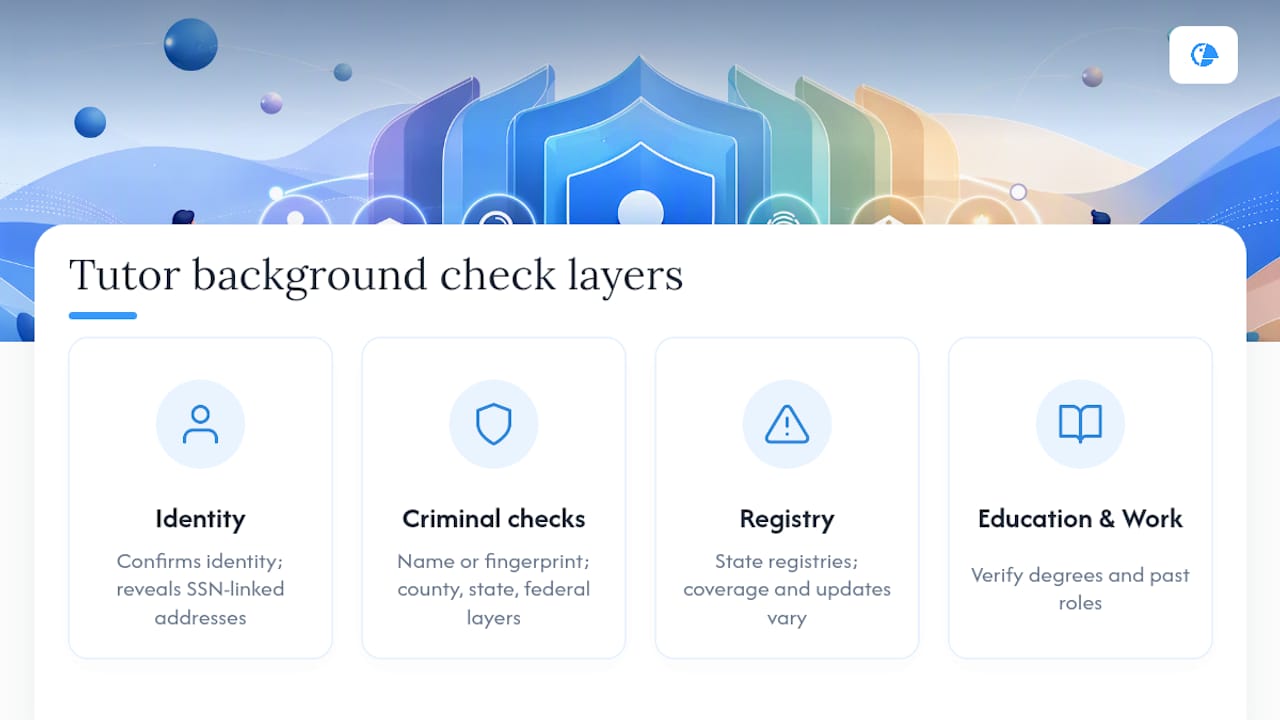
Identity verification and SSN trace confirm the tutor is who they say they are and surface any address history tied to their Social Security number, which helps direct which counties and states to search.
Criminal record searches come in two flavours. A name-based search checks county, state, or national databases against a person's name and date of birth, which is fast but vulnerable to clerical errors and common-name mismatches. An FBI fingerprint-based check matches a physical fingerprint against federal records and is considered the more defensible standard for anyone with unsupervised access to children, according to Missing & Exploited Children guidance. There is no single centralised criminal database in the US, so comprehensive screening typically needs both fingerprint checks and layered state and county searches, since federal systems can omit local misdemeanours or pending state cases.
Sex offender and child-abuse registry checks pull from state-run registries. Coverage and update frequency vary significantly by state.
Beyond criminal history, education and employment verification confirms degrees and past roles, motor vehicle record checks apply if a tutor drives students anywhere, and international checks matter for tutors living or working abroad.
Who should actually require a tutor background check
Anyone putting a tutor in a room, a car, or a video call with a child should require one. That includes:
- Parents hiring a private tutor directly
- Tutoring centres and learning programmes
- Online tutoring platforms and marketplaces like Workit's background screening guide
- Schools contracting outside tutors
- Volunteer-run tutoring and mentorship programmes
Screening expectations rise sharply for unsupervised home visits, one-on-one virtual sessions with young children, or any role with regular, ongoing contact. Some federal grant-funded education programmes impose specific screening obligations on providers working inside schools. And classifying a tutor as an independent contractor doesn't remove your responsibility to screen them properly.
FCRA compliance: the legal steps you cannot skip
If you're ordering a report through a third-party consumer-reporting agency, you must disclose that intent in writing and get the tutor's signed authorisation before ordering anything. If the report later leads you to reject or remove that tutor, you must follow formal adverse-action steps, not just quietly end the relationship.
The FCRA lays out a specific sequence:
- Provide a clear, standalone written disclosure (not buried in other paperwork)
- Get signed authorisation before ordering the report
- Send a pre-adverse action notice if you're considering rejection, including a copy of the report and a summary of rights
- Give the candidate reasonable time to respond or dispute
- Send a final adverse action notice once the decision is made
State and local laws can add further restrictions, particularly around how far back criminal history can be considered.
Guidance from screening bodies is consistent on this point: treat background checks as one part of a documented policy, not a one-off transaction, and pair every report with a clear, written process for what happens next.
This is general guidance, not legal advice. Programmes setting formal hiring policy should confirm obligations with legal counsel familiar with their state.
Step by step: how to run a background check on a tutor
- Define scope. Decide which searches you need based on the role. In-home tutors and those working with young children warrant deeper checks than adult test-prep tutoring over video.
- Choose a vendor. Look for FCRA-compliant reporting, transparent jurisdictional coverage, and a candidate-facing portal.
- Provide disclosure and get written consent. Non-negotiable before ordering anything.
- Order the check. Submit through the vendor's platform, typically with the tutor's help supplying identifying details.
- Review the results carefully, checking for relevance, recency, and any records that need verification.
- Act, and follow adverse-action steps if you're declining the tutor based on what the report shows.
Turnaround varies by check type. Digital name-based searches often return within days, while fingerprint-based FBI checks and international checks can take considerably longer, sometimes weeks. Families on a budget may lean on a single reputable vendor's bundled package, while institutional programmes often run layered checks and build in time for fingerprint processing before a start date is confirmed.
Red flags in a background check report and how to weigh them
Not every finding should be an automatic disqualifier, but some should be close to it: violent offences, sexual offences, findings on a child-abuse registry, or falsified credentials on a résumé. Beyond those, context matters. How long ago did it happen? How serious was it? Is it relevant to working with children?
The fix for inconsistent decision-making is a written policy that spells out disqualifying criteria in advance, so no two applicants are judged by different standards depending on who's reviewing the file.
Pro Tip: Identity mismatches are more common than people expect, particularly with name-based searches. Before treating a record as disqualifying, confirm the date of birth, middle name, and address history actually match your applicant. Disputed records should go back to the reporting agency for reinvestigation before you act on them.
Beyond the criminal check: complementary screening steps
A clean background check doesn't tell you whether someone is good with kids or reliable under pressure. Pair it with:
- Structured reference checks covering both professional performance and character
- Education and licence or certification verification
- Photo ID verification and a real interview, not just a phone screen
- A probationary period with light supervision before full independence
Keep documentation of every step, stored securely and accessible only to people who need it.
How to choose a background-check vendor for tutoring
Not all screening vendors are equal. Confirm coverage across the counties and states relevant to your tutors, ask whether they offer FBI fingerprint-based checks, and check how transparent they are about where their data comes from. Checkr's tutor screening resources outline SSN traces, criminal searches, and education verification as standard components, with a candidate portal that lets tutors track their own status.
Private vendor databases can have gaps in county-level coverage, so ask any provider you're considering to describe their methodology plainly rather than taking "comprehensive nationwide search" at face value.
| Criterion | Why it matters |
|---|---|
| Jurisdictional coverage | Confirms county and state searches actually reach where the tutor has lived |
| FBI fingerprint capability | Provides a defensible standard for roles with unsupervised child contact |
| Adverse-action support | Vendor should help manage FCRA-compliant notices, not just deliver raw data |
| Data security and retention | Sensitive records need clear storage and deletion policies |
A short screening policy checklist you can adapt
Copy this into your own hiring workflow and adjust it to your programme's size:
- Define the tutor role and level of contact with children
- List required searches for that role (criminal, registry, education, etc.)
- Use a standalone written disclosure and consent form
- Decide who pays for screening (family, programme, or shared cost)
- Set a recordkeeping and confidentiality policy
- Document your adverse-action workflow in advance
- Set a renewal schedule, generally annual re-screening for ongoing, frequent-contact roles
What background checks cost and how to budget for them
Pricing varies by how many searches you bundle together. A basic identity check and single-state criminal search sits at the cheap end. Add an FBI fingerprint-based check, multi-state criminal searches, education verification, and a sex offender registry check, and the cost climbs with each additional layer. International checks for tutors living abroad tend to cost more and take longer to process.
Families hiring one tutor directly usually pay a flat fee per check through a screening vendor. Tutoring programmes and platforms screening dozens or hundreds of tutors a year typically negotiate volume pricing, which brings the per-check cost down considerably compared to one-off orders.
Budgeting well means thinking about renewal too, not just the first check. Annual re-screening for ongoing roles adds a recurring line item, and skipping it defeats the purpose of screening in the first place, since a clean record at hiring says nothing about the years after. Programmes should decide upfront who absorbs that cost: the organisation, the tutor, or a split arrangement. Families hiring privately should factor the check into their overall tutoring budget rather than treating it as an afterthought tacked onto the first invoice.
The cheapest option isn't always the most complete one. A rock-bottom price on a "nationwide criminal search" often signals a name-based database search with real coverage gaps, not the layered approach that catches what a single search misses.
Making sense of confusing or conflicting background check results
Reports don't always come back clean or clearly disqualifying. Sometimes they come back confusing, and knowing how to read them matters as much as ordering them in the first place.
A common issue is a record that doesn't clearly match your applicant. Common names, shared birthdates, or outdated address data can attach someone else's record to your tutor's file. Before treating any finding as fact, verify the full name, date of birth, and address history line up exactly.
Another frequent source of confusion is outdated or incomplete status information. A charge might show as "pending" when it was actually resolved months ago, simply because the database hasn't caught up with court records. When a report shows an unresolved or ambiguous status, the fair approach is to ask the tutor directly and give them a chance to provide documentation, such as a court disposition, before you act.
Multiple minor findings versus one serious one also need different handling. A pattern of small, unrelated issues reads differently than a single serious offence, and your written policy should say so explicitly rather than leaving it to whoever reviews the file that day.
When something genuinely doesn't add up, go back to the reporting vendor for reinvestigation rather than guessing. A transparent vendor with a clear methodology and candidate portal makes this dispute process faster and less stressful for everyone involved.
Handling sensitive tutor data responsibly
A background check report contains some of the most sensitive information a family or programme will ever hold on another person: Social Security numbers, criminal history, addresses, and sometimes financial or identity documents.

Store reports securely, whether that's an encrypted digital system or a locked physical file, and limit access to the people who genuinely need it for a hiring decision. Set a clear retention period and delete records once they're no longer needed rather than keeping them indefinitely "just in case." Never share a report's contents with people outside the decision-making process, including other parents or tutors, and never post or forward findings over unsecured channels like group chats or unencrypted email.
If you're a programme operating across the United States, note that some states impose their own rules on how long you can retain background data and who can access it, on top of federal FCRA obligations. Building your policy around the most conservative applicable rule protects you regardless of where a specific tutor happens to live.
Tailoring your screening policy to the tutor's actual role
A university student tutoring algebra over video for two hours a week doesn't need the same screening depth as someone providing daily, unsupervised, in-home instruction to a six-year-old. Matching the check to the actual risk keeps costs proportionate and keeps your policy credible rather than arbitrary.
Consider scaling requirements around a few variables: level of physical access (in-home versus virtual), age of the students (younger children generally warrant fingerprint-based checks, as child-safety guidance recommends for unsupervised roles), frequency of contact, and duration of the engagement (a one-off exam-prep session differs from a year-long arrangement).
Programmes working inside schools should expect to meet the same standard applied to teachers, particularly where funding or contractual obligations require it. Families hiring privately have more flexibility but shouldn't use that flexibility as a reason to skip fingerprint-based checks for young children simply because no external body is mandating it.
Whatever tier you land on, write it down. A documented, role-based policy protects you from claims of inconsistent or discriminatory screening decisions later, and it gives tutors clarity on what to expect before they apply. Verifying credentials alongside criminal screening rounds out a policy that judges the whole person, not just their record.
Why Tutoroo treats verification as a foundation, not an afterthought
Safety-first screening shapes how we think about matching students with tutors across our large global community of language teachers. Our structured tutor registration process asks tutors to document their credentials and experience upfront, which gives families a clearer picture before that first lesson begins.
For families ready to find a vetted, qualified language tutor, Tutoroo connects you with tutors across dozens of languages, matched by location, availability, and teaching style. Browse English tutors or explore tutors in a specific language to see how the matching process works in practice.
Frequently asked questions about tutor background checks
How much does a tutor background check typically cost? Cost depends on how many searches you bundle. A basic identity and single-state criminal search costs less than a package adding FBI fingerprint checks, multi-state searches, and education verification.
Is a tutor background check legally required? Requirements vary by setting. School-contracted tutors and grant-funded programmes may face statutory screening obligations, while private family hires aren't always legally mandated but are strongly advised for safety.
How long does a tutor background verification process take? Digital name-based checks often return within days. Fingerprint-based FBI checks and international checks generally take longer, so build in extra time before a start date.
What shows up on a tutor background check that would disqualify someone? Violent offences, sexual offences, findings on a child-abuse registry, and falsified credentials are the clearest disqualifiers. Other findings need context around recency and relevance.
Do virtual tutors need the same background checks as in-person tutors? Largely yes. Check a virtual tutor's state of residence, not just where the platform operates, since relevant criminal records may sit in a different jurisdiction entirely.
This article is general information, not a substitute for advice from a qualified lawyer. Consult a qualified legal professional about your own circumstances before acting on anything here.
Sources
- Fair Credit Reporting Act (FCRA) | FTC
- Tutor background check | Checkr (resources)
- National Center for Missing & Exploited Children
Consult legal counsel before adopting any policy at an organisational level.