

Routine tutoring is generally not deductible on your federal tax return. Two narrow exceptions exist: tutoring prescribed by a doctor for a diagnosed learning disability can count as a medical expense, and self-employed tutors can deduct their own business costs on Schedule C. Everything else, including the maths tutor you hired to lift a grade, falls under personal expenses the IRS won't touch.
TL;DR:
- Only tutoring prescribed by a doctor for a diagnosed learning disability can potentially be deducted as a medical expense, subject to income thresholds.
- Self-employed tutors can deduct business-related expenses, including materials, platform fees, advertising, and home office costs, on Schedule C.
- Routine academic, test prep, language, or college entrance tutoring remains non-deductible personal expense under IRS rules.
- Reimbursements from employers for tutoring generally count as taxable wages unless structured through specific dependent care benefits, which have strict limits.
- Using a 529 plan to pay for K-12 tutoring-related costs can offer tax-free withdrawals but depends on state-specific rules and actual expenses incurred.
Table of Contents
- Is tutoring tax deductible? Why the IRS treats it as personal
- The special-education medical exception, step by step
- What self-employed tutors can actually deduct
- Tutoring, tax credits, and the educator deduction: three things people mix up
- Tax-advantaged ways to lower the real cost of tutoring
- A short checklist for claiming tutoring costs
- Differences in deductibility for online vs. in-person tutoring services
- What happens when your employer reimburses tutoring costs
- Tutoring costs and dependents: how family situations change the picture
- Publisher perspective: the practical side of tutoring costs and taxes
- Find qualified tutors who make recordkeeping simple
- Authoritative IRS pages and publications to check
- Sources
Is tutoring tax deductible? Why the IRS treats it as personal
The short answer sits in Section 262 of the Internal Revenue Code, which draws a hard line around personal, living, and family expenses. Tutoring falls squarely in that category unless it clears one of two narrow exceptions. The IRS doesn't distinguish between a $40-an-hour reading tutor and a $150-an-hour SAT coach here. Both are treated as choices parents make for their children's wellbeing and development, not as costs the federal government subsidises.
Think about the difference between two families. One pays for after-school algebra tutoring because their child is falling behind in year 9. The other reimburses an employee for a professional certification course tied directly to their current job. The second scenario can sometimes qualify as work-related education under separate rules. The first almost never does, no matter how much the grade improvement matters to the family.
Reality check: most tutoring purchases, regardless of subject, cost, or child's age, sit outside any federal deduction. The IRS doesn't ask why you hired a tutor. It asks whether the expense fits a category it has pre approved, and "helping my kid improve at school" isn't one of them.
A few situations to keep straight:
- After-school tutoring for grades, test prep, or general academic support: not deductible.
- Language tutoring for personal enrichment or travel: not deductible.
- Tutoring purchased purely to improve college admissions odds: not deductible.
- Tutoring tied to a diagnosed medical condition, or run as your own tutoring business: potentially deductible, covered below.
The special-education medical exception, step by step
This is where things get interesting for families dealing with a diagnosed learning disability. Publication 502 allows you to include tutoring fees as a medical expense when a doctor has recommended tutoring to treat a specific condition, and the instruction comes from a specially trained tutor or a special school.
Three conditions need to line up:
- A formal diagnosis from a qualified medical professional, not just a teacher's observation.
- A doctor's written recommendation stating tutoring is necessary to treat that condition, not just helpful.
- Instruction from a tutor with special-education training, or enrolment at a school specialising in that condition.
Even when all three line up, you don't get a straight deduction. Only medical expenses exceeding a certain portion of your adjusted gross income become deductible; expenses below that threshold do not qualify.
Pro Tip: Ask your tutor to issue itemised invoices that separate tutoring fees from any other charges, like materials or administration costs. A lump-sum bill that doesn't specify "special-education tutoring" is one of the most common reasons the IRS pushes back on these claims.
Keep the doctor's letter, the tutor's credentials, and dated invoices in one file. You'll want all three if the claim is ever questioned.
What self-employed tutors can actually deduct
If you tutor for a living, or on the side, you're not filing as a parent claiming a personal expense. You're running a business, and Schedule C is where "ordinary and necessary" business expenses come into play. That standard, drawn from IRS Topic 513, means the cost has to be common in your line of work and genuinely useful to running it.
Typical deductible categories for tutors include:
- Teaching materials, textbooks, and workbooks bought specifically for lessons.
- Platform or marketplace fees paid to find and manage students.
- Advertising costs, including website hosting and business cards.
- Software subscriptions used for scheduling, invoicing, or video lessons.
- Mileage or travel costs for in-person sessions.
- A home office, but only the portion used exclusively and regularly for tutoring.
Bank statements, PayPal records, and platform payout summaries all count as proof, as long as they tie back to specific tutoring income and expenses. One catch trips people up constantly: education that qualifies you for a new trade or profession is never deductible, even if you're a tutor. A certification course that gets you into an entirely different profession doesn't count, no matter how it's framed.
Pro Tip: If you tutor from home and also use that space for anything else, like family dinners or a home gym, the home office deduction gets complicated fast. The IRS wants exclusive, regular business use, not "mostly."
Tutoring, tax credits, and the educator deduction: three things people mix up
Parents often assume tutoring should qualify for the same credits that cover college tuition. It usually doesn't. The American Opportunity Tax Credit and Lifetime Learning Credit are built around post-secondary tuition and required fees paid to eligible institutions, not private tutoring arranged outside a school's enrolment system.
A few clarifications worth locking in:
- AOTC and LLC apply to tuition, enrolment fees, and required course materials at colleges and universities, not standalone tutoring services.
- The Educator Expense Deduction lets eligible K-12 teachers deduct up to $300 in classroom supplies (up to $600 for married couples filing jointly, capped at $300 each), but only teachers who work at least 900 hours during the school year qualify.
- That deduction belongs to the teacher buying supplies for their own classroom. It has nothing to do with a parent paying a private tutor for their child.
Tutoring generally sits outside both frameworks entirely, which is exactly why so many families are caught off guard at tax time.
Tax-advantaged ways to lower the real cost of tutoring
When a deduction isn't available, a 529 plan can still soften the blow. Recent guidance on 529 plans confirms that certain K-12 education costs, including some tutoring-related expenses, can be paid from 529 funds without triggering tax on the withdrawal. That's not a deduction, but tax-free growth and tax-free withdrawal add up to a similar result over time.
Worth checking: state tax rules vary considerably. Some states offer their own K-12 education deductions or credits that federal law doesn't recognise, so what's off the table federally might still be worth something on a state return.
A practical way to think about it:
- If your medical tutoring expenses are significant compared to your adjusted gross income, itemising on Schedule A may be worth exploring.
- If they won't get close to that threshold, a 529 withdrawal or state credit might deliver more value than chasing a federal deduction that won't materialise.
- Keep receipts either way. You won't know which path pays off until you've actually run the numbers at tax time.
A short checklist for claiming tutoring costs
Before you file anything, gather these in one place:
- The doctor's written recommendation, dated and specific about the diagnosis and why tutoring is necessary.
- The tutor's qualifications, especially any special-education training or certification.
- Itemised invoices that separate tutoring fees from other charges.
- Proof of payment, whether bank transfers, cheques, or platform receipts.
- A dated log of sessions, useful if the claim is ever reviewed.
Medical claims go on Schedule A; business expenses go on Schedule C.
Differences in deductibility for online vs. in-person tutoring services
The IRS doesn't distinguish between online and in-person tutoring when it comes to deductibility. The same rules apply either way: routine tutoring is a personal expense, the medical exception depends on diagnosis and doctor's recommendation rather than delivery format, and self-employed tutors deduct ordinary business costs whether they teach through a webcam or across a kitchen table.
Where the format does matter is documentation and expense categories. Online tutoring platforms typically generate automatic payment records and itemised statements, which makes substantiating a medical or business claim considerably easier than chasing down a cheque stub from an in-person session six months ago. Self-employed tutors running online lessons can also deduct costs that don't apply to in-person work, like video conferencing software, screen-recording tools, and website hosting for a booking page.
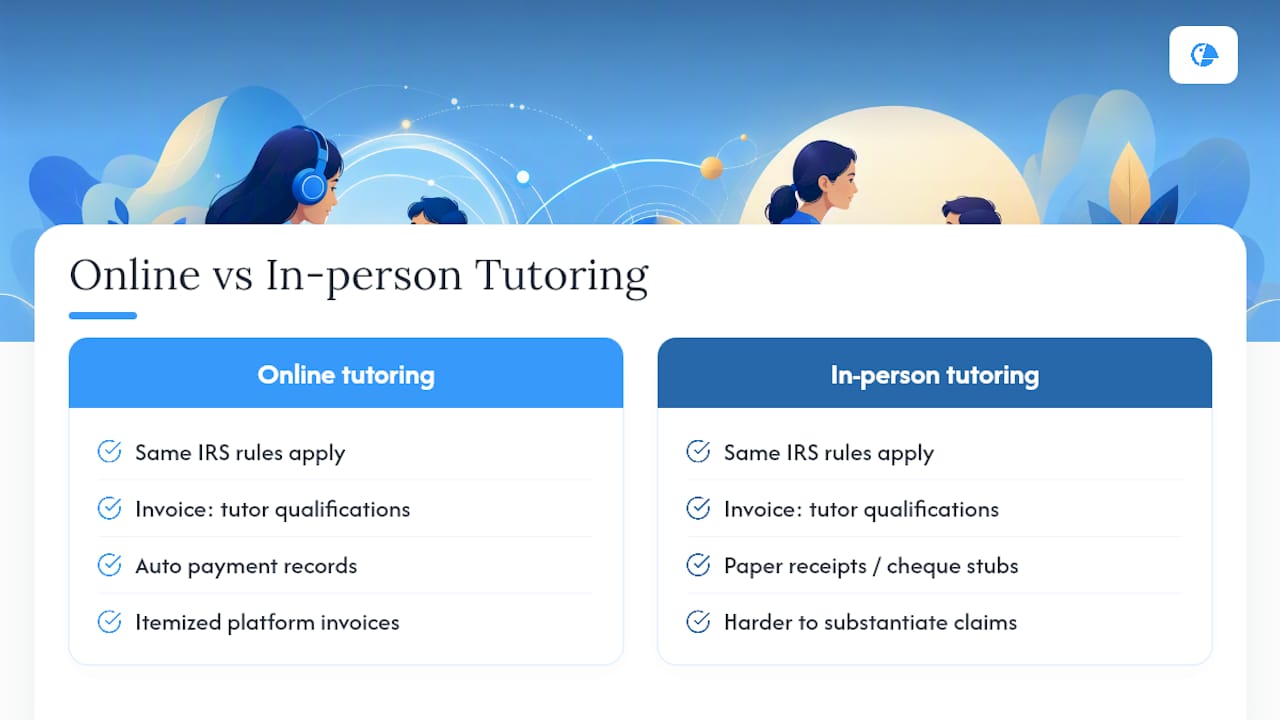
In-person tutors carry their own deductible categories instead, most commonly mileage and travel between sessions, which online tutors generally can't claim.
For a special-education claim, the delivery format matters less than whether the tutor holds appropriate training and whether the invoice states the service was therapeutic tutoring tied to a diagnosed condition. A well-documented online invoice supports a medical claim just as well as a paper receipt from an in-person tutor, as long as it identifies the tutor's qualifications and separates tutoring fees from any other charges.
What happens when your employer reimburses tutoring costs
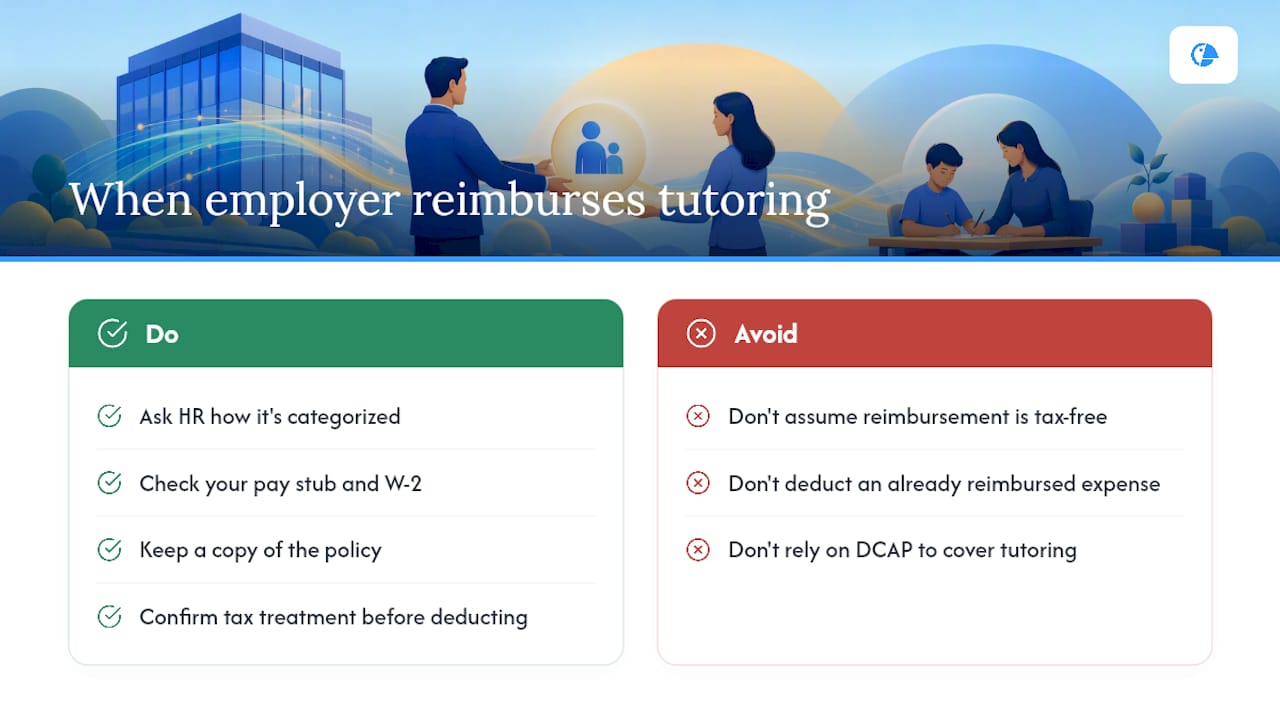
Employer-provided reimbursement for a child's tutoring is uncommon but does show up, usually through flexible benefits programs or as part of a broader dependent-care package. How it's taxed depends heavily on the structure your employer uses.
If your employer simply reimburses tutoring costs as a cash payment or stipend, that amount is generally treated as taxable wages, added to your W-2 income, and subject to standard payroll withholding. There's no special carve-out for tutoring reimbursements the way there is for certain adoption or education assistance benefits tied to post-secondary tuition.
Some employers structure tutoring support through a Dependent Care Assistance Program, but that mechanism is built for care that enables a parent to work, like after-school supervision, not academic tutoring itself. Mixing the two can create compliance headaches for the employer and confusion for you at tax time.
If tutoring reimbursement is offered, ask your employer's HR or benefits team exactly how it's categorised on your pay stub and W-2. If it's already taxed as income, you don't get to separately claim a deduction for the same expense; that would be double dipping the IRS won't allow. Keep a copy of the reimbursement policy alongside your other tax records in case questions come up later.
Tutoring costs and dependents: how family situations change the picture
The deductibility question doesn't shift much based on how many children you're tutoring or their ages, but the practical calculations often do. A family paying for tutoring across three children racks up a bigger annual bill, yet none of it becomes more deductible simply because of volume; the same personal-expense rule from Section 262 applies whether you have one child in tutoring or four.
Where dependent status matters most is the medical exception. The diagnosis and doctor's recommendation need to be tied specifically to the dependent receiving tutoring, and the expense has to be one you actually paid, not reimbursed by insurance or another party. If divorced or separated parents split tutoring costs, only the parent who claims the child as a dependent, and who actually paid the qualifying medical expense, can generally include it in their itemised medical deductions.
For families with multiple children where only one has a diagnosed learning disability, keep that child's tutoring invoices and medical documentation completely separate from any general tutoring purchased for siblings. Mixing the two on one invoice or one payment record makes it far harder to substantiate the medical claim if it's ever reviewed, and it risks the entire deduction being disallowed for lack of clear documentation.
Publisher perspective: the practical side of tutoring costs and taxes
Most families come to this topic assuming there's a deduction hiding somewhere, and the letdown when there isn't one is real. Our honest advice: keep meticulous records anyway. Some tutoring platforms connect parents with tutors who provide clear, itemised invoices, which won't create a deduction that doesn't exist, but it does mean you're never scrambling for paperwork if a legitimate claim comes together.
— TUTOROO
Find qualified tutors who make recordkeeping simple
Whether you're tracking a medical exception or running your own tutoring business, the paperwork only works if the underlying invoices are clean. Some platforms connect students and parents with vetted language tutors, and manage bookings through messaging and payment systems that keep clear records of lessons.

That matters more than most families realise until the file lands in front of a CPA. A tutor who can state their qualifications plainly and issue an itemised invoice on request makes any documentation task easier, whether you're building a case for a doctor's recommendation or tracking your own self-employed tutoring business expenses. Tutoroo doesn't promise tax outcomes, and no legitimate platform should. What it offers is qualified instruction and a payment trail you can actually use. If you're ready to find a tutor who fits your child's needs and your documentation requirements, start browsing tutors on Tutoroo and see who's available in your language and location today.
Authoritative IRS pages and publications to check
Verify every detail against the primary sources before you file:
- Publication 502, Medical and Dental Expenses
- Publication 970, Tax Benefits for Education
- Topic No. 513, Work-Related Education Expenses
- Qualified Education Expenses
- About Schedule C (Form 1040)
A CPA or enrolled agent can confirm how these rules apply to your specific AGI, dependents, and filing status before you submit anything.
This article is general information, not a substitute for advice from a qualified financial advisor. Consult a qualified financial professional about your own circumstances before acting on anything here.
Sources
- Publication 502 (2025), Medical and Dental Expenses | IRS
- Topic No. 513, Work-related education expenses | IRS
- Qualified ed expenses | Internal Revenue Service
- About Schedule C (Form 1040) | IRS
- What you can pay for with a 529 plan | Saving for College