

The fastest way to improve your speaking skills is to practise deliberately, not just frequently. Six actions make the biggest difference: lead every answer with your conclusion, run a focused 15-minute daily session, record and review yourself weekly, work through targeted articulation drills, slow down on key points, and seek regular feedback from real listeners. You can start right now by saying your name, your role, and one clear sentence about what you do — out loud, without notes. That 60-second exercise reveals more about your current habits than an hour of reading about communication. For structured feedback and community practice in Australia, Toastmasters Australia and local public-speaking meetups offer accessible, low-cost entry points.
- Lead with your conclusion. State the main point first, then support it — answer-first responses are consistently perceived as clearer in professional settings.
- Run a 15-minute daily session. Short, consistent practice builds speech fluency faster than occasional long sessions.
- Record and review one short talk each week. Self-recording provides objective feedback on filler words, pacing, and tone.
- Do articulation drills daily. Tongue-twisters and minimal-pair exercises sharpen diction and reduce mumbling.
- Slow down on substance, speed up on setup. Deliberate pausing before key ideas signals importance and cuts filler words.
- Get feedback from real listeners. Peer groups, clubs, and private tutors each offer something a mirror cannot.
Pro Tip: Pair your speaking practice with an existing habit — right after your morning coffee or before you open email. Habit stacking is the single most reliable way to keep a 15-minute routine alive past the first week.
Table of Contents
- What does a 15-minute daily practice routine look like?
- Three preparation pillars that make every talk clearer
- How do you improve delivery: voice, pace, pauses, and gestures?
- How can you manage nerves before speaking?
- Where can you get useful feedback in Australia?
- Your speaking skills checklist and 30-day starter plan
- Key takeaways
- What the fastest-improving speakers actually do differently
- Ready to add a private tutor to your practice?
- Useful sources and Australian resources
What does a 15-minute daily practice routine look like?
Consistency beats volume every time. Short, focused daily sessions build the motor coordination and mental habits that longer, infrequent sessions simply cannot replicate. Here is a four-block structure you can use today and adapt to any context — a casual chat, a team meeting, or a conference presentation.
-
Warm-up (3 minutes). Start with two or three slow, deep diaphragmatic breaths, then run through a short articulation sequence: lip rolls, jaw drops, and one tongue-twister at half speed before building to full pace. "Red lorry, yellow lorry" repeated five times cleanly is a solid benchmark.
-
Targeted drill (5 minutes). Pick one specific skill to work on — minimal-pair pronunciation ("ship" vs "sheep"), answer-first sentence construction, or reading aloud from a passage at a measured pace. Five to ten minutes of daily reading aloud builds diction and rhythm more effectively than sporadic longer sessions.
-
Live or simulated conversation (5 minutes). Speak on a topic for two minutes without stopping — record it. Then spend three minutes in a real exchange: a language partner, a brief phone call, or a shadowing exercise where you repeat audio from a podcast or speech in real time.
-
Brief review (2 minutes). Play back the recording. Check one metric you set at the start: filler word count, pace on key points, or clarity of the opening sentence. Note one correction target for tomorrow.
Micro-goal template:
- Session goal: What one skill am I practising today?
- Metric to check: How will I know if it worked? (e.g. fewer than three "um"s in two minutes)
- One correction target: What will I do differently in the next session?
Pro Tip: Schedule the session at a fixed time and treat it like a meeting. Vague intentions ("I'll practise sometime today") rarely survive a busy afternoon.
Three preparation pillars that make every talk clearer
Most speaking anxiety comes from unclear preparation, not from stage fright. Organising your material around a clear purpose and limiting yourself to three main points increases both your confidence and your audience's retention. Three pillars cover every situation.
Purpose. Before you say a word, answer this: what is the one thing you want your listener to remember? Not three things, not five — one. Every sentence you speak should serve that single idea. If you cannot state your purpose in one sentence, you are not ready to speak yet.
Audience. What does this particular listener care about? A colleague wants the bottom line and the impact on their workload. A client wants reassurance and a clear next step. Adapting your language and examples to what they already value is not manipulation — it is respect for their time.
Structure. Use a simple hook-three points-close template. Open with a question, a surprising fact, or a brief story that earns attention in the first 30 seconds. Then deliver three supporting points. Close by restating your one key message.
A concrete example: you are asked in a meeting why a project is behind schedule.
- Without structure: "Well, there were a few issues with the supplier, and then the team had some capacity problems, and the brief also changed a bit, so..."
- With structure: "We are two weeks behind because the supplier delivered late. Here is what we are doing about it, what it means for the deadline, and what we need from you."
The second version takes the same facts and makes them land. Grabbing attention in the first 30 seconds and using pauses before key concepts amplifies that effect further.
How do you improve delivery: voice, pace, pauses, and gestures?
Delivery is where preparation becomes communication. Even a well-structured message loses its audience if it is rushed, flat, or physically distracting. These techniques are repeatable and improve quickly with deliberate practice.
Voice and projection. Breathe from the diaphragm, not the chest. Place one hand on your stomach — it should push out as you inhale. Projection comes from breath support, not from raising your pitch or straining your throat. Speaking to the back of the room feels louder to you than it sounds to your audience, so practise projecting further than feels natural.
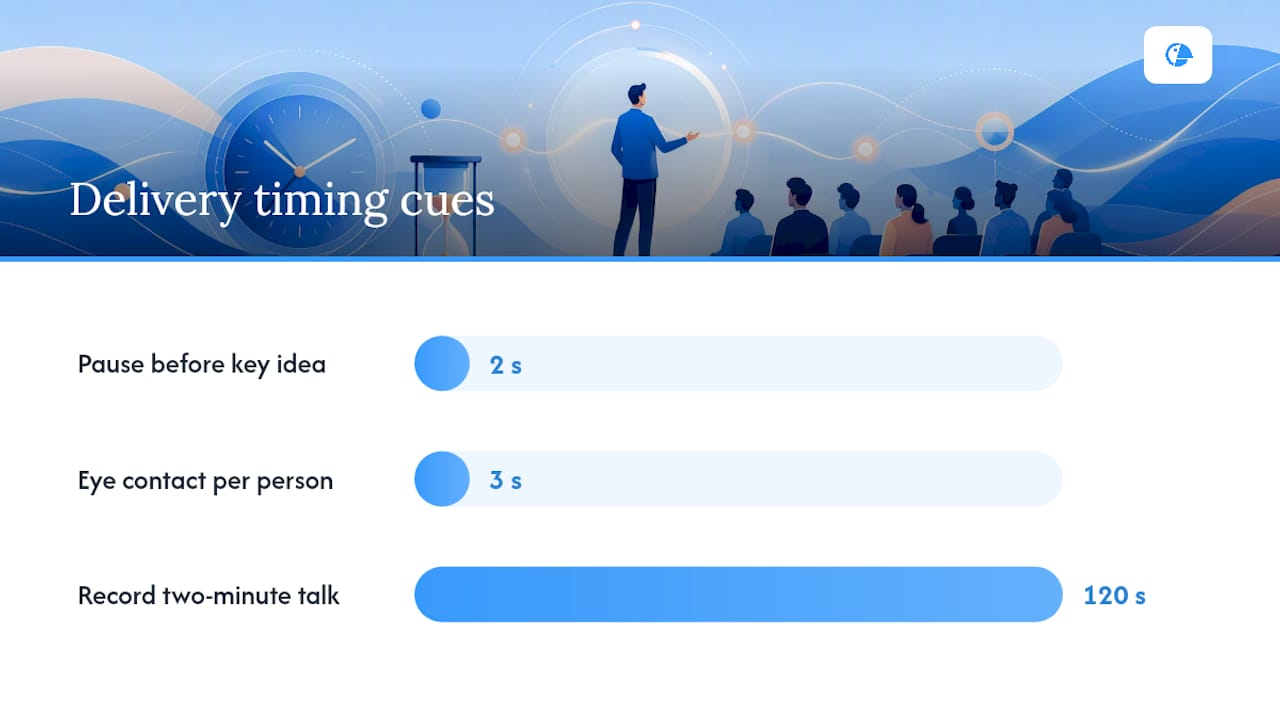
Pacing and pausing. Slowing before key points and numbers helps listener processing and reduces filler word use. The technique is selective deceleration: slow on the substance, normal on the setup. A two-second pause before a key idea feels like an eternity to the speaker and like emphasis to the listener. Fillers ("um", "ah", "like", "you know") almost always fill the space where a pause should be.
Gestures and eye contact. Keep gestures purposeful and above the waist. Open palms signal openness; pointing can feel aggressive. In a room, move your eye contact around naturally — roughly three seconds per person or zone. On a video call, look at the camera, not your own face on screen.
Storytelling. Lead with the point, then add one vivid detail. "We lost the client" is a fact. "We lost the client on a Tuesday morning, two days before the contract renewal, because no one had followed up" is a story. Keep examples brief — one concrete detail is more memorable than three abstract ones.
| Do this | Avoid this |
|---|---|
| Pause for two seconds before a key number | Rushing through data to "get it over with" |
| Use open-palm gestures to emphasise | Crossing arms or gripping the lectern |
| Slow down on your main point | Speaking at the same pace throughout |
| Make eye contact with different parts of the room | Staring at notes or a single spot |
Pro Tip: Record a two-minute talk and watch it on mute. You will see your gestures and posture far more clearly than you ever feel them in the moment.
How can you manage nerves before speaking?
Nerves are not the enemy. The physical sensations of anxiety — elevated heart rate, heightened alertness, faster breathing — are nearly identical to excitement. Cognitive reappraisal, the practice of consciously relabelling "I am nervous" as "I am ready," has been shown in psychological research to improve performance under pressure. The shift is small but it changes what your body does with the energy.
A 60–90 second pre-performance routine:
- Breathe. Inhale for four counts, hold for two, exhale for six. Repeat three times. The extended exhale activates the parasympathetic nervous system and slows the heart rate.
- Set your posture. Stand or sit tall, shoulders back, feet flat. Posture affects how you feel, not just how you look.
- Find a visual anchor. Pick one friendly face or a fixed point at the back of the room. Return to it whenever you feel your focus drift.
- Rehearse your opener. Say your first sentence out loud, quietly, once. Knowing exactly how you will begin removes the biggest spike of anxiety.
For longer-term confidence, build exposure gradually: practise solo first, then with one trusted person, then a small group, then a larger audience. Each step makes the next one feel manageable. Self-recording fits naturally into the early stages of this progression — it is low-stakes and gives you objective data rather than vague impressions.
Pro Tip: The first time you hear your recorded voice, the discomfort is normal and almost universal. It is a cognitive quirk, not a sign that you sound bad. Push through it — the feedback is worth far more than the awkwardness.
Where can you get useful feedback in Australia?
Feedback is the variable that separates speakers who plateau from those who keep improving. Active listening and real-time cues from your audience are themselves a form of feedback — but you also need structured input from people who are paying attention to your delivery.
When asking for feedback, be specific. "What did you think?" produces vague answers. "Can you tell me two things to improve and one thing that worked?" produces useful ones. The more precise your prompt, the more useful the response.
| Feedback channel | Strengths | Cost and access |
|---|---|---|
| Self-recording | Objective, always available, no social pressure | Free; requires only a phone |
| Language exchange partner | Real conversation, mutual accountability | Free; find via language-exchange apps or community boards |
| Peer group or speaking circle | Diverse perspectives, regular cadence | Free to low-cost; community colleges and libraries often host groups |
| Toastmasters Australia | Structured programme, trained evaluators, progressive curriculum | Low annual membership fee; clubs across every state |
| Private tutor or coach | Personalised, targeted, fastest improvement curve | Paid; varies by tutor experience and session length |
Finding local options in Australia. Search "Toastmasters [your city]" on the Toastmasters Australia club finder to locate your nearest club — there are active clubs in Sydney, Melbourne, Brisbane, Perth, Adelaide, and most regional centres. For informal meetups, search "public speaking [your city]" or "communication skills meetup [your suburb]" on Meetup.com. Community colleges such as TAFE NSW and WEA Australia regularly run short public-speaking courses at accessible price points.
For practising conversation skills, a staged progression from structured drills through to spontaneous real-world exchanges produces the most measurable gains. Start with a feedback channel you can access this week, then add a second one within a month.
Your speaking skills checklist and 30-day starter plan
A checklist keeps practice honest. Work through these high-leverage exercises and track which ones you have done consistently.
Core exercises:
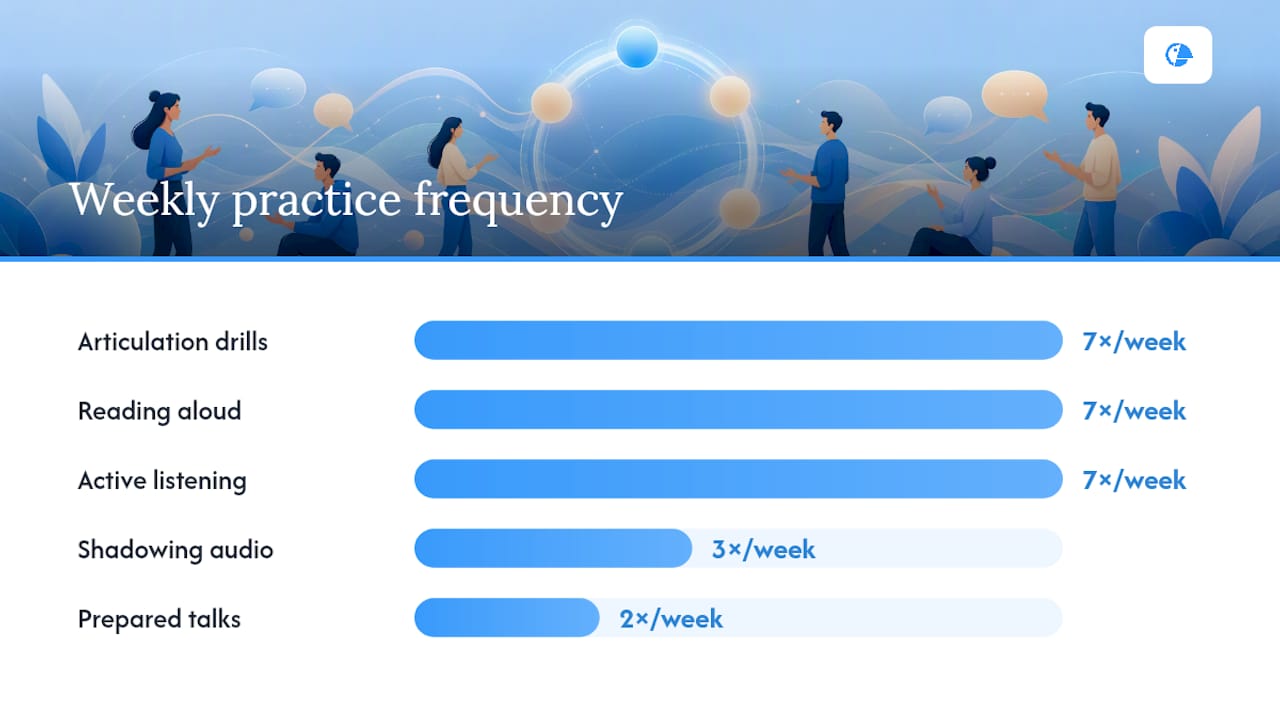
- Articulation drills (tongue-twisters, lip and jaw warm-ups) — daily, 2–3 minutes
- Reading aloud from varied texts (news, fiction, speeches) — daily, 5 minutes
- Shadowing audio from a podcast or recorded speech — three times per week
- Short prepared talks (2 minutes on a topic, recorded) — twice per week
- Filler-word tracking (count "um", "ah", "like" in each recording) — each session
- Active listening drills (summarise what someone said before responding) — daily in conversation
Useful tools. A smartphone voice recorder or the free Voice Memos app covers recording needs. A metronome app (free on iOS and Android) helps you practise speaking at a measured pace. For shadowing, any podcast with a clear, articulate speaker works well — the ABC's In Conversation series and TED Talks are both widely used in Australia. For vocabulary precision that carries into your spoken register, resources like this academic vocabulary guide offer practical exercises that transfer directly to clearer, more confident speech.
30-day starter plan:
| Week | Focus | Daily habit | Weekly checkpoint |
|---|---|---|---|
| Week 1 | Articulation and warm-up | 5-min drill + read aloud | Record one 2-min talk; count fillers |
| Week 2 | Structure and answer-first | Practise hook-three points-close | Record one structured answer; review opening |
| Week 3 | Delivery and pacing | Shadowing + selective deceleration drill | Record one talk; check pace on key points |
| Week 4 | Live feedback | Peer session, meetup, or Toastmasters visit | Compare Week 1 and Week 4 recordings |
With consistent daily practice, most people notice a clear reduction in filler words and improved pacing within 4–6 weeks. Structural clarity — the ability to lead with a conclusion and support it cleanly — tends to improve faster, often within two weeks of deliberate practice.
Key takeaways
Consistent short practice, structured preparation, and regular feedback are the three foundations of faster speaking improvement.
| Point | Details |
|---|---|
| Daily 15-minute routine | Four timed blocks (warm-up, drill, conversation, review) build fluency faster than long infrequent sessions. |
| Answer-first structure | Lead every response with your conclusion, then support it with up to three points for maximum clarity. |
| Record and review weekly | Self-recording reveals filler words, pacing issues, and tone habits that are invisible in the moment. |
| Seek structured feedback | Toastmasters Australia, peer groups, and language exchange partners each offer feedback you cannot give yourself. |
| Tutoroo for personalised coaching | Tutoroo connects you with private tutors for one-on-one speaking practice tailored to your specific goals. |
What the fastest-improving speakers actually do differently
The speakers who improve most quickly share one habit that has nothing to do with talent: they practise with a specific correction target, not a vague intention to "get better." They record themselves, identify one concrete problem — a rising intonation that sounds uncertain, a tendency to rush through numbers, an opener that buries the main point — and they work on that one thing until it changes. Then they move to the next.
What they do not do is attempt a "speaker personality." The instinct to adopt a more dramatic voice, a grander vocabulary, or a performance style borrowed from someone else almost always backfires. The most credible speakers are simply clear, prepared, and present. They know the one thing they want their audience to remember, they structure everything to support it, and they practise until that structure survives nerves.
The other pattern worth noting: the fastest improvers seek feedback early, not after they feel ready. Waiting until you feel confident to show your work to others is backwards. Feedback at the uncomfortable stage is precisely when it does the most good. A Toastmasters meeting, a language exchange session, or a single lesson with a private tutor in the first week of practice will accelerate your progress more than a month of solo rehearsal.
At Tutoroo, the tutors who produce the fastest results in speaking-focused lessons are those who combine structured session goals with genuine conversation — not just drills, but real exchanges where meaning has to be negotiated in real time. That combination of language lessons built around real speaking skills and consistent feedback is what moves learners from functional to fluent.
Ready to add a private tutor to your practice?
Self-study and clubs will take you a long way. When you want to move faster, or when you have a specific goal — a job interview, a presentation, a language exam — a private tutor gives you something neither a recording nor a peer group can: expert, personalised feedback on exactly what is holding you back.

Choosing the right tutor matters. Look for someone with experience in your specific context (professional communication, accent reduction, or conversational fluency), a clear feedback style, and a willingness to offer a trial session before you commit. Ask how they structure lessons and whether they track your progress between sessions.
Tutoroo connects learners with over 386,000 private language tutors worldwide, available for one-on-one sessions online or in person across Australia. Whether you are working on English clarity, preparing for a public presentation, or building confidence in a second language, you can find a tutor matched to your goals and schedule. Browse English tutors on Tutoroo and book a trial session to see how much faster you improve with a dedicated coach in your corner.
Useful sources and Australian resources
- 10 Tips for Improving Your Public Speaking Skills — Harvard DCE
- 8 Ways You Can Improve Your Communication Skills — Harvard DCE
- How to Improve Verbal Communication Skills — Indeed
- How to Speak Better: A Practical Guide — Debate Ladder
- Step by Step Speaking Improvement — Tutoroo Blog
- How to Practise Conversation Skills in a New Language — Tutoroo Blog
- Improving Language Skills Checklist — Tutoroo Blog
- Toastmasters Australia — Find a Club
- Improve Essay Writing Skills Fast — David TC Tutoring Services
Finding local clubs and meetups in Australia. Search "Toastmasters [your city or suburb]" on the Toastmasters Australia website to find your nearest club. For informal groups, try "public speaking meetup [your city]" on Meetup.com, or contact your local TAFE or community college for short-course options. Most capital cities have multiple active clubs meeting weekly, and many now offer hybrid attendance for those outside major centres.