

Build student rapport by deliberately learning every student's name, sharing a little of yourself first, and scheduling short one-to-one check-ins throughout the term. Those three moves, done consistently, shift the dynamic from transactional to genuinely connected.
Quick-start checklist for your next session:
- Learn and use each student's preferred name and pronoun before the session begins.
- Share one personal anecdote about your own learning journey to model openness.
- Schedule at least one 45-second individual check-in per student during the first week.
- Send a brief interest survey or "Assignment 0" before or after the first lesson.
- Track who you have spoken with individually so no one slips through unnoticed.
Success looks like: attendance holding steady, students volunteering answers rather than waiting to be called on, and a mid-term survey question on connection scoring 4 out of 5 or higher.
Key takeaways
Strong rapport is built through consistent, small, deliberate actions: learning names, scheduling micro-conversations, and closing the feedback loop with regular surveys.
| Point | Details |
|---|---|
| Start with names and surveys | Learn preferred names and pronouns before session one; send a five-question interest survey to personalise every lesson after. |
| Use the 5:1 interaction ratio | Aim for five positive or encouraging interactions for every correction; this ratio is the evidence-backed benchmark for student connectedness. |
| Run 2x10 micro-conversations | Spend two minutes per day for ten days in personal, non-academic chat with a disengaged student to shift classroom dynamics measurably. |
| Measure rapport mid-term | A short survey after week four or five surfaces problems early enough to fix them before end-of-term evaluations. |
| Tutoroo supports the match | Tutoroo's tutor profiles, messaging, and scheduling tools let tutors put every practice in this guide into action from the very first contact. |
Table of Contents
- Why does rapport actually improve learning outcomes?
- What should you prepare before the first session?
- First class: low-stakes moves that set the tone immediately
- Daily and weekly routines that sustain rapport over time
- How do you build rapport in online and blended settings?
- Inclusive rapport-building: names, pronouns, and cultural respect
- When rapport is tested: distress signals and professional boundaries
- How do you measure rapport and keep improving it?
- Templates and tools you can use straight away
- A language-tutor perspective on what rapport really requires
- Tutoroo connects you with tutors who make rapport their practice
- Sources
Why does rapport actually improve learning outcomes?
Connecting with students builds rapport that is directly linked to increased engagement, greater comfort in sharing ideas, and a stronger willingness to be intellectually challenged. That last point matters enormously in language learning, where the fear of making mistakes in front of others is often the single biggest barrier to progress.
The CDC's classroom management guidance recommends a 5:1 ratio of positive to negative interactions, a figure grounded in research showing that students report higher connectedness when teachers consistently show care and take time to check in. Maintaining that ratio is not about being relentlessly cheerful; it is about making sure praise, encouragement, and genuine curiosity about a student's thinking far outweigh corrections and redirections.
Stat to keep in mind: A 5:1 positive-to-negative interaction ratio is the evidence-backed benchmark for classrooms where students feel genuinely connected to their teacher.
IES research confirms that concrete steps, greeting students, learning their backgrounds, and co-designing learning activities, produce measurable gains in belonging and trust. Rapport is not a personality trait some tutors have and others lack. It is a set of repeatable behaviours.
What should you prepare before the first session?
Proactive planning produces better engagement than leaving rapport to chance, according to Harvard's Bok Centre. Before your first lesson, work through this short checklist:
Review your student roster and note preferred names and pronouns. If you have access to an intake form, read it carefully. Collecting names, pronouns, and student expectations early supports inclusivity and gives you material for personalised follow-ups.
Prepare a two-minute personal introduction that covers your teaching background, one genuine interest outside teaching, and your philosophy on mistakes. Students who hear you model openness are far more likely to reciprocate.
Draft a short interest survey, sometimes called Assignment 0, with five to seven questions: preferred name, language learning goals, what they find hardest, how they prefer to receive feedback, and one fun fact. Harvard's Instructional Moves framework identifies this kind of early personal sharing as a core evidence-backed practice for building inclusive learning environments.
First class: low-stakes moves that set the tone immediately
The first session sets expectations that are hard to reset later. Keep the tone warm and the stakes low.
A brief intro script that works: "I'm [name]. I've been teaching [language] for [X] years, and I still remember the first time I tried to order coffee in [city] and completely mangled the pronunciation. We're going to make a lot of mistakes in here, and that's exactly how it's supposed to go. Before we start, I'd love to know one thing you're hoping to do with [language] by the end of our time together."
That script models vulnerability, sets a growth mindset, and invites optional disclosure without pressure.
Low-stakes icebreakers for language learners:
- Two truths and a lie in the target language (works at beginner level with simple vocabulary).
- "Three words that describe me" written on a card, then shared with a partner before the group.
- A quick show-and-tell: students bring one object or photo that means something to them and describe it in one sentence.
After the session, send a one-question follow-up: "What's one thing you'd like me to know about how you learn best?" Use those responses to personalise your next session's opening.
Daily and weekly routines that sustain rapport over time
Rapport built on day one fades without consistent reinforcement. The routines below are repeatable and low-effort once they become habit.
- Greet students at the door (or in the chat before an online session starts). Using a student's name in the first ten seconds of contact signals that they are expected and welcome.
- Warm starts: spend the first three to five minutes on a low-stakes conversational prompt unrelated to the lesson content. This is sometimes called a morning meeting structure.
- 2x10 micro-conversations: spend two minutes a day for ten consecutive days having a personal, non-academic conversation with a student who seems disengaged. Edutopia's practitioner accounts report this strategy produces measurable improvements in cohesion and behaviour.
- Interaction tracking: keep a simple log (a spreadsheet or a sticky note system) noting which students you have spoken with individually each week. Rotate deliberately so quieter students receive the same contact as more vocal ones.
Pro Tip: A focused 45-second one-on-one conversation during the first week, just asking what a student is looking forward to or finding tricky, can shift classroom dynamics more than many longer, less-targeted interactions. Set a timer if you need to; the brevity is part of what makes it work.
The Clemson University teaching guide recommends using student names regularly, walking the room, and prompting elaboration with open questions. These habits compound. A student who hears their name used naturally three times in a lesson feels seen in a way that a student addressed only as "you" simply does not. For more on how student-tutor interaction patterns shape language learning outcomes, the Tutoroo blog offers practical examples.
How do you build rapport in online and blended settings?
Online tutoring removes the physical cues, the eye contact, the body language, the casual chat before class, that make rapport feel natural. You need to replace them deliberately.
- Record a short welcome video (60–90 seconds) before the first session introducing yourself and the lesson structure. Students who see your face and hear your voice before logging in arrive warmer.
- Turn your camera on and invite students to do the same, framing it as a preference rather than a rule.
- Use audio or video feedback on written work rather than typed comments alone. Hearing a tutor's voice on a piece of feedback feels personal in a way that tracked changes never do.
- Open every session with a two-minute pre-lesson chat in the video call waiting room or chat window.
- Respond to messages within 24 hours and acknowledge effort explicitly, not just outcomes.
Student-tutor messaging strategies that extend rapport beyond lesson time are covered in depth on the Tutoroo blog, including how to share your background and keep communication warm without blurring professional lines.
Inclusive rapport-building: names, pronouns, and cultural respect
Rapport that excludes or inadvertently harms some students is not rapport; it is selective warmth. A few clear practices keep your approach genuinely inclusive.

Do: ask for and use preferred names and pronouns from the first session. Practise unfamiliar names privately before class so you can say them confidently. Validate students' cultural backgrounds as assets, not curiosities.
Don't: anglicise a student's name without their invitation, make assumptions about cultural background based on appearance, or treat a student's home language as an obstacle to the target language.
Co-design your class norms with students in the first or second session. Asking "What do we need in this space to feel comfortable making mistakes?" produces norms students actually follow because they helped write them. IES guidance specifically recommends co-designing learning activities as a trust-building step.
Small accessibility adjustments, offering written summaries alongside verbal instructions, checking caption settings on video platforms, asking about preferred feedback formats, signal care without requiring a student to disclose a diagnosis.
When rapport is tested: distress signals and professional boundaries
Students sometimes bring personal distress into a lesson. Recognising the signs and responding well protects both the student and you.
Signs to watch for: sudden withdrawal, missed sessions without explanation, tearfulness, or comments that hint at stress beyond the subject matter.
A simple escalation flow:
- Pause the lesson content and ask an open question: "You seem a bit flat today. Are you doing OK?"
- Listen without immediately problem-solving. Acknowledge what you hear.
- If the concern sounds serious, say: "That sounds really hard. There are people who can help with this. Would it be OK if I pointed you toward some support?"
- In an Australian context, refer students to resources such as Beyond Blue (beyondblue.org.au), Lifeline (13 11 14), or their institution's student wellbeing team.
- Document the conversation briefly, date, what was said, what action you took, and keep it confidential.
University of Pittsburgh's teaching guidance recommends pausing and asking empathetic, open questions when students show challenging behaviour, seeking root causes before escalating.
Boundary guidelines: being warm and approachable is not the same as being a friend. Keep personal disclosures relevant to teaching. Avoid private social media contact. If a student's needs exceed your role, refer rather than absorb.
How do you measure rapport and keep improving it?
Waiting until end-of-term evaluations to find out rapport has broken down is too late to fix anything. Build shorter feedback loops.
Mid-term survey (send after week four or five): three to five questions covering whether students feel comfortable asking questions, whether feedback feels useful, and one open-ended prompt: "Is there anything you'd like more or less of in our sessions?"
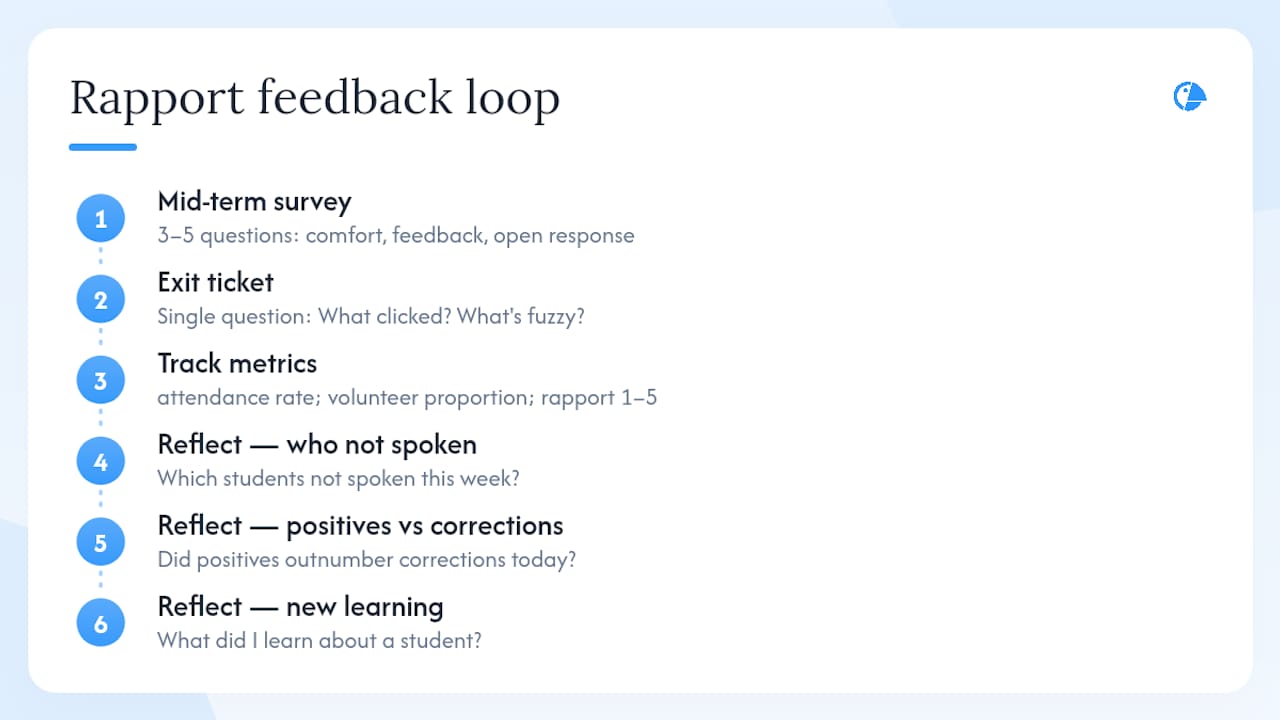
Exit tickets: a single question at the end of a lesson, written or verbal, such as "What's one thing that clicked today, and one thing still fuzzy?" These surface confusion quickly and show students their input shapes the next lesson.
Metrics to track: attendance rate, proportion of students who volunteer responses unprompted, and a single-item rapport rating ("On a scale of 1–5, how supported do you feel in this class?"). A mid-term feedback loop is recommended by the University of Pittsburgh specifically to surface issues early and allow adjustments before summative evaluations.
Reflection prompts for tutors: Which students have I not spoken with individually this week? Did my positive interactions outnumber corrections today? What did I learn about a student this week that I did not know last week?
Templates and tools you can use straight away
Interaction-tracking table
Copy this into a spreadsheet and add one row per interaction. Review weekly to spot students who have not had individual contact.
Sample interest survey (Assignment 0)
- What name would you like me to use?
- What is your main goal for learning this language?
- What do you find hardest about language learning so far?
- How do you prefer to receive feedback (written, verbal, or a mix)?
- One fun fact about yourself.
2x10 plan template
Choose one student who seems disengaged. For ten consecutive sessions, spend two minutes at the start or end of class on a purely personal conversation. Log the topic each time. Review whether engagement or participation has shifted by session ten.
Icebreaker prompts
- "If you could speak any language fluently tomorrow, what would you do first?"
- "Tell me one word in your home language that has no direct English translation."
- "What's a place you'd love to visit where your target language is spoken?"
For individual tutoring, adapt the 2x10 template by extending the warm-up conversation rather than treating it as a separate activity. The goal is the same: consistent, personal contact that is not about the lesson content.
A language-tutor perspective on what rapport really requires
The conventional advice on rapport, learn names, smile, be approachable, is not wrong. It is just incomplete for language tutors specifically.
Language learning is uniquely vulnerable. Students are asked to sound foolish, to mispronounce, to forget words mid-sentence, in a way that no other subject demands. Rapport in this context is not just about warmth; it is about creating a psychological space where that vulnerability feels safe rather than shameful.
The most effective language tutors we see working through Tutoroo do something specific: they use a student's stated interests as the raw material for every lesson. A student who loves surfing practises vocabulary through surf culture. A student who follows K-drama learns Korean through dialogue they actually want to understand. That is not just good pedagogy; it is rapport made structural. The interest survey from day one pays dividends every week after.
Conversational warmups, two or three minutes of genuine chat in the target language before the lesson proper, serve double duty. They build rapport and they build fluency. The tutor learns something real about the student; the student practises without the pressure of a formal task. For tutors supporting exam preparation, that warmup also reduces the anxiety that tanks performance, as explored in Tutoroo's guide on how tutors support language exam preparation.
The tutor marketplace workflow matters here too. A well-written profile, clear messaging before the first session, and a scheduling system that respects a student's time all send signals of care before the first word of the lesson is spoken. Rapport starts at the match, not the meeting.
Tutoroo connects you with tutors who make rapport their practice
Building genuine connections with students takes intention, and it is far easier when the match between tutor and learner is right from the start. Tutoroo's personalised matching connects language learners across Australia with private tutors who bring both subject expertise and the interpersonal skills this guide describes. Tutor profiles show teaching philosophy, communication style, and availability, so learners can choose someone whose approach genuinely fits their goals before the first session begins.
The platform's direct messaging system lets tutors send a warm introduction, share an interest survey, and establish expectations before lesson one, putting the pre-class planning checklist from this guide into immediate practice. Whether you are learning online or in person, find your language tutor on Tutoroo and start building the kind of connection that makes language learning genuinely stick.
Sources
- Connecting with Your Students | Center for Teaching Innovation
- Step 1: Getting to Know Your Students | Instructional Moves (Harvard Graduate School of Education)
- Classroom management: approaches for teacher caring and support | CDC
- How to build positive relationships with students | IES
- Start the semester strong: Strategies for getting to know your students (and why it matters) - Center for Innovative Teaching and Learning