

The fastest way to choose a German tutor is to set one measurable goal, book a short trial lesson, and compare candidates against a fixed screening checklist. Skip the endless profile scrolling. A trusted marketplace like Tutoroo, or any vetted private tutor with clear credentials, gets you into a real lesson within days rather than weeks.
Your immediate next step takes less than five minutes:
- Write down one specific goal (a Goethe-Institut exam date, a workplace German requirement, or simply holding a ten-minute conversation) and book a trial lesson against it.
- Ask the tutor two questions before you commit: do they have relevant experience with your exact goal, and can they show you a sample lesson plan?
That second question matters more than it sounds. A tutor who can't describe how they'll structure your first six weeks is guessing, and you're paying for the guess.
Key Takeaways
Choosing the right German tutor comes down to matching a specific, measurable goal to a tutor's actual specialty, then verifying fit through a trial lesson before committing to any package.
| Point | Details |
|---|---|
| Set the goal first | Name the exam, CEFR level, or job task before searching, so you're matching a tutor to a real target. |
| Use a fixed screening checklist | Check credentials, ask for a sample lesson plan, and confirm progress-tracking methods before booking beyond a trial. |
| Price signals structure, not value | Judge tutors by their plan and progress measures, not by who charges the lowest hourly rate. |
| Native vs trained teacher depends on goal | Pick native speakers for fluency and immersion, trained teachers for grammar and exam technique. |
| Try Tutoroo for a wide, filterable pool | Tutoroo's marketplace of over 386,000 tutors lets you filter by specialty and book a trial before committing to a schedule. |
Table of Contents
- How to choose a German tutor without wasting your first month
- How do you set goals that match the right tutor?
- Where to find German tutors that actually fit your goal
- Screening checklist and trial lesson questions that separate good tutors from average ones
- What does a German tutor actually cost?
- What a genuinely effective online German lesson looks like
- How Tutoroo helps you find and trial a vetted German tutor
- How to tell if your German tutor is actually working
- Native speaker or trained teacher: which German tutor fits you?
- Private tutor, language school, or group class: what actually suits you?
- What most tutoring advice gets wrong
- Ready to start? Booking a German tutor on Tutoroo
- Sources
How to choose a German tutor without wasting your first month
Most people choosing a German tutor default to whoever has the most reviews or the cheapest hourly rate. Both are weak signals on their own. What actually predicts progress is whether the tutor's teaching style matches your specific reason for learning German, and private tutoring earns its cost fastest when that match is tight.
Private tutoring outperforms group classes in a handful of clear situations:
- Exam prep (Goethe-Zertifikat, TestDaF, telc) where you need targeted drilling on weak sections rather than a fixed syllabus.
- Business German where vocabulary and scenarios need to match your actual job, not a textbook chapter.
- Conversation fluency where you need someone correcting you in real time, not waiting for a turn in a group of eight.
Realistic milestones often include progressing through basic sentence structure and everyday vocabulary within a month or so of regular sessions; with focused exam preparation over several weeks, many learners can advance from intermediate B1 to exam-ready B2 level on a specific Goethe module, assuming consistent homework. The bigger, less obvious benefit isn't speed. It's accountability and tailored materials that a fixed curriculum can't offer, plus a tutor who adjusts pace when something isn't landing.
How do you set goals that match the right tutor?
Vague goals produce vague tutor searches. "I want to learn German" gets you a generalist who'll teach whatever comes up next. A goal with a name, a level, and a deadline gets you a specialist.
- Name the target precisely. Write the exam ("Goethe-Zertifikat B2"), the CEFR level, or the job task ("client calls in German by Q3") and a realistic timeframe.
- Match the tutor profile to the goal. Exam prep calls for a tutor who has coached that specific test before. Conversation confidence calls for a native speaker comfortable with informal correction. Grammar foundations call for a certified teacher who can explain the "why," not just the "what."
- Set a session cadence that fits the goal's intensity. Exam prep with a firm date usually needs two sessions a week of 60 minutes. Conversation practice works well at one 45 minute session weekly, with informal practice in between. Grammar rebuilding benefits from shorter, more frequent 30 minute sessions early on.
Once you've written this down, screening candidates becomes a matching exercise, not a guessing game. You're no longer asking "is this a good tutor?" You're asking "is this the right tutor for what I actually need?"
Where to find German tutors that actually fit your goal
You've got four realistic channels, and each has a different trade off between vetting, variety, and cost.
- Marketplace platforms like Tutoroo give you the widest pool of specialists (test-prep coaches, business German experts, native speakers) with reviews, response times, and messaging built in, so you can compare candidates side by side before booking.
- Personal referrals from colleagues or language-exchange groups carry built-in trust, but the pool is small. Great if someone you know already found a strong tutor; limited if your network's German learners are thin.
- University language departments often have graduate students or lecturers open to private students. Vetting is informal, but subject expertise is usually solid, particularly for grammar-heavy goals.
- Community and cultural groups (Goethe-Institut branches, German cultural associations) sometimes maintain informal tutor lists, and starting with these lower-cost local referrals is a sensible first move before paying for a premium platform.
On any channel, the same signals separate a serious tutor from a hobbyist: detailed reviews that mention specific outcomes (not just "great tutor!"), a sample lesson description that shows actual structure, and a response time under 24 hours when you first message them.
A practical workflow: shortlist three candidates who match your goal profile, request a trial lesson from each, then run every trial through the same checklist. Comparing three tutors on identical criteria tells you far more than comparing one tutor against your gut feeling.
Screening checklist and trial lesson questions that separate good tutors from average ones
A consistent process beats intuition every time you're comparing tutors, because intuition changes depending on who you spoke to last. Run every candidate through the same four checks before you commit to more than a trial.
- Pre-interview screening. Check for relevant credentials or experience tied to your specific goal, ask for sample materials or a lesson plan outline, and request a reference or a linked review history. A structured vetting process starts with these basics before you ever book a session.
- Trial lesson observation. During the trial, watch how the tutor structures the hour: is there a warm-up, a clear teaching point, and guided practice, or does it drift? Note how they correct mistakes (immediately and gently, or not at all) and whether they use any shared digital tools.
- Direct questions to ask. Ask how they'll track progress over the next six to twelve weeks, what their cancellation and payment policy is, and how they'll adjust materials if something isn't working. A tutor with a real answer to "how will you measure my progress" is worth far more than one who says "you'll just feel it."
- Red flags to walk away from. Be wary of guaranteed score increases, pressure to prepay a large multi-month package before a single trial, or a vague or absent cancellation policy. Genuine improvement can't be promised on a fixed timeline, and red flags like these usually show up before you've paid anything, if you're looking.
Pro Tip: Ask to see how the tutor handles a mistake you make on purpose during the trial. A tutor who corrects it clearly, explains why, and moves on without derailing the lesson has a teaching method. One who ignores it or over corrects everything is still improvising.
The screening habit is worth building beyond this one decision. The same checklist for evaluating private language teachers applies whether you're hiring for German, Spanish, or any other language down the track.
What does a German tutor actually cost?
Hourly rates for German tutors vary widely depending on who's teaching and what you need. Peer tutors or advanced learners typically sit at the lower end of the market, experienced certified teachers charge a mid-range rate, and specialists in exam prep or business German command the highest rates because they're solving a narrower, higher-stakes problem. Market data on tutoring rates confirms this spread and, more usefully, argues that hourly price alone is a poor way to judge value.
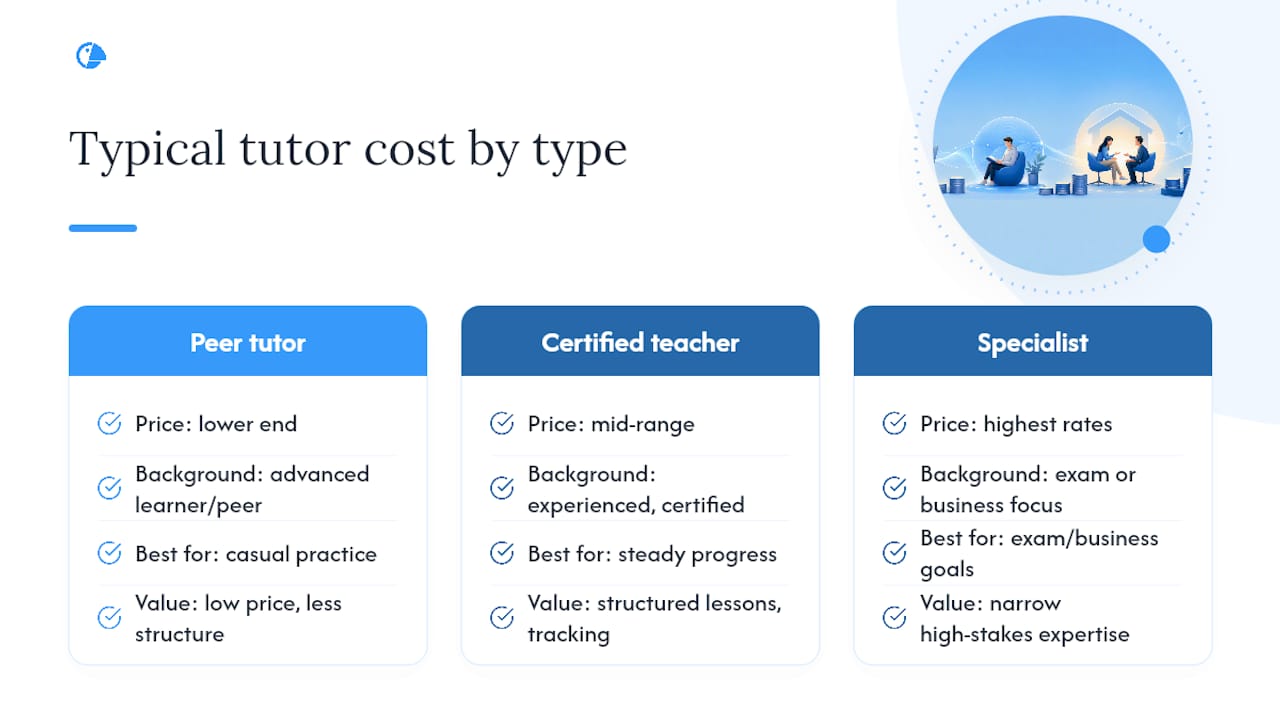
Package deals and trial discounts change the maths further. Many tutors offer a reduced first session specifically so you can assess fit before committing, and multi-lesson packages often lower the effective hourly rate once you've confirmed the match works. Platform fees, where they apply, usually cover matching and messaging rather than the lessons themselves.
The better filter is structure. A tutor charging more but arriving with a plan, a way to measure your progress, and materials matched to your goal is cheaper in real terms than a low-cost tutor who improvises every session and leaves you re-explaining your goals each week.
What a genuinely effective online German lesson looks like
A well-run online lesson follows a recognisable shape: a short warm-up reviewing last session's material, focused instruction on one or two new points, guided practice where you use the new material immediately, correction as you go, and a specific homework task tied to what you just covered. If a trial lesson skips straight to "so what do you want to talk about today," that's a tutor without a plan, not a relaxed one.
The tools matter almost as much as the structure. Look for:
- A shared digital whiteboard for writing out grammar points, vocabulary, and example sentences in real time.
- Annotated notes or a lesson summary sent after the session, so you're not relying on memory for what was covered.
- Recordings or highlights of tricky sections, useful for pronunciation or complex grammar you'll want to revisit.
- Curated resources matched to your level rather than generic worksheets pulled from anywhere online.
Effective online tutoring depends on this kind of structure far more than it depends on flashy software. During your trial, simply ask the tutor to walk you through how they'd plan your first month. Their answer tells you more about their teaching than any credential on their profile.
How Tutoroo helps you find and trial a vetted German tutor
Tutoroo connects learners with over 386,000 language tutors worldwide, which means the pool of German specialists, from exam-prep coaches to conversation-focused native speakers, is wide enough that you can actually match a tutor to a specific goal rather than settling for whoever's available.
The workflow is built around the same goal-first approach this article recommends:
- Filter by language, availability, and specialty so you're comparing candidates who actually fit your timeframe and goal, not a generic list.
- Message tutors directly before booking to ask the screening questions covered above; profiles show response times so you know who's actively teaching.
- Book a trial lesson to test fit before committing to an ongoing schedule.
- Handle scheduling and payment directly through the platform, with tutors paid straight by students once you've found the right match.
Browsing German tutors on Tutoroo is the practical next step once you've written down your goal and your screening checklist.
How to tell if your German tutor is actually working
Progress shows up in specific, checkable ways: you complete tasks you couldn't do a month ago without prompting, your exam practice scores move in the right direction, or you notice you're less hesitant mid conversation. Vague "I think I'm improving" feelings are worth far less than a completed task you couldn't manage six weeks earlier.
Build a review into your plan every six to twelve weeks. At that check-in, ask yourself and your tutor three things:
- Has my ability on the specific goal I set actually moved, and can the tutor point to evidence of it?
- Am I completing homework and practice tasks independently, or still needing heavy support?
- Do I want to keep showing up to these sessions, or has the momentum stalled?
If the answers are weak, don't assume you need a new tutor immediately. Try adjusting session frequency or shifting the pedagogy focus first (more speaking practice, less grammar drilling, for instance). Genuine partnership between tutor and learner, reflected in wanting to return to sessions, is one of the clearest signs the match is right. If frequency and focus changes don't help within another review cycle, that's the point to switch tutors rather than push through.
Native speaker or trained teacher: which German tutor fits you?
This is one of the most common sticking points when choosing a German tutor, and the honest answer is that it depends entirely on your goal, not on which option sounds more prestigious.

A native German speaker brings authentic pronunciation, natural idiom, and cultural context you won't get from a textbook. They're the stronger pick if your goal is conversational fluency, workplace small talk, or simply sounding less textbook-stiff when you speak. The trade off is that not every native speaker can explain why German grammar works the way it does. Being fluent and being able to teach fluency are different skills.
A trained, non-native teacher (or a native speaker with formal teaching credentials) usually has stronger command of grammar explanation, structured curriculum, and exam-specific technique. If your goal is passing the Goethe-Zertifikat or building a solid grammatical foundation from scratch, this profile tends to get you there faster because they've taught the same sticking points to other learners before and know how to explain around them.
Many strong tutors are both, native speakers with formal certification, and they command higher rates accordingly. If budget allows, that combination covers both bases. If it doesn't, match the trade off to your goal: native speaker for immersion and confidence, trained teacher for structure and exams. Ask directly about teaching credentials during your screening call rather than assuming a native speaker automatically teaches well.
Private tutor, language school, or group class: what actually suits you?
Group classes and language schools have one real advantage: cost per hour is lower because you're sharing the teacher's time with several other students. That's genuinely useful if your goal is loose, your timeline is flexible, and you enjoy the social dynamic of learning alongside others at a similar level.
The trade off is pace and attention. In a group of six or eight, you might get a few minutes of individual correction per session, and the curriculum moves at the average student's speed, not yours. If you're ahead, you're bored. If you're behind, you're lost until the next unit.
A private tutor costs more per hour but compresses the timeline because every minute is spent on your specific gaps. For exam prep with a firm deadline, business German tied to your actual job, or simply making faster progress with limited weekly hours, private tutoring is the better return on time even when the sticker price per hour is higher.
A sensible middle path some learners use: a language school or structured course for grammar fundamentals early on, paired with private sessions for conversation practice or targeted weak spots. But if you're choosing one route and your goal has a deadline or a specific outcome attached, a private tutor matched to that exact goal is the more reliable path.
What most tutoring advice gets wrong
Most guides on choosing a tutor treat the process as a checklist exercise: check credentials, read reviews, pick the highest rated option. That advice isn't wrong, but it's incomplete in a way that costs learners weeks of wasted lessons. Credentials tell you a tutor can teach something. They don't tell you whether that tutor can teach you, given your specific goal, your schedule, and how you actually learn.
The workflow that holds up under scrutiny starts with the goal, not the tutor search. Write down what you're actually trying to achieve, in a timeframe, before you look at a single profile. Then use the trial lesson as a genuine test, not a formality, watching for structure and correction style rather than charm.
What's overrated is the hunt for the "best" tutor in the abstract. There's no single best German tutor. There's the tutor whose specialty matches your goal, whose pedagogy suits how you learn, and whose availability fits your life. Prioritise that match over star ratings, and the rest of the process gets a lot simpler.
— TUTOROO
Ready to start? Booking a German tutor on Tutoroo
Tutoroo gives you direct access to a marketplace of over 386,000 tutors, which means you're not choosing from a handful of local options or hoping a referral pans out. You can filter specifically for German, compare specialists in exam prep, business German, or conversation practice, and message candidates before you commit to anything.
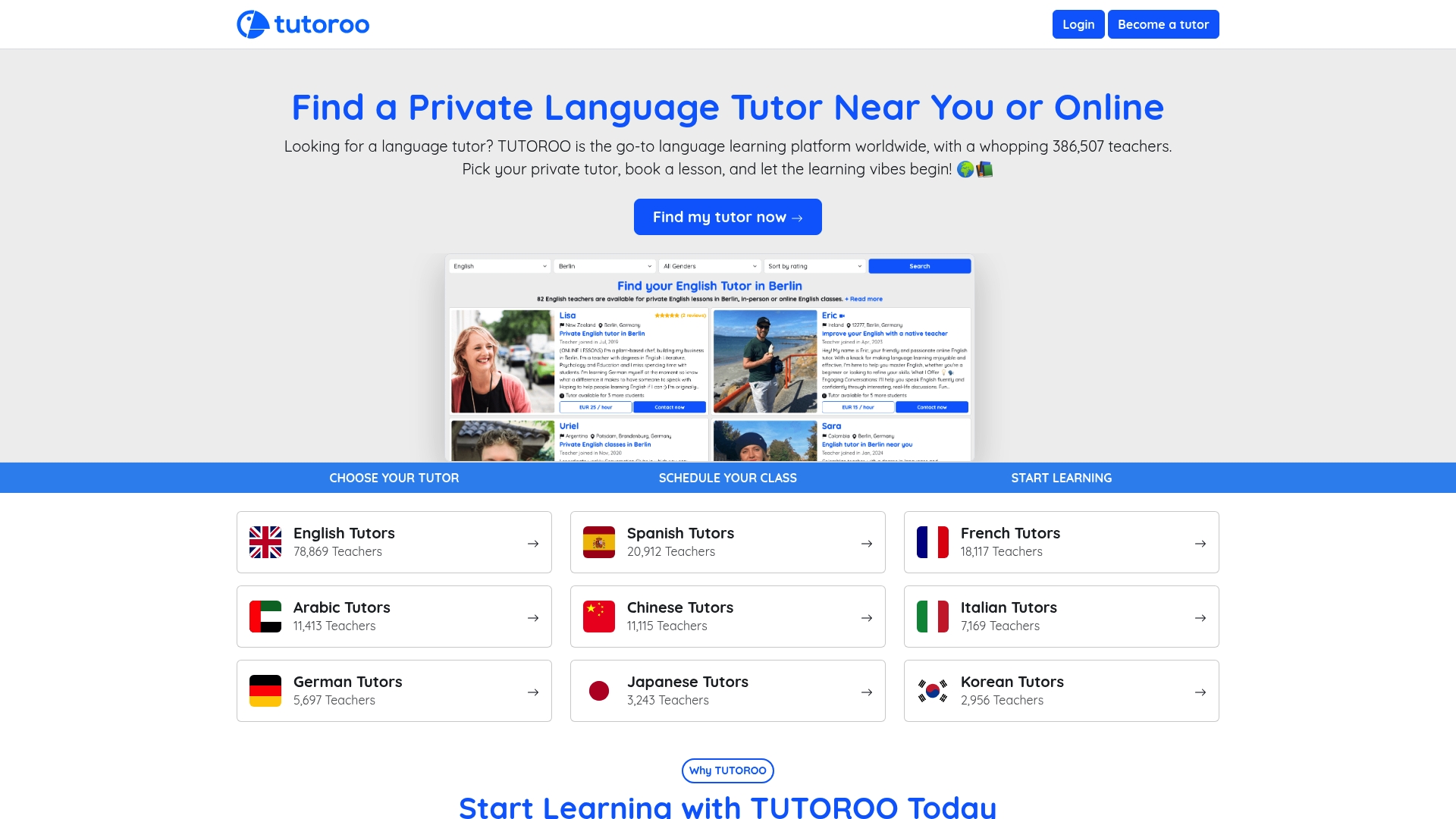
That filtering matters because the goal-first approach outlined throughout this article only works if the pool is large enough to actually contain the right match. A shortlist of three candidates found through personal referrals might all be generalists. A shortlist of three found on Tutoroo can be three genuine specialists in exactly what you need. Payment goes directly to the tutor once you're matched, scheduling happens through the platform's messaging system, and there's no obligation beyond the trial lesson you book first.
If you've already written down your goal and worked through the screening checklist above, the next step is straightforward: head to Tutoroo's German tutor page, filter for your specific goal, and message two or three candidates to book a trial this week.