

A German conversation tutor gives you what a textbook or an app cannot: a patient, fluent speaker who answers you in real time, corrects you gently and keeps you talking. The best way to find one is to start with your goal (travel, an exam, work, family) and then pick a tutor who builds lessons around it. On TUTOROO you can browse private German tutors from a community of more than 386,000 language teachers, filter by language, location and availability, and message them directly before you commit.
This guide explains what conversation lessons actually involve, how to match them to your level, what to look for in a tutor, how to prepare, and how to get the most from each session. It is written for learners, parents and educators alike.
TL;DR
- A conversation tutor's job is to get you speaking German for most of the lesson, with corrections that help rather than interrupt.
- Choose by goal first: travel, an exam such as the Goethe-Zertifikat, work or family each call for different lessons.
- Look for a tutor who listens, explains clearly, adapts to your level and lets you do most of the talking.
- Speak early and often, treat mistakes as part of learning, and prepare a few topics before each session.
- You can search German tutors on TUTOROO by location and availability and message them directly to agree a schedule.
Table of Contents
- What a German conversation tutor actually does
- Match the lessons to your level
- Lessons built around your goal
- How to choose a German conversation tutor
- How to prepare and make progress
- How often and for how long?
- What it costs
- Tutors: building flexible German conversation lessons
- For parents and educators
- Find your German tutor on TUTOROO
- FAQ
- Sources
What a German conversation tutor actually does
A conversation tutor is a private teacher whose lessons centre on speaking and listening rather than grammar drills. You talk about real topics (your week, your job, a trip to Berlin), and the tutor responds, supplies the word you are missing, and corrects patterns that keep recurring.
The role differs from a classroom teacher's in one important way: the lesson is shaped around you. Foreign-language tutoring guidance from Santa Monica College describes good tutors as people who find out the student's level and needs, listen patiently and explain how the language works, while guiding learners rather than doing the work for them. That last point matters in conversation. A tutor who finishes your sentences is doing the speaking you came to practise.
A typical lesson of 45 to 60 minutes often follows this rhythm:
- Warm-up. A few minutes of small talk in German, so you start thinking in the language.
- Main topic. A conversation around a theme: ordering food, describing your job, discussing the news, rehearsing an interview.
- Feedback. The tutor notes recurring mistakes, such as noun genders, word order after "weil" or the choice between "du" and "Sie", and explains them briefly.
- Repeat and extend. You use the corrected phrases again in a new sentence, so they stick.
- Next steps. A short task or topic for next time.
Lessons can happen online by video, or in person if you find a tutor near you. Online widens your choice enormously, because you are no longer limited to teachers in your own town.
Match the lessons to your level
German conversation lessons look very different at A1 and at B2. Levels are usually described using the Common European Framework of Reference (CEFR), a six-step scale from A1 (beginner) to C2 (near-native) that most German courses and exams use. The Council of Europe publishes a table describing spoken performance at each level, covering range, accuracy, fluency, interaction and coherence. It is a useful yardstick when you tell a tutor where you think you are.
Here is how conversation lessons typically adapt:
| Your level | What lessons focus on | What it feels like |
|---|---|---|
| Beginner (A1) | Greetings, introductions, numbers, ordering, simple questions | Short sentences, lots of repetition, the tutor mixes English and German |
| Elementary (A2) | Daily routines, shopping, directions, talking about the past | Mostly German, with the tutor slowing down and rephrasing |
| Intermediate (B1) | Opinions, plans, stories, work topics | Longer answers, more spontaneous speech, focus on connecting ideas |
| Upper intermediate (B2) | Debate, nuance, idioms, news and culture | Near-full immersion, corrections on style and precision |
| Advanced (C1 and up) | Professional or academic topics, regional variation, humour | Natural, fast conversation with fine-tuning |
If you are unsure of your level, tell the tutor what you can already do: whether you can order a coffee, follow a TV show with subtitles or write an email. A good tutor will test your level in the first few minutes of a trial and adjust.
Lessons built around your goal
The same hour of conversation can serve very different purposes. Naming yours up front lets the tutor choose the right material.
Travel
If you are heading to Germany, Austria or Switzerland, you want practical, high-frequency speech: booking a room, asking for directions, handling a restaurant bill, making small talk with a host. Role-play is the best tool here. Your tutor plays the waiter, the train conductor or the shopkeeper, and you practise until the phrases come without effort. Even a handful of lessons before a trip can make a visit richer, because a few warm sentences in German tend to open conversations that English alone would not.
Exams
Exam preparation needs structure. The Goethe-Zertifikat, for example, includes a speaking module. At B1, a Goethe-Institut examination centre in the US notes that the speaking part lasts 15 minutes alongside reading, listening and writing. A tutor can mock-test you in that format: introducing yourself, planning something with a partner, presenting a topic. Practising under timed conditions is often the quickest route to feeling calm on the day. Check the exam provider's official page for the current format and fees for your level.
Work and study
For professional German, lessons might cover meetings, phone calls, emails read aloud, presentations and the formal register that German business culture expects. Bring real material: a job description, a slide deck, a message you need to answer. Your tutor can turn it into a speaking exercise.
Family, friends and culture
Many learners come to German through a partner, relatives or a love of the culture. Here the goal is warmth and fluency: telling stories, understanding humour, joining a family dinner. Tutors who are native speakers can also share the everyday expressions, regional flavour and cultural context that make conversation feel authentic.
Our goal-first approach to choosing a German tutor goes deeper on matching your purpose to the right teacher.
How to choose a German conversation tutor
With so many tutors to choose from, a few clear criteria save time.
1. They listen before they teach. The tutoring guidance mentioned earlier stresses patience and listening as core tutor qualities. In a trial, notice whether the tutor asks about your goals and lets you finish your thoughts.
2. They explain clearly, in the right language. Beginners often benefit from a tutor who can clarify in English; advanced learners usually want German only. A strong tutor adjusts the mix as you grow.
3. They leave the talking to you. In a good conversation lesson, you should be speaking for most of the hour. If the tutor lectures for long stretches, ask to shift toward dialogue.
4. They fit your schedule. Consistency beats intensity in language learning. TUTOROO lets you search by availability, and tutors set their own schedules, so you can look for someone whose hours match yours, whether that is early morning before work or a weekend slot.
5. They match your accent and variety goals. German has regional variation. If you plan to live in Bavaria, you may enjoy a tutor who can introduce the local flavour; our page for Bavarian tutors online shows what is available. For standard conversation, browse our German tutors online.
6. Communication feels easy. Use the messaging system to ask a few questions before you book: how they structure lessons, what materials they use, how they handle your goal. The tone of the reply says a lot about how the lessons will feel.
Native speaker or not?
Both can be excellent. A native speaker brings natural rhythm, idiom and cultural context. A teacher who learned German as a second language often understands exactly which parts are hard for English speakers. What matters most is that the tutor is fluent, a good communicator and enthusiastic about helping you speak. Browse profiles, read what tutors say about their approach, and choose the one whose style appeals to you.
How to prepare and make progress
The University of Michigan's German program advises learners to speak early and often, not worry about mistakes, and learn vocabulary by using it in simple sentences. It also recommends avoiding multitasking during focused study. These principles translate neatly into a routine for conversation lessons.
Before the lesson
- Pick two or three topics you want to talk about, and jot down the words you wish you had last time.
- Warm up for five minutes. Say a few sentences aloud about your day, even to yourself.
- Remove distractions. Put your phone away and close other tabs so you can concentrate.
During the lesson
- Speak in full sentences, even simple ones. A short, imperfect sentence teaches you more than silence.
- Ask the tutor to correct selectively. Many learners prefer to be corrected on recurring errors at the end rather than being interrupted mid-thought. Tell your tutor your preference.
- Write down new phrases as they come up, ideally inside a sentence you might really use.
After the lesson
- Reuse the new vocabulary within 24 hours, in a message, a voice note or a conversation.
- Record yourself retelling the lesson's topic and compare it with last week's attempt.
- Keep a short list of recurring mistakes and bring it to the next lesson.
For more on lessons designed to build real speaking skills, see our guide to language lessons that build real speaking skills.
How often and for how long?
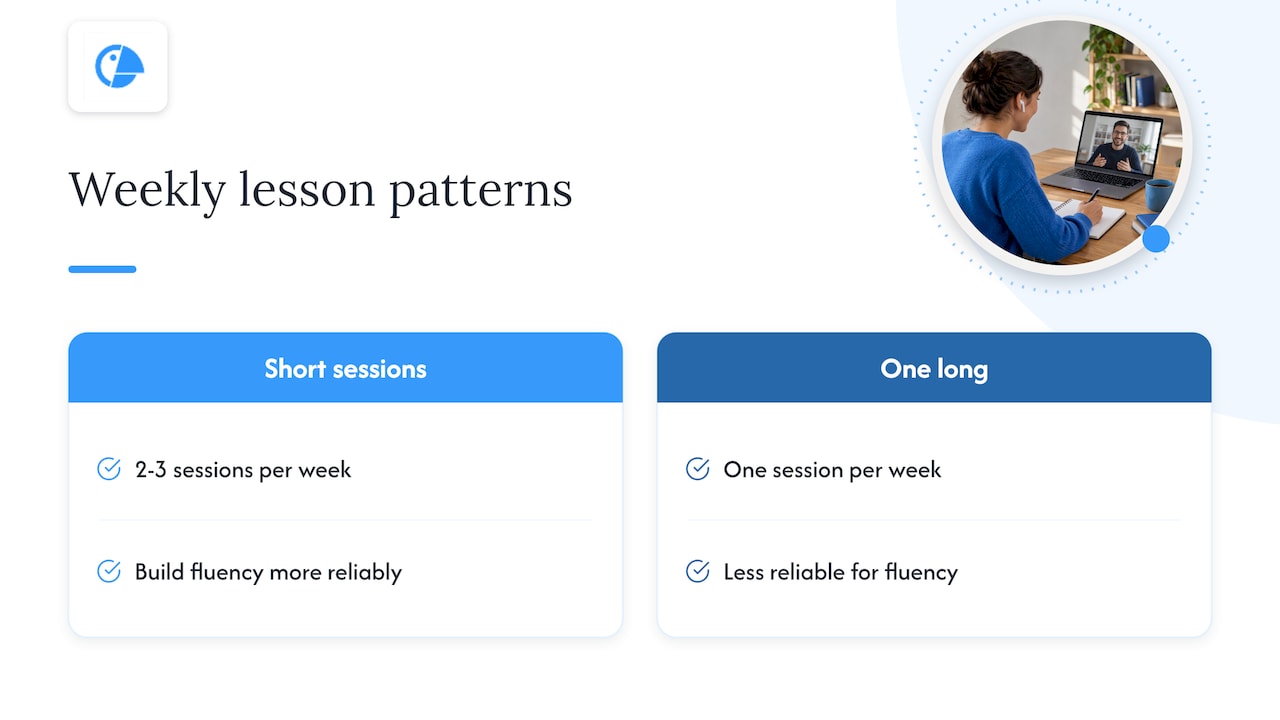
There is no single right answer, but two or three shorter sessions a week usually build fluency more reliably than one long weekly session, because speech is a habit you strengthen through frequent use. Many tutors offer lessons of different lengths, so you can start with an hour and adjust. If your schedule is tight, a 30-minute session focused on one topic still moves you forward.
Beginners may enjoy starting with a weekly lesson and adding daily self-practice. Learners heading for a trip or exam in a few months might front-load lessons, then taper. Your tutor can help set a plan once you share your deadline.
What it costs
Private German lesson rates vary with the tutor's experience, location, lesson length and whether you meet online or in person. Rather than quote a single figure, we recommend you set a monthly budget based on how many lessons you want per week, then compare tutor profiles against it. Our guide to online language tutor costs shows how to build that budget, with worked monthly ranges.
Tutors: building flexible German conversation lessons
If you are a German speaker thinking about teaching, conversation lessons are one of the most flexible ways to start. On TUTOROO you register, set your own schedule and receive payment directly from your students. A few practical habits help you build a steady roster:
- Offer a clear lesson length. Many teachers offer slots of different lengths, so students can choose what suits them.
- State your policies up front. Spell out your cancellation and lateness approach in your profile so students know what to expect.
- Describe your specialities. Travel German, exam speaking practice, business conversation: specific profiles attract students who need exactly that.
- Plan for gaps. Tell students in advance about holidays so lessons can be scheduled around them.
For parents and educators
Private conversation lessons suit students who understand German in class but hesitate to speak. Signs they may benefit include strong written work with little spoken confidence, an upcoming exchange trip or oral exam, or a keen interest in the language that school lessons cannot satisfy.
A useful way to judge fit is to book an introductory lesson and watch three things: whether the student is speaking for most of the session, whether the tutor adapts to their level, and whether the student leaves feeling motivated. For younger learners, agree on the lesson length, the topics and who will be present for online sessions. Frequent, short sessions often suit them better than long ones.
Our view: conversation is where German comes alive
We built TUTOROO around a simple belief: language is learned through meaningful connections. A grammar rule can be memorised, but the moment you say a sentence to a real person and are understood, German stops being a subject and becomes a way to reach people.
That is why we focus on personalised, one-to-one tuition. With a large worldwide community of teachers, you can search by location, language and availability, message a tutor directly and find the person whose style suits your goals, whether that is ordering confidently in Vienna, passing a speaking exam or chatting with your partner's family.
Tutors, in turn, set their own schedules and are paid directly by their students. We think that mix of freedom for teachers and choice for learners makes for lessons that are more authentic, more motivated and more enjoyable.
TUTOROO
Find your German tutor on TUTOROO
Ready to start speaking? TUTOROO connects you with private German tutors for one-to-one lessons, online or locally. Search by availability, read tutor profiles and message your favourites directly to agree on goals and times.
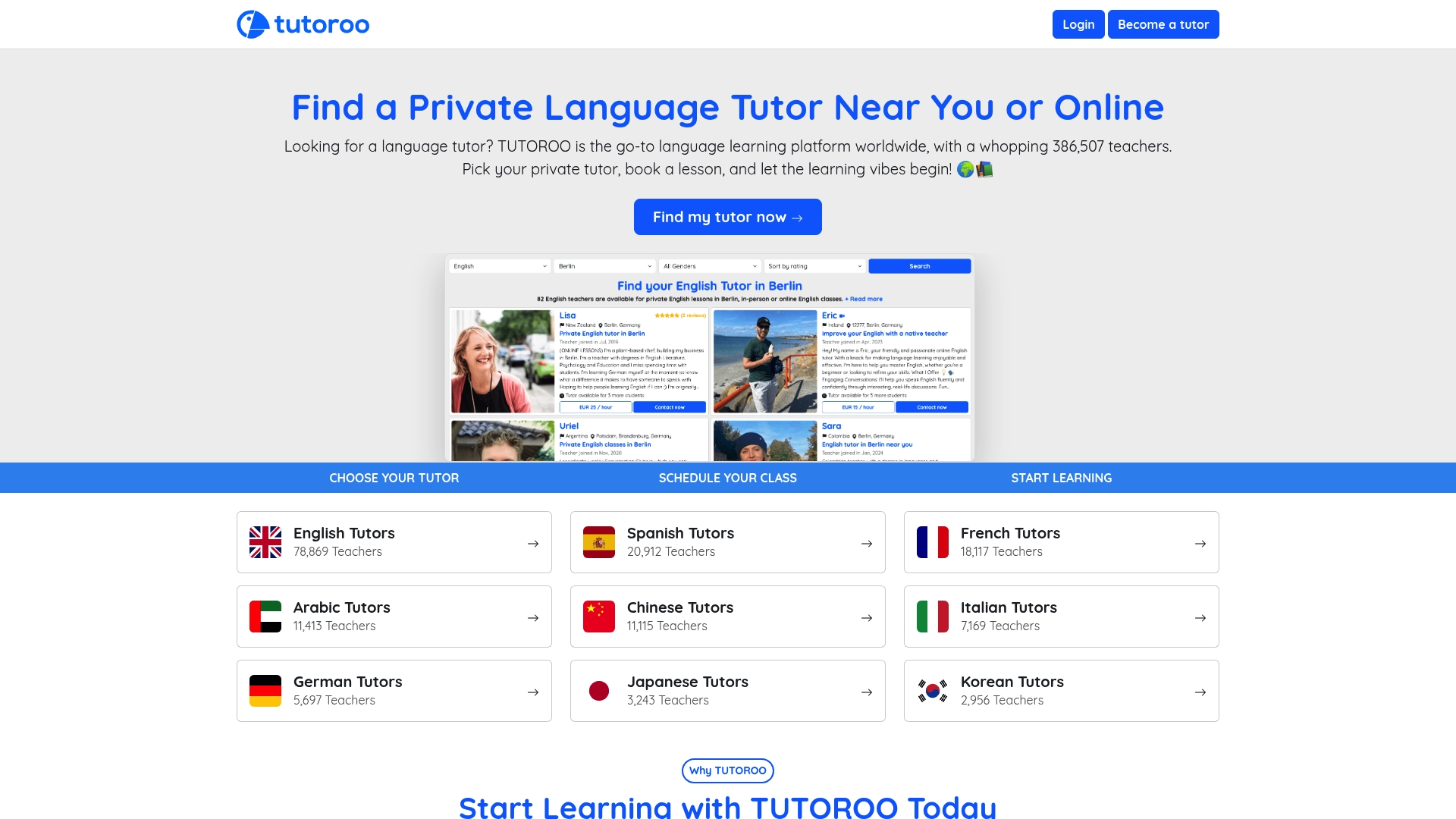
Browse German tutors on TUTOROO, or explore all the languages on offer from the TUTOROO home page.
FAQ
Is a conversation tutor different from a regular German teacher?
Yes, in emphasis. A conversation tutor spends most of the lesson on speaking and listening, adapting topics to your interests and goals, while a general teacher often follows a curriculum of grammar and writing. Many tutors combine both, so you can ask for the balance you want.
Can I start German conversation lessons as a complete beginner?
Yes. At A1, lessons focus on greetings, numbers, introductions and everyday questions, usually with the tutor explaining in English when needed. Speaking from the start is encouraged, since university language guidance recommends using new vocabulary in simple sentences right away.
How do I know which level I am?
Tell the tutor what you can already do, and use the Council of Europe's spoken-language level descriptions as a guide. A tutor will usually confirm your level in a trial lesson and adjust.
Online or in person?
Both work. Online gives you access to tutors anywhere and is easy to fit around work or school. In-person lessons suit learners who enjoy meeting face to face and live near a suitable tutor. TUTOROO supports both, so you can pick what suits you.
Can conversation lessons help with an exam?
Yes. Tutors can run mock speaking tests in the format of exams such as the Goethe-Zertifikat, whose B1 speaking module is 15 minutes long, and give feedback on fluency, accuracy and interaction. Share your exam date and level when you contact a tutor.
Sources
- How To Tutor a Student in a Foreign Language (Santa Monica College, via ERIC)
- General Language Learning Advice, German Resources (University of Michigan)
- Qualitative aspects of spoken language use, CEFR Table 3 (Council of Europe)
- Goethe-Zertifikat B1 (Goethe-Zentrum Atlanta)