

DELF covers CEFR levels A1 to B2. DALF covers C1 and C2. Both are official, lifetime diplomas issued under the French Ministry of National Education, and neither expires.
- Choose DELF if your French sits anywhere from beginner to upper intermediate and you need proof for study, work, or general fluency goals.
- Choose DALF if you can already argue, synthesise and debate in French at a near-native level, typically for postgraduate study or specialised professional roles.
- The practical rule: pick the exam tied to the CEFR level you can perform reliably today, not the one you're aiming for next year.
Key Takeaways
Choosing between DELF and DALF comes down to one factor: DELF covers A1 to B2 for beginner through upper-intermediate goals, while DALF covers C1 to C2 for advanced academic and professional proof.
| Point | Details |
|---|---|
| Levels are fixed | DELF spans A1 to B2; DALF spans C1 to C2, covering the full CEFR scale between them. |
| Diplomas never expire | Both are lifetime credentials, unlike score-based tests such as TCF or TEF. |
| Register for one level | Candidates sit a specific level, such as DELF B2 or DALF C1, not a generic exam. |
| Match level to goal | DELF B2 suits university entry; DALF C1 suits postgraduate study and skilled roles. |
| Targeted practice speeds readiness | Working with a private tutor on timed essays and mock orals, such as those on Tutoroo, often closes exam-technique gaps faster than self-study alone. |
Where to check official dates and rules
Confirm schedules, fees and candidate rights directly through France Éducation international or your nearest authorised exam centre before registering.
Table of Contents
- What are DELF and DALF, exactly?
- DELF vs DALF: a level-by-level comparison
- What the exams actually test
- How scoring, passing and validity work
- Which level should you actually choose?
- Where and how to register
- DELF/DALF versus TCF and TEF: what's actually different
- Getting exam-ready with the right support
- Frequently asked questions
- Sources
What are DELF and DALF, exactly?
DELF stands for Diplôme d'études en langue française and DALF for Diplôme approfondi de langue française. Both are designed by France Éducation international, the body that also handles psychometric validation, and both carry the backing of the French Ministry of National Education. That's a different level of authority to a private language school certificate. There's no central "pass DELF" or "pass DALF" — you sit one specific level, and each level is its own standalone diploma.
DELF also comes in several versions built for different candidates. The standard Tout public edition targets adults and covers A1 through B2, while DELF Junior and DELF Scolaire keep the same skill requirements for teenagers, and DELF Prim adapts the format for children still in primary school.
Six independent diplomas, one continuous scale: A1, A2, B1, B2 for DELF, then C1 and C2 for DALF. Pass one and it's yours for life, printed on secure paper, with no renewal or re-sitting required.
That permanence is worth sitting with for a moment. Unlike some proficiency scores, there's no five-year clock ticking on your result.
DELF vs DALF: a level-by-level comparison
Every CEFR band maps to exactly one diploma and one typical use case. Here's how the six levels break down.
| CEFR level | Diploma | Typical candidate | Common uses |
|---|---|---|---|
| A1 | DELF A1 | Absolute beginner | Basic proof of study, visa support |
| A2 | DELF A2 | Elementary user | School credit, early immigration steps |
| B1 | DELF B1 | Independent user | Some citizenship pathways, workplace basics |
| B2 | DELF B2 | Upper intermediate | University admission, mid-level jobs |
| C1 | DALF C1 | Advanced | Postgraduate study, skilled professional roles |
| C2 | DALF C2 | Mastery | Teaching French, high-level academic or diplomatic work |
Notice you register for a specific level, say DELF B2 or DALF C1, never a vague "DELF exam." Each sitting tests only that band, and the jump in expectation from B2 to C1 is steep enough that most candidates need a dedicated study block to bridge it. If you're unsure where you actually sit, it helps to check a CEFR level breakdown before committing to a registration fee.
What the exams actually test
Every DELF and DALF sitting scores four skills separately: listening, reading, writing and speaking. You need to perform across all of them, not just your strongest one, and the Institut français confirms that task complexity climbs sharply as levels rise.
- A1 to A2: short, concrete prompts, simple dialogues, basic form-filling and everyday listening clips.
- B1 to B2: longer reading passages, guided writing, argumentative essays, and oral tasks that require you to defend an opinion.
- C1 to C2: synthesis tasks that ask you to combine several source documents into one coherent argument, plus extended academic-style essays and formal oral presentations.
Timing scales with difficulty too. A1 exams often run under two hours total across all four skills, while DALF C2 sittings can stretch past four hours once you include the oral preparation window. The writing component alone at C1 or C2 frequently demands a structured, multi-paragraph response built from source material, which is a different beast entirely from the short-form writing expected at A2.
How scoring, passing and validity work
Each skill is marked out of 25 points, for 100 total, and you generally need at least 50 out of 100 overall with no skill scoring too low to drag the whole result down. That structure means you can't coast through listening on the strength of a brilliant essay.
- Papers go through double evaluation in many cases, and marking follows a standardised grid to keep results consistent between exam centres.
- Candidates can request to consult their marked copy after results are released, and jury decisions are final except where there's a clear material error.
- Results typically arrive within a bounded window, with candidates receiving them within a reasonable maximum period, depending on the centre and country.
- Once you pass, the diploma is valid for life. There's no re-sit requirement, ever.
Which level should you actually choose?
Pick the level you can demonstrate under exam pressure right now, not the one you're hoping to reach by exam day. A candidate who can write a decent B2 essay but freezes in a timed oral is not ready for B2. All four skills need to hold up simultaneously, under the clock.
Match the level to your actual goal:
- Residency or naturalisation applications often require B1 as a baseline in many countries, though requirements vary by jurisdiction.
- Undergraduate admission to a French university commonly accepts DELF B2, which frequently exempts you from a separate language entry test.
- Postgraduate study or skilled professional roles usually call for DALF C1, and DELF B2 remains the single most requested level among adult learners according to Institut français data, largely because it sits at that university and workplace threshold.
- Teaching French or top-tier academic work is where DALF C2 comes in, and passing it demands genuine synthesis and argumentation skill, not just vocabulary breadth.
Pro Tip: Sit a full timed practice exam, all four skills, before you register. If your oral falls apart under a clock even though your grammar is solid, that's the gap to close first, not the level to avoid.
Where and how to register
DELF and DALF exams run through authorised centres only, most commonly Alliance Française branches, Institut français locations, and accredited university language centres. You register directly with your chosen centre for the specific level you're sitting, and you don't need proof of a prior level to register at a higher one.
- Exam sessions are published on a fixed calendar, usually several times a year, and fees vary noticeably by country and centre.
- Candidates with a documented disability can request exam adjustments with medical certification, a right built into the official candidate protections.
- Check your nearest authorised centre directly for exact dates, fees and any local registration deadlines, since these details shift year to year.
DELF/DALF versus TCF and TEF: what's actually different
DELF and DALF are pass/fail diplomas with a written and spoken component. TCF and TEF are score-based tests that expire, typically after two years, and exist mainly for administrative or immigration purposes rather than academic proof.
- Validity: DELF/DALF last forever; TCF and TEF scores lapse after a set period.
- Format: DELF/DALF award a diploma at a fixed level; TCF/TEF hand you a numeric score across a range.
- Best for: DELF/DALF suit university pathways and permanent proof of ability; TCF/TEF suit fast-turnaround immigration files with a specific score threshold.
If you need a diploma you'll never have to renew, DELF or DALF is the stronger long-term investment.
A practitioner's take on preparing strategically
The candidates who pass on their first attempt rarely have the strongest grammar. They've simply drilled exam technique, timed essays, mock orals, targeted listening, until the format stops being the obstacle. Book a full mock sitting before you commit to a real one.

Getting exam-ready with the right support
Self-study gets you vocabulary and grammar. It rarely gets you comfortable improvising an oral defence in front of an examiner or structuring a synthesis essay from three unfamiliar source texts under a countdown clock. That's the gap targeted, task-specific coaching closes fastest, and it's also where a lot of otherwise well-prepared candidates lose marks unnecessarily.

Tutoroo connects you with private French tutors, online or local, who can build a study plan around your actual target level rather than a generic course curriculum. Whether you're aiming for DELF B2 before a university deadline or DALF C1 for a postgraduate application, working through timed writing tasks and mock orals with a tutor who knows the exam format tends to shorten the runway to readiness considerably. Browse French tutors on Tutoroo and book a session built around your target level, or start with some targeted listening drills if that's your weakest skill right now.
Frequently asked questions
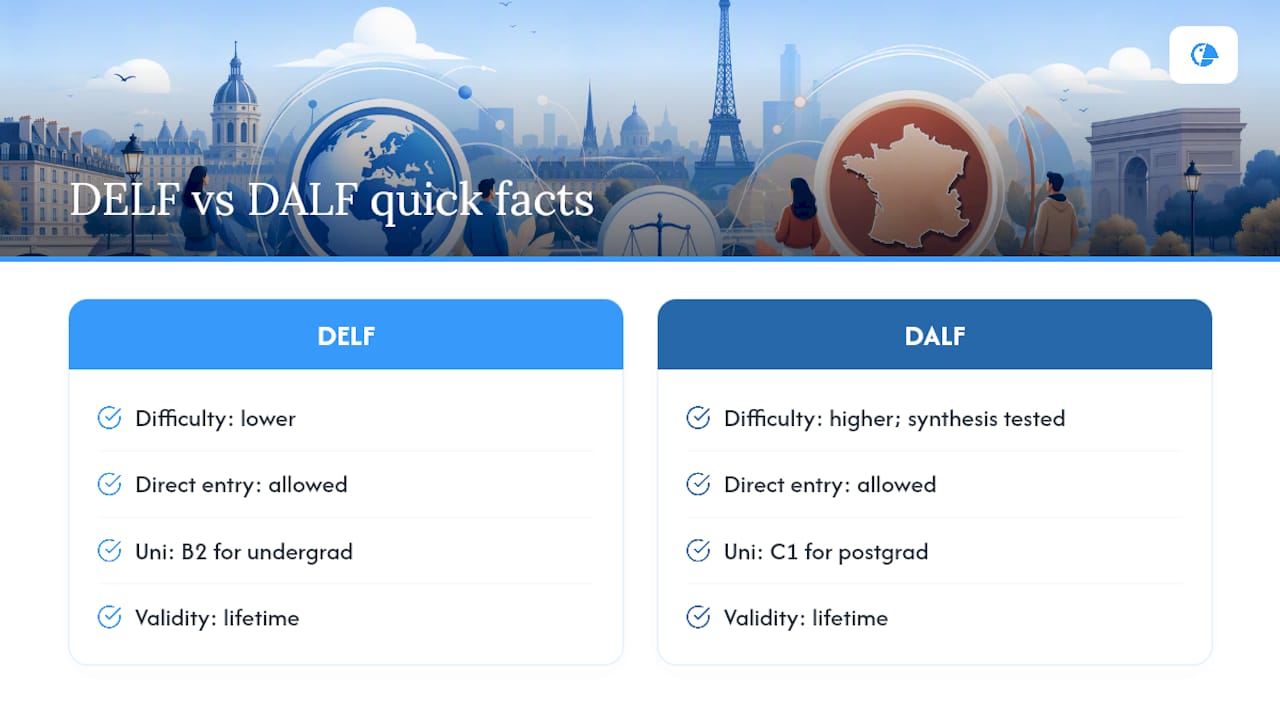
Is DALF harder than DELF? Yes, by design. DALF C1 and C2 require synthesising multiple source documents into a structured argument, a skill DELF never tests directly.
Can I skip straight to DALF without taking DELF first? Yes. Candidates can register directly for any level, including DALF C1 or C2, without proof of a prior diploma.
Which level do most universities accept? DELF B2 is the most commonly requested level for undergraduate admission, while DALF C1 tends to satisfy postgraduate language requirements.
Do DELF and DALF diplomas expire? No. Both are valid for life once you pass, unlike TCF or TEF scores, which typically lapse after a couple of years.
How long does it take to get results? Results are generally issued within a bounded window, often up to two months, though this varies by exam centre and country.
Sources
- DELF/DALF presentation — Embassy of France in Canada
- DELF/DALF exams — Institut français du Canada
- DELF Tout public — France Éducation international