

A repeatable routine—sounds → words → phrases → sentences → connected speech—is the fastest way to fix pronunciation problems that self-study alone can't touch. You run a daily micro-practice on one priority sound, then a weekly review that checks whether it's sticking. That's the whole system. Everything else in this guide fills in the detail so the practice is targeted rather than random.
Here's the two-step action to take right now, before you read another paragraph. First, pick one priority sound that trips you up (English speakers often start with the schwa or TH; French learners usually start with the guttural R or nasal vowels). Second, run a five-minute minimal-pair drill followed by five minutes of shadowing a native speaker, and record yourself doing both. That ten-minute block, repeated daily, is what actually moves the needle. Structured micro-practice sessions of five to fifteen minutes focused on minimal pairs and shadowing produce measurable gains when paired with spaced review.
Quick-start checklist:
- Choose one sound (not five) to work on this week.
- Find three minimal pairs for that sound (e.g. "ship" vs "sheep" for English, "tout" vs "tu" for French).
- Record a five-minute baseline of yourself reading a short paragraph aloud.
- Book ten minutes daily for drilling, and one 20 minute session weekly to review recordings.
- Bookmark one audio dictionary (Cambridge or Forvo) so you always have a native model to copy.
Two-step action plan:
- Today: identify your priority sound, find three minimal pairs, and record your baseline.
- This week: drill that sound for ten minutes daily, then compare your Friday recording against Monday's.
Pro Tip: Don't try to fix everything at once. Pronunciation improves fastest when you isolate one sound family for a full week rather than jumping between five different problems every session.
Key Takeaways
A structured routine, sounds → words → phrases → sentences → connected speech, paired with daily micro-practice and weekly recorded review, is what turns pronunciation study into measurable progress.
| Point | Details |
|---|---|
| Pick one sound at a time | Choose a single priority sound (schwa, TH, guttural R, nasal vowels) and stick with it for at least a week. |
| Run the daily ten-minute drill | Combine five minutes of minimal pairs with five minutes of shadowing native audio, then record it. |
| Use trusted audio dictionaries | Check Cambridge, Oxford, or CMUdict for transcriptions and native audio rather than guessing spelling-to-sound rules. |
| Track progress with recordings | Compare a Monday recording against a Friday one to catch real change instead of relying on how it feels. |
| Get feedback when you plateau | If three weeks of consistent practice brings no change, a private tutor through Tutoroo can diagnose the exact error pattern. |
Frequently asked questions
How long does it take to notice pronunciation improvement? Most learners following a consistent ten-minute daily routine notice a measurable shift in a specific sound within two weeks. Full sentence-level fluency on a new sound, where it holds up in spontaneous conversation, typically takes closer to a month of steady practice.
Do I need to learn the full IPA chart? No. Focus only on the symbols representing sounds that don't exist in your native language. Trying to memorise the entire IPA chart upfront wastes practice time better spent on actual drilling.
What's the fastest way to fix a persistent pronunciation problem? Follow the test, isolate, drill, measure, feedback flow. If two to three weeks of targeted practice brings no change, get a tutor or fluent speaker to listen, since self-assessment has a real ceiling.
Is Forvo or Cambridge better for practice? They serve different purposes. Cambridge gives you a clean, standard reference transcription and audio for both British and American English. Forvo gives you multiple real speakers across various regional accents, useful once you've nailed the standard version and want exposure to natural variation.
How is French pronunciation practice different from English? French practice leans more heavily on articulatory placement, tongue position, nasal airflow, lip rounding, rather than vowel length distinctions, which matter more in English. Liaison and silent letters also demand their own dedicated drilling that English doesn't require in the same way.
Table of Contents
- Pronunciation fundamentals every learner must know
- English: step-by-step routine and priority sounds to practise first
- French: step-by-step routine and priority sounds to practise first
- How do you build a weekly practice routine with measurable milestones?
- Which pronunciation tools and dictionaries are worth using?
- What are the most common pronunciation mistakes and how do you fix them?
- How do you create your own personal pronunciation guide?
- Why one-on-one feedback speeds up pronunciation progress
- Want guided, one-on-one pronunciation practice?
- Sources
Pronunciation fundamentals every learner must know
You don't need a linguistics degree to pronounce clearly, but you do need to understand a handful of building blocks before your practice sessions start paying off. Skipping this step is why so many learners drill for weeks and hear no improvement. They're practising the wrong thing.

A phoneme is the smallest unit of sound that changes meaning in a word (the difference between "bat" and "bad" is one phoneme). Vowels are produced with an open vocal tract and carry pitch and length; consonants involve some kind of blockage or narrowing of airflow, which is why they're easier to isolate and drill. The schwa (/ə/) is the unstressed, relaxed vowel sound that appears in unstressed syllables across English, "the," "about," "banana," and it's arguably the single most under-practised sound in the language because it looks like nothing on the page but shapes how natural your speech sounds.
Word stress refers to which syllable in a word carries emphasis (PHO-to-graph vs pho-TOG-ra-phy), while sentence stress determines which words in a sentence carry the meaning, usually content words like nouns and verbs, while grammar words shrink into weak forms. Intonation is the rise and fall of pitch across a phrase, and it does real communicative work: a rising tone at the end of a statement in English often signals a question or uncertainty, not just politeness.
Rhythm and stress matter more than nailing individual consonants. Sentence stress shapes whether a listener understands you, and weak forms and schwa are what make English sound natural rather than robotic.
The International Phonetic Alphabet (IPA) gives every sound in every language a unique symbol, but memorising the whole chart is a waste of your practice time. Use it selectively, focus only on the symbols for sounds that don't exist in your native language, and skip the rest. The Oxford Advanced Learner's Dictionary lays out IPA symbols alongside plain-English descriptions of features like weak forms, tapping, and the glottal stop, which makes it a genuinely useful reference rather than an academic wall chart.
Key terms worth locking in before you move on:
- Phoneme: the smallest sound unit that changes word meaning.
- Schwa (/ə/): the reduced, unstressed vowel sound found in most unstressed English syllables.
- Weak form: how function words (to, and, of) shrink in connected speech.
- Connected speech: the way sounds link, merge, or drop between words in natural talk.
Cambridge's pronunciation resources pair IPA transcriptions with actual audio for both British and American accents, and the CMU Pronouncing Dictionary does something similar for North American English using ARPAbet notation across more than 134,000 entries, handy if you ever want to look up a word's phoneme breakdown programmatically rather than by ear.
Pro Tip: Treat pronunciation as a motor skill, not a knowledge problem. Your tongue, lips, and jaw need repeated physical practice to form new habits. Understanding a sound intellectually doesn't mean your mouth can produce it yet.
English: step-by-step routine and priority sounds to practise first
English pronunciation problems cluster around a small set of recurring trouble spots, and fixing those first gets you more intelligibility gain per minute of practice than trying to sound "native" across the board. Here's the order that works.
- Analyse the target sound. Identify exactly where your tongue, lips, or jaw need to sit. For TH sounds (/θ/ as in "think," /ð/ as in "this"), the tongue tip needs to touch or nearly touch the back of the top front teeth, a position most learners' native languages never require.
- Drill minimal pairs. Practise word pairs that differ by only the target sound.
- Move to whole words. Say the sound in five to ten different words, varying its position (start, middle, end).
- Build short phrases. Combine two or three words containing the sound.
- Practise full sentences. Slow down, then speed up to natural pace.
- Shadow a native speaker. Play a short audio clip and speak along in real time, matching rhythm and pitch, not just individual sounds.
- Record and compare. Listen back against the native model and note the gap.
Your priority list for English, in rough order of impact:
- Schwa (/ə/): the unstressed vowel in "about," "sofa," "the." Mispronouncing this makes speech sound stilted even when every consonant is perfect.
- Vowel length pairs: /ɪ/ vs /iː/ ("ship" vs "sheep," "live" vs "leave"). This pair alone causes more real-world misunderstandings than almost any consonant error.
- TH sounds (/θ, ð/): "think" vs "sink," "this" vs "diss."
- /r/ variation: how strongly the /r/ is pronounced varies by accent, but consistency matters more than which variant you choose.
- Consonant clusters: words like "strengths" or "sixths" stack multiple consonants with no vowel breaks, which is rare in most other languages.
- Linking and tapping: how "not at all" becomes something closer to "no-ta-tall" in fast natural speech.
Sample minimal pairs to drill: "bit/beat," "full/fool," "thin/sin," "then/den," "cot/cut," "light/right." Say each pair five times, then record yourself saying ten random words containing the sound and check them against a native model.
Statistic check: Howjsay's free audio dictionary currently holds more than 181,987 pronunciation entries recorded by native speakers, which gives you an enormous pool of real audio to shadow rather than relying on robotic text-to-speech playback.
For your daily drill plan, keep sessions short and frequent rather than long and rare:
- Morning (5 minutes): minimal pair drill on this week's target sound.
- Midday (5 minutes): shadow one short audio clip from BBC's Tim's Pronunciation Workshop, which covers connected speech features like linking, assimilation, and elision in bite-sized episodes.
- Evening (5 minutes): record ten sentences using today's sound, listen back once.
If you're not there by week two, you're either drilling the wrong sound or need a second pair of ears (a tutor) to tell you what your own ear is missing.
French: step-by-step routine and priority sounds to practise first
French rewards a slightly different approach than English because so many of its defining features, nasal vowels, liaison, silent letters, live in places English speakers don't expect to look. The routine still follows the same logic, but the emphasis shifts toward articulatory placement over vowel length.
The order for French practice:
- Identify the target sound and understand where it's produced (back of the throat for the guttural R, through the nose for nasal vowels).
- Practise articulation in isolation, ignoring word meaning entirely at first. Just get the mouth shape right.
- Drill minimal pairs once the isolated sound feels stable.
- Practise liaison and elision in short scripted phrases.
- Move to phrase-level and sentence-level practice, reading aloud with a native audio model playing alongside you.
Your French priority list:
- The guttural R: produced at the back of the throat, unlike the English /r/. Most learners overcorrect into a rolled Spanish-style R, which is equally wrong.
- Nasal vowels (ɑ̃, ɔ̃, ɛ̃): as in "sans," "son," "vin." Air flows through the nose and mouth simultaneously, a mechanism most English speakers have never consciously used.
- Front rounded vowels (y): as in "tu" versus "tout." The lips round like they're saying "oo" while the tongue stays forward like it's saying "ee."
- Silent letters and liaison: French drops many word-final consonants in isolation but "links" them when the next word starts with a vowel ("les amis" sounds like "lez-ami").
- Vowel length and schwa handling: French schwa behaves differently to English schwa and often disappears entirely in casual speech ("je ne sais pas" often becomes "j'sais pas").
Minimal pairs worth drilling: "tu/tout," "rue/roue," "vin/vent," "bon/banc," "dessus/dessous." For liaison, script short phrases and mark where the link happens: "les enfants" (link the S to the following vowel), "un grand ami" (link the D), "vous avez" (link the S).
Don't chase full IPA fluency for French. Focus your energy on articulatory placement, where the tongue sits, whether air goes through the nose, how rounded the lips are, because that's what actually changes how you sound, more than memorising transcription symbols ever will.
A daily drill plan tuned to French:
- 5 minutes: nasal vowel drills, repeating minimal sets like "banc/bon/bain" to feel the difference between the three nasal qualities.
- 5 minutes: read a short paragraph aloud, marking every liaison point beforehand, then checking your recording against a native model.
- 5 minutes: shadow a French news clip or podcast segment, focusing purely on rhythm and linking rather than individual words.
Pro Tip: Record yourself saying the same five sentences on Monday and Friday. French liaison mistakes are often invisible to your own ear until you hear a week-old version of yourself getting it wrong the same way.
How do you build a weekly practice routine with measurable milestones?
A routine only works if you can tell whether it's working, and most learners never set up a way to measure that. Here's a structure that scales from ten minutes a day up to a full immersive schedule, plus checkpoints so you know when to change tack.
| Day | Focus | Time |
|---|---|---|
| Monday | Minimal pair drill (new sound) | ten minutes |
| Tuesday | Shadowing native audio | ten minutes |
| Wednesday | Record and self-compare | ten minutes |
| Thursday | Phrase and sentence practice | ten minutes |
| Friday | Weekly review recording | 15 minutes |
| Weekend | Free conversation or reading aloud | 15 to 20 minutes |
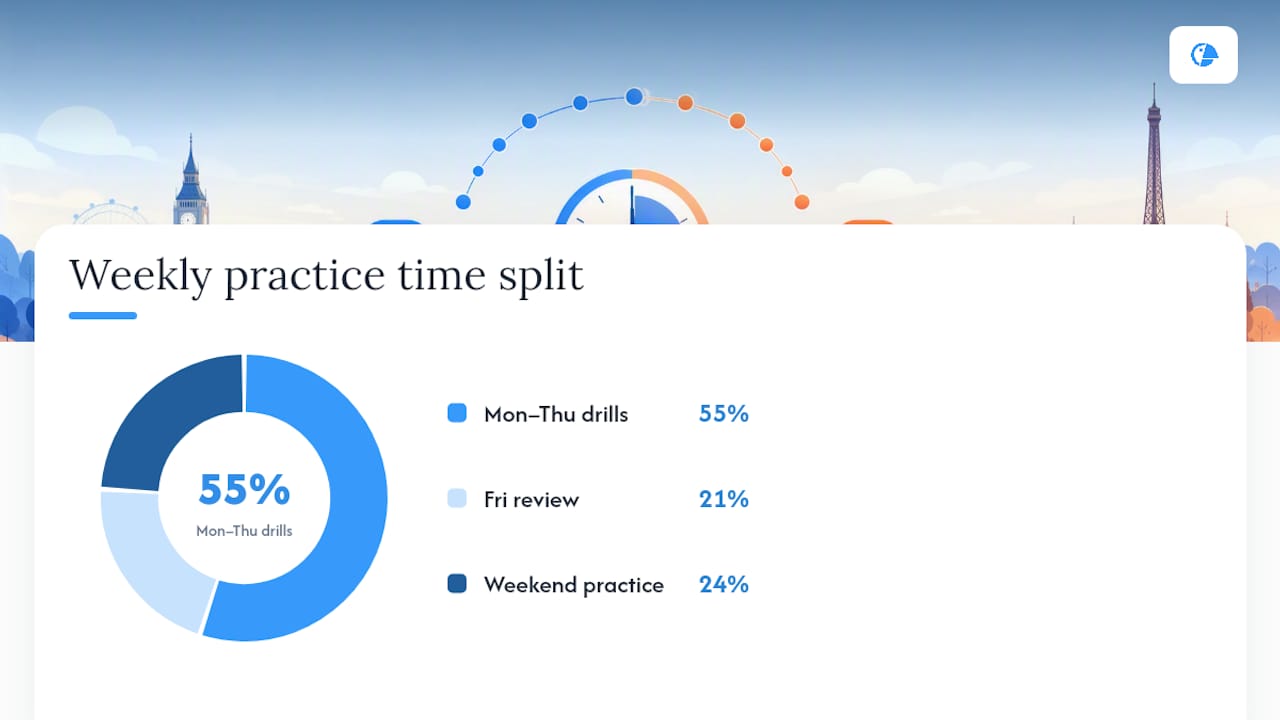
If you've got more time, double each session rather than adding new sounds, depth beats breadth every time in early pronunciation work.
Milestone checkpoints to track:
- Two weeks in: you should hit roughly 80% accuracy on your priority sound's minimal pairs when recorded cold.
- One month in: a native speaker or tutor should be able to understand you without asking for repetition on common vocabulary containing your target sounds.
- Three months in: you should be able to shift between two or three previously mastered sounds without regression, and be ready to pick a new priority sound.
Self-assessment doesn't need fancy equipment. Record yourself on your phone, wait 24 hours, then listen back "blind," without reading the script, and mark every place you flinch or notice a mismatch against the native model. If you have access to a free spectrogram app, comparing your vowel formants visually against a native clip can catch subtle vowel-length errors your ear might miss. But don't let the tech become a distraction: the recording-and-listening habit matters far more than the analysis tool.
Keep the distinction between "intelligible" and "native-like" clear in your own head. Intelligibility, being understood without repetition, is the goal for the first three months. Native-like accuracy is a much longer project, and chasing it too early tends to slow down basic communication progress.
Which pronunciation tools and dictionaries are worth using?
Not every tool deserves a spot in your routine. These six are worth bookmarking because each does one job better than the alternatives, and knowing which is which saves you from bouncing between apps without a plan.
- Cambridge English Dictionary: use this when you need both UK and US audio for the same word side by side, plus a clean IPA transcription. It's the fastest way to settle "wait, how is this actually said?" arguments with yourself.
- Oxford Advanced Learner's Dictionary: reach for Oxford when you want the phonetic key explained in plain language alongside the transcription, particularly useful for understanding features like weak forms and the glottal stop rather than just seeing the symbols.
- CMU Pronouncing Dictionary (CMUdict): this is the one for programmatic or automated lookup. If you're building your own word list with ARPAbet transcriptions or working with text-to-speech tools, CMUdict's open-source database covers more than 134,000 North American English words.
- Forvo: the best source for regional native-speaker clips recorded by real people, not synthesised voices. Search a word and you'll often get five or six different accents pronouncing it.
- Howjsay: a fast, no-frills audio dictionary with over 181,987 entries, useful when you just need to hear a word once and move on.
- BBC's Tim's Pronunciation Workshop: short, structured episodes on connected speech, linking, assimilation, elision, that go beyond single-word pronunciation into how English actually flows in context.
- YouGlish: search a word and get it pulled from real YouTube clips in context, useful for hearing how a sound behaves inside natural sentences rather than in isolation.
For recording and self-analysis, your phone's voice memo app is genuinely enough for the first few months. If you want more detail later, Audacity is a free, open-source option that shows waveforms and lets you slow down native audio without changing pitch, useful for catching fast connected-speech features you'd otherwise miss.
Pro Tip: Automated phonetic converters (the kind that spit out an IPA transcription from typed text) are handy for a quick reference, but they're no substitute for listening. Always check the transcription against real native audio before you trust it, converters occasionally miss regional variation or connected-speech reductions.
If you want a broader view of how these resources fit into a wider learning plan, this step-by-step language learning guide covers how pronunciation practice slots alongside vocabulary and grammar work.
What are the most common pronunciation mistakes and how do you fix them?
Most pronunciation problems fall into a small number of recognisable patterns. Here's a diagnostic checklist and a fix for each one.
Common English errors:
- TH substitution ("think" becomes "sink" or "tink"): fix with tongue-tip-to-teeth placement drills, then minimal pairs (thin/sin, though/dough), five minutes daily for a week.
- Schwa over-pronunciation (stressing every syllable equally): fix by marking stressed syllables in a script beforehand, then deliberately underplaying the unstressed ones during read-aloud practice.
- Wrong stress placement (PHO-to-graph vs pho-TOG-ra-phy): fix by checking word stress in Cambridge's dictionary entry before you say a new multisyllabic word aloud for the first time.
- Dropped final consonants: fix with word-final consonant drills, focusing on completing the sound rather than trailing off.
- Missing linking: fix by scripting connected phrases and marking link points, then shadowing BBC's connected-speech episodes.
Common French errors:
- English-style rolled or American R instead of the guttural French R: fix with isolated back-of-throat gargling exercises before attaching the sound to any word.
- Nasal vowel confusion (mixing up ɑ̃, ɔ̃, ɛ̃): fix with minimal triplets like "banc/bon/bain," drilled slowly with a mirror to check lip and jaw position.
- Liaison mistakes (linking where you shouldn't, or missing a required link): fix by scripting phrases in advance and marking every liaison point before reading aloud.
- Ignoring silent letters: fix by reading transcriptions alongside spelling until the pattern becomes automatic for common word endings.
Ordered troubleshooting flow to follow whenever a sound isn't improving:
- Test: record yourself producing the sound in isolation, in a word, and in a sentence.
- Isolate: figure out which context (isolation, word, sentence) is where the error actually happens.
- Drill: target that specific context with minimal pairs or shadowing.
- Measure: re-record after one week and compare against your baseline.
- Seek feedback: if there's no improvement after two consistent weeks, get a second opinion from a tutor or fluent speaker. Self-assessment has a ceiling, you genuinely can't always hear your own errors.
Red flags that it's time for one-on-one help: you've plateaued despite consistent daily practice for three or more weeks, or native speakers regularly ask you to repeat the same words in real conversation. Both are signs that self-diagnosis has hit its limit and outside feedback will move you faster than more solo drilling.
How do you create your own personal pronunciation guide?
A personal guide, built as a simple spreadsheet or notebook, turns scattered practice into a system you can actually track over months. Here's how to set one up.
- Choose your target sounds for the current month (no more than two or three at a time).
- Collect 20 to 50 words containing those sounds, pulled from vocabulary you're already learning rather than random word lists.
- Add dictionary transcriptions and audio links for each word from Cambridge, Oxford, or CMUdict.
- Record native models (save the audio link or a short voice clip) alongside your own recording of the same word.
- Schedule reviews using spaced repetition, revisit each word after one day, then three days, then a week, then a month.
Sample spreadsheet fields:
- Word
- IPA transcription
- Audio link (dictionary source)
- Date first recorded
- Date last reviewed
- Improvement notes (what changed, what's still off)
A five-step method for working out unfamiliar words, find the vowels, divide into syllables, pronounce each syllable, work out the stress, then say the whole word smoothly, fits neatly into the "collect words" step above and gives you a repeatable process for any new word you meet outside a dictionary.
Keep the guide small enough to actually maintain. Fifty words reviewed properly beats five hundred words added and never revisited. If a tutor or fluent friend corrects you mid-conversation, add that word to the guide immediately, corrections caught in real speech are worth more than words picked from a list because they represent an error you're actually making, not one you might make.
Why one-on-one feedback speeds up pronunciation progress
Self-study gets you a long way, but there's a ceiling built into working alone: you can't always hear your own mistakes, no matter how many recordings you make. A trained ear catches in thirty seconds what might take you three weeks of guessing to isolate. That's not a knock on the routines in this guide, they work, but they work faster with a second, expert opinion layered on top.
Tutors typically diagnose problems by listening for patterns across a conversation rather than isolated words, which is exactly the kind of error self-recording tends to miss. A learner might nail every minimal pair drill in isolation and still stumble on the same sound the moment it's embedded in fast, natural speech, and that's precisely the gap a live listener catches immediately.
Teacher tip: a focused 15-minute tutor session, spent entirely on one priority sound, can generate a full week of targeted homework: three specific minimal pairs, two shadowing clips, and a clear benchmark for what "fixed" sounds like. That's far more efficient than a learner guessing which of five possible problems to drill next.
Connecting with a private tutor through a platform like Tutoroo gives you exactly this kind of targeted, personalised diagnosis, someone who can hear your specific error patterns and build a practice plan around them rather than a generic one. The tutoring process itself is built around setting clear pronunciation goals early and tracking them session by session.
Want guided, one-on-one pronunciation practice?
If a plateau shows up after a few weeks of solo drilling, the fastest fix isn't a new app, it's a trained ear listening to you speak in real time. Tutoroo connects you directly with private language tutors, online or in person, who can hear the specific pattern behind your pronunciation errors and build a week of homework around it, the same way a physiotherapist would design exercises around exactly where your movement breaks down.

Getting started takes three steps:
- Search for a tutor in your target language and filter by availability, location, or teaching style.
- Message a few tutors directly through the platform to ask about their approach to pronunciation coaching specifically.
- Book a session and bring your recorded baseline so the tutor can diagnose your priority sounds from minute one.
Tutoroo's community includes tutors across dozens of languages, so whether you're chasing English connected speech or French liaison, you can find someone who specialises in exactly that. Start by browsing private language tutors on Tutoroo and messaging one who fits your schedule, or check the step-by-step guide to hiring the right tutor if you're not sure what to ask in that first message.
Sources
A handful of resources cover almost everything you'll need across both languages, and knowing which one to reach for saves time compared to searching blindly each time a new word trips you up.
- The CMU Pronouncing Dictionary
- Cambridge English Dictionary — Pronunciation
- Pronunciation (Oxford Learner's Dictionaries)
When citing pronunciation sources in your own guide, note both the resource name and the specific transcription style (IPA versus ARPAbet), since mixing notation systems in one spreadsheet gets confusing fast. Cambridge and Oxford both use IPA, while CMUdict uses ARPAbet, so keep a note of which one you're pulling from in each entry.