

Hire a private tutor matched to one clear, measurable goal, then prove the fit with a short trial before committing to a bundle. Success looks like this: after two or three trial lessons, you understand their correction style, they've adjusted to your level within minutes, and you can picture doing this every week for a year. Platforms such as Tutoroo exist precisely to help you find and message several matched tutors quickly, so you're comparing real fit, not guessing from a static profile photo.
TL;DR:
- Trial lessons should be short and focus on assessing the tutor's ability to tailor lessons to your specific goal within the first 20 to 30 minutes.
- Expect to pay between entry-level, standard, and top-tier rates based on credentials, with higher rates offering more structured curriculum and specialization.
- Setting a goal beforehand filters tutor options effectively, with video introductions providing better insight than written profiles alone.
- The most successful learners show up regularly, with twice-weekly lessons providing the best balance between progress and workload.
- Using a dedicated platform like Tutoroo simplifies comparing and messaging multiple tutors, enabling quick validation of credentials and teaching approach.
Table of Contents
- How to choose an Italian tutor: a goal-first checklist
- Lesson formats and scheduling: choose the right delivery
- Pricing expectations and budgeting for lessons
- Run trial lessons and structure your first month for reliable gains
- Why a vetted matching service helps — Tutoroo's proof points
- Learner perspective: what actually worked for real adults
- How Tutoroo can help you put the checklist into practice
- Sources
- FAQ
How to choose an Italian tutor: a goal-first checklist
Most people choose an Italian tutor the way they choose a streaming service: scroll, skim, pick whoever looks friendliest. That approach wastes weeks and money, because a tutor who's brilliant for exam prep may bore a learner who just wants to order confidently in Florence. Start with the goal, not the profile.
Write a single line before you look at a single tutor. Something like: "I want to hold a 10 minute conversation about my job in six months," or "I need CILS B1 certification by September." That sentence becomes your filter for everything that follows.
1. Match qualifications to your goal. Exam candidates need someone who has actually prepared students for CILS, CELI, or PLIDA, not just a native speaker with good grammar. Conversation-focused learners benefit more from an engaging communicator than a linguistics graduate. Business Italian learners should ask directly whether the tutor has taught professional vocabulary before, because generic conversation tutors often haven't.
2. Watch the intro video before reading the bio. A tutor's written profile tells you what they claim; a short video tells you how they actually speak, how fast, and whether their manner suits you. This single habit filters out more bad matches than any review score.
3. Check reviews for specifics, not stars. A 5.0 rating with three generic comments tells you less than a 4.8 rating where students mention "helped me stop translating in my head" or "patient with my terrible verb conjugations."
4. Confirm availability and language overlap before you get attached. A tutor teaching from Rome at 8pm CET might be 2am for you. Check whether lessons happen in English, Italian, or a mix, since some tutors teach immersion-only from lesson one.
Once you've filtered on those four points, build a shortlist of exactly three finalists. More than that and you'll drown in messages; fewer and you have no comparison.
- Send all three the identical message: your goal sentence, your current level (even a rough guess), and your preferred lesson time.
- Book a trial with each before deciding on anyone.
- Compare response time and clarity of reply, not just the lesson itself.
Pro Tip: Ask each finalist one identical question in your trial message: "How would you structure my first month?" A vague answer or a copy-paste response is often the clearest red flag you'll get before ever paying for a lesson.
Watch for a few warning signs while you shortlist. A tutor who won't do a short trial before a bundle purchase is asking you to trust blindly. One who can't explain their method beyond "we'll just chat" often lacks a structured approach for actual progress. And a profile with reviews that all read like they were written by the same person, same day, deserves a second look before you commit.
Lesson formats and scheduling: choose the right delivery
Online one-to-one lessons suit anyone whose schedule doesn't line up with local tutors, and they widen your pool from a handful of nearby teachers to hundreds of native speakers across Italy. In-person lessons suit learners who want the accountability of leaving the house and who value body language and real-world context, especially if you're preparing to live or travel there soon.
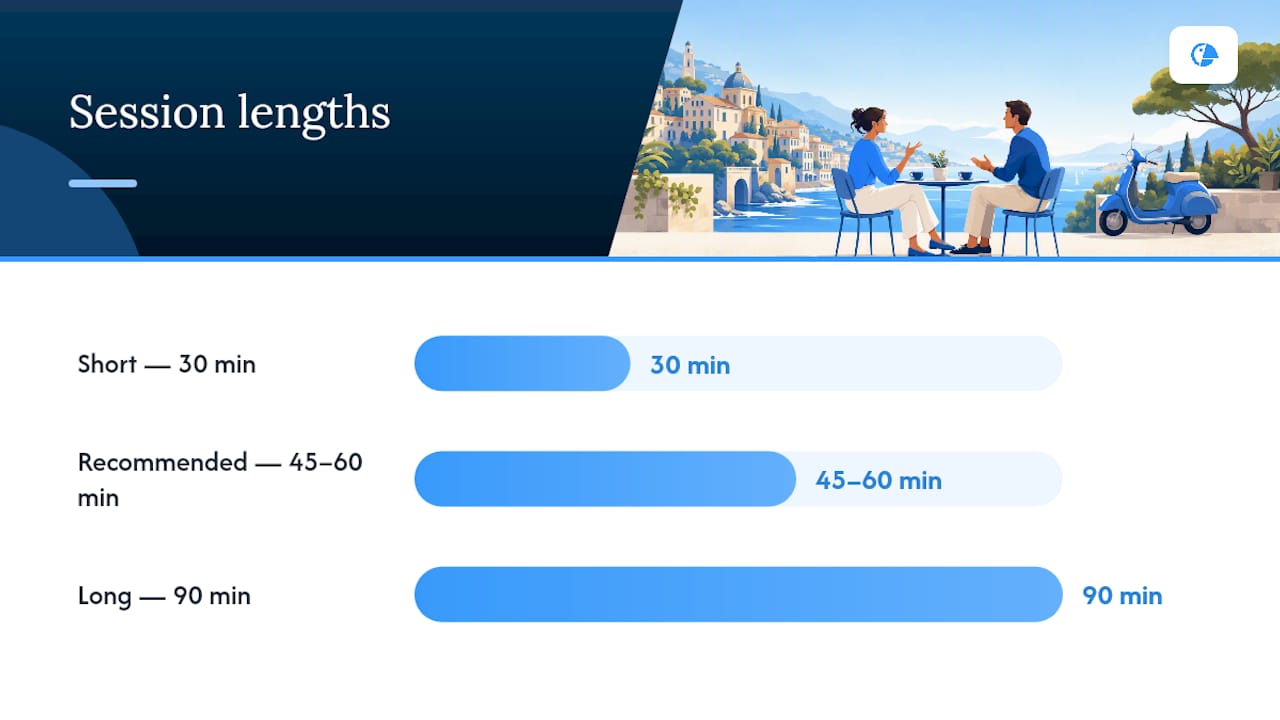
Session length matters more than most learners assume. A 30 minute lesson barely gets past warm-up chat; a 90 minute lesson risks fatigue and diminishing returns for most working adults. Most tutors and learners settle on 45 to 60 minutes as the practical middle ground.
On frequency, the research is fairly consistent: twice a week is the commonly recommended cadence for adults balancing steady progress against homework load and burnout. Once a week tends to lose momentum between sessions; four or five times a week is only realistic if you've got the time and the budget.
- Once weekly: maintenance pace, fine for slow, low-pressure progress.
- Twice weekly: the balance point most learners settle on.
- Three or more weekly: fast progress, but demands genuine time for review between sessions.
Bundles and block bookings usually drop the per-lesson price by 10 to 20% but lock you into a longer commitment before you've proven the tutor is right for you. That's exactly why the trial comes first, always, before any bundle purchase.
Pro Tip: Pair your live lessons with a structured app or podcast for the days in between. Research on adult language acquisition shows active speaking practice with corrective feedback drives far more progress than passive listening alone, so apps work best as reinforcement, not a replacement for your tutor's feedback.
Pricing expectations and budgeting for lessons
Private Italian lessons typically fall into three price bands, and each buys a genuinely different experience. Entry-level conversation partners, often non-certified native speakers, tend to sit at the bottom of the market and suit learners who mainly want speaking practice and confidence, not structured curriculum.
Standard-rate tutors, usually trained teachers or native speakers with several years of tutoring experience, occupy the middle band and typically offer lesson planning, homework, and progress tracking. Top-tier tutors, specialists in exam preparation or business Italian with formal qualifications, command the highest rates because they bring a proven syllabus and specific outcomes.
- Entry-level: casual conversation partners, best for confidence building and speaking volume.
- Standard: trained tutors with structured lessons, homework, and clear progression.
- Top-tier: exam specialists or business-Italian experts with a track record in that specific outcome.
Price guidance across tutor platforms shows the gap between bands is often substantial, driven mostly by credentials and specialisation rather than nationality alone. A trained non-native teacher who has spent years explaining Italian grammar to English speakers can outperform a native speaker with no teaching background, particularly for beginners who need clear explanations rather than pure immersion.
Budget sustainably by working backwards from frequency: two lessons a week at even a modest rate adds up monthly, so decide your ceiling before you start browsing. Accept a lower-rate tutor when your goal is speaking volume and confidence. Invest in a higher-rate specialist when you're working toward a specific exam, certification, or professional deadline, where the wrong guidance costs you more time than the extra cost of the lesson.
Run trial lessons and structure your first month for reliable gains
A trial lesson has one job: prove whether this tutor can adapt to you, not showcase their teaching in general. Keep it to 20 to 30 minutes and test three things specifically: do they ask about your goal before diving in, do they adjust their pace to your actual level, and how do they correct mistakes, gently mid-sentence or with a note at the end?
- Week 1: Establish baseline. The tutor should assess your level honestly, even if it stings, and agree on a realistic first-month focus, whether that's survival vocabulary, verb conjugation, or conversational flow.
- Week 2: Introduce light homework, five to ten minutes a day, and one review checkpoint mid-week to catch misunderstandings early.
- Week 3: Push into slightly harder territory, longer sentences, more spontaneous speaking, less reliance on English.
- Week 4: Review against your original goal sentence. Can you actually do the thing you said you wanted to do in month one?
- Keep a simple log: three sentences after each lesson on what felt easy and what felt hard.
- If you're still translating in your head by week four, that's not failure, but it is a signal to discuss method with your tutor directly.
- Decide to continue, adjust, or switch based on that log, not on how much you liked the tutor personally.
Standardise your trial questions across every tutor you try, since comparing identical questions across candidates reveals real differences in responsiveness and teaching clarity far faster than judging each tutor in isolation. A message template helps here too: state your goal, your level, your available times, and ask directly how they'd structure a first month. The tutor who answers specifically is usually the one worth trialling first.
Why a vetted matching service helps — Tutoroo's proof points
Choosing blind from a search engine or a local noticeboard means you're evaluating one tutor at a time with no easy way to compare. A dedicated matching platform flips that: Tutoroo's Italian tutor page lets you filter by availability, price, and language spoken, and see intro videos before you send a single message, which is exactly the shortlist process the checklist above depends on.
The platform connects learners with a global community of tutors, and its messaging system lets you send that identical trial question to several candidates at once without juggling emails or booking apps. That speed matters most in the first week, when momentum is fragile and a slow reply can quietly kill your motivation to start at all.
To verify credentials properly on any platform, ask directly:
- Which exams or curricula have you actually prepared students for, and how many?
- Can I see or hear a short teaching sample before booking a paid block?
- What happens if the first lesson isn't the right fit, is there a trial or replacement option?
Those three questions, asked identically across your shortlist, do more to reveal genuine teaching quality than any star rating ever will.
Learner perspective: what actually worked for real adults
The learners who stick with Italian long enough to actually speak it aren't the ones who found the "best" tutor. They're the ones who trialled a few, picked someone tolerable rather than perfect, and showed up twice a week regardless of motivation that day. Time pressure and flagging motivation kill more language goals than a mismatched tutor ever does. If there's one thing worth obsessing over, it's consistency, not the perfect first choice.
— Tutoroo
How Tutoroo can help you put the checklist into practice
Tutoroo cuts the guesswork out of finding a tutor by putting the whole shortlist process in one place, browse profiles, watch intro videos, filter by availability and price, and message several candidates the same way you'd compare quotes from tradespeople, all before you commit to a single lesson.
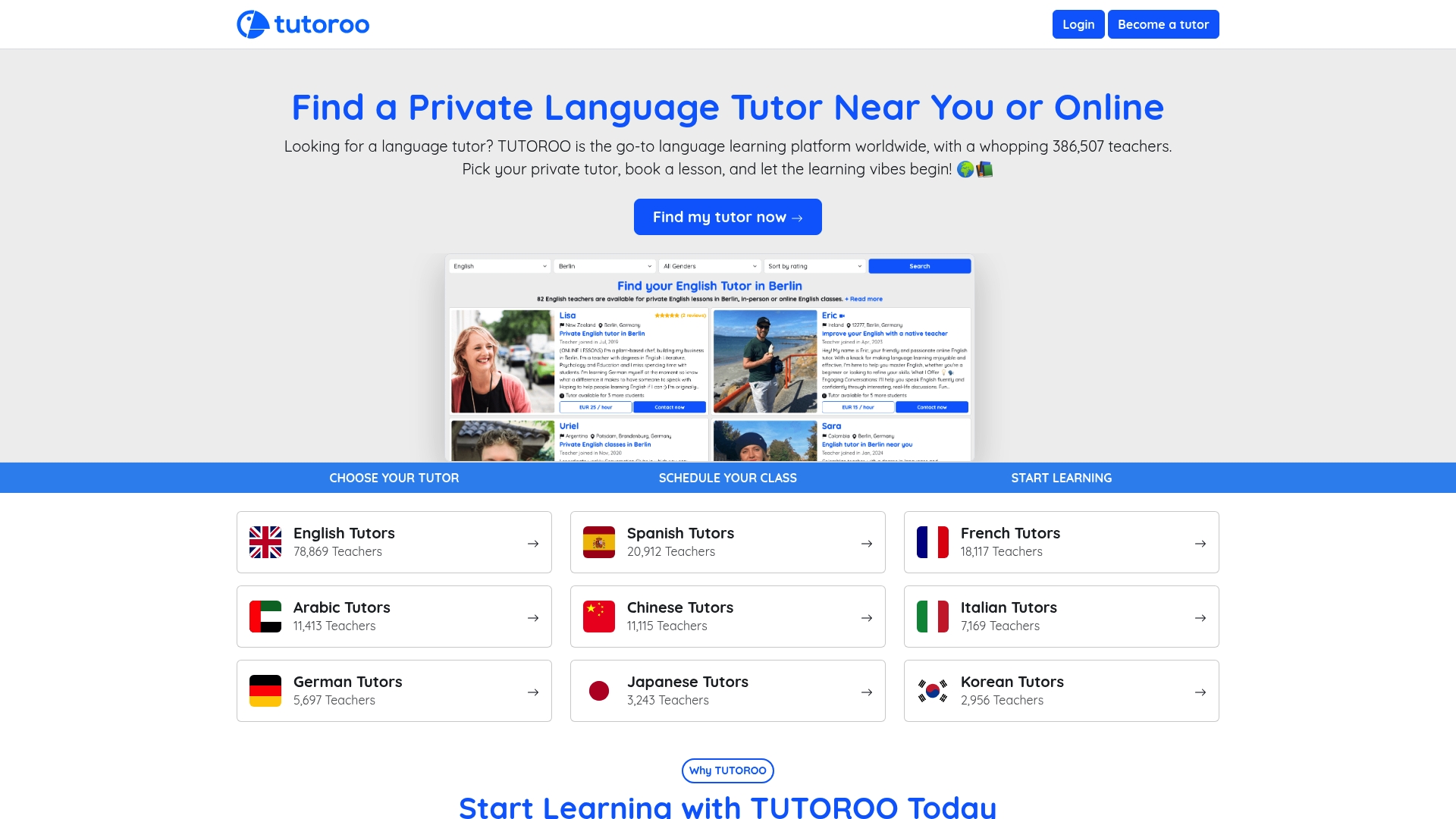
On the Italian tutor page, you'll find tutors ranging from casual conversation partners to certified exam specialists, each with a video introduction and recent student feedback, so you can apply the goal-first filter from this guide in minutes rather than days. The messaging system means your standardised trial question reaches every finalist at once, and you'll see who replies fastest and most specifically, exactly the signal worth trusting over a polished bio.
If you've written your goal sentence and shortlisted your three finalists, the next step is simple: head to Tutoroo and start those conversations today. Trial lessons cost you thirty minutes; skipping them can cost you a wasted month.
Sources
For the evidence behind the speaking-first approach, the PMC review of speaking practice and feedback lays out why active production beats passive study for adult learners. For practical method comparisons and pricing context, the ranked guide to learning Italian methods is worth a read. For hands-on next steps, Tutoroo's own guide to hiring the right language tutor and guide to evaluating private teachers expand on the checklist covered here.
- The role of speaking practice and feedback in language learning (PMC article)
- Best way to learn Italian in 2026 — 6 methods ranked for English speakers
FAQ
What is the best way to learn Italian?
Combining structured self-study, apps or audio courses, with regular live conversation lessons produces faster gains than either method alone, since active speaking practice with corrective feedback drives most of the real progress.
How much are private Italian lessons?
Rates vary by tutor experience and specialisation: casual conversation partners sit at the lower end, trained tutors with structured lessons sit in the middle, and certified exam or business-Italian specialists command the highest rates, reflecting documented price band differences across tutoring platforms.
Is $50 an hour too much for tutoring?
It depends entirely on what you're paying for. For a certified exam specialist or business-Italian expert with a proven track record, that rate can be reasonable; for a casual conversation partner with no teaching credentials, it's worth comparing against standard-tier alternatives before committing to a bundle.
What is the best platform to find an Italian tutor?
A platform that lets you filter by availability and price, watch intro videos, and message multiple tutors directly speeds up the whole selection process considerably. Tutoroo's Italian tutor page is built around exactly that shortlist and trial workflow.