

Learn Latin American Spanish first if you're a general learner, since it gives you wider exposure through media, travel and everyday conversation across two dozen countries. Choose Castilian Spanish if you're headed for study, work or life in Spain specifically. Either path is compatible with the other: the two varieties are mutually intelligible, and a tutor through Tutoroo can help you build fluency in whichever one matches your goals, then bridge across later.
TL;DR:
- Latin American Spanish offers broader media exposure and easier understanding, making it more practical for most learners without specific regional ties.
- Pronunciation differences such as seseo, yeísmo, and final-s aspiration vary regionally within Latin America, affecting listening and speaking skills.
- In Spain, vosotros is used for informal plural, whereas Latin America relies on ustedes in all contexts, impacting verb conjugations and pronoun practice.
- Vocabulary distinctions like coche versus carro and indigenous-influenced words are region-specific, requiring targeted learning based on travel or social plans.
- Focusing on one variety initially helps build fluency faster, with mutual intelligibility making transition or exposure to other dialects easier over time.
Table of Contents
- Castilian vs Latin American Spanish: the pronunciation gap you'll hear first
- Vosotros, ustedes and voseo: which pronouns actually matter?
- Everyday vocabulary: the words that trip up every learner
- Verb tense habits that shape real conversation
- Which Spanish should I study? A decision checklist
- How to train your ear and mouth for either variety
- How Tutoroo helps you practise the variety you choose
- Mutual intelligibility: do you really need to pick one?
- Regional accents inside Latin America: it's not one Spanish
- How indigenous languages shaped Latin American Spanish
- Formal and informal speech: politeness rules differ by region
- Why Castilian and Latin American Spanish split in the first place
- Subjunctive mood: does it change between varieties?
- Idioms that give away where someone learned their Spanish
- A teacher's perspective: chase communication, not accent perfection
- Get started: book targeted practice with a native tutor
- Sources
- FAQ
Castilian vs Latin American Spanish: the pronunciation gap you'll hear first
The most obvious difference between Castilian and Latin American Spanish hits your ears before it touches your grammar. In much of Spain, speakers use distinción: the letters z and soft c get a "th" sound, so cinco sounds closer to "thin-co." Most of Latin America uses seseo instead, pronouncing those same letters as a plain "s." That single shift changes how casa (house) and caza (hunt) sound in Spain (different) versus most of Latin America (identical).
A second pattern, yeísmo, affects how ll and y are pronounced. Most speakers in Spain and Latin America merge the two sounds, but Rioplatense Spanish (Argentina, Uruguay) pushes it further, turning ll and y into something closer to the English "sh." So calle (street) can sound like "CAH-yeh," "CAH-jeh" or "CAH-sheh" depending on where you're standing.
Then there's final-s aspiration, common across the Caribbean and coastal Latin America, where s at the end of a syllable softens or disappears entirely. Estás can come out sounding closer to "ehtá."
Practical drills that actually help:
- Listen for minimal pairs like casa/caza to train your ear for distinción.
- Shadow a Rioplatense podcast for ten minutes to catch the "sh" yeísmo pattern.
- Record yourself repeating a sentence with soft final-s, then compare it to a Caribbean news clip.
Pro Tip: Don't try to master every accent at once. Pick one region's audio source, stick with it for a fortnight, then introduce a second accent once the first one stops sounding "foreign" in your ears.
Vosotros, ustedes and voseo: which pronouns actually matter?
Pronoun choice is where Castilian and Latin American Spanish diverge most sharply in daily conversation. In Spain, vosotros is the standard informal plural "you," used constantly among friends, family and classmates. It's almost entirely absent from spoken Latin American Spanish, where ustedes covers both formal and informal plural address.
That single swap changes verb conjugation patterns you'll need to drill:
- Vosotros habláis (Spain, informal plural) becomes ustedes hablan (Latin America, all registers).
- Vosotros sois becomes ustedes son.
Voseo adds another layer in parts of Latin America, especially Argentina, Uruguay and pockets of Central America, where vos replaces tú for informal singular "you," carrying its own verb forms (vos hablás instead of tú hablas).
Tense preference shifts too. Spain leans on the present perfect for same-day events: He comido ("I've eaten"). Much of Latin America prefers the simple past for the identical moment: Comí. Neither is wrong. They're just different defaults for the same idea.
Everyday vocabulary: the words that trip up every learner
Vocabulary differences between Castilian and Latin American Spanish rarely block understanding, but they do slow you down until you've mapped the common swaps. These are the pairs you'll hit within your first week in either region:
- Transport: coche (Spain) vs carro or auto (Latin America) for car.
- Technology: móvil (Spain) vs celular (Latin America) for mobile phone; ordenador (Spain) vs computadora (Latin America) for computer.
- Food and drink: zumo (Spain) vs jugo (Latin America) for juice.
- Household: piso (Spain) vs departamento or apartamento (Latin America) for apartment.
Regional variation inside Latin America itself adds another wrinkle. Mexicans say computadora, Argentines often say the same, but word choice for "straw" alone shifts between pajita, pitillo, sorbete and bombilla depending on the country. Context almost always fills the gap: if someone hands you jugo at breakfast, you don't need the dictionary.
The practical fix is a two-track vocabulary method. Learn the term used where you're actually going or speaking, then keep a mental note of the neutral or Spain-based alternative so you're not lost reading a menu or subtitle from a different region.
Verb tense habits that shape real conversation
Beyond the vosotros/ustedes split, tense preference is the grammar habit most likely to trip up a learner mid-conversation. Spain's preference for the present perfect on same-day actions (Hoy he trabajado mucho, "I've worked a lot today") contrasts with the Latin American pull toward the simple past for the same sentence (Hoy trabajé mucho).
Smaller habits vary too:
- Diminutives get heavier use in much of Latin America. Ahorita (a softened "now") and cafecito (a small coffee, or an invitation to chat) appear constantly in Mexican and Central American speech.
- Pronoun placement with commands shifts slightly by region, though it rarely blocks comprehension.
The practical rule: if your speaking goal is fluency in one region, drill that region's tense defaults until they're automatic. Save the contrast-study for listening comprehension, where recognising both patterns matters more than producing both.
Which Spanish should I study? A decision checklist
Choosing between Castilian and Latin American Spanish gets easier once you separate the decision from vague "which is better" thinking. Ask yourself four questions:
- Where will you actually speak it? If you're moving to, working in or regularly visiting Spain, prioritise Castilian. If your travel, family or professional ties point to Mexico, Colombia, Argentina or anywhere else in Latin America, start there.
- Who do you talk to most? A partner, in-laws or colleagues from a specific country should dictate your default accent and vocabulary, full stop.
- What media do you already consume? If your Spanish-language podcasts, shows and music skew Mexican or Colombian, lean into that exposure rather than fighting it with Spain-based textbooks.
- What's the career or study goal? Studying in Madrid or Salamanca calls for Castilian. Working with Latin American markets or clients calls for the regional variety they use.
For most learners without a specific tie to Spain, the Latin American norm gives more immediate return, purely because of the sheer volume of accessible media and the larger population of speakers you'll likely interact with day to day.
Pro Tip: You're not locking yourself in. Learners who build strong fluency in one variety typically pick up the other's quirks within a few months of regular exposure, because the grammar core is shared. Treat your first choice as a foundation, not a fence.
How to train your ear and mouth for either variety
Once you've picked a direction, the training method matters more than the variety itself. Start with listening material that matches your target accent specifically. A learner focusing on Rioplatense Spanish gets little benefit from Castilian news broadcasts, and vice versa.
Shadowing drills work well here: play a short clip, pause, repeat it aloud matching rhythm and intonation, then compare your recording to the original. Do this daily with two or three minutes of audio rather than stretching it across a full podcast episode.
For vocabulary, tag entries in your spaced repetition system by region. If you're logging carro and coche as the same flashcard, you're building confusion instead of clarity. Keep them separate until the target term is automatic, then merge for recognition only.
- Use shadowing for pronunciation, not passive listening alone.
- Tag flashcards by region to avoid vocabulary muddling.
- Roleplay tú/vos/usted switches out loud, since written drills rarely fix spoken habits.
Contrast-study both varieties once your target variety feels stable, usually after a few months of focused exposure to a single accent and vocabulary set. Trying to absorb both from day one slows early progress without speeding up eventual bidialectal skill.
How Tutoroo helps you practise the variety you choose
A tutor who actually speaks your target variety fixes the biggest gap in self-study: nobody corrects your vos conjugation or your distinción when you're alone with an app. The platform connects learners with tutors matched by language and regional accent from a global community of teachers. Book sessions for pronunciation drills, tú/vos/usted roleplay, or region-specific vocabulary lists, and pace lessons against a realistic target like the C1-in-18-months pathway a relevant blog outlines for English speakers.
Mutual intelligibility: do you really need to pick one?
Castilian and Latin American Spanish speakers understand each other without much friction. A Colombian and a Spaniard can hold a full conversation, trading a few vocabulary clarifications along the way, much like an Australian chatting with a Texan. The differences sit mostly in accent, some verb forms and everyday word choice, not in grammar fundamentals or sentence structure.
That mutual intelligibility is exactly why the "which one" question matters less than beginners assume. You're not choosing a separate language. You're choosing a starting accent and vocabulary set that will need light adjustment later if your circumstances change.
Choose Castilian for study or travel when Spain is genuinely your destination: an exchange semester in Seville, a job posting in Madrid, or a long-term move. Choose a Latin American variety when your travel, work or social circle points toward Mexico, Peru, Chile or any of the other Spanish-speaking nations across the Americas. If your ties are genuinely mixed, for example a heritage connection to Spain but a job that involves Latin American clients, start with whichever variety gives you more weekly speaking practice, since consistency beats theoretical "correctness" every time.
The only scenario where the choice carries real weight is formal writing and academic contexts, where Spain's Royal Spanish Academy standards still carry prestige in some institutional settings. For spoken fluency and travel, that distinction rarely comes up.
Regional accents inside Latin America: it's not one Spanish
Treating "Latin American Spanish" as a single accent is the second mistake learners make, right after assuming Castilian is the only "proper" version. The region spans wildly different phonetic habits from country to country, sometimes from city to city.
Mexican Spanish tends toward clear, evenly stressed syllables, which is part of why it's often recommended as a starting accent for beginners; it's widely broadcast and comparatively easy to parse. Caribbean Spanish (Cuba, Puerto Rico, the Dominican Republic, coastal Colombia and Venezuela) moves faster, drops final consonants more aggressively, and often merges syllables that other regions keep distinct. Andean Spanish (Peru, Bolivia, parts of Ecuador) tends to be slower and more conservative phonetically, partly due to sustained contact with Quechua and Aymara speakers. Rioplatense Spanish (Argentina, Uruguay) stands apart with its Italian-influenced intonation and that distinctive "sh" yeísmo mentioned earlier.
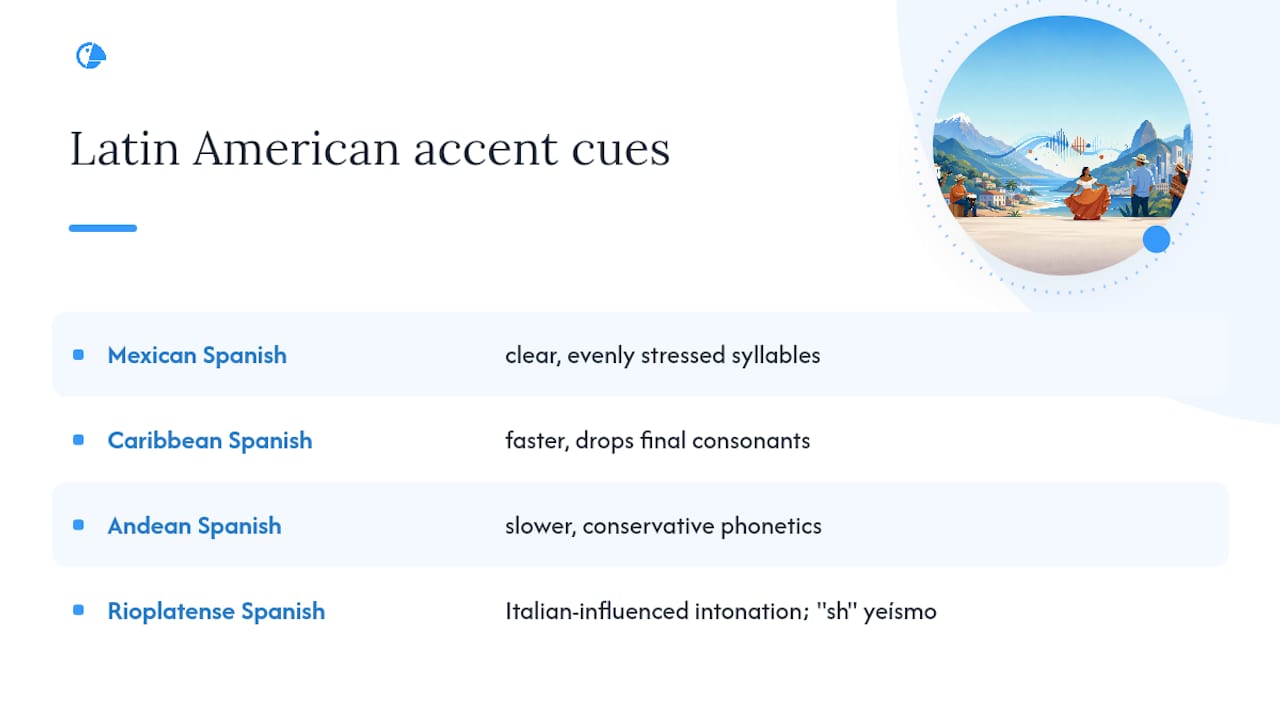
This internal variety is actually good news for learners. It means there's no single "correct" Latin American accent to chase, and picking a regional target based on your actual travel or social plans is more useful than hunting for a mythical neutral version. A learner heading to Buenos Aires who trains on Mexican audio will understand plenty, but will need an adjustment period for rhythm and vocabulary once they land.
How indigenous languages shaped Latin American Spanish
A layer of vocabulary in Latin American Spanish traces directly back to indigenous languages spoken before and during Spanish colonisation, and this influence barely touches Castilian Spanish at all. Nahuatl, spoken historically across central Mexico, gave Spanish (and English, by extension) words like chocolate, tomate and aguacate (avocado). Quechua, from the Andes, contributed papa (potato) and cóndor. Guaraní, still widely spoken in Paraguay, shaped regional terms and even everyday grammar patterns in that country's Spanish.
These aren't museum-piece words confined to history books. They're active, everyday vocabulary that a learner focused purely on Spain-based materials will simply never encounter, because Castilian Spanish developed largely without this contact. If you're learning Mexican Spanish specifically, expect a steady stream of Nahuatl-derived words for food, plants and place names. If you're focused on Peru or Bolivia, Quechua influence shows up constantly, not just in vocabulary but in some regional grammar quirks, like a heavier reliance on diminutives.
This is one of the more overlooked reasons Latin American Spanish rewards region-specific study over generic "neutral Spanish" textbooks. A vocabulary list built for Madrid won't prepare you for a market conversation in Oaxaca or Cusco, where half the produce names have indigenous roots.
Formal and informal speech: politeness rules differ by region
Formality operates differently depending on which side of the Atlantic you're speaking. In Spain, the shift from tú to usted has genuinely loosened over recent decades. Younger Spaniards often use tú with strangers, shop staff and even some professional contacts, reserving usted mainly for clear hierarchy or elderly strangers.
Much of Latin America holds onto more formal default settings, particularly in customer service, workplace hierarchy and interactions with anyone notably older. Countries with strong voseo or ustedes-based formality, like Colombia or Costa Rica, can feel noticeably more polite in everyday transactions than the fairly relaxed tone common in urban Spain.
This matters practically for two reasons. First, addressing a stranger with tú in parts of Latin America where formality runs higher can land as presumptuous, even if it wouldn't raise an eyebrow in Barcelona. Second, learners who study exclusively from Spain-based textbooks sometimes under-practise the usted conjugations they'll actually need daily in a country like Peru or Chile.
The safest habit for a beginner speaking to strangers, service staff or anyone clearly older, is to default to usted until you're invited to switch, regardless of which variety you're focused on. That single habit smooths over most regional variation in politeness norms.
Why Castilian and Latin American Spanish split in the first place
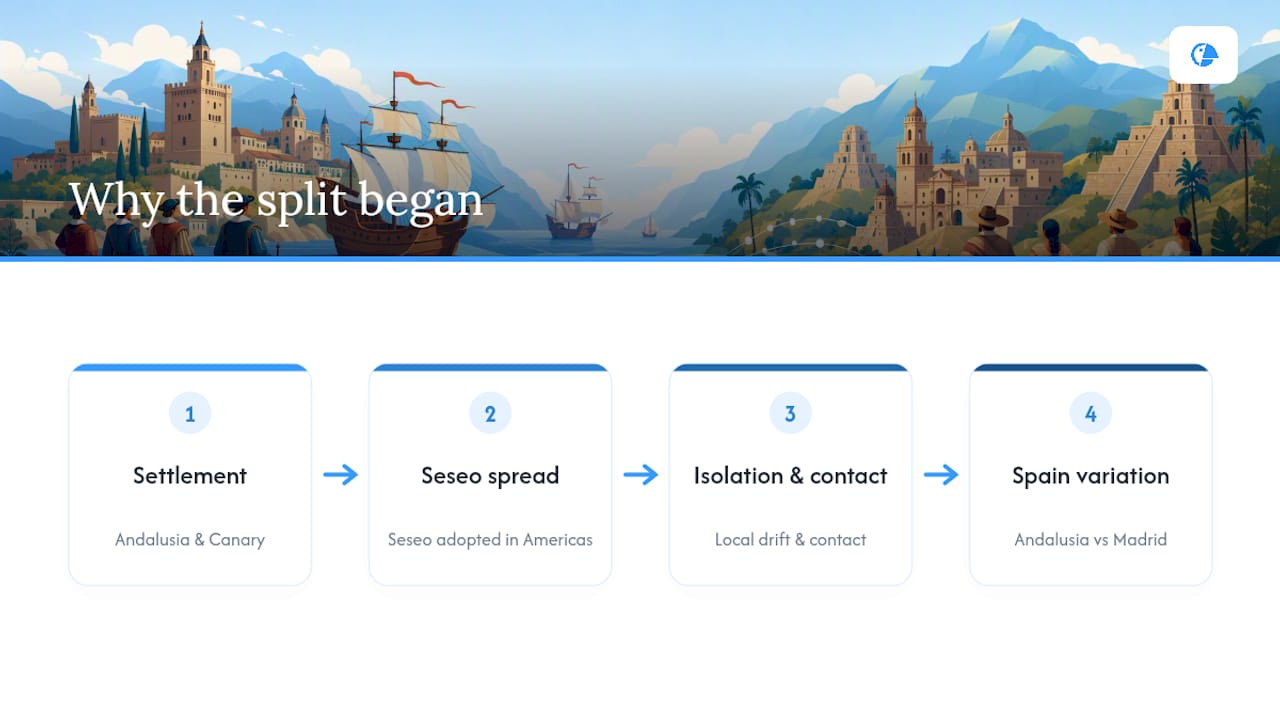
The differences between Castilian and Latin American Spanish trace back to colonisation patterns starting in the late 15th century, not a clean linguistic divide. Spanish colonists arriving in the Americas came disproportionately from Andalusia and the Canary Islands, regions that already used seseo rather than the distinción found further north in Spain. That single migration pattern explains why most of Latin America still uses seseo today, while much of northern and central Spain retained distinción.
Isolation did the rest. Once established across the Americas, Spanish in each colony evolved somewhat separately, absorbing local indigenous vocabulary, developing distinct rhythms, and drifting from peninsular Spanish norms at different speeds depending on trade routes, immigration waves and geographic isolation. Argentina's heavy 19th and 20th century Italian immigration shaped Rioplatense intonation. The Caribbean's plantation economy and its associated migration patterns shaped that region's rapid, consonant-dropping speech style.
Meanwhile, Spain's own regions never fully standardised either. Andalusian Spanish, spoken across southern Spain, shares more phonetic habits with Latin American Spanish (seseo, softened final consonants) than it does with the Castilian Spanish of Madrid or northern Spain, which is a useful reminder that "Castilian vs Andalusian Spanish" is its own internal split worth knowing about if you're headed south of Madrid rather than to the capital itself. The upshot: these aren't two neat boxes. They're a spectrum shaped by five centuries of migration, isolation and contact.
Subjunctive mood: does it change between varieties?
The subjunctive mood itself, used for doubt, desire, emotion and hypothetical situations, works on the same grammatical logic in both Castilian and Latin American Spanish. Espero que vengas ("I hope you come") uses the same subjunctive structure whether you're in Madrid or Mexico City. The real variation sits in frequency and register rather than grammar rules.
Spain tends to use the imperfect subjunctive with -se endings (viniese) slightly more often in formal or literary contexts, while Latin American Spanish leans more heavily on the -ra form (viniera) across both formal and casual speech. Both forms are grammatically correct everywhere; it's a stylistic preference, not a regional error.
Voseo regions add a small twist to subjunctive-adjacent commands. Argentine Spanish, for instance, handles some command forms tied to vos slightly differently from standard tú commands, though the actual subjunctive conjugations stay consistent with broader Spanish grammar.
For a learner, this means subjunctive study barely changes based on which variety you're targeting. Master the standard subjunctive triggers, que, ojalá, expressions of doubt and emotion, and you're covered almost identically across both varieties. Save your region-specific attention for pronunciation, pronouns and vocabulary, where the real workload differences actually live.
Idioms that give away where someone learned their Spanish
Idiomatic expressions are where Castilian and Latin American Spanish diverge most colourfully, and where textbook Spanish tends to fall flat. In Spain, vale functions as a constant, casual "okay," dropped into conversation dozens of times a day. You'll rarely hear it used the same way across most of Latin America, where listo, dale or okey fill that same conversational gap depending on the country.
¡Qué guay! ("How cool!") marks Spain-based casual speech, while *¡Qué chévere!" performs the same job across much of the Caribbean and northern South America, and ¡Qué padre! does it in Mexico specifically. Argentina reaches instead for ¡Qué bueno! or the distinctly Rioplatense ¡Qué copado!
Mexican Spanish carries a rich vein of idioms drawing on that indigenous vocabulary layer discussed earlier: qué oso (literally "what a bear," meaning "how embarrassing") has no direct equivalent in Spain. Argentina's che, used to grab attention much like "hey" or "mate," is instantly recognisable as regional shorthand and rarely heard outside Rioplatense-influenced speech.
None of this needs memorising in bulk before you start speaking. Idioms stick naturally once you're immersed in a specific region's media or conversation, and mismatched idioms rarely block comprehension, they just mark you clearly as having learned your Spanish somewhere else. That's not a failure. It's just useful to know going in, so an unfamiliar phrase doesn't throw you off mid-conversation.
A teacher's perspective: chase communication, not accent perfection
Most experienced teachers will tell you the same thing: build strong active fluency in one variety first, then widen your listening exposure gradually. Chasing a flawless accent across two dialects at once slows down real conversation skills. Comprehension matters more than mimicry.
— Tutoroo
Get started: book targeted practice with a native tutor
Reading about distinción and voseo only gets you so far. The fastest way to lock in either variety is speaking it out loud with someone who actually uses it daily, and that's exactly the gap this platform closes for learners who've made their decision using the checklist above. Search the Spanish tutor directory by region, filter for a Castilian or Latin American native speaker, and message a few candidates directly before booking.

A first lesson works well as a diagnostic: run through pronunciation drills for your target accent, test out tú versus usted or vos in roleplay, and flag which regional vocabulary gaps trip you up most. Tutors set their own schedules, so sessions fit around work, study or travel plans rather than a fixed timetable. If budgeting matters, check typical US tutor price ranges before booking your first session, then head to Tutoroo to find a tutor matched to the exact variety you've chosen.
Sources
- Spanish dialects and varieties
- Spanish Dialects in Spain vs Latin America: Key Vocabulary and Pronunciation Differences - WORLDLANGS
- How Different Are Spanish Dialects Around the World? - Duolingo blog
FAQ
Is it better to learn Castilian Spanish or Latin American Spanish?
Neither is objectively better. Latin American Spanish suits most general learners due to wider media and speaker exposure, while Castilian Spanish suits anyone planning to live, study or work specifically in Spain.
How do you say "hi" in Castilian?
Hola is standard across both Castilian and Latin American Spanish. Spain adds casual variants like ¿Qué tal? or ¡Buenas! in everyday greetings, though these appear in parts of Latin America too.
Can Mexicans understand Castilian Spanish?
Yes. Mexican and Castilian Spanish speakers understand each other with ease, aside from occasional vocabulary clarification (coche versus carro, for example) and adjusting to accent differences like distinción.
What is the hardest dialect of Spanish to understand for learners?
Caribbean varieties (Cuban, Dominican, Puerto Rican) tend to challenge learners most, due to fast speech, dropped final consonants and heavy final-s aspiration. Andean and Mexican Spanish are generally considered more accessible starting points for beginners.
Which Spanish should I learn if I'm just starting out?
Start with whichever variety matches your actual travel, work or social goals, since both are fully functional starting points thanks to mutual intelligibility. A tutor through Tutoroo can help you test both accents in early lessons before committing.